What Shots Do Puppies Need? Core Vaccines & Schedule Guide
Every puppy needs the core combination vaccine (written DHPP or DA2PP), which protects against distemper, adenovirus (hepatitis), parvovirus, and parainfluenza, plus a rabies vaccine as local law requires. The combination shot starts at 6 to 8 weeks and repeats every 2 to 4 weeks, and the last puppy dose must land at 16 weeks of age or older. AAHA now treats leptospirosis as core too, while Bordetella, canine flu, and Lyme depend on your puppy’s lifestyle and where you live.
Table of Contents
- Introduction
- Why Puppies Need More Than One Shot
- The Core Puppy Vaccines, Explained
- Non-Core Vaccines: Do They Apply to Your Puppy?
- Puppy Vaccine Schedule by Age (With the 16-Week Rule)
- US, UK, Europe, and Rabies-Endemic Countries: Why Schedules Differ
- When Can Your Puppy Go Outside?
- Late Start, Missed Shots, or Unknown History
- What Puppy Shots Cost, and What Parvo Costs
- Vaccine Reactions: Normal Versus Call-the-Vet
- Working, Protection, and Sport Puppies
- How We Built This Guide
- FAQs
- Conclusion
Introduction
You bring your new puppy home, and within a week the vet hands you a card with four or five appointments on it. So, what shots do puppies need, and why so many visits? It’s the question I hear most from first-time owners, and it deserves a straight answer.
Here’s the problem. Vaccine advice online is messy. One site says three shots, another says four. One calls leptospirosis optional, while the latest AAHA guidelines call it core. And almost nobody explains the single rule that matters most: the age of the last puppy dose, not how many shots your puppy got.
In this guide, you’ll get a clear puppy vaccination schedule by age, a plain-English breakdown of each core and non-core vaccine, and real costs. You’ll also learn how schedules differ between the US, UK, and rabies-endemic countries, when your puppy can safely go outside, and what to do if you’re late or have no records. I’ve built it from the AAHA 2022 canine guidelines, WSAVA’s 2024 global guidelines, and other primary sources, so you can walk into your vet’s office with good questions.
Why Puppies Need More Than One Shot
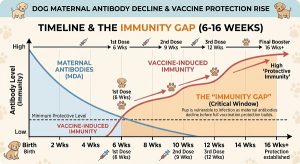
Quick answer: Puppies need several rounds of shots because antibodies from their mother can block a vaccine from working, and nobody can tell when those antibodies fade in any one puppy. Repeating the core vaccine every 2 to 4 weeks until at least 16 weeks makes sure one dose lands after the block is gone.
A newborn puppy gets antibodies from its mother’s first milk. Vets call them maternal antibodies. They protect the puppy early on, but here’s the catch: they also neutralize vaccine ingredients. If you vaccinate while mom’s antibodies are still high, the puppy’s own immune system never gets the message.
The tricky part is timing. Maternal antibodies fade at different speeds, even inside the same litter. The chair of WSAVA’s vaccination guidelines group has written that studies show roughly 1 in 10 puppies still carry enough maternal antibody to block parvovirus vaccine at 12 to 14 weeks. That’s why a single shot, or even three shots finished by 12 weeks, can leave a puppy unprotected while everyone thinks the job is done.
Think of it like a relay race. Mom’s antibodies run the first leg, and nobody sees the exact moment she hands off the baton. So the vet vaccinates every few weeks, making sure someone is always ready to take it. Space the shots too far apart and you leave a gap. Start too late and you miss the early risk window.
The Core Puppy Vaccines, Explained
Both AAHA (the American Animal Hospital Association) and WSAVA (the World Small Animal Veterinary Association) split vaccines into two groups. Core vaccines are for every dog, because the diseases are severe and widespread. Non-core vaccines depend on lifestyle and location.
DHPP (also called DA2PP or the “5-in-1”)
This single injection covers four diseases. Labels vary, so don’t panic if your card says DA2PP, DAPP, or DHP. They’re close cousins.
- Distemper: A virus that attacks the breathing, digestive, and nervous systems. It’s often fatal, and survivors can end up with lasting twitching or seizures.
- Adenovirus (infectious hepatitis): Damages the liver and can kill young puppies fast. The “A2” in DA2PP refers to adenovirus type 2, which gives protection against hepatitis as well.
- Parvovirus: The one vets fear most in puppies. It causes violent vomiting, bloody diarrhea, and dehydration. More on this below.
- Parainfluenza: A respiratory virus that feeds into the “kennel cough” complex.
One label check worth doing: a “DHLPP” shot also includes leptospirosis (the “L”). Some older combinations also contain canine coronavirus, which isn’t considered a core vaccine. Ask your vet exactly what’s in the syringe.
Leptospirosis: The Vaccine Many Guides Still Call Optional
Here’s where many competing articles are out of date. AAHA’s 2022 guidelines list leptospirosis among the core vaccines for all dogs. They recommend two doses given 2 to 4 weeks apart, starting at 12 weeks of age, with an annual booster.
WSAVA still lists the lepto vaccine as non-core, but it says vaccination should be considered core where the disease is common. That’s a lot of places, because the bacteria spread through the urine of rats and wildlife and survive in puddles, ponds, and wet soil. People can catch lepto too.
So what does this mean for you? If your puppy will sniff puddles, swim, hike, or live anywhere wildlife roams, including a city park, ask your vet about it early. In the UK, vets often use a four-strain vaccine called L4, which needs two doses four weeks apart.
Rabies
Rabies is the one vaccine that matters beyond your dog. The WHO estimates 59,000 people die from rabies each year in over 150 countries, with up to 99% of human cases coming from dog bites. Once symptoms appear, it’s virtually 100% fatal. About 95% of human deaths happen in Africa and Asia.
Timing depends on law. AAHA simply says to vaccinate as required by law. WSAVA says puppies in rabies-endemic areas should receive one dose at 12 weeks or older, even if no law forces it. In practice, most puppies get their first rabies shot between 12 and 16 weeks, a booster at about a year, and then boosters every one or three years depending on your local rules and the product used. The UK is rabies-free, so the vaccine isn’t routine there, but you’ll need it before travelling abroad with your dog.
Non-Core Vaccines: Do They Apply to Your Puppy?
These shots are for puppies whose lifestyle or location raises the risk. Your vet decides, but here’s how to think about it.
| Vaccine | Who usually needs it | Typical puppy dosing (AAHA 2022) |
|---|---|---|
| Bordetella (kennel cough), often with parainfluenza | Dogs going to boarding, daycare, training classes, groomers, or dog shows | One intranasal dose, or two injections 2 to 4 weeks apart; yearly booster |
| Canine influenza (H3N8/H3N2) | Social dogs in busy areas, shows, daycare, or outbreak zones | Two doses 2 to 4 weeks apart; yearly booster |
| Lyme disease (Borrelia) | Puppies in tick-heavy regions, such as the northeastern and upper midwestern US and parts of Europe | Two doses 2 to 4 weeks apart; yearly booster |
| Rattlesnake toxoid | Dogs in parts of the western US with rattlesnake exposure | Dosing varies by weight and risk |
A practical tip: many boarding kennels want proof of the kennel cough vaccine at least two weeks before your puppy’s stay. If you’ve got a trip coming up, tell the vet at the first visit so they can plan it.
If you live in a tick area, vaccines are only half the plan. You’ll also need a tick-prevention routine, and young puppies have age limits on many products, so ask your vet before using anything. For handlers working dogs in tick country, our K9 Advantix II tick care guide for working dogs covers the practical side.
Puppy Vaccine Schedule by Age (With the 16-Week Rule)
This table follows AAHA 2022 and WSAVA 2024. Your vet may shift a visit by a week or two to fit your puppy and your local risk, and that’s normal.
| Puppy age | Core shots | Add if your vet recommends | Notes |
|---|---|---|---|
| 6 to 8 weeks | DHPP dose 1 | Bordetella (intranasal) if exposure is likely | Often given by the breeder or shelter. Ask for the paperwork. |
| 10 to 12 weeks | DHPP dose 2 | Canine flu dose 1 | Doses are spaced 2 to 4 weeks apart. |
| 12 weeks or older | Rabies dose 1 (as local law requires) | Leptospirosis dose 1 (AAHA starts it at 12 weeks) | Rabies timing can differ by country or state. |
| 14 to 16 weeks | DHPP dose 3, which must be given at 16 weeks or older | Leptospirosis dose 2 (2 to 4 weeks after the first) | The final DHPP dose is the one that counts most. |
| 18 to 20 weeks | An extra DHPP dose only in high-risk parvo areas | n/a | AAHA suggests this for high-risk areas. Your vet decides. |
| 26 weeks (6 months) | WSAVA advises a core booster at or after 26 weeks | n/a | Catches the few puppies still blocked at 16 weeks. |
| 12 to 16 months | DHPP booster (if not done at 26 weeks), rabies booster | Lepto, Bordetella, flu, Lyme boosters | AAHA: one dose within a year of the last puppy dose. |
| Adult dogs | Core DHPP about every 3 years | Lepto, Bordetella, flu, Lyme usually yearly | Rabies every 1 or 3 years per local law. |
The 16-Week Rule, Explained
Quick answer: The last puppy dose of the core combination vaccine must be given when your puppy is at least 16 weeks old. A puppy that finishes three shots by 12 weeks isn’t fully vaccinated yet.
This is the part most guides skip. People ask “how many shots does a puppy need?” as if there’s one number. There isn’t. Both AAHA and WSAVA focus on the age at the final dose, because that dose is the one most likely to land after maternal antibodies have faded.
Here’s an example. Puppy A starts at 6 weeks and gets shots at 6, 9, and 12 weeks. That’s three shots, but all three could have been blocked in some puppies. Puppy B starts at 8 weeks and gets shots at 8, 12, and 16 weeks. That’s also three shots, but the last one lands at 16 weeks. Puppy B has the stronger protection. Puppy A needs another dose at 16 weeks or later.
So when you read your puppy’s card, check the age at the last dose, not just the count.
Your First-Year Tracker
Anyone who’s argued with a boarding kennel or border official knows “I think it was in spring” doesn’t work. Keep a photo of every page of the vaccine record and write down:
- The vaccine name and brand
- The date and your puppy’s age that day
- The vet clinic and vet’s name
- The batch or lot number, if the sticker is there
- The date the next dose is due
US, UK, Europe, and Rabies-Endemic Countries: Why Schedules Differ
This is the section the US-focused page-one articles mostly miss. If you’re reading from outside the US, your vet’s schedule may look different from the table above, and that doesn’t mean someone made a mistake.
United States. Vets typically follow AAHA’s three-or-more doses between 6 and 16 weeks, with core boosters about every 3 years and rabies set by state or local law.
United Kingdom. Many UK vets run a two-injection course, often at 8 weeks and then at 10 to 12 weeks, because some licensed vaccines allow the last dose from 10 weeks to help early socialization. Some vets add an extra dose at 16 weeks in high-risk areas or for breeds whose maternal antibodies last longer. Leptospirosis shots (L2 or L4) usually come with a second dose a few weeks later, and a puppy isn’t fully covered for lepto until a few weeks after that second dose. A primary course often costs about £40 to £70, and charities such as PDSA, Blue Cross, and the RSPCA run subsidised services for people who qualify.
So which is right, a UK-style course or WSAVA’s 16-week rule? Both can be sound if your vet adds a later dose or a 6-month booster to cover puppies that were still blocked. If your vet finishes at 12 weeks, ask this exact question: “What’s our plan to make sure the maternal antibody block is covered?”
Rabies-endemic countries (much of Africa and Asia). WSAVA treats rabies vaccination as essential in these regions, even without a legal requirement. If you live in one, don’t wait for a rule. Get that rabies dose at 12 weeks or older and keep the certificate safe, since it’s also what you’ll need for any travel.
Travelling with your puppy. Many countries require a rabies certificate and sometimes a waiting period before entry. Check the rules for your destination months ahead, because a puppy that’s too young or vaccinated too late can be refused.
When Can Your Puppy Go Outside?
Quick answer: Your puppy can start safe, controlled socializing from the day it comes home, but should stay away from dog parks, pet-store floors, and unknown dogs until about one to two weeks after the final core vaccine. Where your puppy goes matters more than the calendar.
This is the big conflict in puppy raising. Vaccines say “stay home.” Behavior experts say “get out and meet the world.” Both are right, and you can do both.
The American Veterinary Society of Animal Behavior (AVSAB) says puppies can start socialization classes as early as 7 to 8 weeks, as long as they’ve had at least one set of vaccines at least 7 days earlier and a first deworming. AVSAB’s reasoning is simple: the first three months are the prime socialization window, and behavior problems are a serious threat to a young dog’s life too.
Now the other side. Parvovirus is tough. It can survive on surfaces for up to a year, and the main household product that kills it is bleach. So a patch of grass where an unvaccinated dog walked months ago can still be risky.
Here’s how I’d sort it, as a handler:
| Lower-risk choices | Higher-risk choices (wait) |
|---|---|
| Your own yard, if unvaccinated dogs haven’t used it | Dog parks and dog beaches |
| A friend’s home with a healthy, fully vaccinated dog | Pet-store floors and grooming-salon floors |
| A puppy class that cleans the venue and checks vaccine records | Public pavements and grass with lots of unknown dogs |
| Carrying your puppy to watch traffic, people, and bikes | Puddles, ponds, and areas with rats (lepto risk) |
| Sitting on a blanket outside a shop and letting the puppy watch | Boarding or daycare before your vet clears it |
Some extra rules that work well. Carry your puppy through the vet’s parking lot and waiting room. Ask visitors to wash hands and change shoes if they’ve been around other dogs. And if you’re in the UK or another lepto area, keep your puppy away from water and “ratty” spots until a few weeks after the last lepto dose.
Late Start, Missed Shots, or Unknown History
Life doesn’t always follow the chart. Maybe you adopted a puppy at 14 weeks. Maybe you found one on the road. Maybe you missed an appointment. Here’s what the guidelines say, in plain words.
Starting after 16 weeks. AAHA suggests two doses of the combination vaccine, 2 to 4 weeks apart, for dogs that begin the series after 16 weeks. For leptospirosis, it’s two doses 2 to 4 weeks apart regardless of age.
Unknown history. AAHA’s rule of thumb for dogs with unknown or overdue vaccine history is simple: when in doubt, vaccinate. The benefit far outweighs the risk. For rabies, follow your local laws and ask your vet or public health office.
A rescued or stray puppy. Treat it as unvaccinated, even if it looks healthy. Keep it away from other dogs, and call a vet before you introduce it to the rest of your household. Tell the clinic right away about vomiting, diarrhea, or low energy. Parvo can show up days after exposure.
A missed appointment. Call the clinic as soon as you notice. A late dose doesn’t always mean starting over, but it depends on your puppy’s age, how long the gap is, and the brand used. Your vet decides whether to continue or repeat part of the series. Don’t wait for the “next” scheduled visit.
No breeder records. Ask the breeder or shelter for a written record of every shot and deworming. A vet can’t rely on “he got his shots.” The exact vaccine and age at each dose matter.
What Puppy Shots Cost, and What Parvo Costs
Prices vary by country, city, and clinic. These ranges come from recent 2026 price guides and are meant as a planning guide, not a quote.
| Item | Typical US range |
|---|---|
| DHPP, per dose | about $20 to $50 |
| Rabies, per dose | about $15 to $35 |
| Leptospirosis, per dose | about $25 to $60 |
| Bordetella or canine flu, per dose | about $20 to $50 |
| Full first year at a private clinic (exams included) | about $200 to $500 |
| Low-cost or shelter clinic bundles | some advertised from roughly $45 to $70 in August 2026, so check what’s included |
In the UK, a primary puppy course is often about £40 to £70, and subsidised options exist through PDSA, Blue Cross, and the RSPCA.
Money-saving tips that don’t cut safety:
- Compare the whole visit price, since exam fees can cost more than the vaccine.
- Ask about puppy wellness plans that bundle shots, deworming, and exams.
- Try shelter and low-cost clinics, which give the same core vaccines in a stripped-down visit.
- Never skip the final 16-week dose to save money.
The Real Cost of Skipping: Parvovirus
Here’s the comparison that changes minds. A major study from Austin Pets Alive!, a shelter in Texas, followed 5,127 dogs treated for parvo over 11.5 years. The researchers noted that parvo kills more than 90% of dogs if left untreated. With intensive shelter treatment, 86.6% of the dogs survived, and survival climbed to 96.7% for dogs that made it through the first five days. Most deaths happened in that first five-day stretch.
That’s a very good result, and it took a specialist volunteer program about a week of round-the-clock care per dog. A Pennsylvania SPCA clinic using a lower-cost outpatient protocol reported 83% survival, at an estimated $479 per dog. Private-hospital inpatient care costs more, often well over $1,000, though prices vary a lot.
Put those numbers beside a first-year vaccine bill of a few hundred dollars. Vaccines are the cheapest insurance you’ll ever buy for your puppy.
Vaccine Reactions: Normal Versus Call-the-Vet
Most puppies sail through. A bit of soreness where the needle went in, a sleepy day, or a smaller appetite for 24 to 48 hours is common.
Call your vet right away if you see:
- Facial swelling, hives, or repeated vomiting within hours of a shot
- Trouble breathing, pale gums, or collapse (this is an emergency, so go straight to the clinic)
- Sleepiness or fever that lasts beyond two days
- A lump at the injection site that keeps growing or doesn’t fade
A few smart habits help. Book vaccine visits for a morning so you can watch your puppy all day. Tell the vet about any past reaction, even a mild one. And never give human pain medicine to a puppy after a shot. Ask the vet what’s safe.
Vets see serious reactions far less often than owners fear, and the risk is much smaller than the risk of the diseases themselves.
Working, Protection, and Sport Puppies
If you’re raising a puppy for K9 work, protection sport, or competition, such as a Malinois, German Shepherd, Dutch Shepherd, or Rottweiler, the same schedule applies. What changes is the pressure to socialize and travel.
Don’t pause socialization. Working-dog programs don’t lock puppies away until 16 weeks. They control the environment instead: calm, healthy, fully vaccinated adult dogs, clean surfaces, and short, positive exposures to sounds, floors, and people. A puppy that misses its early window can develop fears that are as hard to fix as an illness.
Plan paperwork early. Handlers move dogs for training, shows, and deployments. Keep the rabies certificate, a full vaccine record, and the microchip number together in a folder, on paper and on your phone.
Boarding and training facilities. Many want Bordetella at least two weeks before arrival, and some want canine flu. Ask your vet in advance.
What about titer testing? A titer is a blood test that measures antibodies. WSAVA’s approach lets owners either titer-test at around 20 to 26 weeks or give a final dose at 26 weeks. Titers don’t replace the first puppy doses, because they can’t tell you if a specific shot triggered immunity at that moment. Talk to your vet about whether titers make sense for your adult dog. Rabies rules are separate, and the law usually decides.
Build good vet-visit habits. Bring high-value treats to every visit, and practice gentle handling at home so the exam doesn’t feel strange. Our guide to essential dog grooming tips for a healthy puppy walks through the ear, paw, and mouth handling that makes vet visits easier. After each shot, keep the day low-key, and use that time to practice settling. Our crate training a puppy guide shows how to make rest time calm.
If you want a deeper, handler-level playbook for raising a stable, healthy dog from the first week, my e-book Beyond the Bark: Inside a Pro Handler’s Playbook for Raising the Ideal Dog covers how professionals build structure from day one.
How We Built This Guide
As a military working dog instructor and handler, I see the same pattern again and again. Owners who understand why the schedule works stick with it, and owners who only hear “come back in three weeks” drift. I wrote this guide to give you the why.
To keep it accurate, I checked each claim against primary sources:
- AAHA 2022 Canine Vaccination Guidelines for core and non-core vaccines and puppy dosing
- WSAVA 2024 Guidelines for the Vaccination of Dogs and Cats for the 16-week rule, the 26-week booster, and global rabies advice
- AVSAB Position Statement on Puppy Socialization for early classes
- WHO rabies data
- Austin Pets Alive! parvovirus study (Animals, 2020) for treatment and survival numbers
- UK vet and charity pages (Wood Green, Forest Vets, and others) for UK schedules and costs
Prices and local rules change, so confirm them with your vet. If anything in this guide differs from your vet’s plan, trust your vet, who has examined your puppy and knows your area’s outbreaks.
Frequently Asked Questions
1. How many shots does a puppy need in total?
Most puppies get at least three doses of the core combination vaccine between 6 and 16 weeks, plus rabies and often leptospirosis. They get a booster within a year, and WSAVA suggests one at or after 26 weeks. The number matters less than the age at the last puppy dose, which must be 16 weeks or older.
2. What shots does a puppy need at 8 weeks?
At 8 weeks, a puppy usually gets its first or second dose of the DHPP combination vaccine. Some vets add an intranasal Bordetella dose if the puppy will meet other dogs. Rabies and leptospirosis normally come later, from 12 weeks.
3. Can I walk my puppy after the second shot?
It depends on where you walk. Controlled socializing, like classes and visits with healthy, vaccinated dogs, is fine and recommended. Avoid dog parks, pet-store floors, and areas with unknown dogs until one to two weeks after the final core dose, and keep away from puddles and rat areas until lepto protection is complete.
4. What if I miss a puppy vaccine appointment?
Call your vet as soon as you notice. A late dose doesn’t always mean restarting, but your vet will check your puppy’s age and the length of the gap. Don’t wait for the next scheduled visit.
5. Are puppy shots safe?
Yes, for the large majority of puppies. Mild soreness and tiredness for a day or two are normal. Serious reactions are rare, and the diseases the shots prevent are far more dangerous. Tell your vet about any past reaction before the next shot.
Conclusion
So, what shots do puppies need? The core DHPP combination vaccine every 2 to 4 weeks from 6 to 8 weeks, with the last dose at 16 weeks or older. Add rabies as your local law and risk require, and talk to your vet about leptospirosis, since AAHA now calls it core. Bordetella, canine flu, and Lyme are lifestyle choices. Then book the booster, and ask about the 26-week dose that WSAVA suggests.
Here’s your action checklist:
- Book the first vet visit as soon as your puppy comes home, and bring any breeder or shelter records.
- Ask your vet what age the final puppy dose will be, and make sure it’s 16 weeks or later.
- Ask which non-core vaccines fit your area and lifestyle, especially leptospirosis and Lyme.
- Socialize in controlled, lower-risk places while the series runs.
- Photograph every vaccine record page and save it on your phone.
- Call your vet the same day if you miss an appointment or notice a strong reaction.
- Put the booster dates in your calendar before you leave the clinic.
Vaccines aren’t the fun part of puppyhood. But they protect all the fun parts that come after.
Want more guides like this in your inbox? Subscribe to our weekly articles roundup at arfsk9team.com.ng/newsletter for fresh K9 and puppy-care tips every week.

Her work centres on obedience, detection, protection and operational readiness. She favours proven methods built on repetition, consistency and real-world conditioning, so that both dogs and handlers are prepared for high-pressure tasks.
Rofiat represented the Nigerian Army Dog Centre at the Nigerian Army Day Celebration (NADCEL) 2026, where she led demonstrations in obedience, explosive detection, agility and tactical movement. Through articles, training content and documentaries, she shares field-based insight into how structured training, clear communication and trust between handler and dog affect performance and reliability.
She is the author of Beyond the Bark: Inside a Pro Handler's Playbook for Raising the Ideal Dog, a practical guide that helps dog owners and handlers apply professional training principles in everyday situations.
- Westminster Dog Show 2026: Winners & Full Results - October 17, 2026
- 10 K9-Approved Tricks to Teach Your Dog (Step-by-Step) - October 16, 2026
- COBA National Dog Championship 2026: Full Guide - October 15, 2026