Dog Breeds with the Best Memory: Who Remembers Longest?
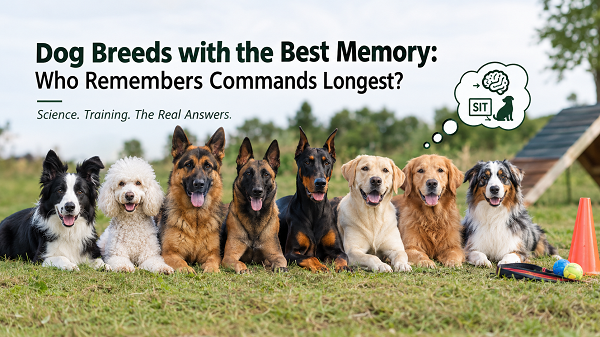
Which dog breeds have the best memory? Border Collies, Poodles, German Shepherds, Belgian Malinois, Dobermans, Labradors, Golden Retrievers, Australian Shepherds, Australian Cattle Dogs and Shetland Sheepdogs top the lists. Once a command is truly learned, these breeds can remember it for years. Researchers have even documented Border Collies remembering the names of toys for two months and, in one study, up to two years.
But here’s the part most articles skip: breed explains only about 9% of the behavior differences between individual dogs (Morrill et al., Science, 2022). So your dog’s memory depends far more on how you train, rest and refresh a command than on the label on the pedigree papers.
Table of Contents
- Introduction
- How Dog Memory Really Works (and Why “Smart” Isn’t the Same as “Remembers”)
- What Science Says About How Long Dogs Remember
- The 10 Dog Breeds with the Best Memory
- Breed Isn’t Destiny: Why Your Mixed-Breed Might Beat a Border Collie
- Why Dogs “Forget” Commands (5 Real Reasons)
- How Long Does a Command Last? A Handler’s Refresher Schedule
- How Working Dogs Keep Their Memory Sharp (Trainer Note)
- 8 Ways to Help Any Dog Remember Commands Longer
- FAQs
- The Bottom Line
Introduction
Ever taught your dog “down” perfectly on Monday, then watched them stare at you like a stranger on Saturday? You’re not alone. It’s one of the most common complaints I hear from new owners and even from new handlers.
Here’s the problem. Most articles about dog breeds with the best memory just copy the “smartest dog breeds” list and call it a day. But learning a command fast and remembering it for years are two different skills. A dog can pick up “sit” in five minutes and still ignore it at the park a week later.
In this guide you’ll learn:
- How dog memory works, in plain English
- What real studies say about how long dogs remember commands
- Which breeds hold on to training the longest (and which ones are just fast learners)
- Why your dog seems to forget, and how to fix it
- A simple refresher schedule you can start this week
I’ve spent over 14 years working with dogs at the Nigerian Army Dog Centre, so I’ll mix the science with what actually happens on the training ground.
How Dog Memory Really Works (and Why “Smart” Isn’t the Same as “Remembers”)
The Short Answer
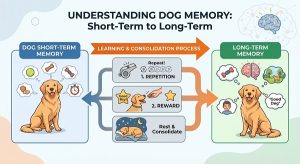
Dogs have both short-term and long-term memory. Short-term memory lasts seconds to minutes, while long-term memory can last months or years when a command has been practiced enough and linked to a reward. Dogs store commands mostly as habits and associations, not as stories.
Short-Term vs Long-Term Memory
Short-term memory holds what just happened: where the treat landed, what you just asked. You’ll often see the claim that dogs only hold an event in mind for about two minutes. That figure (from a 2014 National Geographic report, as cited by Whole Dog Journal) is about remembering events. It doesn’t describe trained skills, which move into long-term memory through repetition, reward and sleep.
Long-term memory is where “sit,” “heel,” a scent pattern or your face live. That’s what you’re building every time you train.
Two Kinds of Long-Term Memory That Matter for Commands
- Procedural memory: the “muscle memory” of how to do something, like dropping into a down or jumping a hurdle. It becomes almost automatic with practice.
- Associative memory: linking a cue (your word, hand signal, a sound) to an outcome (a reward, safety, fun). This is why a dog can recognize a handler after years apart.
Most obedience is a mix of both. The cue triggers the association, and the body does the rest.
The Trap: Trainability vs Memory
Nearly every “smartest breeds” list comes from Stanley Coren’s work in The Intelligence of Dogs (2006), built with help from obedience judges and an owner survey. It ranks how fast breeds learn and how reliably they obey. That’s trainability. It’s a useful proxy for memory, but it isn’t a direct memory test.
That matters. To my knowledge, no large study has ranked breeds by how long they hold a command without practice. So every breed list you read, including mine below, combines science, breed history and field experience. I’d rather tell you that straight than pretend the data is cleaner than it is.
If you want the bigger picture of how obedience intelligence differs from instinct, read our guide on the two types of dog intelligence every handler must understand.
What Science Says About How Long Dogs Remember
Chaser and Rico: The Vocabulary Stars
Rico, a Border Collie, was shown to know over 200 words. Chaser, another Border Collie owned by retired professor John Pilley, went further. Researchers at Wofford College confirmed she understood the names of more than 1,000 objects, and she could tell the difference between a noun (“toy name”) and a verb (“fetch”). Worth noting: the same write-up says her retention using that testing method was limited to short periods, much like young children.
The 2021 Gifted Word Learner Study
Researchers at Eötvös Loránd University in Budapest (Shany Dror, Claudia Fugazza and colleagues) tested six “Gifted Word Learner” dogs. All six were Border Collies. Owners taught them the names of up to 12 new toys in one week. Most dogs learned them quickly, five still remembered after one month, and four after two months, without further practice (Royal Society Open Science, 2021).
Two Years Later
A follow-up published in Biology Letters tested five gifted dogs again after the toys had been stored away for two years. Some dogs still picked out the right toy by name. The authors warn this doesn’t apply to all dogs, because only a rare few can learn object names at all.
Sleep Locks It In
This one is gold for owners. A Hungarian team led by Anna Kis ran EEG sleep studies on pet dogs (Scientific Reports, 2017). Dogs that napped or rested after learning a new command performed better later. Dogs that spent the next hour learning another skill did worse on the first one, in both short-term and long-term tests. In plain words: cramming new commands back to back can interfere with memory.
What this means for you: rare gifted dogs can remember for months or years, but most dogs need regular refreshers. And rest isn’t wasted time. It’s part of the training.
The 10 Dog Breeds with the Best Memory
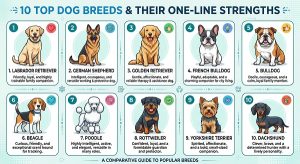
Here’s how I rank them, combining Coren’s trainability rankings, the research above and what handlers see in the field. Each dog is an individual, so treat this as a guide, not a guarantee.
| Breed | Coren rank | Memory style | Best known for |
|---|---|---|---|
| Border Collie | 1 | Sequences, names, complex tasks | Herding, agility, word learning |
| Poodle (Standard) | 2 | Cue recognition, tricks | Obedience, service work |
| German Shepherd | 3 | Routines, patrol behavior | Police, military, protection |
| Belgian Malinois | Not top-10 in Coren; elite in the field | Task and drive-based memory | Military, detection, protection |
| Doberman Pinscher | 5 | Quick retention, structure | Guarding, protection |
| Labrador Retriever | 7 | Steady, reward-based retention | Guide, detection, SAR |
| Golden Retriever | 4 | Multi-step tasks | Therapy, assistance |
| Australian Shepherd | Mid-high | Multi-step herding commands | Herding, sports |
| Australian Cattle Dog | 10 | Long-held commands, work patterns | Herding, active homes |
| Shetland Sheepdog | 6 | Responsive cue recognition | Obedience trials |
1. Border Collie
The champion. Border Collies were bred to hold long chains of commands while working sheep at a distance. Every gifted word learner study so far is dominated by this breed. The catch: they need a job. A bored Border Collie remembers everything, including bad habits.
2. Poodle (Standard)
Poodles are far more than a haircut. They were bred as water retrievers, and they learn abstract cues quickly and keep them when training is clear and structured.
3. German Shepherd
The all-round working breed. German Shepherds hold routines for years, which is why they’re still a backbone of police and military units. If you’re choosing between this breed and the Malinois, our comparison of German Shepherd vs Belgian Malinois intelligence breaks down memory, trainability and decision-making.
4. Belgian Malinois
Intense focus and drive. A Malinois ties commands to the work itself, so their memory is strongest when the command leads to a task they love. They’re not for casual owners, though.
5. Doberman Pinscher
Dobermans pick up commands with few repetitions and thrive on routine. They’re sensitive, so harsh handling shows up fast as stress and sloppy responses.
6. Labrador Retriever
Labs aren’t the flashiest learners, but they’re steady. Food drive helps cement commands, which is why they’re so common in guide dog, detection and search-and-rescue programs.
7. Golden Retriever
Goldens remember multi-step tasks and pair that with a calm, people-focused temperament. That’s why they work so well as therapy and assistance dogs.
8. Australian Shepherd
Strong at remembering long sequences, like “go left, circle, hold.” Like Border Collies, they need mental work or they invent their own.
9. Australian Cattle Dog (Blue Heeler)
Coren ranks them 10th. They hold on to commands and patterns well, but they’re independent. Their memory is fine; their willingness to follow orders is the thing you’ll work on.
10. Shetland Sheepdog
Small, fast and tuned in to human cues. Shelties shine in obedience trials because they notice small signals and remember them.
Honorable mentions: Papillon, Rottweiler and Cocker Spaniel. Don’t count them out.
Breed Isn’t Destiny: Why Your Mixed-Breed Might Beat a Border Collie
This is the section the top-ranking pages leave out, and it’s the most useful one if you own a mixed breed or a local dog.
In 2022, researchers at the Broad Institute and UMass Chan surveyed owners of 18,385 dogs and genotyped 2,155 of them. Their findings in Science:
- Most behavioral traits are heritable (above 25%).
- But breed explains only about 9% of behavior differences between individual dogs.
- The study’s authors say breed is a poor predictor of an individual dog’s behavior.
So genes do matter, but the breed label is a weak predictor. A motivated, well-trained Labrador mix can easily out-remember a bored, untrained Border Collie.
If you’re in Nigeria or elsewhere with local breeds, the same rule applies. See our guide to local dog breeds and how to train them for what to expect.
Handler tip: Stop asking “Which breed remembers best?” Start asking “How is this dog motivated, and how often do I practice?”
Why Dogs “Forget” Commands (5 Real Reasons)
Most of the time, your dog hasn’t forgotten anything. Here’s what’s usually going on:
- The command was never generalized. Dogs learn by context. “Sit” in your living room isn’t the same as “sit” at the market. Train in new places, with growing distractions, and the response travels with the dog.
- It was never fully learned. A dog that sits 7 times out of 10 at home hasn’t mastered it. It’s still shaky. Shaky skills fade fastest.
- Stress is blocking it. A scared, overexcited or overtired dog can’t access training. The memory is there, but the brain can’t reach it. Harsh methods make this worse.
- Rewards dried up. If a command stops paying off, dogs stop offering it. Handlers call this “reward drift.”
- Adolescence or health. Teenage dogs (roughly 6 to 18 months) often seem to “forget” everything because their focus shifts. In older dogs, sudden memory problems can signal canine cognitive dysfunction (a dementia-like condition), pain or hearing loss. If a senior dog suddenly stops responding, book a vet visit.
Real-world pattern: In kennel work, the dog that “forgot” is almost always the dog that was only ever trained in one place, by one person, in one tone of voice. [Rofiat: add a short real example from the Dog Centre here, e.g. a dog returning from leave or a new handler taking over, to strengthen E-E-A-T.]
How Long Does a Command Last? A Handler’s Refresher Schedule
There’s no universal number of days, because it depends on the dog, the command and how well it was learned. What I can give you is a practical schedule handlers use to move a command from “learned” to “locked in.” This comes from field experience, not a single study, so adjust it to your dog.
| When | What to do | Why |
|---|---|---|
| Day 1 | 3 to 5 short sessions of 2 to 5 minutes, then let your dog rest or nap | New memory needs consolidation |
| Day 2 | One quick test, in the same place | Checks what stuck overnight |
| Day 4 to 5 | Practice in a new room or yard | Starts generalizing |
| Week 2 | Add mild distractions (a toy, a person walking by) | Builds reliability |
| Week 4 | Practice outdoors | Real-world proofing |
| Month 2 and 3 | One quick check per week | Moves the command to long-term memory |
| After that | A 5-minute “tune-up” every 1 to 2 weeks | Keeps it sharp for life |
Rule of thumb: If a command has gone weeks without use and your dog hesitates, don’t scold. Go back one step in difficulty, reward heavily and rebuild. Dogs usually bounce back much faster the second time.
How Working Dogs Keep Their Memory Sharp (Trainer E-E-A-T Section)
I’m a Nigerian Army military working dog instructor and handler with more than 14 years at the Nigerian Army Dog Centre, with advanced obedience, K9 patrol and explosive detection certifications. I also led obedience, explosive detection, agility and tactical movement demonstrations at the Nigerian Army Day Celebration (NADCEL) 2026. Here’s what we do that most pet owners don’t:
- Maintenance training is built into the schedule. Even a fully trained dog gets short, regular refreshers. Skills are never “finished.”
- Commands are proofed under pressure. Noise, crowds, heat and fatigue. If it works in chaos, it’ll work at home.
- Handler consistency is enforced. One word, one meaning, one hand signal. Mixed signals break memory faster than time does.
- Rewards are matched to the dog. Ball, food, tug or praise, whatever that dog works hardest for.
- Rest is respected. Dogs get recovery time after intense sessions.
This is the same thinking behind professional programs. For a look inside, see how military working dogs are trained.
8 Ways to Help Any Dog Remember Commands Longer
- Keep sessions short. Two to ten minutes beats an hour. Quit while your dog is still keen.
- Let your dog sleep after learning something new. The Kis study shows rest helps memory consolidation. Follow a new skill with a nap or a chew, not another new skill.
- Use one cue per behavior. Pick “down” or “lie down,” not both.
- Pay properly at the start. Reward every correct response while learning, then slowly make rewards less predictable.
- Change the location every few days. Kitchen, garden, street, a friend’s yard.
- Add one distraction at a time. Jump from easy to chaos and the command breaks.
- Refresh before it fades. Weekly quick checks beat a panic re-train after a month off.
- Keep it positive. Reward-based training builds stronger, calmer responses. Stress blocks recall.
Want the full system? My ebook, Beyond the Bark: Inside a Pro Handler’s Playbook for Raising the Ideal Dog, walks you through the exact step-by-step approach I use, built for everyday owners as well as new handlers.
FAQs
1. How long can a dog remember a command without practicing it?
A well-learned command can last months or even years, but it varies by dog. Research on gifted Border Collies found they remembered new toy names for at least two months with no refreshers, and one study found some remembered after two years. Most pet dogs need regular practice, so plan a quick tune-up every one to two weeks.
2. Which dog breed has the best memory?
The Border Collie is the best-documented. It has the strongest research record, including Chaser’s 1,000+ object names and the gifted word learner studies. German Shepherds, Poodles, Malinois and Dobermans follow closely for command retention in obedience and working roles.
3. Do mixed-breed dogs have good memory?
Yes, they can. Breed explains only around 9% of behavioral variation between individual dogs, according to a 2022 Science study of over 18,000 dogs. Motivation, training quality and consistency matter more than the breed label.
4. Do dogs forget commands if you stop training?
They can get rusty, but they rarely forget completely. A dog that hesitates after a long break usually needs a short refresher, not a full restart. Go back one step, reward well and rebuild.
5. Does a dog’s memory get worse with age?
Healthy older dogs often keep commands they learned years ago, although learning new skills can take longer. A sudden drop in responses, confusion or disorientation can point to canine cognitive dysfunction, pain or hearing loss, so see a vet.
The Bottom Line
Border Collies, Poodles, German Shepherds, Malinois, Dobermans, Labradors and Goldens are the dog breeds with the best memory when it comes to remembering commands. But the real winners are dogs whose owners practice in new places, reward well, keep sessions short and let them sleep.
Your action plan this week:
- Pick one command your dog sometimes ignores.
- Re-teach it in a new place, with high-value treats, in sessions under 5 minutes.
- Let your dog rest afterward.
- Follow the refresher schedule above.
Want more practical K9 tips like this? Subscribe to our weekly articles roundup newsletter and get new guides in your inbox.
Sources and Further Reading
- Morrill et al. (2022). Ancestry-inclusive dog genomics challenges popular breed stereotypes. Science, 376(6592).
- Dror, Fugazza et al. (2021). Acquisition and long-term memory of object names in a sample of Gifted Word Learner dogs. Royal Society Open Science.
- Dror et al. Long-term memory of object names in gifted dogs. Biology Letters.
- Kis et al. (2017). The interrelated effect of sleep and learning in dogs. Scientific Reports, 7, 41873.
- Pilley & Reid (2011). Border collie comprehends object names as verbal referents (Wofford College).
- Coren, S. (2006). The Intelligence of Dogs.
- Whole Dog Journal: “Do Dogs Have Good Memory?”

Her work centres on obedience, detection, protection and operational readiness. She favours proven methods built on repetition, consistency and real-world conditioning, so that both dogs and handlers are prepared for high-pressure tasks.
Rofiat represented the Nigerian Army Dog Centre at the Nigerian Army Day Celebration (NADCEL) 2026, where she led demonstrations in obedience, explosive detection, agility and tactical movement. Through articles, training content and documentaries, she shares field-based insight into how structured training, clear communication and trust between handler and dog affect performance and reliability.
She is the author of Beyond the Bark: Inside a Pro Handler's Playbook for Raising the Ideal Dog, a practical guide that helps dog owners and handlers apply professional training principles in everyday situations.
- Can You Handle a Cane Corso Puppy? 7 Hard Truths - October 23, 2026
- How to Train a Stubborn Pug: A K9 Trainer’s Real Guide - October 22, 2026
- Dog Hotel Prep: 7 Must-Haves Before Boarding - October 21, 2026