Carprofen for Dogs: Dosage, Uses & Safety Guide
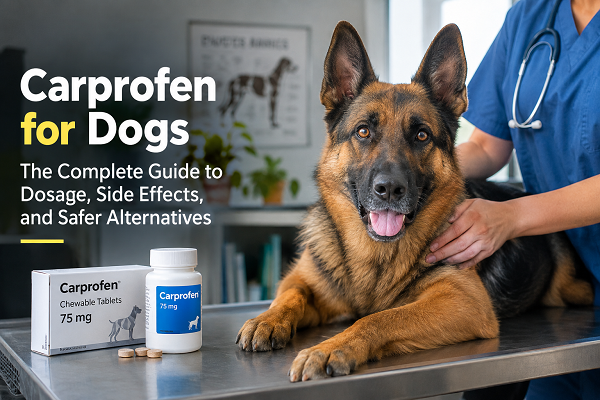
Carprofen (brand names Rimadyl, Novox, Carprieve, Vetprofen) is a prescription NSAID that vets use to control pain and inflammation in dogs, most often from osteoarthritis or after surgery. The FDA-labeled dose is 4.4 mg per kilogram of body weight per day (about 2 mg per pound), given once daily or split into two smaller doses. Most dogs tolerate it well, but it carries real risks to the stomach, liver, and kidneys, so it should only ever be given under a vet’s direction and monitoring.
Table of Contents
- What Is Carprofen? (Rimadyl and Its Other Names)
- How Carprofen Actually Works
- What Vets Prescribe Carprofen For
- Carprofen Dosage for Dogs by Weight
- Side Effects: What’s Normal and What’s a Red Flag
- The Rimadyl Controversy: What Every Owner Should Know
- Dogs That Should Never Take Carprofen
- Carprofen vs. Other NSAIDs (Meloxicam, Galliprant, Previcox, Deramaxx)
- How Much Does Carprofen Cost?
- A Handler’s Real Case: Managing Arthritis in an Aging Working Dog
- 7 Expert Tips for Giving Carprofen Safely
- Natural and Complementary Support for Joint Pain
- FAQs
- Conclusion
Introduction
I’ve handled working dogs for years, and if there’s one medication cabinet staple that comes up again and again in conversations with owners and fellow handlers, it’s carprofen. Half the questions I get aren’t really about the drug itself. They’re about fear. “Is this the stuff that killed dogs?” “Why does my vet want blood tests before refilling it?” “Can I just give my dog a human ibuprofen instead since it’s basically the same thing?” (Please don’t. More on that below.)
So here’s the thing, carprofen is one of the most prescribed medications in veterinary medicine, and it’s also one of the most misunderstood. This guide pulls together the FDA prescribing data, current veterinary research, and the real-world lessons I’ve picked up from handling dogs through joint pain, surgery recovery, and old age, so you walk away actually knowing what you’re giving your dog and why.
1. What Is Carprofen? (Rimadyl and Its Other Names)
Carprofen is a nonsteroidal anti-inflammatory drug, or NSAID, made specifically for veterinary use. It first hit the market under the brand name Rimadyl, launched by Pfizer in January 1997. It was a genuine breakthrough at the time, the first drug that gave vets a reliable, long-term option for canine arthritis pain that wasn’t a steroid.
Since Rimadyl’s patent expired, carprofen has become available under a long list of generic and alternative brand names, including:
- Rimadyl® (the original, now made by Zoetis)
- Novox®
- Carprieve® (common in the UK)
- Vetprofen®
- Truprofen®
- Rovera®
- Quellin®
They’re all the same active ingredient, carprofen, and the FDA requires generics to prove bioequivalence to the original before approval. A 2019 palatability study comparing Rimadyl and Carprieve chewables found dogs accepted both at almost identical rates (73% versus 70.3%), so brand loyalty here is mostly about your vet’s preference and your dog’s taste buds, not effectiveness.
2. How Carprofen Actually Works
Ever wonder why a pill can calm a swollen, painful joint within hours? Carprofen blocks an enzyme called cyclooxygenase (COX), which your dog’s body uses to make prostaglandins, the chemical messengers responsible for pain, swelling, and fever.
The catch is that prostaglandins aren’t only involved in inflammation. They also protect the stomach lining, help regulate blood flow to the kidneys, and support normal blood clotting. Carprofen doesn’t fully distinguish between the “bad” prostaglandins causing your dog’s pain and the “good” ones keeping their organs running smoothly. That’s the entire reason carprofen (and every NSAID like it) comes with a real side-effect profile instead of being risk-free.
3. What Vets Prescribe Carprofen For
In day-to-day practice, carprofen shows up most often for:
- Osteoarthritis (OA): by far the most common reason. Radiographic studies show joint OA is present in roughly 20% of dogs over a year old, and that number climbs sharply with age, one 2024 study found OA in the shoulder, elbow, hip, or stifle in 35–57% of dogs over eight years old, depending on the joint.
- Post-surgical pain, especially after orthopedic procedures like cruciate ligament repair (TPLO) or spays and neuters.
- Acute injuries such as sprains, strains, or soft-tissue trauma.
- Dental procedures, where inflammation control speeds up recovery.
For working and sport dogs specifically, I see it prescribed a lot for older Malinois and German Shepherds who’ve put thousands of miles on their joints doing bite work, agility, or patrol duty. It’s not a performance enhancer, and it should never be used to mask pain so a working dog can keep training or working through an injury. That’s a fast way to turn a manageable strain into a career-ending one.
4. Carprofen Dosage for Dogs by Weight
The FDA-approved label dose for carprofen is 4.4 mg per kilogram of body weight per day (about 2 mg per pound). Vets typically give this in one of two ways:
- Once daily: the full 4.4 mg/kg given as a single dose
- Twice daily: split into 2.2 mg/kg every 12 hours, which some vets prefer because it may reduce stomach upset
Here’s a general reference chart based on the standard label dose. This is for understanding purposes only, your vet will calculate the exact dose, form, and schedule for your specific dog based on weight, kidney/liver function, age, and bloodwork.
| Dog’s Weight | Reference Total Daily Dose (2 mg/lb) |
|---|---|
| 10 lbs (4.5 kg) | 20 mg |
| 25 lbs (11.3 kg) | 50 mg |
| 40 lbs (18 kg) | 80 mg |
| 60 lbs (27 kg) | 120 mg |
| 80 lbs (36 kg) | 160 mg |
| 100 lbs (45 kg) | 200 mg |
Carprofen comes in several forms:
- Chewable, liver-flavored tablets (typically 25 mg, 75 mg, and 100 mg), the most common at-home option
- Plain caplets/tablets for dogs that are picky about flavored chews
- Injectable solution, given by a vet, usually for immediate post-surgical pain control
A few practical rules that matter more than the number on the label:
- Never give carprofen more often than your vet’s prescribed interval, doubling up “just this once” is a common cause of overdose.
- Food isn’t required, but giving it with a meal can lower the odds of stomach upset.
- Never split a dose between two dogs of different weights. Weigh your dog regularly, since dosing is based on current body weight, not what they weighed at their last annual exam.
- If your dog needs the same drug for a different reason down the line, say, a food-related sensitivity comes up, dosing by weight is a theme that carries across pet health generally. We cover how that works for something as simple as a kitchen spice in our guide on safe dosage by weight for cinnamon and dogs, which is a good example of why “weight matters more than age” is a rule worth remembering for anything you give your dog.
5. Side Effects: What’s Normal and What’s a Red Flag
Common, usually mild side effects
In Pfizer’s own field trials of nearly 300 dogs, these were the reported rates and interestingly, they were similar between the carprofen group and the placebo group:
- Vomiting: 4%
- Diarrhea: 4%
- Appetite changes: 3%
- Lethargy: 1.4%
- Behavioral changes: 1%
- Constipation: 0.3%
Most dogs sail through carprofen treatment without any of this. When it does happen, it’s usually mild GI upset that resolves once the dog adjusts or the vet lowers the dose.
Serious side effects, call your vet immediately
- Black, tarry, or bloody stool, or vomit that looks like coffee grounds
- Persistent vomiting or refusal to eat for more than a day
- Yellowing of the gums, skin, or whites of the eyes (jaundice)
- Increased thirst or urination
- Pale gums
- Seizures, loss of coordination, or disorientation
- Unusual aggression or restlessness
- Skin issues like hives, facial swelling, or sudden hot spots
If your dog vomits repeatedly while on carprofen, don’t assume it’s “just the meds” and wait it out. Persistent vomiting in a young dog especially deserves a same-day vet check, since GI blockages can look similar in the early stages, something we go into detail on in our post on urgent puppy obstruction symptoms to watch for. It’s better to rule it out than assume.
6. The Rimadyl Controversy: What Every Owner Should Know
This is the part that makes people nervous, and honestly, they should know the real story rather than a rumor.
Rimadyl launched in January 1997 to a lot of enthusiasm, for the first time, vets had a well-studied option for chronic arthritis pain that wasn’t a corticosteroid. But within months, the FDA’s Center for Veterinary Medicine started receiving adverse event reports. By 1999, the FDA had logged roughly 6,000 reports of dogs with negative reactions and around 1,000 reported deaths or euthanasia cases linked to the drug, according to reporting at the time by the Wall Street Journal.
The FDA pushed Pfizer to update warning labels multiple times between 1997 and 1999, eventually requiring “death” to be listed explicitly as a possible adverse reaction, a rare and serious step for an approved drug.
Why Labrador Retrievers specifically? Pfizer’s own post-approval safety data showed that roughly one-fourth of all reported hepatic (liver) reactions occurred in Labrador Retrievers. Researchers later described this liver toxicity as “idiosyncratic,” meaning it isn’t dose-dependent in the way an overdose reaction would be, some individual dogs simply have a rare, unpredictable sensitivity. In one clinical review, 13 of the first 21 reported hepatic toxicity cases involved Labradors specifically, well out of proportion to how common the breed is.
Here’s the context that matters, though: Labradors and Golden Retrievers are also the breeds most prone to hip dysplasia and arthritis in the first place, so they’re simply prescribed carprofen far more often than other breeds, which naturally inflates their share of the reported side effects. It doesn’t necessarily mean carprofen is uniquely dangerous for the breed, but it is why most vets now recommend baseline liver bloodwork before starting carprofen and periodic rechecks (often at 2-4 weeks, then every few months) for any dog on long-term treatment, Labradors included.
The reassuring part: nearly 30 years and an estimated 30 million+ dogs treated later, carprofen remains one of the most-studied and most-prescribed veterinary NSAIDs in the world, and serious reactions remain rare relative to total use. The controversy pushed the entire veterinary NSAID category toward better labeling, mandatory client information sheets, and routine bloodwork monitoring, practices that protect dogs today regardless of which NSAID they’re on.
7. Dogs That Should Never Take Carprofen
Carprofen is contraindicated, or should be used only with extreme caution and close monitoring, in dogs with:
- Known hypersensitivity to carprofen or other NSAIDs
- Active gastrointestinal ulcers or a history of GI bleeding
- Pre-existing liver disease
- Pre-existing kidney disease, especially in dehydrated or elderly dogs
- Bleeding disorders (carprofen can affect platelet function)
- Pregnancy, lactation, or use in breeding dogs (safety hasn’t been established)
- Puppies under 6 weeks of age
Drug interactions to flag for your vet:
- Other NSAIDs or aspirin — never combine two NSAIDs; the GI bleeding risk compounds fast
- Corticosteroids (like prednisone) — same rule; this combination significantly raises ulcer risk
- ACE inhibitors or diuretics used for heart conditions, can increase kidney strain when combined with an NSAID
- Phenobarbital — some evidence suggests it may raise the risk of carprofen-related liver toxicity
Always give your vet a full list of every medication and supplement your dog is currently on, including over-the-counter joint supplements, before starting carprofen.
8. Carprofen vs. Other NSAIDs (Meloxicam, Galliprant, Previcox, Deramaxx)
Carprofen isn’t the only option, and it’s worth knowing where it fits.
| Drug (Brand) | Type | Frequency | Notable Point |
|---|---|---|---|
| Carprofen (Rimadyl) | Traditional NSAID (COX inhibitor) | Once or twice daily | Most established track record; broadest range of approved uses |
| Meloxicam (Metacam) | Traditional NSAID (COX inhibitor) | Once daily | Liquid form makes weight-based dose adjustments easy |
| Grapiprant (Galliprant) | EP4 receptor antagonist (newer mechanism) | Once daily | Approved specifically for OA pain; considered gentler on the GI tract for some dogs |
| Firocoxib (Previcox) | COX-2 selective NSAID | Once daily | Often used for both OA and post-op pain |
| Deracoxib (Deramaxx) | COX-2 selective NSAID | Once daily | Common after orthopedic surgery |
A few research findings worth knowing:
- A well-designed, independently funded crossover study comparing Galliprant directly to carprofen found little measurable difference in effectiveness between the two for arthritis pain.
- A 2024 randomized clinical trial comparing grapiprant to meloxicam after cruciate ligament surgery found grapiprant produced modestly lower pain scores in the first days after surgery, though both drugs worked.
- Galliprant should never be combined with carprofen, meloxicam, aspirin, or corticosteroids, vets switch between these drugs, they don’t stack them.
The bottom line from actual clinical evidence: no single NSAID is dramatically superior for every dog. The “best” one is the one your specific dog tolerates well, which is exactly why vets sometimes trial two or three options over time.
9. How Much Does Carprofen Cost?
Generic carprofen is one of the more affordable long-term arthritis medications, which matters a lot for owners managing a chronic condition. Rough monthly cost ranges (varies by region, pharmacy, and dog size):
- Small dogs (under 25 lbs): roughly $10–25/month for generic carprofen
- Medium dogs (25–60 lbs): roughly $20–45/month
- Large dogs (60+ lbs): roughly $30–70/month
Brand-name Rimadyl typically costs noticeably more than the generics (Novox, Carprieve, Vetprofen). Many online pet pharmacies and even big-box pet stores fill carprofen prescriptions at lower prices than in-clinic pharmacies, so it’s worth asking your vet for a written prescription you can fill wherever’s cheapest, that’s standard practice and no vet should push back on the request.
10. A Handler’s Real Case: Managing Arthritis in an Aging Working Dog
A few years back, I worked with a nine-year-old Belgian Malinois who’d spent his whole career in patrol and detection work. By year eight, his handler noticed him hesitating before jumping into the truck bed and slowing down noticeably on long tracking sessions. X-rays showed moderate elbow and hip osteoarthritis, unsurprising after a career of hard impact work.
The vet started him on carprofen at the standard twice-daily dose, alongside a joint supplement and a modified exercise plan that traded high-impact bite work for controlled leash tracking and swimming. Within about two weeks, his handler reported he was jumping into the truck again without hesitation. We rechecked liver values at four weeks (clean) and again at three months (still clean), and he stayed on a stable dose for the remainder of his working years with only the occasional soft stool that resolved by giving the pill with food instead of on an empty stomach.
The lesson that stuck with me: carprofen worked well here specifically because it was paired with monitoring, not used as a standalone fix. Owners who treat it as “give the pill and forget it” are the ones who run into trouble.
11. 7 Expert Tips for Giving Carprofen Safely
- Get a real diagnosis first. Don’t start carprofen based on a guess that your dog “seems stiff.” X-rays or a proper orthopedic exam rule out things like ligament tears that need a different treatment plan entirely.
- Ask for baseline bloodwork. A CBC and chemistry panel before starting long-term carprofen catches hidden liver or kidney issues before the drug ever touches your dog’s system.
- Give it with food. It’s not required, but a small amount of food with each dose noticeably cuts down on stomach upset in dogs prone to sensitive tummies.
- Watch the first 3-5 days closely. Most adverse reactions, when they happen, show up early. Keep a mental note of your dog’s normal appetite, stool, and energy so you’ll spot a change fast.
- Never combine with another NSAID, steroid, or over-the-counter pain reliever. This includes never reaching for human ibuprofen or Tylenol “just to help”, both are toxic to dogs and dangerous when stacked with carprofen.
- Recheck bloodwork periodically. Most vets recommend rechecks at 2-4 weeks after starting, then every 3-6 months for long-term use.
- Don’t stop or adjust the dose yourself. If your dog seems “too sedated” or “not helped enough,” call your vet rather than doubling the dose or skipping days on your own.
12. Natural and Complementary Support for Joint Pain
Carprofen manages pain, but it doesn’t reverse joint damage. Most vets recommend pairing it with supportive measures, especially for chronic OA:
- Weight management — even a few extra pounds meaningfully increases joint load in dogs; this is often the single biggest lever an owner controls.
- Joint supplements like glucosamine, chondroitin, and omega-3 fatty acids, which have reasonable evidence for reducing inflammation over time (though they work slower than an NSAID).
- Low-impact exercise — swimming and controlled leash walks maintain muscle support around joints without the pounding of running or jumping.
- Physical rehab and cold laser therapy, increasingly available through veterinary rehab specialists.
- Orthopedic bedding to reduce pressure on sore joints, especially for senior and working dogs.
If you’re building out a broader nutrition and conditioning plan for a working or aging dog, our guide on nutrition and health tips for working dogs covers how diet quality supports joint and organ health long before medication ever becomes necessary. And if you want a deeper, structured look at reading your dog’s behavior and health signals before small issues become big ones, our e-book Beyond the Bark walks through exactly that.
FAQs
1. Can I give my dog human carprofen or a leftover prescription from another dog?
No. Carprofen must be dosed precisely to your dog’s current weight and health status. Never share medication between dogs or use an old prescription without your vet rechecking the dose and your dog’s current bloodwork.
2. How long does it take for carprofen to work?
Many dogs show noticeable pain relief within 24 hours for acute pain, though chronic arthritis pain may take a few days of consistent dosing to show its full effect.
3. Can carprofen be given long-term for the rest of my dog’s life?
Yes, many dogs stay on carprofen for years to manage chronic arthritis, as long as they’re monitored with periodic bloodwork and show no signs of liver, kidney, or GI trouble.
4. Is carprofen safe for cats?
No. Carprofen is not FDA-approved for long-term use in cats and carries a much higher risk of toxicity in that species. It’s occasionally used off-label by vets for a single injectable dose, but never as an at-home oral medication for cats.
5. What should I do if my dog misses a dose or I accidentally give too much?
For a missed dose, give it as soon as you remember unless it’s close to the next scheduled dose, don’t double up. For a suspected overdose, call your vet or an animal poison control hotline immediately; don’t wait for symptoms to appear.
Conclusion
Carprofen has helped millions of dogs move, play, and recover with less pain since 1997, and the data backs up that it remains one of the most effective tools vets have for canine arthritis and post-surgical pain. But “effective” and “risk-free” aren’t the same thing. The real safety net isn’t avoiding the drug out of fear of old headlines, it’s baseline bloodwork, watching your dog closely in the first week, never combining it with other anti-inflammatories, and keeping up with rechecks for long-term use.
If your dog has been diagnosed with arthritis or is heading into surgery, talk to your vet about whether carprofen fits their specific health profile, and don’t be shy about asking exactly what monitoring plan they recommend. That conversation, more than anything on this page, is what keeps dogs safe on this medication.
Want more no-nonsense, handler-tested guides like this one delivered weekly? Subscribe to the ARFS K9 Team newsletter for training tips, health guides, and gear reviews straight from real working dog experience.
This article is for informational purposes and does not replace professional veterinary advice. Always consult your veterinarian before starting, stopping, or adjusting any medication for your dog.

Her work centres on obedience, detection, protection and operational readiness. She favours proven methods built on repetition, consistency and real-world conditioning, so that both dogs and handlers are prepared for high-pressure tasks.
Rofiat represented the Nigerian Army Dog Centre at the Nigerian Army Day Celebration (NADCEL) 2026, where she led demonstrations in obedience, explosive detection, agility and tactical movement. Through articles, training content and documentaries, she shares field-based insight into how structured training, clear communication and trust between handler and dog affect performance and reliability.
She is the author of Beyond the Bark: Inside a Pro Handler's Playbook for Raising the Ideal Dog, a practical guide that helps dog owners and handlers apply professional training principles in everyday situations.
- Maltipoo Potty Training Schedule: Pro Tips That Work - October 30, 2026
- Pug Exercise Safety Guide: How Much Is Too Much? - October 29, 2026
- How Much Do Local Dog Groomers Cost? (2026 Price Guide) - October 28, 2026