13 Everyday Foods That Are Poisoning Your Dog (Vet Guide)

The everyday foods most likely to poison a dog are xylitol, chocolate, grapes and raisins, onions and garlic, macadamia nuts, alcohol, raw bread dough and caffeine. Fatty scraps, cooked bones, salty snacks, moldy food and fruit pits also cause serious harm. If your dog eats any of them, call a vet or poison hotline right away, before symptoms show.
Table of Contents
- Introduction
- Why ‘Just a Little Bit’ Is Riskier Than You Think
- Quick-Reference Chart: Doses, Signs and Timing
- Danger Math: How Much Is Too Much for Your Dog’s Size?
- The 13 Everyday Foods Poisoning Dogs
- Other Foods on the Watch List
- 6 Myths That Get Dogs Hurt
- What to Do in the First 60 Minutes
- Safe Swaps and Handler-Style Kitchen Proofing
- Why You Can Trust This Guide
- FAQs
- Final Word
Introduction
Ever tossed your dog a bite of whatever you were eating and thought, what’s the harm? Most of us have. But many foods toxic to dogs look completely harmless on a plate, and some poison a dog at doses smaller than you’d guess.
Here’s the problem. Dogs process food differently than we do. They clear theobromine (the stimulant in chocolate) very slowly. Their kidneys react badly to grapes. And xylitol, a sweetener that’s fine for you, can crash a dog’s blood sugar in under an hour.
I’ve spent more than 14 years around military working dogs, and one lesson sticks: the dangerous moments are rarely dramatic. They’re a dropped grape, a gum packet at the bottom of a handbag, a plate left on a low table.
In this guide you’ll get the 13 foods that cause the most harm, the toxic doses from veterinary references, how fast signs appear, a size-by-size danger chart, what to do in the first hour, and how handlers keep dogs away from this stuff. Bookmark it. You’ll want it open the one night you need it.
Why ‘Just a Little Bit’ Is Riskier Than You Think
This isn’t a rare problem. The ASPCA’s poison control team handled calls about more than 376,000 pet exposures in 2025. Food and drink ranked second at 16.4% of calls, led by grapes and raisins, xylitol gum, and onions and garlic. ASPCA lists chocolate separately at 13.6%, so food-related calls add up to roughly 30% of everything it sees. Its team also helped more than 10,600 animals exposed to xylitol in 2025 alone.
Two things make food poisoning sneaky:
- Some toxins strike fast, others take days. Xylitol and chocolate act within hours. Onion and garlic quietly damage red blood cells for days before your dog looks sick.
- Dose depends on body weight. A square of baking chocolate that barely bothers a Labrador can land a Chihuahua in the clinic.
So ‘my dog ate it and seems fine’ proves very little. It often means the clock is still running.
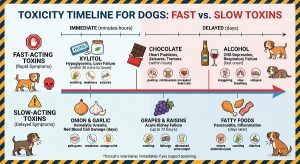
Quick-Reference Chart: Doses, Signs and Timing
Screenshot this one. The numbers come from the Merck Veterinary Manual, ASPCA toxicology publications and peer-reviewed case reports. Treat them as red-flag thresholds, never as safe amounts.
| Food | Danger | Lowest dose linked to problems | First signs | Delayed risk |
|---|---|---|---|---|
| Xylitol | Emergency | 0.1 g/kg (low blood sugar); 0.5 g/kg (liver damage) | 30-60 min, sometimes 12+ hrs | Liver failure, 9-72 hrs |
| Chocolate | High | 20 mg/kg theobromine (mild); 40-50 (heart); 60+ (seizures) | Usually 6-12 hrs | Toxin lingers (17.5-hr half-life) |
| Grapes, raisins, tamarind | Emergency | No reliable safe dose | Vomiting, 6-12 hrs | Kidney values rise at 18-53 hrs |
| Onion, garlic, chives, leeks | High | 15-30 g/kg raw onion | Often 1-5 days | Hemolytic anemia |
| Macadamia nuts | Moderate | 2.4 g/kg (about 1 nut per kg) | Within 12 hrs | Usually clears in 24-48 hrs |
| Alcohol | High | Tiny amounts in small dogs | Within about 1 hr | Breathing trouble, collapse |
| Raw bread dough | Emergency | Any amount in small dogs | Within hours | Bloat, twisted stomach |
| Caffeine | High | Similar range to theobromine | Within a few hrs | Heart rhythm problems, seizures |
| Fatty or fried food | Moderate-High | No set dose; varies by dog | Hours to 1-3 days | Pancreatitis |
| Cooked bones, corn cobs | High | Any swallowed piece | Hours to 2 days | Blockage, perforation |
| Very salty food | Moderate-High | Heavy snack binges, salt dough | Hours | Seizures in severe cases |
| Moldy food, compost | High | Small amounts can trigger tremors | Often within hours | Seizures |
| Avocado, fruit pits | Moderate | A swallowed pit is an emergency | Hours | Intestinal blockage |
Danger Math: How Much Is Too Much for Your Dog’s Size?
Most articles give you doses per kilogram and leave you to do the math at 2 a.m. Here’s the work done for you. These are the lowest amounts linked to signs, so anything near them deserves a call to your vet.
| Dog weight | Milk chocolate (mild signs) | Baking chocolate | Xylitol (low blood sugar) | Macadamia nuts | Raw onion (low end) |
|---|---|---|---|---|---|
| 5 kg (11 lb) | About 40 g (1.5 oz) | About 6 g (a small piece) | 0.5 g (one piece of some gums) | About 5 nuts | About 75 g (half a medium onion) |
| 10 kg (22 lb) | About 85 g (3 oz) | About 12 g | 1 g (1-4 pieces of gum) | About 10 nuts | About 150 g (1 medium onion) |
| 25 kg (55 lb) | About 210 g (7 oz) | About 31 g (1 oz) | 2.5 g (3-10 pieces) | About 25 nuts | About 375 g (2-3 medium onions) |
| 40 kg (88 lb) | About 335 g (12 oz) | About 50 g (1.8 oz) | 4 g (4-18 pieces) | About 40 nuts | About 600 g (4 medium onions) |
Chocolate figures use roughly 2.4 mg of theobromine per gram of milk chocolate and 16 mg per gram of baking chocolate. Brands vary. Dark chocolate falls between the two, and cocoa powder is richer still. Gum figures assume 0.22 to 1 g of xylitol per piece.
Notice the grape rule too. Merck notes that more than about one grape or raisin per 4.5 kg of body weight may carry enough tartaric acid to risk the kidneys. But grape content varies so much that vets treat any exposure seriously.
The 13 Everyday Foods Poisoning Dogs
1. Xylitol (Sugar-Free Gum, Mints, Some Peanut Butters)
Xylitol is the fastest-acting threat on this list, and it hides in more products every year: sugar-free gum, mints, baked goods, protein bars, toothpaste, mouthwash, vitamins, gummies and even some liquid medicines. Check labels for ‘xylitol’, ‘birch sugar’ or ‘wood sugar’.
In dogs, xylitol triggers a huge insulin release. In one study, peak insulin after 1 g/kg of xylitol ran about six times higher than after the same amount of glucose. Above 0.1 g/kg, a dog risks dangerously low blood sugar. Above 0.5 g/kg, liver damage becomes possible. A single piece of gum can be enough for a 4.5 kg (10 lb) dog.
Here’s the part most guides skip. In a 2006 JAVMA case report of eight dogs with liver failure after xylitol, six never showed low blood sugar first. Lethargy and vomiting appeared 9 to 72 hours later. A dog that dodged the sugar crash isn’t automatically safe.
Watch for: vomiting, weakness, stumbling, collapse and seizures. Later: yellow gums or eyes and loss of appetite.
Do this: call a vet immediately, even if your dog looks fine. Dogs that ate a risky dose usually stay 12 to 24 hours for blood sugar monitoring.
Safe swap: peanut butter with one ingredient: peanuts.
2. Chocolate (Especially Baking Chocolate and Cocoa Powder)
Chocolate contains theobromine and caffeine. Dogs break down theobromine so slowly that its half-life in their blood is about 17.5 hours. According to the Merck Veterinary Manual, mild signs (vomiting, diarrhea, extra thirst) can start around 20 mg/kg. Heart effects follow at 40-50 mg/kg, and seizures at 60 mg/kg or more.
Type matters more than most owners realize. Milk chocolate holds roughly 2.4 mg of theobromine per gram. Baking chocolate holds about 16 mg per gram. Cocoa powder runs higher still, so one tablespoon (about 5 g) can deliver around 130 mg, which already passes the mild-sign line for a 5 kg dog. White chocolate has almost none, though its fat can still upset the stomach.
Watch the sneaky versions: brownie batter, chocolate-covered coffee beans, trail mix with raisins, and cookies with macadamia nuts. Those stack two toxins at once.
Watch for (usually 6-12 hours in): vomiting, diarrhea, restlessness, racing heart, tremors, seizures.
Safe swap: carob-based dog treats, which contain no theobromine or caffeine.
3. Grapes, Raisins, Currants and Sultanas (Plus Tamarind and Cream of Tartar)
Grapes are the great mystery of veterinary toxicology. Some dogs eat a handful and walk away. Others develop kidney failure after very few. The ASPCA’s poison center first spotted the pattern in 2003-2004, when it logged 140 cases.
For nearly two decades nobody knew why. Then a 2022 case series in the Journal of Veterinary Emergency and Critical Care pointed at tartaric acid. Six dogs that ate cream of tartar or tamarind developed vomiting within 1 to 14 hours, and kidney values climbed 18 to 53 hours after eating. Tartaric acid makes up 0.35% to 2% of a grape, and that nearly sixfold range likely explains why one dog reacts and another doesn’t.
The finding added new hazards to the list: tamarind candy and paste, and homemade play dough made with cream of tartar. Common grape hiding spots include raisin bread, hot cross buns, oatmeal-raisin cookies, fruit cake, Christmas pudding and trail mix.
Watch for: vomiting, diarrhea, lethargy, drinking more, drinking less, belly pain. Early treatment, before kidney values climb, makes a big difference.
Safe swap: blueberries, seedless apple slices, or seedless watermelon.
4. Onions, Garlic, Chives and Leeks
Every member of the allium family contains sulfur compounds that damage a dog’s red blood cells. The cells become fragile, the body destroys them faster than it can replace them, and anemia follows. Studies put the harmful dose at about 15-30 g of onion per kg of body weight. Garlic is roughly three to five times stronger by weight.
Cooking does not fix it. Raw, cooked, dried and powdered forms all poison dogs, and powder is the most concentrated. That makes gravy mixes, stock cubes, soups, sauces and baby food bigger risks than a slice of raw onion. Small amounts over several days add up, too.
Here’s something most lists miss: Japanese breeds, including the Akita, Shiba Inu and Jindo, can be more sensitive. A review in Frontiers in Veterinary Science links this to inherited differences in their red blood cells.
Watch for (often 1 to 5 days later): tiredness, pale or yellowish gums, dark reddish urine, fast breathing, poor appetite.
Cooking big pots of stew? Read why sharing common household stews with your dog is riskier than it looks.
Safe swap: plain boiled chicken or turkey with no seasoning, or a spoon of plain cooked pumpkin.
5. Macadamia Nuts
Nobody has pinned down the toxic compound, but the pattern is clear. The Merck manual reports signs at 2.4 g/kg, which works out to about one nut per kilogram of body weight. Some sources list problems at even lower doses. Within 12 hours, dogs develop weakness (often in the back legs), tremors, vomiting, wobbliness and a raised temperature.
The good news: it’s rarely fatal, and most dogs recover within 24 to 48 hours. The catch is fat. A pile of macadamias can set off pancreatitis, and macadamia cookies often come with chocolate.
Safe swap: a few unsalted peanuts or plain cashews, rarely and in tiny amounts.
6. Alcohol
Dogs are small, so a splash goes a long way. Spilled cocktails, unattended beer, wine glasses on low tables, rum cake and fermented fruit all count. Signs can start within an hour: stumbling, vomiting, confusion, slow breathing and, in bad cases, collapse.
Do this: this one needs a vet. Don’t wait to see if your dog sleeps it off.
7. Raw Bread Dough
Raw yeast dough is a double hit. It keeps rising in the warm, wet stomach, which can cause painful bloating or even gastric dilatation-volvulus (a twisted stomach). Meanwhile, the yeast turns sugars into ethanol, so your dog gets alcohol poisoning from the inside.
Deep-chested breeds, including German Shepherds, Malinois and Great Danes, face the highest bloat risk. A hard, swollen belly with unproductive retching is an emergency.
Safe swap: a small piece of fully baked, plain bread now and then. Baking kills the yeast. Just skip loaves with raisins or garlic.
8. Caffeine (Coffee Grounds, Tea Bags, Energy Drinks, Pre-Workout)
Caffeine belongs to the same chemical family as theobromine. Its half-life in dogs is about 4.5 hours. Used coffee grounds in an open bin are a classic culprit, along with caffeine tablets and pre-workout powders. Expect restlessness, panting, a racing heart and tremors.
Safe swap: none needed. Dogs have no nutritional use for caffeine. Keep cups, pods and grounds out of reach.
9. Fatty and Fried Foods (Bacon, Turkey Skin, Roast Fat)
These foods aren’t poisons in the strict sense, but rich fat is a top trigger for pancreatitis, a painful inflammation that can mean days in hospital. Bacon grease on kibble, turkey skin, sausage and barbecue trimmings are the usual offenders. Vets see emergency visits spike after holiday meals.
Miniature Schnauzers are especially prone, but any breed can get it after one greasy feast. Look for vomiting, a hunched ‘praying’ posture, belly pain and refusing food, usually within one to three days.
Safe swap: lean boiled chicken breast or white fish with the skin and fat trimmed off.
10. Cooked Bones and Corn Cobs
Cooked bones turn brittle and splinter into sharp shards that can cut the mouth, throat and gut. Corn cobs create a different problem: they don’t break down, so they block the intestine, often needing surgery. Drooling, gagging, repeated vomiting, straining and a tight, painful belly mean a vet visit.
Safe swap: a chew or dental treat made for dogs and sized for your dog’s mouth, with supervision.
11. Very Salty Foods (Chips, Cured Meat, Stock Cubes, Salt Dough)
A big salty snack pulls water out of cells and can cause sodium poisoning: heavy thirst, vomiting, tremors and, in severe cases, seizures. Homemade play dough is a double threat because it often has both lots of salt and cream of tartar. Always keep fresh water available, and read our guide on spotting dehydration in dogs in hot weather if your dog has eaten something salty.
Safe swap: raw carrot sticks, green beans, or plain cooked sweet potato.
12. Moldy Food and Compost
This is the hazard almost nobody lists. Mold on old bread, cheese, nuts and leftovers can produce tremor-causing toxins called mycotoxins. Blue cheese carries a related mold compound too. Bin raiders and dogs that dig through compost are the usual victims.
Signs include shaking, twitching, agitation, vomiting and sometimes seizures, often within hours. This needs a vet, not a wait-and-see approach.
Prevention: lidded bins, a compost heap your dog can’t reach, and no ‘it’s just a bit of mold’ leftovers in the dog bowl.
13. Avocado and Fruit Pits
Ripe avocado flesh is low-risk for most dogs in small bites. The real dangers are the pit, which can choke a dog or block the gut, and the fatty flesh and skin, which can trigger pancreatitis. Stone fruit pits (peach, plum, cherry, apricot) and mango seeds cause the same blockage risk. Some pits also contain cyanide-forming compounds, though obstruction is the more likely problem.
A swallowed pit calls for a vet, especially if your dog starts vomiting repeatedly or its belly turns hard and sore.
Safe swap: a few seedless apple slices or melon cubes.
Other Foods on the Watch List
- Nutmeg: large amounts can cause tremors, a fast heart rate and disorientation.
- Wild mushrooms: only some species are toxic, but those can be deadly. Treat every wild mushroom as a vet call.
- Green tomato and potato parts: leaves, stems and green skin carry irritating compounds.
- Milk and dairy: not poison, but many adult dogs can’t digest lactose, so expect gas and loose stools.
- Spicy food: irritates the stomach lining and can cause vomiting and diarrhea.
6 Myths That Get Dogs Hurt
- ‘A bit of onion or garlic in gravy won’t matter.’ Powders are concentrated, and small doses add up across days.
- ‘Natural peanut butter has no xylitol.’ ‘Natural’ isn’t a safety label. Read the ingredients.
- ‘Only dark chocolate is dangerous.’ Milk chocolate also hurts a small dog, and baking chocolate and cocoa powder are the worst.
- ‘One grape is fine.’ Tartaric acid levels vary up to sixfold, so you can’t predict which grape is the bad one.
- ‘My dog seems fine, so we’re in the clear.’ Onion, grapes and xylitol’s liver damage all show up late.
- ‘I can make my dog vomit with salt water.’ Never. Salt water can cause sodium poisoning. Induce vomiting only if a vet tells you how.
What to Do in the First 60 Minutes
Time beats certainty here. Act first, confirm later.
- Remove your dog and any leftovers. Keep the packaging.
- Call right away. In the US, ASPCA Animal Poison Control is (888) 426-4435 and Pet Poison Helpline is (855) 764-7661; a consultation fee may apply. Outside the US, ring your nearest emergency vet or your country’s pet poison service. Find that number tonight and save it.
- Have these ready: your dog’s weight, what they ate, how much, when, the brand or label, current symptoms, and any health conditions or medications.
- Don’t induce vomiting unless a professional guides you. No salt, no milk, no home remedies.
- Follow the advice, even if it’s ‘monitor at home.’ ASPCA’s team says many cases can be managed at home, so calling isn’t overreacting.
- Book follow-up bloodwork when advised. Kidney and liver values can lag the exposure by one to three days.
Safe Swaps and Handler-Style Kitchen Proofing
Safe, simple treats: plain cooked chicken or turkey, carrot sticks, blueberries, seedless apple slices, seedless watermelon, plain pumpkin, cooked sweet potato, and one-ingredient peanut butter. Keep treats to roughly 10% of daily food.
In working-dog kennels, nothing edible reaches a dog except from the handler’s hand or the bowl. At home, copy that system:
- Treat the diet as a closed system. Complete dog food plus approved treats. Everything else is a no.
- Guard the usual hiding spots: handbags and coat pockets (a top xylitol source), bins, counters, pantry doors and holiday tables.
- Brief your guests and kids. ‘Please don’t feed the dog’ saves emergency visits.
- Teach ‘leave it.’ Start with a treat under a closed fist until your dog backs off. Reward calm eyes. Next, drop food on the floor and cover it with your hand. Finally, practice with real food while your dog’s on a leash. Short daily sessions over a couple of weeks build a reliable base, and proofing around distractions takes longer.
If your dog begs, counter-surfs or raids bins, that’s a boundaries problem as much as a food problem. Our piece on dominance vs discipline in dog training shows how calm, consistent rules fix it at the root.
Why You Can Trust This Guide
Experience: Cpl. Rofiat Muritala is a Nigerian Army military working dog instructor and handler with more than 14 years at the Nigerian Army Dog Centre. Her work covers obedience, detection and patrol dogs, including daily feeding discipline and health routines.
Expertise and sources: every dose and timeline above was checked against the Merck Veterinary Manual, ASPCA Poison Control reports, peer-reviewed case reports (JAVMA 2006 on xylitol; the Journal of Veterinary Emergency and Critical Care 2022 on tartaric acid) and a Frontiers in Veterinary Science review on household food toxins.
Want the full system for raising a dog with rock-solid food manners and household discipline from day one? Her book, Beyond the Bark: Inside a Pro Handler’s Playbook for Raising the Ideal Dog, walks through the routines professional handlers use.
Frequently Asked Questions
1. What human foods are most poisonous to dogs?
Xylitol, chocolate, grapes and raisins, onions and garlic, macadamia nuts, alcohol, raw bread dough and caffeine cause the most serious poisonings. Xylitol and grapes can cause organ damage from a single exposure, so call a vet right away for any of these.
2. How long after eating something toxic will a dog show symptoms?
It depends on the food. Xylitol can drop blood sugar within 30 to 60 minutes. Chocolate signs usually begin 6 to 12 hours in. Grapes cause vomiting in 6 to 12 hours, with kidney damage showing up one to three days later. Onion and garlic can take days. Call before signs appear.
3. Can one grape kill a dog?
It’s rare, but possible. Grapes contain between 0.35% and 2% tartaric acid, so one grape may do nothing to one dog and cause kidney injury in another. Vets treat every grape or raisin exposure as serious, so call even after a single one.
4. Which everyday products hide xylitol?
Sugar-free gum and mints are the big ones, but xylitol also appears in some peanut butters, baked goods, protein bars, toothpaste, mouthwash, vitamins, gummies and liquid medicines. Read every label, and keep handbags and pockets out of your dog’s reach.
5. Should I make my dog vomit after they eat something toxic?
Not on your own. Some substances do more damage coming back up, and home methods like salt water can cause sodium poisoning. Call a vet or poison hotline first and follow their instructions exactly.
Final Word
The foods on this list sit in ordinary kitchens everywhere, and that’s exactly why they hurt so many dogs. Here’s what to carry with you:
- Know the big five: xylitol, chocolate, grapes, onion and garlic, and raw dough.
- Do the weight math. Use the size chart and call early if your dog gets near those numbers.
- Don’t wait for symptoms. Several toxins show their worst damage days later.
- Save the number tonight. Put your vet, an emergency clinic and a poison hotline in your phone.
- Build the habit. A reliable ‘leave it’ and a closed-system diet prevent most emergencies.
Want more expert tips like these? Join our weekly articles roundup by subscribing to the ARFS K9 Team newsletter.
Sources: ASPCA Poison Control, Top 10 Pet Toxins of 2025; Merck Veterinary Manual (chocolate, grape and raisin, and macadamia nut toxicosis); Piscitelli et al., Compendium, 2010 (xylitol); Dunayer and Gwaltney-Brant, JAVMA, 2006 (xylitol and liver failure); Journal of Veterinary Emergency and Critical Care, 2022 (tartaric acid); Frontiers in Veterinary Science, 2016 (household food toxins).
This article is for general education and isn’t a substitute for professional veterinary advice. If you suspect your dog ate something toxic, contact your vet or an emergency animal poison service immediately.

Her work centres on obedience, detection, protection and operational readiness. She favours proven methods built on repetition, consistency and real-world conditioning, so that both dogs and handlers are prepared for high-pressure tasks.
Rofiat represented the Nigerian Army Dog Centre at the Nigerian Army Day Celebration (NADCEL) 2026, where she led demonstrations in obedience, explosive detection, agility and tactical movement. Through articles, training content and documentaries, she shares field-based insight into how structured training, clear communication and trust between handler and dog affect performance and reliability.
She is the author of Beyond the Bark: Inside a Pro Handler's Playbook for Raising the Ideal Dog, a practical guide that helps dog owners and handlers apply professional training principles in everyday situations.
- Can You Handle a Cane Corso Puppy? 7 Hard Truths - October 23, 2026
- How to Train a Stubborn Pug: A K9 Trainer’s Real Guide - October 22, 2026
- Dog Hotel Prep: 7 Must-Haves Before Boarding - October 21, 2026