Is Your Dog Drinking Enough Water? Hidden Dangers

Most dogs need about 50 to 70 ml of water per kilogram of body weight each day (roughly 1 ounce per pound), and up to double that in hot weather or after hard exercise. Your dog is probably drinking enough if the gums feel wet and slippery, urine is pale yellow, and energy is normal. Tacky gums, thick saliva, dark urine and a slow skin snap-back are early dehydration signs. Heavy panting at rest, weakness or collapse means an emergency: cool your dog with water first, then get to a vet.
Table of Contents
- Why Dehydration Is So Easy to Miss
- How Much Water Does a Dog Need Each Day?
- Why Hot Climates Make Everything Harder
- Early Signs of Dehydration in Dogs (and How to Check at Home)
- The Dehydration Stages: What Each Level Looks Like
- Dehydration vs. Heatstroke: Know the Difference
- Which Dogs Are at the Highest Risk?
- The Opposite Danger: Too Much Water
- A Simple Hydration Routine for Hot Weather
- What to Do If You Think Your Dog Is Dehydrated
- Electrolytes, Broth and Pedialyte: What Is Safe?
- Hydration Mistakes Even Careful Owners Make
- Trainer’s Notes: Where This Advice Comes From
- Frequently Asked Questions
- Final Thoughts
Introduction
Ever watched your dog run around all morning, flop down at lunchtime, and figured he was just tired? Here’s the problem: “tired” and “dehydrated” can look almost the same, but only one of them needs water, shade and sometimes a vet.
Dogs lose water all day through panting, urine and their paw pads. They also don’t reliably drink ahead of need, especially when they’re excited, working or stressed. A full bowl in the corner doesn’t mean your dog is drinking enough from it.
In this guide, you’ll learn how much water your dog needs by weight, the early signs most owners miss, a few quick home checks that actually hold up in research, and the difference between dehydration and heatstroke. You’ll also learn a danger most articles skip: drinking too much water, too fast. I’ll finish with a simple routine you can start today. If you’re a pet owner, a security dog handler or a K9 trainer, this guide will help you.
Why Dehydration Is So Easy to Miss
Dehydration doesn’t announce itself. There’s no dramatic moment where your dog looks parched. It creeps in. A little less energy here, a slower response to a command there, until the body is already under strain.
I learned this the hard way with a young shepherd fresh off a morning training session. He’d had a few sips before drills and nothing after. By midday he’d gone quiet, skipped his food and was panting in the shade. His gums were tacky, and when I lifted the skin over his shoulders, it took almost two full seconds to settle. He wasn’t lazy or moody. He was dehydrated, and the water bowl six feet away hadn’t been touched in hours.
That’s the hidden danger. Water being available is not the same as water being drunk.
Here’s a number that puts it in perspective. A dog’s body is roughly 60% water. Take a 30 kg dog: losing just 5% of its body weight in fluid means losing about 1.5 liters. That is close to a full day’s normal drinking, gone, and it can happen in one hot, active afternoon.
How Much Water Does a Dog Need Each Day?
A good starting point is 50 to 70 ml per kilogram of body weight per day. The old “1 ounce per pound” rule sits at the top of that range. Think of it as the floor for a calm day in mild weather, not the ceiling.
Daily water needs by dog weight
| Dog’s weight | Normal day | Hot weather or active day |
|---|---|---|
| 5 kg (11 lb) | 250 to 350 ml | Up to 700 ml |
| 10 kg (22 lb) | 500 to 700 ml | Up to 1.4 liters |
| 20 kg (44 lb) | 1 to 1.4 liters | Up to 2.8 liters |
| 30 kg (66 lb) | 1.5 to 2.1 liters | Up to 4.2 liters |
| 40 kg (88 lb) | 2 to 2.8 liters | Up to 5.6 liters |
These are general guides, not prescriptions. Your vet can adjust them for your dog’s health.
What changes the number
- Diet. Dry kibble is only about 10% water. Wet or raw food is roughly 60 to 80% water, so those dogs drink less from the bowl. Our guide to dry, wet, raw and homemade dog food explains how each one affects fluid intake.
- Exercise. Dogs that work or play hard lose far more water, whatever the air temperature. If your dog is a working breed, our guide on how often to exercise a working dog shows how to pace the day.
- Life stage. Puppies, nursing mothers and pregnant dogs need more. Puppies carry a higher share of water in their bodies and have smaller reserves.
- Illness and medication. Vomiting, diarrhea and fever all drain fluid fast. Some medications also change thirst, so check with your vet.
The 24-hour bowl test most owners never try
Want a real answer instead of a guess? Measure it. Fill the bowl with a known amount in the morning (for example, 2 liters). Next morning, pour what’s left into a measuring jug. Subtract, and you have your dog’s intake. Do it on a normal day and again on a hot day.
Two things to remember. First, wet food and any water your dog drinks elsewhere (puddles, the garden hose) muddy the result. Second, the number matters less than the change. If intake suddenly jumps or drops, that’s your cue to look closer.
Why Hot Climates Make Everything Harder
Dogs don’t cool down like we do. We have sweat glands all over our skin. Dogs mostly rely on panting, plus a little sweating through the paw pads.
Panting works by evaporating moisture from the tongue and airways. Every pant releases water your dog doesn’t get back. And in humid weather, panting works poorly because the air is already full of moisture. So the dog pants harder, loses more water and cools less. That loop is exactly how a mild problem becomes a serious one.
Here’s what makes hot climates especially tricky:
- Humidity. High humidity slows evaporation, so panting cools less. A 30°C day with high humidity is harder on your dog than a dry 33°C day.
- Hot ground. On a 25°C (77°F) day, asphalt can reach roughly 52°C (125°F). Press the back of your hand on it for 5 to 7 seconds. If it’s too hot for you, it’s too hot for paws.
- Trapped heat. Cars, tin-roofed kennels, balconies and tight crates heat up fast. UK veterinary research found the risk of severe heat illness was greater when dogs couldn’t escape the heat source, such as when shut in a vehicle.
- Power cuts and broken fans. If your dog depends on a fan or air conditioning, an outage can turn a safe room into a heat trap. Plan for it before it happens.
- Water that’s too warm or dirty. Dogs avoid warm, stale water just like we do. And murky, discolored or standing water outdoors can make dogs sick, which makes dehydration worse.
Early Signs of Dehydration in Dogs (and How to Check at Home)
Catching dehydration early is the difference between “give him water and watch him” and “get to the vet now.” Here are the checks I rely on, from easiest to most useful.
1. Look at the gums and saliva
Healthy gums feel wet and slippery. Dehydrated gums feel dry or tacky, like the back of a postage stamp. Saliva turns thick and stringy. If your dog’s gums are pale or bright red, don’t wait. See a vet.
2. Do the capillary refill test (most owners skip this one)
Lift your dog’s lip and press a finger firmly on the gum until the spot turns white. Let go and count. In a healthy dog, the pink color returns in about 1 to 2 seconds. If it takes longer than 2 seconds, blood flow is slowing down. That’s a sign dehydration has gone past the “offer water and watch” stage, especially if skin recovery is also slow.
3. Try the skin tent test (the right way)
Gently pinch a fold of skin and let go. Healthy skin snaps back almost instantly. Dehydrated skin stays raised, or “tents,” for a moment.
Here’s a detail most articles get wrong. A 2019 study on working dogs (Goucher and colleagues) measured skin tent time on the forehead, not the back or shoulders. After only 15 minutes of exercise, dogs lost about 0.83% of their body weight, and the forehead skin test picked up that small change. The loose skin on the shoulders is less reliable. It’s naturally looser in senior dogs and thin dogs, and tighter or thicker in some overweight dogs. So use the skin test as one clue, never the only one.
[Image: how to gently lift forehead skin for the tent test]
4. Check the urine
Pale yellow is the target. Dark yellow or amber means your dog’s kidneys are holding on to water. Fewer toilet trips than normal is another warning.
5. Watch energy, appetite and panting
A dog that’s quiet, slow to greet you or off his food on a hot day deserves a closer look. Panting that continues while your dog lies still in the shade is not “just the heat.” It’s the body working overtime.
6. Weigh your dog before and after work
If you have a scale, weigh your dog before and after a long walk or training session. A steady drop in weight over a session is fluid loss, not fat. It’s a simple way to see how much water a hard session really costs your dog.
The Dehydration Stages: What Each Level Looks Like
Vets often describe dehydration as a percentage of body weight lost. These ranges are a general teaching guide, and individual dogs vary.
| Approx. fluid loss | What you may see |
|---|---|
| Under 5% | Often nothing obvious. Slightly tacky gums, a bit quieter than normal |
| 5 to 6% | Subtle loss of skin elasticity, dry gums, less appetite |
| 6 to 8% | Clear skin tenting, slow capillary refill, sunken-looking eyes, tired and weak |
| 10% or more | Skin stays tented, weak or rapid pulse, deep lethargy, collapse. Emergency |
Notice how little you can see at the start. That’s why checking gums and urine daily in hot weather matters more than waiting for “obvious” signs.
Red flags that mean call a vet now
- Sunken eyes
- Weakness, stumbling or collapse
- Refusing water, or vomiting after drinking
- Repeated vomiting or diarrhea
- Rapid, weak or irregular pulse
- Confusion or disorientation
- Very pale or bright red gums
A dog that looks dehydrated and won’t drink needs emergency care. At that point, dogs often need fluids under the skin or through a drip, not just a bowl of water.
Dehydration vs. Heatstroke: Know the Difference
These two overlap, and mixing them up costs time. Dehydration is a fluid problem. Heatstroke is a temperature problem. A dehydrated dog can slide into heatstroke, and a dog with heatstroke is always losing fluid fast.
| Dehydration | Heatstroke (heat-related illness) | |
|---|---|---|
| Main problem | Not enough body water | Body temperature too high |
| Typical trigger | Not drinking enough, vomiting, diarrhea, long work | Exercise in heat, hot cars, no shade |
| Early signs | Tacky gums, dark urine, quiet | Heavy panting, drooling, bright red gums, reluctance to move |
| What to do first | Small drinks, shade, call vet if no improvement | Cool with water immediately, then go to the vet |
Heatstroke is dangerous. In a UK study covering more than 905,000 dogs (Hall and colleagues, 2020), 395 heat-related illness events were confirmed, and about 14% of those dogs died. The Royal Veterinary College’s follow-up work found that 97% of dogs treated for mild heat illness survived, but only 43% of dogs with severe heatstroke did. The lesson is simple: the earlier you act, the better the odds.
Which Dogs Are at the Highest Risk?
Some dogs start the day at a disadvantage. If yours is on this list, check hydration daily in warm weather.
- Flat-faced breeds such as Bulldogs, French Bulldogs, Pugs and Boxers. They move air poorly, so panting cools them less. Researchers say they may even generate more heat gasping for air than they lose.
- Thick-coated breeds like Chow Chows and Golden Retrievers. Their coats trap heat.
- Heavy dogs. Dogs over 50 kg had about 3.4 times the odds of heat illness compared with dogs under 10 kg.
- Older dogs. Dogs aged 6 to 8 had about 1.5 times the odds, and dogs over 12 had about 1.75 times the odds, compared with dogs under 2.
- Puppies, pregnant and nursing females. Smaller reserves or higher demand.
- Working, sporting and security dogs. More effort means more water lost. Belgian Malinois and similar high-drive breeds often push on when they should stop.
- Dogs with kidney disease, diabetes or Cushing’s disease. Their fluid balance is already shaky.
The same UK research compared breeds against Labradors. Chow Chows were about 17 times more likely to suffer heatstroke, Bulldogs about 14 times and French Bulldogs about 6 times. Pugs and Golden Retrievers were each around 3 times more likely. Purebreds overall carried about double the risk of crossbreeds.
Also keep in mind that exercise is the biggest trigger. Roughly three out of four canine heat-illness cases in UK studies followed exercise. A dog doesn’t have to be left in a car to get into trouble. A normal walk at the wrong time of day can do it.
If your dog works outdoors, the right cooling vest can help, but it’s a backup. It never replaces water, shade and rest.
The Opposite Danger: Too Much Water
Most articles stop at “make sure your dog drinks enough.” But there are two ways to get hydration wrong.
Water intoxication (hyponatremia)
This is rare but serious. When a dog swallows large amounts of water quickly, the sodium in the blood gets diluted. Cells swell, including brain cells, and the dog can deteriorate in hours.
It mostly happens during water play: repeatedly retrieving toys from a pool, lake or river, biting at a hose or sprinkler, or swimming for hours without a break. Smaller and lean dogs show signs faster, but it can happen to any dog. Veterinary clinics also warn about dogs that empty their bowl in a rush after hard exercise.
Warning signs: vomiting, bloated belly, loss of coordination, glazed eyes, drooling, lethargy, difficulty breathing, and in severe cases seizures. This is an emergency. Call a vet at once.
How to prevent it:
- Give water-play breaks every 10 to 15 minutes
- Use flat, floating toys so your dog doesn’t dive and gulp
- Skip games that involve biting at a hose or sprinkler jet
- Offer small drinks after exercise instead of letting your dog gulp a full bowl
Drinking much more than usual (polydipsia)
A dog that suddenly drinks far more than normal isn’t always thirsty from heat. It can point to diabetes, kidney disease, Cushing’s disease, infection or medication effects. Many vets use around 100 ml per kg per day as the point where heavy drinking deserves a check-up. Use the 24-hour bowl test from earlier, and call your vet if the jump lasts more than a day or two without a clear heat or exercise reason.
A Simple Hydration Routine for Hot Weather
Small habits beat big gestures. Here’s the routine I recommend.
- Put water in more than one place. Dogs drink small amounts often when water is always nearby. For multi-dog homes, give each dog its own bowl so a dominant dog can’t guard the supply.
- Refresh water 2 to 3 times a day. Warm, stale water gets ignored. Keep bowls in shade.
- Wash bowls daily. A slimy bowl puts dogs off. This includes bowls with built-in filters.
- Add moisture to meals. A splash of water or low-sodium broth over kibble adds up across a day. Use broth without onion or garlic.
- Offer frozen treats. Ice cubes, frozen low-sodium broth cubes and seedless apple pieces are good fluid boosters in hot weather.
- Plan walks for early morning or after sunset. In hot climates, midday exercise is where most trouble starts.
- Carry water and a collapsible bowl. Offer a few sips at regular breaks, not one big drink at the end.
- Do a 10-second check each day in heat. Gums, saliva, energy. That’s all.
For working and security dogs, add two more rules. Schedule water breaks during sessions, not only before and after. And treat gear as part of hydration management: vests, harnesses and muzzles that trap heat raise water loss. Our guide to the best K9 harness for maximum control covers what to look for.
What to Do If You Think Your Dog Is Dehydrated
The right response depends on how your dog looks. Start here.
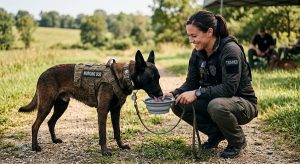
If the signs are mild (tacky gums, quiet, still alert and drinking)
- Move your dog to shade or a cool room.
- Offer small amounts of cool water often. A big bowl all at once can trigger vomiting, which makes things worse.
- Recheck gums and energy every 10 to 15 minutes.
- If your dog isn’t clearly improving within about 30 minutes, call your vet.
If your dog shows heatstroke signs (heavy panting at rest, drooling, bright red gums, wobbling, collapse)
This is where outdated advice can cost lives. You may have heard “cool slowly” with lukewarm water, or that cold water is dangerous. Research from the Royal Veterinary College and the Vets Now study says otherwise. Their guidance is “cool first, transport second.”
- Stop the heat. Move the dog out of the sun or hot vehicle at once.
- Cool with water right away. For a healthy, conscious dog, cold water immersion was the most effective method in the research, and no harmful effects were seen. If you can’t submerge the dog, pour or spray cool water over the body and create airflow with a fan or air conditioning. Use whatever water is quickest, as long as it’s cooler than the dog.
- Don’t cover the dog with a wet towel. It can trap heat. Keep air moving.
- Keep cooling on the way to the vet. Cool the car first and run the air conditioning.
- Call the vet while you cool. Even if the dog seems better, heatstroke can cause damage inside that you can’t see.
Here’s the sad part. In the UK study of 856 dogs, only 24% were cooled with water before treatment. In the Vets Now records (more than 800 dogs, 2022 to 2023), only 28% were cooled before being driven to the vet, and just 40% of those were cooled with water. Most owners rush to the car and skip the one step that matters most.
One note: I’ve changed my own advice here. Older guides, including earlier versions of this article, said to avoid cold water. Current evidence points the other way, so I follow the evidence.
Electrolytes, Broth and Pedialyte: What Is Safe?
Owners often ask whether they should give an electrolyte drink. Here’s the balanced answer.
- Plain, fresh water is always the base. Nothing replaces it.
- Unflavored Pedialyte, diluted with water, is considered safe for most dogs for short-term use and only when your vet agrees. Flavored versions can contain sweeteners that aren’t safe for dogs. The sugar can also be a problem for diabetic dogs.
- Don’t give it to a dog that is vomiting repeatedly. It can make things worse, and that dog needs a vet.
- Too much can cause diarrhea. More electrolytes is not better.
- Low-sodium broth (no onion, no garlic) can tempt a reluctant drinker.
- Moderate to severe dehydration needs a vet. Dogs at that stage usually need fluids under the skin or into a vein.
Bottom line: electrolyte solutions are a short-term helper for mild cases, not a treatment plan. When in doubt, call your vet before you pour anything into your dog.
Hydration Mistakes Even Careful Owners Make
- Trusting the bowl. Full doesn’t mean drunk. Check what’s actually gone.
- Leaving water in the sun. Hot water goes untouched.
- Using one bowl for several dogs. The boss dog drinks first and most.
- Relying on the shoulder skin pinch alone. It’s a clue, not a test.
- Letting a thirsty dog gulp. Small, repeated drinks are safer.
- Forgetting that chronic low-level dehydration is real. A dog that’s slightly under-hydrated week after week can show lower energy, a duller coat, more digestive upsets and less heat tolerance. Over time it also strains the kidneys.
- Believing old cooling myths. See the heatstroke section above.
Trainer’s Notes: Where This Advice Comes From
I’m Cpl. Rofiat Muritala, a Nigerian Army military working dog instructor and handler with more than 14 years at the Nigerian Army Dog Centre. My work covers dog selection, obedience, detection and operational readiness, so I see how heat and exertion affect dogs in real conditions, not just in theory.
This guide blends that field experience with published veterinary research, including the VetCompass studies from the Royal Veterinary College and Nottingham Trent University, a 2019 study on skin turgor and capillary refill in exercising working dogs, and cooling research. Sources are listed at the end.
I’m not a veterinarian, and this article doesn’t replace one. My goal is to help you spot trouble early enough that a vet visit is a precaution, not an emergency.
If you want more of my day-to-day routines for keeping dogs healthy, conditioned and well-handled, my book Beyond the Bark: Inside a Pro Handler’s Playbook for Raising the Ideal Dog goes deeper on the same field-tested principles.
Frequently Asked Questions
How can I tell if my dog is drinking enough water?
Check three things: gums that feel wet and slippery, pale yellow urine, and normal energy. Add the capillary refill test (pink color back within 2 seconds) and a gentle forehead skin check. For a number, measure the bowl over 24 hours and compare it with the weight table above.
How long can a dog go without water?
A healthy dog can survive roughly two to three days without water, but harm starts much sooner, especially in heat. Even a few hours without water on a hot, active day can cause real dehydration. Never test it.
Can I give my dog ice cubes or electrolytes when it’s hot?
Ice cubes and frozen broth cubes are fine in small amounts and make a good hot-weather treat. Unflavored, diluted Pedialyte may be used short term if your vet agrees. Don’t use either as a substitute for fresh water or a vet visit when your dog looks unwell.
Why is my dog drinking more water than usual?
Heat, exercise, salty food or dry kibble can explain it. But a sudden, lasting increase can signal diabetes, kidney disease, Cushing’s disease or an infection. If the increase lasts more than a day or two with no clear reason, book a vet check.
Why won’t my dog drink in hot weather?
Common causes are warm or stale water, nausea, stress and pain. Try fresh, cool water in several spots, wash the bowl, add a splash of low-sodium broth, or offer wet food. If your dog refuses water and also seems weak or quiet, treat it as a medical problem and call your vet.
Final Thoughts
Here’s the uncomfortable truth: canine dehydration rarely looks urgent until it already is. A dog can seem fine at 9 a.m. and be in real trouble by 1 p.m., with no dramatic signs in between.
The fix is simple. Put water in several places. Refresh it often. Do a 10-second gum and saliva check every hot day. Know whether your dog is in a high-risk group. Walk early or late. Give small drinks during exercise, and don’t let any dog gulp or play in water for hours without a break. If you ever see heatstroke signs, remember the rule: cool first, vet second.
Hydration is one of the easiest things you control as an owner and one of the easiest to get wrong without noticing. Check often, not just when it feels hot.
Want more guides like this? Subscribe to our weekly roundup newsletter at arfsk9team.com.ng/newsletter and get new K9 health and training articles in your inbox.
Sources and Further Reading
- Hall EJ, Carter AJ, O’Neill DG. Incidence and risk factors for heat-related illness (heatstroke) in UK dogs under primary veterinary care in 2016. Scientific Reports, 2020.
- Carter AJ and colleagues. Risk factors for severe and fatal heat-related illness in UK dogs: a VetCompass study. Veterinary Sciences, 2022.
- Cooling methods used to manage heat-related illness in dogs presented to primary care veterinary practices in the UK, 2016 to 2018.
- Royal Veterinary College. The RVC urges owners of hot dogs to “cool first, transport second.” RVC VetCompass
- Vets Now. Wet before vet: how to cool dogs safely and effectively. Vets Now
- Goucher TK and colleagues. Evaluation of skin turgor and capillary refill time as predictors of dehydration in exercising dogs, 2019.
- American Kennel Club. Pedialyte and electrolytes for dogs.
- Purina. Dog hydration: how to keep your dog healthy and hydrated.
This article is general information and not a substitute for advice from your veterinarian.

Her work centres on obedience, detection, protection and operational readiness. She favours proven methods built on repetition, consistency and real-world conditioning, so that both dogs and handlers are prepared for high-pressure tasks.
Rofiat represented the Nigerian Army Dog Centre at the Nigerian Army Day Celebration (NADCEL) 2026, where she led demonstrations in obedience, explosive detection, agility and tactical movement. Through articles, training content and documentaries, she shares field-based insight into how structured training, clear communication and trust between handler and dog affect performance and reliability.
She is the author of Beyond the Bark: Inside a Pro Handler's Playbook for Raising the Ideal Dog, a practical guide that helps dog owners and handlers apply professional training principles in everyday situations.
- K9 Advantix Dosage Chart & Safety Guide for Dogs - October 19, 2026
- How to Set Up & Use Bousnic Dog Training Collar - October 18, 2026
- Westminster Dog Show 2026: Winners & Full Results - October 17, 2026