Why Some Dog Breeds Mature Faster Mentally (Science)
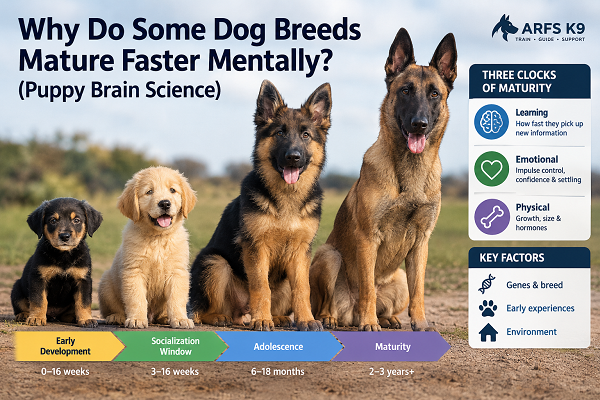
Mental maturity in dogs is the point where a dog has reliable impulse control, emotional stability, and focus, not just fast learning. Most dogs reach it between 12 and 24 months, but large and high-drive working breeds often need 2 to 3 years or more.
The short version:
- Breed matters, but it explains only about 9% of behavior differences between individual dogs.
- Puppies’ brains are most open to new experiences in the first three months.
- Almost every dog hits a “teenage dip” in obedience around 8 months, then recovers.
Table of Contents
- Introduction
- The Three Clocks: What “Mental Maturity” Really Means
- Puppy Brain Science: What Happens in the First 16 Weeks
- Genetics: How Much Does Breed Really Matter?
- Which Breeds Mature Faster? (Fast Learners vs Fast Settlers)
- The Part You Control: Environment and Early Experience
- The Teenage Dip: Why Smart Puppies “Forget” Everything
- The Handler’s Maturity Check: 5 Tests You Can Do at Home
- How to Train Fast-Maturing and Slow-Maturing Dogs
- A Handler’s Note: What We Look for in K9 Selection
- FAQs
- Conclusion
Introduction
You meet two puppies, both 10 weeks old. One locks eyes with you, follows your pointing hand, and sits for a treat after two tries. The other is a mouthy, bouncing tornado. Same age. Why does one look “older”?
If you’ve wondered why some dog breeds mature faster mentally, you’re asking the right question. And you’ve probably found confusing answers. One website says small dogs grow up first. Another says working breeds do. A third says it’s all about training.
Here’s the problem. Most articles treat “mental maturity” as a single switch. It isn’t. In this guide, you’ll learn what puppy brain science actually shows, which breeds learn fast but settle late, and how to raise each type without frustration.
The Three Clocks: What “Mental Maturity” Really Means
Here’s the model I use when I explain this to new handlers. Every dog runs on three clocks, and they don’t tick at the same speed.
1. The learning clock. How fast the dog picks up new information, reads people, and solves problems.
2. The emotional clock. Impulse control, recovering from stress, tolerating frustration, and settling down. This is what most owners mean when they say a dog has “calmed down.”
3. The body clock. Skeleton, muscle, and sex hormones. This one is easy to see, so people assume the brain follows along. It doesn’t.
Researchers back up the idea that growth timing varies by size. Smaller breeds grow faster, but larger breeds stay in a growth phase longer. That’s the body clock. It says nothing about when a dog will stop chewing your shoes.
So a Belgian Malinois has a very fast learning clock and a slow emotional clock. A Chihuahua may finish growing early but still act silly for years. Neither is “more mature.” They’re mature in different ways, on different schedules.
That timing isn’t a guess. One vet-written guide notes that most dogs become noticeably less hyper between 12 and 24 months, though it varies a lot by breed, temperament, and training.
Puppy Brain Science: What Happens in the First 16 Weeks
The first weeks of life do more to shape a dog’s brain than almost any later period. Let’s look at what the research says.
Puppies are born ready to read people
In 2021, a team led by Emily Bray and Evan MacLean tested 375 retriever puppies at an average age of 8.5 weeks. The puppies successfully followed human gestures from the very first trial, and the researchers found no sign that learning was required. Genes also played a big part: over 40% of the variation in point-following and attention to human faces was linked to genetics.
The same study found that puppies remembered where food was hidden for delays of up to 20 seconds. That’s at about 8 weeks old.
What does this tell us? Some “smart” behavior isn’t taught. It’s built in, and it differs from puppy to puppy.
The socialization window
Brain science is only half the story. The other half is timing.
The American Veterinary Society of Animal Behavior (AVSAB) says the most important time for socialization is the first three months of life. That’s when sociability outweighs fear, so puppies adapt to new people, places, and sounds most easily. The group also says puppy classes can start as early as 7 to 8 weeks. Another position statement puts the sensitive period at about 3 to 16 weeks, and notes that socialization should continue through the first 9 to 12 months so the lessons stick.
And the stakes are real. AVSAB points out that more deaths in dogs under three are linked to behavior problems than to infectious disease.
Here’s the catch many articles miss. Much of this window happens before your puppy comes home. A breeder who handles, exposes, and stimulates the litter in weeks 3 to 8 hands you a puppy with a head start. A breeder who doesn’t hands you a puppy that’s already behind. That’s why I always tell owners: judge the breeder as much as the breed.
Genetics: How Much Does Breed Really Matter?
Let’s clear up a big myth. People say, “It’s all genetics.” Others say, “It’s all how you raise them.” The truth sits in the middle, and the numbers are interesting.
Evidence that breed shapes the brain:
- Harvard’s Erin Hecht scanned 62 dogs from 33 breeds with MRI and found real brain differences that body size, brain size, and skull shape couldn’t explain. The differences lined up with breed jobs like sight hunting, scent hunting, guarding, and companionship. Hecht summed it up as “a predisposition to learn that behavior.”
- A 2019 study of more than 14,000 dogs from 101 breeds found high heritability across breeds for 14 behavior traits. It also flagged 131 genetic markers in genes active in the brain.
Evidence that breed isn’t destiny:
- A big 2022 Science study (the Darwin’s Ark project) surveyed 18,385 dogs and genotyped 2,155. It found that most behavior traits are heritable, but breed explains just 9% of behavior variation in individual dogs. Breed’s pull varied by trait. It was strongest for biddability and herding types, and ranged from about 0% to 25% depending on the trait.
So how do these fit together? Genes absolutely shape tendencies, and breeds do differ on average. But inside any breed, individual dogs vary a lot. A “fast-maturing breed” gives you better odds, not a guarantee.
That’s why I call breed a starting point, not a prediction. For more on how instinct and trainability differ by breed, see our guide on obedience vs instinct: the two types of dog intelligence every handler must understand.
Which Breeds Mature Faster? Fast Learners vs Fast Settlers
Now the question you came for. Here’s the honest version, using the three clocks.
| Breed type | Learning clock | Emotional clock | What to expect |
|---|---|---|---|
| Border Collie | Very fast | Slow to moderate | Learns quickly, needs a “job” or invents one |
| Belgian Malinois | Very fast | Slow | Brilliant early, intense for years |
| German Shepherd | Fast | Moderate to slow | Focused young, steadier by 2 to 3 years |
| Poodle (all sizes) | Fast | Moderate | Quick, people-tuned, sensitive |
| Golden / Labrador (service lines) | Fast | Moderate | Strong early impulse control in well-bred lines |
| Small companion breeds | Moderate | Often faster | Finish growing early, may settle sooner |
| Giant breeds | Moderate | Slow | Long growth phase, “puppy” for years |
Remember: these are tendencies. With breed explaining about 9% of individual behavior, your own puppy may break the pattern.
The Malinois example
This is where many articles go wrong. They say the Malinois “matures mentally fast.” But learning fast and settling fast are different things.
One breed guide says a Malinois reaches mental maturity around age 2 to 3. Another says most Malinois reach full physical and behavioral maturity between about 3 and 5 years. Some working-dog schools set age minimums to match. One says its German Shepherd protection dogs must be at least 2 to 2.5 years old and its Malinois at least 3 to 3.5. The same source says police K9s start serious training around 18 months.
So the Malinois is a fast learner and a slow settler. If you buy one expecting a calm, grown-up mind at 12 months, you’ll be disappointed. For a deeper breed comparison, read our German Shepherd vs Belgian Malinois intelligence comparison.
Why does the internet contradict itself?
Search this topic and you’ll see two camps. One says intelligent working breeds mature mentally faster. The other says smaller breeds often mature mentally earlier, while larger breeds take longer. Both are partly right, because they’re measuring different clocks. Working breeds win the learning clock. Small breeds often win the body clock and sometimes the emotional clock.
Some well-bred service lines show how much selection matters. One article notes that a well-bred Golden Retriever can learn to put its own urges aside to help its handler much earlier than most breeds. That’s selection for the emotional clock, not just the learning clock.
The Part You Control: Environment and Early Experience
Genes load the gun, but environment decides how it fires. Here’s some of the best evidence.
A research team followed German Shepherds bred for the Swedish Armed Forces. The dogs lived with host families for about a year, then took a standard temperament test. The finding: experiences and behavior during the first year strongly predicted later temperament.
That means a high-potential puppy in a poor first year can end up behind a lower-potential puppy raised well. This also explains a common surprise: puppy tests aren’t crystal balls. One longitudinal study found little link between puppy-test behavior and adult behavior, so early tests have limited predictive power. Results from working-dog programs are mixed too, though one detection-dog test did predict later selection as early as 3 months. The takeaway: predictions get better as the dog gets older.
What helps a puppy’s brain grow well:
- Many short, positive exposures to new people, surfaces, and sounds
- Safe contact with calm adult dogs
- Problem-solving games (scent hunts, puzzle feeders, simple “find it”)
- Short, consistent training sessions
- Rest. Puppies need a lot of sleep to process what they learn
What slows it down:
- Isolation or long hours alone
- Overwhelming experiences (flooding a shy puppy with crowds)
- Skipping the socialization window and “catching up” later
- Inconsistent rules in the house
Crate rest, routines, and calm exposure all count too. And fast learners need a lot of mental work. Our guide on how often to exercise a working dog shows why a long walk alone isn’t enough for sharp-minded breeds.
The Teenage Dip: Why Smart Puppies “Forget” Everything
Here’s something no breed chart will warn you about. At around 6 to 9 months, almost every dog, even a gifted one, hits a rough patch.
Researchers from Newcastle and Nottingham tested 69 guide-dog candidates at 5 months and again at 8 months. At 8 months, caregivers scored trainability lower than at 5 months or 12 months. In one test, pups that sat instantly for everyone before adolescence often repeatedly refused the same command from their caregiver once adolescent. The reduced obedience was mostly aimed at owners, with strangers getting better behavior.
In the same research, dogs with insecure attachment to their owners reached puberty earlier, around 5 months instead of 8. That’s a reminder that the emotional bond affects development.
Why does this matter? The authors warn that adolescence is a peak age for dogs being abandoned to shelters. Owners think the dog “got dumb” or “turned bad.” It didn’t. The dog’s brain is reorganizing.
What to do:
- Stay consistent. Don’t escalate or punish. The researchers advise staying consistent and using rewards instead of punishment.
- Go back to easier criteria. Ask for a “sit” in a quiet room, then add distractions slowly.
- Keep socialization going. It should continue through the first year or so.
- Remember it ends. Trainability came back by 12 months in that study.
A note on “fear periods.” Many trainers describe a second fear phase in adolescence, and I see the pattern in the field. But direct research on it is limited, so treat it as practical experience rather than settled science. If your dog suddenly shows real fear or aggression, talk to a vet or qualified behaviorist.
The Handler’s Maturity Check: 5 Tests You Can Do at Home
These aren’t scientific tests. They’re the quick checks I’d use to see where a dog sits on the emotional clock. Run them in the same place each month and write down the results.
- The settle test. Put your dog on a mat with light distractions. How long until it lies down calmly? Early on, it might be one minute. A maturing dog can manage ten.
- The recovery test. Drop a metal bowl at a safe distance. How fast does your dog bounce back? Quick recovery is a good sign. Lingering worry means more confidence work.
- The frustration test. Hold a treat behind a barrier. Does your dog whine and scratch, or think and wait? You’re watching for self-control.
- The focus test. Ask for eye contact in a mildly busy place. Count the seconds before the dog looks away.
- The recall test. Call your dog away from a mild distraction. Does it come right away, hesitate, or ignore you?
Track the trend, not one bad day. Remember the adolescent dip: scores can drop around 8 months, then climb again.
How to Train Fast-Maturing and Slow-Maturing Dogs
For fast learners (Malinois, Border Collie, GSD types)
Do:
- Teach settling as a skill, not an accident. “Boring” is a lesson for these dogs.
- Keep sessions short. One Malinois training guide suggests 3 to 5 short sessions a day, about 5 to 10 minutes each, for puppies.
- Give them a job: scent games, tricks, structured retrieves.
- Reward calm, not just action.
Don’t:
- Assume a quick learner is a ready adult. Learning “down” in a week doesn’t mean holding it in a crowd.
- Over-drill. Fast learners also learn bad habits fast.
- Add intense drive work too early. Protection or bite work belongs to older, stable dogs and professionals.
For slower-maturing dogs (giants, some retrievers, many late bloomers)
Do:
- Use short, joyful sessions
- Praise small wins
- Keep expectations realistic for the age
- Stay patient through the long “teen” phase
Don’t:
- Compare your dog with a neighbor’s Border Collie
- Use pressure or harsh corrections to “speed things up”
For every dog
Mix three things daily: physical exercise, mental work, and rest. If you want a step-by-step handler’s approach to raising a balanced dog, my e-book Beyond the Bark: Inside a Pro Handler’s Playbook for Raising the Ideal Dog walks through it.
A Handler’s Note: What We Look for in K9 Selection
In working-dog selection, we don’t just pick the puppy that learns “sit” fastest. We look at how the dog handles pressure, how quickly it recovers after a surprise, and whether it keeps its head when excited. A dog with high drive and a fast learning clock still needs time before it can do real work. That’s why serious programs wait for emotional stability before they ask for reliable protection or detection performance.
The lesson applies to pet owners too. Maturity isn’t about how smart your dog looks at 10 weeks. It’s about how steady your dog is at 2 years.
Frequently Asked Questions
1. At what age do dogs reach mental maturity?
Most dogs reach mental maturity between 12 and 24 months. Small breeds often settle by about their first birthday, while larger and high-drive working breeds may take 2 to 3 years or longer. Every dog is different, so use age as a guide, not a deadline.
2. Do small dogs really mature faster than large dogs?
Physically, yes. Small breeds grow faster, while large breeds keep growing for longer. Mentally, it’s less clear. Small dogs often calm down earlier, but a quick-learning large breed may “know” more early and still take years to settle emotionally.
3. Is the Belgian Malinois really a fast-maturing breed?
The Malinois learns fast, but it settles slowly. Most sources put its mental maturity at around 2 to 3 years, with full behavioral maturity sometimes taking up to 5. Plan for a long, intense adolescence.
4. Can a slow-maturing dog catch up to a fast-maturing one?
Yes, in many ways. Genes set tendencies, but breed explains only about 9% of behavior differences between individual dogs. Good early socialization, consistent training, and patience can help a “late bloomer” become a calm, well-balanced adult.
5. Why does my smart puppy ignore me at 8 months?
That’s the adolescent dip. Research on guide-dog candidates found trainability falls around 8 months and recovers by 12 months. Stay consistent, use rewards, and keep training easy and fun until it passes.
Conclusion
So, why do some dog breeds mature faster mentally? Because dogs run on three clocks (learning, emotional, and physical) and breeds tick at different speeds on each one. Genes shaped by centuries of work give some breeds a head start on learning. Early brain development and the first-year experience decide how much of that potential shows up. And almost every dog hits a bumpy adolescence before it settles.
Your action plan:
- Judge your breeder on early handling, not just pedigree.
- Socialize hard between 3 and 16 weeks, and keep going through the first year.
- Expect a training dip around 6 to 9 months, and stay consistent.
- Teach settling and impulse control as skills.
- Track progress with the 5-test maturity check.
- Be patient. Many dogs don’t fully settle until 2 to 3 years old.
Want weekly handler-tested training tips? Subscribe to our weekly newsletter roundup here. And if you’d like a full playbook for raising a balanced dog.
Sources and further reading
- Morrill et al. (2022), Science: https://www.science.org/doi/10.1126/science.abk0639
- MacLean et al. (2019), Proc. R. Soc. B: https://pubmed.ncbi.nlm.nih.gov/31575369/
- Hecht et al. (2019), Journal of Neuroscience: https://www.sciencedaily.com/releases/2019/09/190902135309.htm
- Bray et al. (2021), Current Biology: https://www.cell.com/current-biology/fulltext/S0960-9822(21)00602-3
- Asher/Harvey et al. (2020), Biology Letters: https://pmc.ncbi.nlm.nih.gov/articles/PMC7280042
- AVSAB Puppy Socialization Position Statement: https://avsab.org/wp-content/uploads/2018/03/Puppy_Socialization_Position_Statement_Download_-_10-3-14.pdf
- Serra et al. puppy-test predictive value study (PLoS ONE): https://journals.plos.org/plosone/article?id=10.1371%2Fjournal.pone.0101237

Her work centres on obedience, detection, protection and operational readiness. She favours proven methods built on repetition, consistency and real-world conditioning, so that both dogs and handlers are prepared for high-pressure tasks.
Rofiat represented the Nigerian Army Dog Centre at the Nigerian Army Day Celebration (NADCEL) 2026, where she led demonstrations in obedience, explosive detection, agility and tactical movement. Through articles, training content and documentaries, she shares field-based insight into how structured training, clear communication and trust between handler and dog affect performance and reliability.
She is the author of Beyond the Bark: Inside a Pro Handler's Playbook for Raising the Ideal Dog, a practical guide that helps dog owners and handlers apply professional training principles in everyday situations.
- Can You Handle a Cane Corso Puppy? 7 Hard Truths - October 23, 2026
- How to Train a Stubborn Pug: A K9 Trainer’s Real Guide - October 22, 2026
- Dog Hotel Prep: 7 Must-Haves Before Boarding - October 21, 2026