Bite Sleeve Guide: How to Pick the Right One for Your Dog

The right bite sleeve matches your dog’s current skill, not its size or birthday. Start with tugs and a soft puppy sleeve, move to a medium (intermediate) sleeve once your dog bites with a full, calm mouth, and save hard sleeves for dogs that already grip well. Jute gives the best grip feedback, French linen and soft synthetics suit young dogs, and a good sleeve costs roughly $60 to $250, plus a cover or cuff for hard models.
Table of Contents
- Introduction
- Quick Answer: Which Bite Sleeve Do You Need?
- What a Bite Sleeve Really Does (and Why the Wrong One Hurts)
- Before You Buy: The Bite Training Ladder
- Bite Sleeve Strength Levels: Soft, Medium and Hard
- Hard Sleeves Need a Cuff (and Other Things Sellers Skip)
- Jute vs French Linen vs Synthetic: Which Material Wins?
- 7 Factors for Choosing the Right Bite Sleeve for Your Dog
- Pick by Goal: Sport, Police, Personal Protection and Guardian Work
- How Much Does a Bite Sleeve Cost?
- Our Bite Sleeve Recommendations
- Buyer’s Checklist: Red Flags Before You Click Buy
- 6 Signs You’re Using the Wrong Sleeve (and the Fix)
- How to Care for Your Sleeve
- Safety and Decoy Basics
- Why Trust This Guide
- FAQs
- Final Thoughts
Introduction
Picking the wrong bite sleeve is one of the quietest ways to damage a good dog. This bite sleeve guide will help you avoid that. Nothing breaks. Nobody gets hurt on day one. But a dog pushed onto equipment that’s too hard, too stiff or too slippery starts to bite shallow, hold back or avoid the decoy, and those habits take months to fix.
If you’ve searched “how to choose a bite sleeve”, you’ve probably noticed the problem. Most pages tell you “soft for puppies, hard for pros” and then drop a list of products. That’s not enough. A sleeve is a tool your dog learns through, so the right choice depends on your dog’s mouth, confidence, training goal and even the person wearing it.
Here’s what you’ll learn in this guide:
- How soft, medium and hard sleeves actually differ
- Why you should often start with a tug, not a sleeve
- How jute, French linen and synthetic covers feel to a dog
- How to size a sleeve for your decoy, not just your dog
- What sleeves really cost, including covers and cuffs
- The warning signs that your current sleeve is hurting progress
Whether you raise a Malinois for sport, a German Shepherd for security work or a protection dog for your family, you’ll buy smarter after reading this.
Quick Answer: Which Bite Sleeve Do You Need?
Puppies and nervous dogs need a soft sleeve (or a tug first). Adolescent dogs that bite with a full mouth need a medium sleeve. Mature dogs with a calm, deep grip can move to a hard sleeve, and only if the decoy wears a cuff or gauntlet underneath.
| Your dog | Best sleeve | Material to look for | Main goal |
|---|---|---|---|
| Puppy, or a dog new to biting | Soft puppy sleeve (after tug work) | French linen, soft synthetic, light jute | Confidence and fun |
| Teen dog with adult teeth, biting well | Medium or intermediate sleeve | Jute, soft synthetic | Full grip and technique |
| Mature dog with a calm, deep grip | Hard or advanced sleeve with cuff | Reinforced jute, heavy synthetic | Grip strength and testing |
| Dog that bites shallow or avoids | Step back one level | Soft jute or French linen | Rebuild confidence |
| Club or professional use | Several sleeves of different types | Mix of jute and synthetic | Variety and durability |
What a Bite Sleeve Really Does (and Why the Wrong One Hurts)
Let’s clear up a myth. A bite sleeve isn’t just arm protection for whoever plays decoy. Every time your dog bites, the sleeve teaches it something: where to bite, how hard to commit, whether to stay calm or thrash, and whether biting even feels good.
I’ve seen what happens when that lesson goes wrong. A promising young Malinois was pushed onto a hard sleeve months before he was ready. Within three sessions he went from a full, confident grip to running in, nipping and bailing out. It took almost four months on soft equipment to rebuild his confidence. That’s four months of lost training time, and it started with one gear decision.
The science backs up the idea that dogs differ a lot. A study of 20 police dogs measured bite force with a special sleeve fitted with three force sensors. The dogs ran 25 meters and bit the sleeve. German Shepherds had a median bite force of about 360 newtons, while Malinois came in around 247 newtons. Skull shape and body weight both mattered.
Two takeaways:
- Dogs aren’t interchangeable. A sleeve that suits one dog can be wrong for another of the same breed.
- Be careful with “PSI” charts online. Very few breeds have been tested properly, and many internet numbers are guesses. Choose by your dog’s behavior, not a breed bite-force chart.
A well-matched sleeve helps your dog:
- Build a full, calm, committed grip
- Grow bite pressure gradually
- Learn to target the arm
- Move smoothly from prey drive into controlled work
- Avoid strain on teeth, jaw and neck
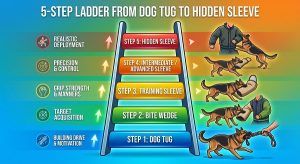
Before You Buy: The Bite Training Ladder
Here’s something most buying guides leave out: the sleeve often isn’t the first rung.
Leerburg, a well-known working dog training company, lays out bite training as small steps. Young pups start on a soft leather bite rag. Next comes a short puppy tug or puppy soft sleeve. Then a young dog sleeve, then an intermediate soft sleeve. After that comes an advanced soft sleeve, a body bite suit or hard arm, and finally a hidden sleeve or muzzle work.
Their trainers also answered a owner of a six-month-old female Malinois who wanted to buy a sleeve. The pup had all her adult teeth and loved to tug. The advice was to hold off. Make sure the dog has good technique and clean presentations on a tug first, then use a bite pillow, then move to a sleeve. Going to a sleeve too soon, they warned, can put a dog off the game.
I agree with that. Here’s the ladder I use as a simple guide:
- Tugs and bite rags. Your dog learns to grab, hold and enjoy it.
- Bite pillow or puppy sleeve. Your dog learns to bite something bigger with a full mouth.
- Young dog or soft sleeve. Your dog meets arm-sized targets and handles.
- Medium sleeve. Your dog builds real grip and technique.
- Hard sleeve, suit or hidden sleeve. Your dog is tested under pressure.
Move up when your dog’s skill says so, not when the calendar does. If you’re still sorting out the basics of protection work, our guide on how to train your dog for security and protection shows where bite work fits in the bigger picture.
Bite Sleeve Strength Levels: Soft, Medium and Hard
Brands label levels differently. One company’s “Level 2” can feel like another’s “Level 4”. So treat the numbers as rough, and compare the feel: how easily the sleeve compresses and how much it flexes. Think in three tiers.
Soft or Puppy Bite Sleeves
Best for: puppies, nervous dogs and first-time biters.
At this stage, motivation matters more than power. A soft sleeve lets a young dog “win” nearly every rep. That constant success builds the enthusiasm you’ll rely on later.
What to look for:
- Light, forgiving material such as French linen, soft synthetic or light jute
- A forearm-sized sleeve that doesn’t overwhelm a small mouth
- A bite surface the pup can close its mouth around
- Easy re-grip so the pup can try again without frustration
Don’t put a puppy on a hard sleeve to “toughen it up.” It doesn’t make a tougher dog. It teaches the dog that bite work hurts. Remember, baby teeth are sharp and fragile, and a young jaw is still growing.
Medium or Intermediate Bite Sleeves
Best for: adolescent dogs with adult teeth, dogs moving from play into structured work, and sport dogs refining grip.
This is where technique gets built or ruined. The dog needs enough resistance to develop real pressure, but not so much that the grip falls apart. Many dogs spend the longest stretch of their training here, often six to twelve months.
What to look for:
- Moderate, even padding (jute is the classic choice)
- A bite bar or core that guides a deep, full grip
- A sturdy handle and a cover you can replace
- Enough durability for repeated sessions
Some makers add a “compression” design to this level. Ray Allen, a U.S. maker of K9 gear, builds sleeves with a wedge or crumple zone at the front. The dog has to open wide and take a full grip into the back of the bite bar. The same crumple zone softens the impact, so newer decoys are less likely to jam the dog. That’s a smart feature for dogs that bite shallow.
Hard or Advanced Bite Sleeves
Best for: mature dogs with an established, calm grip, and those heading into certification or higher-level sport.
Hard sleeves aren’t teaching tools. They’re conditioning and testing tools. They resist, they flex less, and they ask a dog that already knows its job to commit fully.
What to look for:
- Dense, reinforced padding
- A replaceable cover, since this takes the most abuse
- Weight you can handle (more on that below)
- A cuff or gauntlet for the decoy
Push a dog here too early and you’ll see the same pattern: hesitation, shallow bites or avoidance. Use the hard sleeve to test what you’ve built. Don’t use it to build the dog from scratch.
Soft Sleeves Still Matter for Real-World Work
Here’s an insight many sport-focused guides miss. Leerburg points out that dogs trained only on hard sleeves can struggle with their first grip on a real, moving person, because they’ve never bitten something soft that moves. A soft sleeve lets the dog feel the arm shift as the decoy reacts. For personal protection and police-style work, their trainers like to use both a hard and a soft sleeve.
A police trainer on one forum made a similar point: sleeves without a bite bar let the dog feel the arm and let the decoy reward a hard bite with a reaction, and those benefits fade with a bite-bar sleeve. Opinions differ here, which is exactly why variety helps.
Hard Sleeves Need a Cuff (and Other Things Sellers Skip)
This is the section I wish every buyer read first.
Wear a cuff under hard sleeves. Ray Allen states plainly that a sleeve cuff is required on all hard sleeves, to prevent harm to the decoy and damage to the sleeve. Leerburg suggests a neoprene gauntlet under the sleeve for really hard-biting dogs, and Ray Allen says the same for advanced dogs on its soft padded hidden sleeve.
Check what you replace. On some sleeves you replace only the cover when it wears out. On others you replace the lower part. That changes your long-term cost.
Rotate sleeve types. Leerburg trainers use a mix of materials and styles with Schutzhund and ring sport dogs so the dogs don’t get used to just one surface. I do the same. A dog that only knows one sleeve can fall apart when the surface feels different.
Watch the weight. Ray Allen’s lightest training sleeves weigh under 2.5 to 3.5 pounds. That might sound small, but your decoy holds it out at arm’s length with a dog hanging on. Heavy sleeves tire the decoy fast, and tired decoys make sloppy presentations.
Jute vs French Linen vs Synthetic: Which Material Wins?
Strength level is half the story. The cover changes how a bite feels in the dog’s mouth.
| Material | How it feels to the dog | Best for | Watch out for |
|---|---|---|---|
| Jute | Rough, grippy weave, easy to “purchase” onto | Medium and advanced work, building full grips | Wears faster in rain and humidity, needs dry storage |
| French linen | Softer, lighter, smooth but sturdy | Puppies, sensitive mouths, sport foundation | Less grip texture than jute |
| Synthetic (nylon-type or similar) | Slicker, very durable, easy to clean | Clubs, daily professional use, wet weather | Cheap weaves can feel harsh on teeth |
Jute is the industry standard for a reason. The loose weave gives a dog something to dig into, so deep grips come more easily.
French linen is the same fabric many bite suits are made from, according to makers like Dingo Gear in Poland. It’s tough but gentle, which is why it’s popular for young dogs. Dingo Gear also points out that a good puppy sleeve should have a wide bite bar with no metal or plastic parts.
Synthetics suit busy clubs and professional decoys who run many dogs a day. They’re lighter and tougher in wet weather. The catch? Cheap synthetic covers can be harder on a dog’s teeth. Buy from a reputable maker, not the lowest price on the page.
7 Factors for Choosing the Right Bite Sleeve for Your Dog
Don’t choose by size alone. A confident 60-pound Malinois may be ready for gear that a nervous 90-pound Rottweiler isn’t. Use these seven checks.
- Skill level. Does your dog bite with a full mouth and hold calmly? That matters more than age.
- Age and teeth. Puppies still teething need very soft gear. Adult teeth are usually in by about 6 to 7 months, but a young jaw and neck still aren’t built for hard work.
- Confidence. A hesitant dog needs easy wins. A bold dog may need a firmer bar so it learns to slow down and grip.
- Bite style. Does your dog chew, shallow-bite or slip? A compression-style sleeve or a step back may help.
- Mouth shape. Long-muzzled shepherds, short-faced breeds and giant breeds all bite differently. Make sure your dog can close its mouth around the bite surface.
- Training goal. Sport, police, personal protection and guardian work don’t use the same progression (see the next section).
- Your decoy. The sleeve must fit the person wearing it. Check arm length, handle position, weight and whether it works for either arm. Ambidextrous designs help when several decoys share gear.
For tougher breeds, remember that bite force varies by individual dog. In the police dog study I mentioned, GSDs outscored Malinois on median force, but that doesn’t mean every GSD needs a harder sleeve. Behavior wins every time.
Pick by Goal: Sport, Police, Personal Protection and Guardian Work
| Goal | Smart sleeve plan |
|---|---|
| Protection sport (IGP, ring sports) | Follow your club’s and trial’s equipment rules. Use French linen or soft jute early, then medium and advanced sleeves, with a suit for later stages. |
| Police and security patrol | Move from soft to medium sleeves, then hidden sleeve and suit work, so the dog learns to bite a real, moving person. |
| Personal protection | Use both a soft and a medium or hard sleeve. Add a suit and qualified decoy as the dog advances. |
| Livestock guardian dogs | Start soft jute and move firmer as the dog matures. Match the sleeve to today’s training aim, not the “best” one on the market. |
Before you spend, talk to your local club or training program. The sleeve you need for foundation work often differs from what’s used on trial day. For a wider look at gear that goes with this work, see our guide to essential K9 training equipment.
How Much Does a Bite Sleeve Cost?
Most quality bite sleeves cost between $60 and $250. Soft puppy sleeves start around $30 to $60, and premium advanced sleeves from specialist makers can pass $200. Bite suits cost far more, with Leerburg noting that many handlers can’t justify $1,300 or more for a full body suit.
Here are real price points I checked in October 2026:
| Item | Approximate price (USD) |
|---|---|
| Entry-level puppy or soft sleeve | $30 to $60 |
| Mid-range jute or French linen sleeve | $60 to $150 |
| Ray Allen Ultra Light training sleeves (intermediate to advanced) | about $198 to $240 |
| Ray Allen soft padded hidden sleeve | about $165 |
| Dingo Gear soft French linen sleeve (retailer listing) | about $104 |
| Full body bite suit | $1,000 to $1,300+ |
Prices change, so check the current listing before you buy.
Budget tip: Plan for covers, cuffs and gauntlets. Many serious programs replace covers every season, and a hard sleeve without a cuff isn’t a complete purchase.
Our Bite Sleeve Recommendations
As an Amazon Associate we earn from qualifying purchases. We only list gear that fits a clear stage of training.
I can’t test every sleeve on the market, so treat these as stage-based starting points. Always read the latest listing details and reviews before you buy.
Best for Intermediate Training: YES4QUALITY Dog Bite Sleeve
A jute sleeve for medium and large breeds, with a listed size of about 20 by 12 inches. It’s a sensible mid-range pick for German Shepherds, Malinois and similar dogs that already bite well and need to build grip.  Check the YES4QUALITY Dog Bite Sleeve
Best for Building Hold Technique: JINJULI Dog Bite Sleeve Training Set
A jute outer layer with thick inner padding and sturdy handles, so you keep good control while the dog learns to hold. It suits handlers who want a training set rather than a single piece. Check the JINJULI Dog Bite Sleeve Training Set
Best for Advanced Drills: Rbanbew Professional Bite Sleeve
An ambidextrous option aimed at trainers and decoys running advanced controlled-aggression drills and certification prep. Remember the rule: advanced dog, calm grip, cuff underneath. Check the Rbanbew Bite Sleeve
Planning to gear up beyond sleeves? Our roundup of top tactical K9 gear for working dogs covers the rest of the kit.
Buyer’s Checklist: Red Flags Before You Click Buy
Use this before you spend money on any sleeve:
- No clear level. If the listing doesn’t say puppy, intermediate or advanced, ask why.
- Metal or hard plastic in the bite area. Avoid it, especially for young dogs.
- Thin or sloppy stitching. Look for reinforced stitching in the bite area.
- No info on replacing the cover. You’ll need to know the long-term cost.
- No handle details. A bad handle makes a bad decoy.
- Weight not stated. Heavy sleeves tire decoys.
- Seller won’t say what the cover is made of. Jute, linen and synthetic all behave differently.
- Hard sleeve with no mention of a cuff. Treat that as a warning.
- Rock-bottom price for “professional” gear. Quality stitching and covers cost money.
6 Signs You’re Using the Wrong Sleeve (and the Fix)
One sign can just be an off day. A few together, especially if they’re new, mean it’s time to rethink.
- Chewing or milking instead of a firm, still grip. Fix: check the sleeve isn’t too hard or too slippery. Try a softer or grippier cover.
- Shallow bites or slipping off. Fix: try a compression-style or softer sleeve and keep the decoy’s presentation clean.
- Sudden hesitation or slow starts. Fix: step back one level and rebuild with easy wins.
- Can’t close the mouth around the bite surface. Fix: the bar is too thick. Move to a smaller or softer sleeve.
- The dog only works on one sleeve. Fix: rotate surfaces and styles gradually.
- The decoy feels harsh impact or fatigue. Fix: check weight, cuff and padding, and let the decoy rest.
If avoidance shows up, stop and rebuild. Don’t push through it.
How to Care for Your Sleeve
A sleeve is not a one-time purchase. Treat it like safety gear, because it is.
- Inspect before every session. Look for loose seams, frayed fabric and an exposed bite bar.
- Dry it fully. Natural fibers like jute break down faster when they stay damp.
- Store it flat or hanging in a ventilated spot. Don’t leave it in a hot car or a closed bag.
- Keep it for training only. Never let the dog treat it as an unsupervised chew toy.
- Replace covers on schedule. A worn cover is a bite-surface problem and a decoy-injury risk.
- Keep a spare. A second sleeve helps you rotate surfaces and keeps training going while one dries.
Safety and Decoy Basics
Bite work isn’t a solo hobby. Follow these basics:
- Use an experienced decoy. Timing and pressure matter as much as the sleeve.
- Don’t skip levels. Skipping causes more setbacks than it saves time.
- Stop when the dog is tired. Tired dogs bite worse and get hurt more easily.
- Put clean technique before power at every stage.
- Check local rules and insurance. Protection training has legal and liability limits that vary by country.
- Learn first, then buy. Join a club or work with a qualified instructor before you start bite work with a young or strong dog.
If you want a handler’s step-by-step approach to raising a balanced working dog, my book Beyond the Bark: Inside a Pro Handler’s Playbook for Raising the Ideal Dog is a practical place to start. Get the book on Amazon
Why Trust This Guide
I’m Cpl. Rofiat Muritala, a Nigerian Army military working dog instructor and handler with more than 14 years at the Nigerian Army Dog Centre. My work covers dog selection, foundation training, behavior shaping and performance evaluation in real operational settings. I’ve completed advanced obedience, K9 patrol and advanced explosive detection courses, and I led obedience, detection, agility and tactical movement demonstrations at the Nigerian Army Day Celebration (NADCEL) 2026.
To keep this guide honest, I cross-checked it with published manufacturer guidance from Leerburg and Ray Allen, a study of police dog bite force, and manufacturer details from Dingo Gear. Where experts disagree, such as on bite-bar versus no-bar sleeves, I tell you so.
FAQs
1. What is the best bite sleeve for a puppy?
A soft sleeve in French linen, soft synthetic or light jute, used after tug and bite-rag work, is best for a puppy. It should be sized so the pup can close its mouth around the bite surface. Never use a hard sleeve on a puppy.
2. What’s the difference between a soft and a hard bite sleeve?
A soft sleeve compresses easily, lets the dog feel the arm move and builds confidence. A hard sleeve flexes less and tests a mature dog’s grip. Soft sleeves teach, and hard sleeves test. Hard sleeves also need a cuff under them to protect the decoy.
3. Is jute or French linen better for a bite sleeve?
Jute gives a grippier feel and works well for medium and advanced training. French linen is softer and lighter, so it suits puppies, sensitive mouths and sport foundation work. Many trainers own both and rotate them so the dog gets used to different surfaces.
4. How do I know when my dog is ready for a harder sleeve?
Your dog is ready when it bites with a full mouth, holds calmly, targets the sleeve every time and shows no hesitation. If it chews, slips or avoids, step back a level. Use skill and confidence as your guide, not age alone.
5. Can I buy a bite sleeve and train my dog myself?
You can buy one easily, but bite work should involve an experienced decoy, because timing and pressure affect both the dog and the person. Join a club or work with a qualified instructor, especially with a strong or young dog, and check local rules before you start.
Final Thoughts
The best bite sleeve isn’t the toughest one you can buy. It’s the one that matches where your dog is right now. Soft sleeves build confidence, medium sleeves build technique and hard sleeves test what you’ve built.
Here’s your quick action plan:
- Start with tug and bite-rag work before any sleeve.
- Pick a sleeve by skill level, not size or age.
- Match the material to the job: jute for grip, French linen for young dogs, synthetic for heavy club use.
- Size the sleeve for your decoy and add a cuff to every hard sleeve.
- Rotate sleeve types and inspect gear before every session.
- Step back a level the moment you see avoidance.
Do that consistently, and the sleeve stops being just protective gear. It becomes one of the best training tools you own.
Want more handler-tested tips like this? Subscribe to our weekly articles roundup at https://arfsk9team.com.ng/newsletter/ and get new K9 training and gear guides in your inbox.

Her work centres on obedience, detection, protection and operational readiness. She favours proven methods built on repetition, consistency and real-world conditioning, so that both dogs and handlers are prepared for high-pressure tasks.
Rofiat represented the Nigerian Army Dog Centre at the Nigerian Army Day Celebration (NADCEL) 2026, where she led demonstrations in obedience, explosive detection, agility and tactical movement. Through articles, training content and documentaries, she shares field-based insight into how structured training, clear communication and trust between handler and dog affect performance and reliability.
She is the author of Beyond the Bark: Inside a Pro Handler's Playbook for Raising the Ideal Dog, a practical guide that helps dog owners and handlers apply professional training principles in everyday situations.
- How to Enter the COBA National Dog Championship - October 20, 2026
- K9 Advantix Dosage Chart & Safety Guide for Dogs - October 19, 2026
- How to Set Up & Use Bousnic Dog Training Collar - October 18, 2026