Bousnic Dog Training Collar Review: Is It Safe?
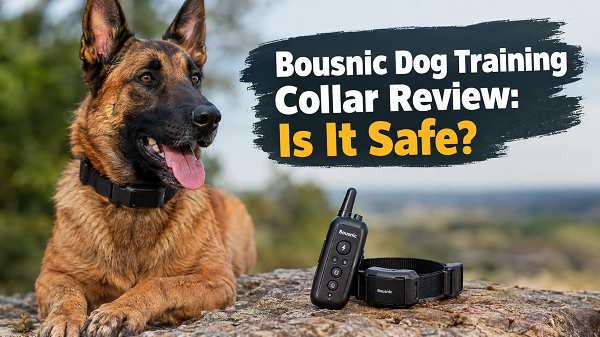
The Bousnic dog training collar is a budget-friendly e-collar (typically $35–$70) with beep, vibration, and static “shock” modes, IP67/IPX7 waterproofing, and a remote range between 1,000 and 4,000 feet depending on the model. It’s reasonably safe if you use the beep and vibration modes first, fit the collar correctly, limit wear time, and follow a proper training protocol. It is not inherently more dangerous than other consumer e-collars, but it is not risk-free either, and it’s currently illegal to use in England, Wales, Scotland (by guidance), France, Germany, and several other countries. If you’re in a region where e-collars are legal and you want one, Bousnic is a defensible budget pick, but it isn’t the one I’d reach for first, and I’ll explain exactly why below.
Table of Contents
- What Is the Bousnic Dog Training Collar?
- Bousnic Model Lineup: Which One Is Which
- Is the Bousnic Dog Training Collar Safe? What the Research Actually Shows
- Common Injuries and Mistakes (And How to Avoid Every One)
- Is the Bousnic Collar Legal Where You Live?
- How to Use the Bousnic Collar Safely: A Step-by-Step Protocol
- Bousnic vs. Other E-Collar Brands
- Real Owner Experiences: What People Actually Say
- Pros and Cons, Honestly
- Trainer’s Take: Who Should (and Shouldn’t) Buy This Collar
- Frequently Asked Questions
- Conclusion
Introduction
Here’s the problem. Type “Bousnic dog training collar review” into Google and you’ll get a stack of near-identical articles: a bulleted spec sheet, a “customers loved it” paragraph, and a 4.6-star rating pulled straight from the Amazon listing. Not one of them actually answers the question buried in most people’s search bar, which is some version of “will this thing hurt my dog?”
That’s the gap this article is built to fill. I’ve handled protection and working dogs for over ten years, fitted e-collars on everything from a jumpy Border Collie to a 90-lb Malinois, and read through the actual peer-reviewed research on static stimulation collars, not just the marketing copy built around it. So instead of another “here are the pros and cons” rehash, you’re getting a straight, evidence-based answer: what the Bousnic collar is, how it stacks up against the safety data, where it’s legal, where it’s banned, and exactly how to use one without causing the kind of harm that shows up in vet clinics.
By the end of this guide, you’ll know whether the Bousnic collar is the right (or wrong) tool for your dog, and if you do buy one, how to use it in a way that actually trains rather than just startles.
1. What Is the Bousnic Dog Training Collar?
Bousnic is an Amazon-native pet brand that’s been selling remote training collars for roughly a decade, positioning itself as an affordable alternative to premium e-collar brands like Dogtra, Educator (E-Collar Technologies), and Garmin. Nearly every Bousnic collar follows the same basic formula:
- Three correction modes: beep (audible tone), vibration, and adjustable static stimulation
- Rechargeable lithium-ion battery in both collar receiver and remote
- Waterproof rating of IPX7 or IP67 (submersible, not just splash-proof)
- Remote range ranging from 1,000 feet up to 4,000 feet depending on the exact model
- Dual-channel options on some models, letting one remote control two dogs
- Adjustable nylon strap fitting necks roughly 6–27 inches, suited to dogs from about 5–120 lbs
The static stimulation itself is what most people mean when they say “shock collar,” and this is where the safety conversation actually needs to happen. Bousnic’s static mode is typically adjustable across 1–99 levels (some older models use 1–16), which sounds intense until you understand that these levels represent tiny incremental voltage steps, not 99 degrees of pain. Most trainers, myself included, rarely go past level 10–15 on any dog, and many dogs respond fully at levels so low they’re barely perceptible to a human hand pressed against the contact points.
If you’re still deciding whether an e-collar is even the right category of tool for your dog, it’s worth reading our broader breakdown of dog training collar types and how to choose the right one before you commit to a static/shock unit specifically.
2. Bousnic Model Lineup: Which One Is Which
Bousnic sells under several overlapping model numbers on Amazon, which causes a lot of buyer confusion. Here’s how the main ones actually differ:
| Model | Remote Range | Waterproof Rating | Shock Levels | Best For |
|---|---|---|---|---|
| p-collar 356 | 1,000 ft | IPX7 | 1–16 | Backyard training, single dog |
| P Collar 650A/650B | 1,000 ft | IPX7 | Adjustable | Budget single-dog training |
| RS2A/RS2B | 3,300 ft | IP67 | 1–99 | Larger properties, hiking |
| pcollar 670 (4000ft edition) | 4,000 ft | IPX7 | 1–99 | Hunting, farm/rural use |
| T30 (2-dog edition) | 3,300 ft | IP67 | 1–99, dual channel | Multi-dog households |
None of the current Bousnic lineup includes an automatic bark-triggered mode or GPS containment/wireless fence function, if you need either of those, you’ll want to look elsewhere (more on alternatives later). Prices generally run $35–$70, compared to $150–$300+ for professional-grade brands, which is the single biggest reason Bousnic shows up so often in budget buying guides. If a stubborn, high-drive dog is exactly the reason you’re shopping for one of these, our guide to the best dog training collars for stubborn dogs walks through how Bousnic stacks up against other budget and mid-range picks for that specific problem.
3. Is the Bousnic Dog Training Collar Safe? What the Research Actually Shows
This is the section every other Bousnic review skips, and it’s the one that actually matters.
The Short, Evidence-Based Answer
Static stimulation from a well-made e-collar, used correctly, does not appear to cause the kind of injury people fear when they hear “shock collar.” But used incorrectly, the same device reliably raises stress hormones and can create long-term fear and anxiety in the dog. The device isn’t automatically “safe” or “cruel”, the person holding the remote determines that.
What the Studies Actually Found
There’s a genuine scientific debate here, and it’s worth understanding both sides instead of picking whichever one supports what you already wanted to do.
The case for concern: A frequently cited 2013 study led by animal behavior researchers at the University of Lincoln found that dogs trained with e-collars showed more stress-related behavior, tense body language, lip-licking, and yawning, than dogs trained with reward-based methods, even when the e-collars were used by professional trainers following manufacturer-recommended protocols. Earlier laboratory work by Schalke and colleagues measured salivary cortisol, a stress hormone, to gauge how intensely dogs reacted to shock collars, and found that dogs given poorly timed, high-intensity pulses showed severe and persistent stress signs.
The case for “it depends on timing”: The same Schalke research is also the piece most often misquoted. Fourteen Beagles were split into three groups: one received stimulation directly tied to their own behavior (touching a decoy), making it predictable and controllable, while the other two received stimulation for disobeying a recall command or completely at random. Only the group receiving predictable, contingent stimulation showed no significant rise in cortisol, the groups getting random or delayed stimulation did. In plain English: it wasn’t the electricity that caused the stress response, it was bad timing and unpredictability. A 2024 peer-reviewed study comparing training methods on chasing behavior similarly found that, aside from a pain-induced yelp at the moment of the shock itself, dogs trained with e-collars showed no other signs of stress or distress, either during training or later at a park unrelated to training.
What this means for a Bousnic buyer specifically: Bousnic collars aren’t the ones used in these clinical studies (those were mostly Dogtra and Innotek units), but the underlying physics of static stimulation is the same across consumer brands. The risk factor isn’t the logo on the box, it’s whether the person holding the remote presses the button randomly, at high intensity, without a “shape the behavior first” plan.
Physical Safety: Burns, Skin Irritation, and Neck Injuries
The physical risks that do show up in veterinary literature are real, but they’re mostly mechanical, not electrical:
- Pressure necrosis (contact-point sores): This is the most commonly reported injury, and it’s almost always caused by leaving the collar on too tight, for too long, without rotating contact points, not by the shock itself. Vets recommend removing any e-collar for several hours a day and never leaving one on for more than 8–12 hours at a stretch.
- Neck strain in small dogs: Bousnic’s receiver units weigh roughly 0.1–0.2 lbs, which is light by e-collar standards, but it’s still worth checking that the collar sits snugly (two fingers should fit between strap and neck) rather than swinging and tugging on a small dog’s skin.
- Electrical burns: These are rare and almost always tied to a malfunctioning or wet-contact unit left running continuously, not to a properly used training pulse. Keep contact points clean and dry between sessions and inspect the skin under the probes weekly.
Bottom Line on Safety
Used with the beep and vibration modes as your default, static as an occasional backup, sessions capped at 10–15 minutes, and the collar removed for several hours daily, the Bousnic collar carries a similar safety profile to any other consumer e-collar. Used as a “correction button” pressed randomly and at high intensity, it carries the same welfare risks documented in the research above, regardless of brand.
4. Common Injuries and Mistakes (And How to Avoid Every One)
In ten-plus years of fitting e-collars, I see the same five mistakes over and over. None of them are unique to Bousnic, but Bousnic’s low price point means it often ends up in the hands of first-time e-collar users who haven’t been walked through these basics.
- Starting on shock instead of beep/vibration. Every session should start at the lowest, least invasive setting. Escalate only if the dog genuinely doesn’t respond.
- Leaving the collar on 24/7. This is the #1 cause of pressure sores. Take it off overnight and during crate time.
- Never adjusting contact point length. Longer coats need longer contact points to reach skin; using short points on a thick-coated dog forces you to over-tighten the strap, which causes irritation.
- Using shock as punishment for fear-based behavior. Shocking a dog that’s growling or lunging out of fear (not dominance) reliably makes the underlying fear worse, not better, this is one of the most consistent findings across the behavioral literature.
- Skipping the “control group” test. Before your first real session, put the collar on and press the lowest static level while watching your dog’s reaction from a few feet away. You want a mild flick of the ear or head turn, not a yelp or bolt. If you see the latter, you’re starting too high.
5. Is the Bousnic Collar Legal Where You Live?
This is the section most Bousnic review articles leave out entirely, and it genuinely matters if you’re outside the US.
Where remote-controlled e-collars are currently banned or restricted:
- Wales — banned since 2010 under the Animal Welfare (Electronic Collars) (Wales) Regulations
- England — the government laid legislation completely banning hand-held remote-controlled electric shock collars, effective February 1, 2024, following a decade-long campaign and a failed legal challenge from collar manufacturers
- Scotland — not a legal ban, but government guidance actively advises against their use
- France — banned from January 2023
- Germany, Austria, Denmark, Finland, Norway, Slovenia, Sweden — all have bans or near-total restrictions on remote shock collars
- Parts of Australia (including Victoria and parts of NSW/Queensland with permit requirements), restricted or banned depending on the state
Where they remain legal: the United States (federally; some states and municipalities have local restrictions, so check your city/county), Canada (province-dependent), and most of the rest of the world without specific legislation.
If you’re ordering a Bousnic collar from the UK, Wales, or France expecting to use it for everyday training, you could be looking at fines rather than a well-behaved dog, the UK ban carries penalties that have been reported as high as £20,000 or up to six months in prison for violations. Always check your specific country and local council rules before buying, since this space has shifted quickly over the past few years and is likely to keep shifting.
6. How to Use the Bousnic Collar Safely: A Step-by-Step Protocol
This is the protocol I actually walk clients through. It works for Bousnic or any comparable e-collar.
- Fit check first. Two fingers between collar and neck. Contact points touching skin, not buried in fur or hanging loose.
- Desensitize before training. Let your dog wear the powered-off collar around the house for 2–3 days so it’s not associated with anything new or scary.
- Find the “recognition level.” Start at level 1 static (or use vibration first) and increase by one level at a time until you see a subtle response, ear flick, head turn, not a yelp or flinch. That’s your working level.
- Pair with a known command. Only use the collar alongside a command your dog already knows from reward-based training (like “come” taught with treats). Never use it to teach something brand new.
- Keep sessions short. 10–15 minutes maximum, 1–2 times a day.
- Reward heavily. Every correct response gets praise or a treat within one to two seconds. The collar interrupts; the reward is what actually teaches.
- Rest the skin. Remove the collar for at least 4–6 hours a day and rotate contact point position slightly every few days.
- Never use static mode on fear or aggression rooted in anxiety. If your dog is reactive out of fear, work with a certified behaviorist instead, this is a scenario where e-collars consistently make things worse, not better.
Understanding why a dog isn’t responding matters just as much as the protocol itself. If you’re not sure whether you’re dealing with a genuine obedience gap or a drive/instinct issue the collar can’t fix, our piece on dog obedience vs. instinct is a useful gut-check before you reach for any correction tool. It also pairs well with our breakdown of dominance vs. discipline in K9 training, since a lot of “stubborn dog” cases are actually a leadership and structure gap that no collar setting will solve on its own.
7. Bousnic vs. Other E-Collar Brands
| Feature | Bousnic | PetSafe | Dogtra | Educator (E-Collar Tech) |
|---|---|---|---|---|
| Price range | $35–$70 | $60–$130 | $150–$300+ | $130–$250 |
| Range | 1,000–4,000 ft | 500–3,000 ft | Up to 1 mile+ | Up to ¾ mile |
| Stimulation precision | Basic (1–99 preset levels) | Basic | Fine-tuned, momentary/continuous options | Fine-tuned, very low starting levels |
| Build quality/durability | Budget-grade, shorter lifespan reported | Mid-grade | Professional/working-dog grade | Professional/working-dog grade |
| Best for | Casual owners, tight budgets | General pet owners | Hunting dogs, serious off-leash work | Precision training, sensitive dogs |
If budget is your main constraint and you’re training a dog with mild-to-moderate behavior issues (leash pulling, mild recall problems), Bousnic is a reasonable entry point. If you’re working with a genuinely stubborn, high-drive, or working-line dog, or a dog that’s especially sensitive, the finer stimulation control on a Dogtra or Educator unit is worth the extra cost, the difference in adjustability really does matter once you’re past the basics.
8. Real Owner Experiences: What People Actually Say
Pulling from verified purchase patterns across retailer reviews, a few honest themes come up again and again:
- Praise: Long remote range gets consistently good marks, especially from owners with large yards or who hike with off-leash dogs. Battery life (often lasting one to two weeks between charges with normal use) is another frequent positive.
- Complaints: The most common gripe isn’t about safety, it’s about inconsistent signal reliability through walls or across longer distances than advertised, and a handful of owners reporting that the remote itself isn’t as waterproof as the collar receiver, which matters if you train near water.
- Mixed reports: Some owners say the shock levels are gentler than expected (a plus for sensitive dogs); others with thick-coated or larger breeds say they had to push higher into the range to get a response, which can be a sign the fit or contact-point length needs adjusting rather than the dog needing more shock.
9. Pros and Cons, Honestly
Pros:
- Genuinely affordable compared to professional-grade e-collars
- Three correction modes give you room to start gentle
- Waterproof receiver suitable for swimming dogs
- Long remote range (up to 4,000 ft on some models) covers most yards and trails
- Long battery life reduces mid-session interruptions
Cons:
- Build quality doesn’t match premium brands, expect a shorter product lifespan
- Remote units are often less waterproof than the collar itself
- Stimulation adjustability is coarser than higher-end competitors, which matters for very sensitive dogs
- No bark-triggered or GPS containment options in the current lineup
- Illegal to use in the UK, France, and several other countries as of this writing.
10. Trainer’s Take: Who Should (and Shouldn’t) Buy This Collar
Buy it if: you’re in a country where e-collars are legal, you’ve already got a handle on basic obedience through positive reinforcement, your dog has a mild-to-moderate issue (recall, mild leash reactivity, boundary training), and you’re working with a tight budget.
Skip it if: your dog’s unwanted behavior is rooted in fear or anxiety rather than simple disobedience, you live somewhere e-collars are restricted or banned, you want fine-grained stimulation control for a very sensitive breed, or you’re not prepared to actually learn a proper protocol before using it (in which case, honestly, skip e-collars altogether and start with a certified positive-reinforcement trainer).
If you’re leaning toward using the collar for protection-style boundary work rather than basic obedience, pair it with real command structure first, see our guide to essential protection dog commands every owner should master so the e-collar is reinforcing commands your dog already understands, not replacing training you haven’t done yet.
If you want a deeper walkthrough on structuring a full obedience program before you ever introduce an e-collar, I cover the exact sequence I use with client dogs, including recall-proofing and impulse control drills, in my training e-book, which has become a go-to reference for owners who want to get the foundation right before adding any tool: Beyond the Bark: Inside a Pro Handler’s Playbook for Raising the Ideal Dog.
11. Frequently Asked Questions
1. Is the Bousnic dog training collar safe for small dogs?
Yes, with caution. Bousnic’s smaller receivers (as light as 0.1 lbs) are marketed for dogs from 5–8 lbs and up, but small dogs have thinner skin and shorter necks, so use the lowest effective stimulation level, check the fit often, and never leave the collar on for extended periods.
2. How many volts does a Bousnic shock collar deliver?
Bousnic doesn’t publish exact voltage figures, but like most consumer e-collars, output is measured in adjustable intensity levels (1–99 on most current models) rather than a fixed voltage, with actual current kept low by design and further limited by the dog’s skin resistance and coat thickness.
3. Can the Bousnic collar be used on puppies?
Most trainers, myself included, recommend waiting until a puppy is at least 6 months old and has a solid foundation in basic obedience through reward-based training before introducing any e-collar, static stimulation or otherwise.
4. Is Bousnic as good as Dogtra or PetSafe?
Not in terms of build quality or stimulation precision, but it’s considerably cheaper and adequate for casual training needs. If you need fine-tuned control for a working or highly sensitive dog, a premium brand is worth the extra cost.
5. Why are shock collars banned in some countries but not others?
Bans in England, Wales, France, and several other countries stem from welfare research showing that poorly timed or high-intensity static stimulation raises stress hormones and can worsen fear-based behavior. Countries without bans generally argue that, used correctly by trained handlers, the risk is manageable, which is exactly why how you use the collar matters more than which brand you buy.
12. Conclusion
The honest answer to “is the Bousnic dog training collar safe?” is: it’s as safe as the person using it. The device itself isn’t dramatically more dangerous than other budget e-collars on the market, and the physical injury risks that do exist (pressure sores, skin irritation) are almost entirely preventable with proper fit and wear-time discipline. The psychological risks, elevated stress, worsened fear-based behavior, show up specifically when static stimulation is applied randomly, at high intensity, or as a first resort instead of a last one.
If you’re going to use one: start on beep or vibration, keep static as a backup, cap your sessions, check the fit weekly, and never use it on a dog that’s acting out of fear rather than simple disobedience. And before you buy anything, double-check your local laws, a growing list of countries have decided the risk isn’t worth taking at all.
Get the fundamentals right first, and a tool like this becomes exactly that: a tool. Skip the fundamentals, and no amount of adjustable shock levels will fix the real problem.
Have questions about fitting or introducing an e-collar to your specific dog? Drop them in the comments below, and check out our related guides on choosing the right training collar type and the best collars for stubborn dogs before you introduce any tool.

Her work centres on obedience, detection, protection and operational readiness. She favours proven methods built on repetition, consistency and real-world conditioning, so that both dogs and handlers are prepared for high-pressure tasks.
Rofiat represented the Nigerian Army Dog Centre at the Nigerian Army Day Celebration (NADCEL) 2026, where she led demonstrations in obedience, explosive detection, agility and tactical movement. Through articles, training content and documentaries, she shares field-based insight into how structured training, clear communication and trust between handler and dog affect performance and reliability.
She is the author of Beyond the Bark: Inside a Pro Handler's Playbook for Raising the Ideal Dog, a practical guide that helps dog owners and handlers apply professional training principles in everyday situations.
- Australian Cattle Dog vs Blue Heeler: Any Difference? - October 1, 2026
- Bousnic Dog Training Collar Review: Is It Safe? - September 30, 2026
- Gravy Train Dog Food Review: Ingredients & Recalls - September 30, 2026