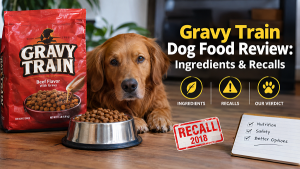
Gravy Train Dog Food Review: Ingredients & Recalls
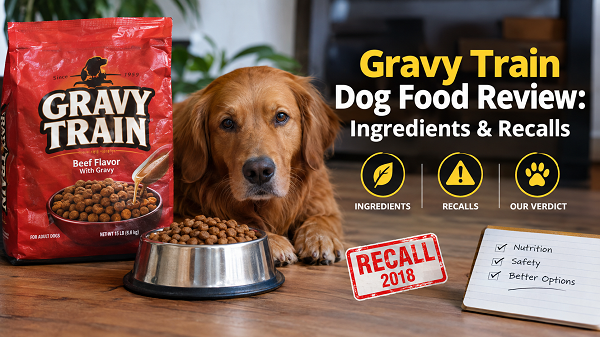
Gravy Train dog food meets AAFCO’s minimum nutritional standards for adult maintenance, but it leans heavily on corn, soybean meal, and unnamed animal fats rather than named meat proteins, and it was at the center of a 2018 pentobarbital contamination recall that pulled more than 90 million cans off shelves. It’s not the worst food on the shelf, but it’s not a food I’d recommend as a long-term primary diet, especially for dogs with sensitive stomachs or allergies. Below, I’ll walk you through exactly why, ingredient by ingredient.
Table of Contents
- What Is Gravy Train Dog Food?
- Gravy Train Ingredients: What’s Really in the Bag
- Is Gravy Train Dog Food Bad? Our Honest Verdict
- The Gravy Train Recall History
- Gravy Train vs. Other Budget Dog Foods
- Who Should (and Shouldn’t) Feed Gravy Train
- How to Transition Your Dog Safely
- Expert Tips: A Trainer’s Take on Budget Dog Food
- FAQs
- Conclusion
What Is Gravy Train Dog Food?
Gravy Train has been sitting on supermarket shelves since 1959, when General Foods trademarked the brand and gave it a gimmick that’s still its calling card today: dry kibble that turns into an instant, meaty-smelling gravy when you mix in warm water. No blending, no cooking, just stir and serve.
That trick alone has kept Gravy Train relevant for well over six decades, especially with owners of picky eaters or dogs who don’t drink enough water on their own.
From General Foods to Post Consumer Brands: A Timeline
Here’s something most reviews you’ll find on page one of Google get wrong or leave out entirely, Gravy Train doesn’t belong to J.M. Smucker anymore. A lot of older articles still list Smucker as the current owner, but that changed years ago. Here’s the actual ownership trail:
- 1959–1960: Developed and trademarked by General Foods.
- Later years: Passed through Del Monte Foods, then became part of Big Heart Pet Brands.
- 2015: The J.M. Smucker Company acquired Big Heart Pet Brands, taking over Gravy Train along with Kibbles ‘n Bits, Meow Mix, Milk-Bone, and 9Lives.
- April 28, 2023: Smucker sold Gravy Train, along with Kibbles ‘n Bits and several other legacy brands, to Post Holdings in a deal worth roughly $1.2 billion. Gravy Train is now marketed by Post Consumer Brands, the same company behind 9Lives and Kibbles ‘n Bits.
Why does this matter to you as a dog owner? Because manufacturing facilities, supplier relationships, and quality control can shift when a brand changes hands. If you’re researching recall risk or trying to understand who to contact with a complaint, you need the current owner, not a company that hasn’t held the brand since 2023.
Where You Can Buy It
Gravy Train is widely available across North America, the UK, and parts of Europe through major retailers like Walmart, Tractor Supply, Kroger, and various regional supermarket chains, plus online through Amazon and Chewy. It comes in dry kibble, canned wet food, and a small treat lineup, with prices generally running well below premium and mid-tier brands, usually somewhere in the $0.50–$1.00 per pound range for dry food, depending on region and retailer.
Gravy Train Ingredients: What’s Really in the Bag
This is where the rubber meets the road. Marketing copy can say “wholesome” and “delicious” all day long, the ingredient panel tells the real story.
Dry Food Ingredient Breakdown
Take Gravy Train’s Beef Flavor dry recipe as a typical example. The first several ingredients usually read something like this:
- Corn — an inexpensive carbohydrate filler that supplies energy but very little else nutritionally for a carnivore-leaning animal.
- Soybean meal — a plant-based protein source that bulks up the crude protein number on the label but digests less efficiently than named animal protein.
- Wheat — another carb-heavy filler and a common allergen trigger in sensitive dogs.
- Meat and bone meal — a rendered protein source, but notice the word “meat” isn’t tied to a specific animal. It could be beef, pork, or a mix, and that inconsistency matters if your dog has a known protein allergy.
- Animal fat (preserved with BHA) — again, non-specific, and BHA (butylated hydroxyanisole) is listed by California’s Proposition 65 as a substance with suspected carcinogenic properties at high exposure levels. The FDA still permits it in the small amounts used in pet food, but it’s a preservative most premium brands have already phased out in favor of mixed tocopherols (natural vitamin E).
Further down the list, you’ll typically find artificial colors, Red 40, Yellow 5, Blue 2, and Yellow 6, added purely to make the kibble look more appetizing to you, since dogs don’t see color the way humans do. You’ll also usually spot sodium selenite, a cheaper and less bioavailable form of selenium compared to selenium yeast, which more premium formulas use instead.
What’s missing? A named meat as the first ingredient. That’s the single biggest red flag nutrition-focused reviewers flag with Gravy Train, and it’s a fair one.
Wet/Canned Food Ingredient Breakdown
The canned varieties follow a similar pattern, water, meat by-products, corn, soybean meal and several recipes also include onion and garlic extract. In small amounts these are generally considered safe by veterinary toxicologists, but garlic and onion in any form carry a documented, if rare, risk of causing Heinz body anemia in dogs, a condition where red blood cells become damaged. It’s not a reason to panic, but it is worth knowing if you’re already feeding your dog anything else containing alliums.
Guaranteed Analysis & Nutrient Numbers
Independent lab-style dry matter analysis of Gravy Train’s dry formulas typically shows:
| Nutrient | Dry Matter Basis |
|---|---|
| Protein | ~20.1% |
| Fat | ~9.8% |
| Estimated Carbohydrates | ~57.8% |
For context, AAFCO’s minimum requirement for adult dog maintenance is 18% protein and 5.5% fat on a dry matter basis. Gravy Train technically clears that bar, but the protein-to-carb ratio is heavily skewed toward carbohydrate filler compared to mid-range and premium competitors, which often run 26–32% protein.
Is Gravy Train Dog Food Bad? Our Honest Verdict
Let’s be balanced here, because “bad” is a strong word and it depends entirely on what you’re comparing it to.
The Good
- Meets AAFCO minimums for complete and balanced adult nutrition, it won’t cause deficiency-related illness in a healthy adult dog when fed as directed.
- Genuinely helps picky or dehydration-prone eaters. The gravy mechanic works, especially for senior dogs or dogs recovering from illness who need encouragement to eat and extra moisture.
- Budget-friendly, which matters for multi-dog households, shelters, and owners going through financial hardship. A dog eating Gravy Train consistently is better off than a dog not eating at all.
- Widely available, so you’re not hunting down a specialty retailer.
The Concerning
- Corn and soybean meal lead the ingredient list ahead of any named animal protein, not what you want to see if you’re prioritizing digestibility and lean muscle support.
- Vague “meat and bone meal” and “animal fat” sourcing makes it hard to manage food allergies.
- Artificial dyes add zero nutritional value and exist purely for visual appeal to shoppers.
- BHA preservative is a legacy choice most competitors have already moved away from.
- A documented contamination recall (more on that below) that, while resolved, is worth knowing about before you buy.
My honest take, after comparing this against dozens of budget and mid-tier formulas: Gravy Train isn’t going to poison your dog or cause immediate harm in a healthy adult. But it’s built around cost-efficiency, not nutritional optimization, and there are budget-friendly alternatives on the market today with better protein sourcing for a similar price point.
The Gravy Train Recall History
This is the part most casual buyers have heard whispers about but don’t have the full story on.
The 2018 Pentobarbital Contamination
In late 2016, a dog named Toula died after eating a different brand of canned food (Evanger’s) that later tested positive for pentobarbital, a drug used in veterinary sedation and euthanasia. That case triggered an independent investigation by a Washington, D.C. news station (WJLA) working with Ellipse Analytics, which tested a range of pet food brands for the same contaminant.
Their findings were alarming: out of 15 cans of Gravy Train tested, 60% came back positive for pentobarbital.
Here’s the timeline of what happened next:
- February 15–16, 2018: The FDA issued a public alert after J.M. Smucker (Gravy Train’s owner at the time) began voluntarily withdrawing canned dog food products across the Gravy Train, Kibbles ‘n Bits, Ol’ Roy, and Skippy brands.
- March 2, 2018: The FDA upgraded the withdrawal to an official Class III recall after confirming pentobarbital in the tallow (rendered animal fat) used in production.
- Scale: Reports indicate more than 90 million cans were ultimately pulled from shelves nationwide.
- Investigation findings: Smucker traced the contamination to a single supplier and a single minor ingredient used at one manufacturing facility. The FDA stated that the levels detected were low and unlikely to cause serious illness, but stressed that any amount of pentobarbital in pet food is considered adulteration under federal law and is never acceptable.
- What it wasn’t: To be clear, this was not linked to euthanized companion animals. The suspected source was contaminated livestock material, not pets, a distinction that got lost in a lot of the panic at the time.
- Legal aftermath: A consolidated class-action lawsuit was filed against Big Heart Pet Brands/Smucker in California in 2018, alleging negligent misrepresentation and false advertising, among other claims.
- Recall closure: The FDA officially terminated the recall on December 7, 2020, nearly three years after it began.
What Happened After
Since the 2020 recall closure, there’s no public record of a repeat pentobarbital incident tied to Gravy Train. Post Consumer Brands took over the brand in 2023, and there’s been no new contamination recall since the ownership change as of this writing. That said, the 2018 episode is a legitimate reason some pet owners remain cautious, and it’s worth knowing the full story rather than just the headline.
Gravy Train vs. Other Budget Dog Foods
If Gravy Train’s ingredient profile is giving you pause, here’s how it stacks up against other well-known budget options:
| Brand | First Ingredient | Named Meat First? | Artificial Colors? | Approx. Protein (Dry Matter) | Recall History |
|---|---|---|---|---|---|
| Gravy Train | Corn | No | Yes | ~20.1% | Yes (2018 pentobarbital) |
| Ol’ Roy | Corn/grain blend | No | Yes | ~21% | Yes (2018 pentobarbital, same event) |
| Purina Dog Chow | Chicken by-product meal | Partial | Yes | ~21% | Minor, isolated incidents |
| Kibbles ‘n Bits | Corn | No | Yes | ~21% | Yes (2018 pentobarbital, same event) |
| Victor Hi-Pro Plus (mid-tier value) | Beef meal | Yes | No | ~30% | No major recalls |
The takeaway: Gravy Train sits squarely in the “economy” tier alongside Ol’ Roy and Kibbles ‘n Bits, all three, notably, were caught up in the same 2018 pentobarbital event since they shared the same manufacturer and supply chain at the time. If you want to stay in a similar price bracket but get meaningfully better protein sourcing, brands like Victor’s value lines are worth a look.
Who Should (and Shouldn’t) Feed Gravy Train
Might be a reasonable fit for:
- Healthy adult dogs with no known food allergies or sensitivities
- Owners on a tight budget who need their dog eating consistently
- Picky eaters or dogs who need encouragement to drink more water through their food
- Senior dogs with dental issues who benefit from a softer, gravy-moistened texture
Probably not the right choice for:
- Puppies who need higher protein and DHA for growth and development (Gravy Train’s dry formulas are generally marketed for adult maintenance, not growth)
- Dogs with diagnosed soy, wheat, or corn allergies
- Dogs with a history of digestive upset, itchy skin, or chronic ear infections, often linked to grain and plant-protein-heavy diets
- Working or high-drive dogs like Belgian Malinois, German Shepherds, or Dutch Shepherds that burn through calories fast and need denser, higher-protein nutrition to maintain muscle and stamina during training
If you’re raising or feeding a working dog, protein quality isn’t optional, it directly affects endurance, recovery time, and coat condition on the job.
How to Transition Your Dog Safely
Whether you’re switching to Gravy Train for budget reasons or away from it toward a higher-protein formula, don’t do it overnight. Sudden food changes are one of the most common causes of vomiting and diarrhea in dogs.
Use this simple 7-day ratio:
- Days 1–2: 75% old food, 25% new food
- Days 3–4: 50% old food, 50% new food
- Days 5–6: 25% old food, 75% new food
- Day 7 onward: 100% new food
Watch stool consistency and energy levels closely during the switch. If you’re not sure whether a symptom warrants a vet visit, our guide on puppy vomiting and diarrhea: when to call the vet walks through exactly what’s normal adjustment and what’s a red flag. And if you notice anything darker or unusual in your dog’s stool after a food switch, it’s worth comparing it against our black puppy stool guide before assuming it’s diet-related.
Expert Tips: A Trainer’s Take on Budget Dog Food
I’ve handled and trained working dogs for years, and I’ve fielded this exact question more times than I can count from owners who feel guilty for not affording the $80 bag of “premium” kibble. Here’s my honest, field-tested take:
- A consistently-fed dog on a budget food beats an inconsistently-fed dog on a premium one. Don’t let perfect be the enemy of good if money is genuinely tight.
- Watch the dog, not just the label. Coat shine, stool firmness, energy levels, and weight stability tell you more about whether a food is working than any ingredient panel. Give a new food 4–6 weeks before judging it.
- Rotate proteins where you can, even within a budget brand’s lineup, to reduce the odds of developing a protein-specific allergy over time.
- If you’re feeding a working or high-energy breed, budget corn-and-soy-based formulas often can’t keep up caloric density-wise, you may need to supplement with a protein topper or transition to a performance formula during heavy training periods. Our guide on how often to exercise a working dog breaks down how activity level should actually inform feeding decisions.
- Puppies are the exception, not the rule. Growing puppies need calorically dense, protein-rich food, if you’re raising a Goldendoodle or any other breed, check a proper feeding schedule like our Goldendoodle puppy food schedule guide rather than defaulting to an adult economy formula.
A note on trust and transparency: any brand, budget or premium, can end up in a recall. What matters is how you, as the owner, stay informed. Subscribe to the FDA’s pet food recall alerts, check ingredient panels every time you buy (formulas do change), and don’t ignore sudden symptoms like lethargy, vomiting, or loss of balance after a food switch, all of which are documented pentobarbital exposure symptoms.
If you want a deeper dive into building a complete nutrition and care plan for your dog beyond just picking a bag off the shelf, my e-book Beyond the Bark: Inside a Pro Handler’s Playbook for Raising the Ideal Dog covers feeding strategy, health monitoring, and daily care routines I’ve used with working and family dogs alike.
Frequently Asked Questions
Is Gravy Train dog food safe to feed in 2026?
Yes, based on current available information, Gravy Train is safe to feed as of 2026. The 2018 pentobarbital recall was officially closed by the FDA in December 2020, and there’s no public record of a repeat contamination event since. As with any food, buy from reputable retailers and check for active recalls periodically.
Who owns Gravy Train dog food now?
Gravy Train is currently owned and marketed by Post Consumer Brands, which acquired it from The J.M. Smucker Company in an April 2023 deal worth approximately $1.2 billion, alongside sister brands like Kibbles ‘n Bits and 9Lives.
Why is corn the first ingredient in Gravy Train dog food?
Corn is a cheap, calorie-dense filler that helps manufacturers keep production costs low, which is reflected in Gravy Train’s budget price point. It’s not toxic to dogs, but it offers far less nutritional value than a named animal protein and is a common contributor to allergic and digestive sensitivities in some dogs.
Is Gravy Train good for puppies?
Generally, no. Gravy Train’s core dry formulas are typically labeled for adult maintenance rather than growth, meaning they don’t provide the protein and calorie density puppies need during their growth phase. Look for a food specifically labeled “for growth” or “all life stages” if you’re feeding a puppy.
What’s a better alternative to Gravy Train at a similar price?
If you want to stay in a similar budget range but improve protein quality, look at value-tier lines like Victor Hi-Pro Plus or Diamond Naturals, which list a named meat meal as the first ingredient and skip artificial dyes, usually for a comparable or only slightly higher price per pound.
Conclusion
So, is Gravy Train dog food bad? Not in the dramatic, “throw the bag away today” sense, it meets basic nutritional standards and has a clean recall record since 2020. But it’s built on a foundation of corn, soybean meal, and vaguely-sourced animal fat rather than named meat protein, and that’s a real trade-off you’re making for the low price tag and the gravy gimmick.
Here’s my actual advice: if budget is your primary constraint and your dog is a healthy adult with no allergies, Gravy Train won’t hurt them. But if you’ve got any wiggle room in your budget, or you’re feeding a puppy, a senior with health issues, or a high-drive working breed, put that money toward a formula with a named meat as the first ingredient instead. Your dog’s coat, energy, and long-term digestive health will thank you for it.
Whatever you choose, don’t switch cold turkey, keep an eye on how your dog’s body actually responds over the first few weeks, and stay signed up for FDA recall alerts no matter which brand ends up in the bowl.
This article is for informational purposes and reflects research current as of 2026. Always consult your veterinarian before making significant changes to your dog’s diet, especially if your dog has existing health conditions.

Her work centres on obedience, detection, protection and operational readiness. She favours proven methods built on repetition, consistency and real-world conditioning, so that both dogs and handlers are prepared for high-pressure tasks.
Rofiat represented the Nigerian Army Dog Centre at the Nigerian Army Day Celebration (NADCEL) 2026, where she led demonstrations in obedience, explosive detection, agility and tactical movement. Through articles, training content and documentaries, she shares field-based insight into how structured training, clear communication and trust between handler and dog affect performance and reliability.
She is the author of Beyond the Bark: Inside a Pro Handler's Playbook for Raising the Ideal Dog, a practical guide that helps dog owners and handlers apply professional training principles in everyday situations.
- Bousnic Dog Training Collar Review: Is It Safe? - September 30, 2026
- Gravy Train Dog Food Review: Ingredients & Recalls - September 30, 2026
- How to Spot Fake AKC Registered Dogs: 5 Warning Signs - September 29, 2026