Carhartt Dual Handle Leash Review: Worth It for Pullers?
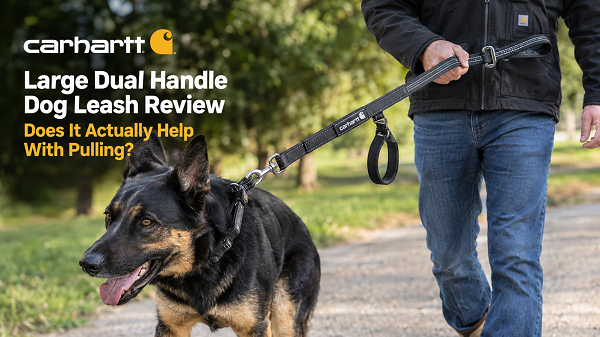
The Carhartt Large Dual Handle Dog Leash is a 6-foot, 1-inch-wide nylon leash with two grip points: a padded primary handle at the end for everyday walking, and a shorter “traffic control” handle near the clasp for pulling your dog in close during sudden pulling, crossings, or crowded sidewalks. It’s built from duck-canvas-reinforced nylon webbing with a glove-friendly metal trigger clasp, retails between roughly $22 and $32 depending on color and retailer, and works best as a control tool for training, not a stand-alone fix for a dog that hasn’t learned any leash manners yet.
If your arm feels like it’s been through a workout every time you walk your dog, you already know the problem a leash alone can’t fix by itself. But the right leash can make a real difference in how much control you have in the moment your dog decides to lunge and that’s exactly the gap the Carhartt Large Dual Handle Dog Leash is built to close.
Table of Contents
- What Is the Carhartt Large Dual Handle Dog Leash?
- At-a-Glance Specs
- Why Two Handles Actually Help With Pulling
- Hands-On Review: Build Quality and Materials
- What Real Owners Are Saying
- Sizing Guide: Large vs. Small
- Colors and Pricing Across Retailers
- Pros and Cons
- How It Compares to Other Dual-Handle Leashes
- Who Should (and Shouldn’t) Buy This Leash
- How to Use the Traffic Handle the Right Way
- One Safety Check Every Owner Should Do First
- Gear That Pairs Well With This Leash
- A Trainer’s Take
- FAQs
- Final Verdict
What Is the Carhartt Large Dual Handle Dog Leash?
Carhartt has been making workwear since 1889, and it leaned on that same “built for the job site” mindset when it licensed its pet line to Signature Products Group. The Dual Handle Dog Leash (model P0000570) is one of the more practical results of that partnership.
Here’s the idea in plain terms: a standard leash only gives you one grip point, way down at the far end. That’s fine for a calm dog on a quiet street. It’s a problem the second your dog lunges at a squirrel, another dog crosses your path, or you need to close the gap fast near traffic. By the time you’ve reeled in three or four feet of slack leash, the moment’s already happened.
The Dual Handle solves that with a second, shorter loop positioned close to the clasp, often called a “traffic handle.” Grab it and you instantly have your dog within about a foot of your hand, no scrambling, no dropping the primary handle. It’s the same concept trainers have used for years with two-handled leashes on working and service dogs, just packaged in Carhartt’s signature duck-canvas-reinforced nylon.
At-a-Glance Specs
| Feature | Detail |
|---|---|
| Length | 6 feet |
| Width | 1 inch (Large size) |
| Material | 100% nylon webbing with duck canvas weave |
| Handles | 2, reinforced primary handle + lower traffic handle |
| Clasp | Metal trigger-claw clasp, glove-friendly |
| Hardware | Sliding metal D-ring for adjustable attachment |
| Visibility | Reflective triple-needle stitching |
| Weight | Roughly 6.7–7.5 oz |
| Best for | Medium to large dogs, 40 lbs and up |
| Colors | Black, Carhartt Brown, Deep Wine, Hunter Orange, Shaded Spruce |
| Price range | Approx. $22–$32 depending on color/retailer |
| Manufacturer | Signature Products Group (SPG), under Carhartt license |
Why Two Handles Actually Help With Pulling
Let’s get one thing straight before we go further: no leash, dual handle or otherwise, teaches your dog not to pull. A leash is a management tool, not a training method. If you want the actual behavior-fix side of this, we’ve broken that down in detail in Dog Pulling on Walks? Here’s the Real Fix, which covers why pulling gets reinforced in the first place and the exercises that actually change it long-term.
What a dual-handle leash gives you is control in the gap between “my dog is pulling” and “I’ve done something about it.” And that gap matters more than most owners realize.
Consider the mechanics: a dog that weighs 60–70 lbs and lunges suddenly can generate a surprising amount of force through a standard leash, enough to throw a handler off balance, especially on wet pavement or an incline. Researchers at the University of Queensland measured this directly in a 2021 study published in Frontiers in Veterinary Science, which used a custom leash-tension meter on 52 shelter dogs. The study found that pulling force and pulling time were actually higher when dogs were restrained by a back-connection harness compared to a plain collar during high-motivation moments, a useful reminder that no piece of gear removes the physics of a determined dog entirely. Control still comes down to how quickly you, the handler, can respond.
That’s the traffic handle’s whole job. Instead of hand-over-handing down a slack leash while your dog is already three feet ahead of you, you drop your hand to the second loop and you’ve got tight, immediate control, the same principle K9 handlers use with a short lead during close-quarters work.
Hands-On Review: Build Quality and Materials
The nylon webbing on this leash has real heft to it, noticeably thicker than the bargain-bin leashes you’ll find for $8–$10. Carhartt reinforces the webbing with its duck canvas weave, the same treatment it’s used on work jackets and overalls for over a century, and it shows in how the leash resists fraying at the stitched edges after repeated use.
A few things stand out in day-to-day handling:
- The clasp is genuinely glove-friendly. The trigger-claw design opens with one thumb push, which matters a lot more than it sounds like once you’re walking a dog at 6 a.m. in January with frozen fingers.
- The sliding D-ring is a nice touch. It lets you shift the attachment point up or down the leash, which is handy if you want to shorten the working length temporarily without unclipping anything.
- Reflective stitching is subtle but functional. It won’t light up like a safety vest, but it catches headlights and streetlamps enough to matter on evening walks.
- The traffic handle sits close enough to the clip to be useful, not so close that it gets in your dog’s face. Positioning here matters, some competitor leashes place the second handle too far up, which defeats the purpose.
The one thing to watch: this is a firm, structured leash, not a soft, floppy one. Some owners coming from thin nylon leashes describe an adjustment period getting used to the stiffer feel, especially in cold weather when nylon webbing naturally stiffens further.
What Real Owners Are Saying
Across Amazon listings for the Dual Handle line, owners of large dogs consistently point to the same strengths: solid stitching, a comfortable primary grip, and confidence that the leash holds up under real pulling force. One owner of an 80 lb dog specifically noted the leash held up well over time despite some initial hesitation about the clasp mechanism, and appreciated the reflective side strip for early-morning walks. Another described it as their favorite leash after switching from a thinner nylon model, citing the look and overall utility.
It’s worth being upfront about something, too, in the spirit of an honest review: Carhartt’s broader leash lineup, including the Shock-Absorbing and Tradesman models, which share some hardware with the Dual Handle, has drawn a handful of complaints on other retail sites about the trigger clasp opening under sudden, awkward-angle pressure. It’s a minority of reviews, not a pattern across the line, but it’s exactly why we’ve included a simple pre-walk safety check further down this article. A $25 leash is not worth a bolted dog, and a 10-second check before your first walk removes the risk entirely.
Sizing Guide: Large vs. Small
Carhartt makes this leash in two widths:
| Size | Width | Best for |
|---|---|---|
| Small | ¾ inch | Dogs under 40 lbs |
| Large | 1 inch | Dogs 40 lbs and up, strong pullers, working breeds |
Both sizes run 6 feet long. If your dog is a Labrador, German Shepherd, Doberman, Rottweiler, or anything in that weight class and known to pull, the Large is the one to buy, the extra webbing width gives you more surface area to grip under load, and it simply holds up better against sustained tension.
Colors and Pricing Across Retailers
Pricing varies more than you’d expect for a single product, mostly because different retailers stock different colorways at different markups. As of this review, here’s roughly what you’ll pay:
- Black (Large): around $21–$22 on Amazon
- Deep Wine (Large): around $23–$26
- Carhartt Brown / Hunter Orange / Shaded Spruce: typically $26–$32 depending on retailer
Farm supply chains and outdoor retailers sometimes list it slightly higher than Amazon, so it’s worth a quick price check across two or three sources before buying, especially if color isn’t a priority for you.
Pros and Cons
Pros:
- Genuine dual-handle design with sensible handle placement
- Duck-canvas-reinforced nylon holds up to daily use and strong pulling
- Glove-friendly metal clasp, useful in cold-weather climates
- Sliding D-ring adds flexibility for tethering or shortening the leash
- Reflective stitching for low-light visibility
- Reasonably priced compared to premium competitors like Ruffwear or 2 Hounds Design
Cons:
- Firm, structured nylon has a break-in period for owners used to softer leashes
- A minority of owners across the broader Carhartt leash lineup report clasp durability concerns, worth a pre-walk check
- Doesn’t include a bungee/shock-absorbing section, so sudden lunges transmit more directly to your arm than on a bungee leash
- Only available in one length (6 ft), no short-lead or long-line versions
How It Compares to Other Dual-Handle Leashes
| Leash | Handles | Shock Absorption | Price (approx.) | Best For |
|---|---|---|---|---|
| Carhartt Dual Handle | 2 | No | $22–$32 | Everyday control, durability, cold-weather use |
| Leashboss Original Two-Handle | 2 | No | $20–$25 | Budget-friendly dual-handle option |
| EzyDog Zero Shock Leash | 1 (bungee) | Yes | $30–$40 | Reducing jarring impact on handler’s arm |
| Max & Neo Double Handle Leash | 2 | No | $18–$24 | Budget option, lighter-duty use |
| 2 Hounds Design Freedom (w/ leash) | 2 (harness + leash system) | Some | $45–$60 | Maximum control for very strong pullers |
The honest takeaway: the Carhartt sits in a comfortable middle ground. It’s not the cheapest dual-handle leash on the market, but it’s built more ruggedly than most budget options, and it undercuts premium harness-and-leash systems by a wide margin while still giving you the traffic-handle control that actually matters day to day.
Who Should (and Shouldn’t) Buy This Leash
This leash makes sense if:
- You have a medium-to-large dog that pulls occasionally, especially around distractions
- You walk in areas with traffic, crowded sidewalks, or frequent dog encounters
- You want a durable, no-frills leash that isn’t going to fray after a season of daily walks
- You handle your dog in cold weather and need a clasp you can operate with gloves on
You might want something else if:
- Your dog is an extreme, constant puller and you haven’t paired the leash with a front-clip harness yet (leash alone won’t solve that, see the harness recommendations below)
- You specifically want shock absorption to protect your shoulder from sudden jolts
- You need a longer line for recall or sniff-walk training
How to Use the Traffic Handle the Right Way
Owning the leash is only half the equation. Here’s how to actually use the second handle effectively:
- Walk with the primary handle as normal. Keep a relaxed grip; don’t wrap the leash around your wrist.
- Spot the trigger before it happens. Watch your dog’s body language, ears forward, head lock, weight shifting onto the front paws are all pre-pull signals.
- Drop your free hand to the traffic handle, not the leash itself. Grabbing the bare webbing mid-pull can burn your palm; the handle is padded for exactly this reason.
- Bring your dog in close and pause. Don’t yank, a firm, steady close-in is more effective and safer than a sharp jerk.
- Release back to full length once your dog settles. The traffic handle is for moments, not for walking the whole route on a short lead.
- Practice the transition in low-distraction settings first. Your own muscle memory matters here just as much as your dog’s training.
One Safety Check Every Owner Should Do First
Before your first real walk with any new leash, Carhartt or otherwise, do this 10-second check:
- Clip the leash to a fixed, sturdy object (a doorknob or railing works).
- Pull firmly at a few different angles, including sideways, not just straight-on.
- Confirm the clasp stays locked under pressure from every angle.
This single habit catches the rare manufacturing defect before it becomes a real-world incident, and it takes less time than tying your shoes. If you want a deeper dive into hardware reliability across different gear types, our Best Tactical K9 Harness Guide covers what handlers specifically check on load-bearing hardware before trusting it in the field.
Gear That Pairs Well With This Leash
A leash is only one piece of the control equation. If your dog is a strong or constant puller, pairing this leash with the right harness makes a noticeable difference, the leash gives you the grip options, the harness changes the physics of the pull itself.
Carhartt Nylon Dual Handle Dog Leash, Large (Black) This is the leash reviewed in this article. Sturdy nylon webbing, glove-friendly clasp, and the dual-handle design covered above. A solid everyday pick for medium-to-large dogs. 👉 Check current price on Amazon
PetSafe Easy Walk Comfort No-Pull Harness Pairs naturally with the traffic handle. Its front martingale loop gently redirects a pulling dog back toward you the moment they lean into the leash, which means you’ll reach for that second handle far less often. Full-body padding keeps things comfortable for daily wear. 👉 Check current price on Amazon
Ruffwear Front Range Dog Harness A step up in build quality for owners who want dual leash-clip points (front and back) plus foam padding for all-day comfort. A strong choice if your dog also hikes, travels, or spends long hours in gear. 👉 Check current price on Amazon
If you’re building out a full gear setup rather than buying piece by piece, our 10 Best Tactical K9 Gear Items for Working Dogs roundup covers everything from leashes to boots in one place.
A Trainer’s Take
At ARFS K9 Team, we handle and test gear on working and family dogs under real conditions, not just showroom demos. The honest read on the Carhartt Dual Handle: it’s not magic, and it won’t replace training, but it closes the exact gap most owners struggle with, that half-second between “my dog is about to lunge” and “I’ve done something about it.” For a dog still learning leash manners, we generally recommend running this leash alongside a front-clip harness and a structured training plan rather than expecting the leash to do the training for you. If pulling is connected to a bigger obedience gap, it’s also worth looking at how your dog responds to structured commands generally, our guide on training collar types is a good next stop if leash management alone isn’t closing the gap.
For owners who want a full, structured framework for building better walking manners and overall obedience from the ground up, our resource Beyond the Bark walks through the training principles we use with working dogs, adapted for everyday owners.
FAQs
Is the Carhartt Dual Handle Dog Leash good for dogs that pull?
Yes, with a caveat. The second “traffic” handle gives you fast, close control the moment your dog lunges, which helps you manage pulling in the moment. It doesn’t train the behavior out of your dog on its own, pair it with a front-clip harness and consistent training for lasting results.
What size dog is the Large Carhartt Dual Handle Leash best for?
The Large (1-inch width) is built for dogs roughly 40 lbs and up, including strong or working breeds. Dogs under 40 lbs generally do better with the Small (¾-inch) version.
Does the Carhartt Dual Handle Leash have shock absorption?
No. This is a fixed-length nylon leash without a bungee section. If shoulder-jarring is a specific concern for you, a shock-absorbing leash like the EzyDog Zero Shock may suit you better, though it won’t offer the same close-control traffic handle.
Is the clasp on this leash safe for strong dogs?
The metal trigger-claw clasp is rated for daily use with large dogs and most owner reviews report no issues. A small number of complaints exist across Carhartt’s broader leash lineup regarding clasp durability under sideways pressure, so we recommend a quick pre-walk pressure check (detailed above) before your first real walk.
How much does the Carhartt Dual Handle Dog Leash cost?
Pricing typically runs $22–$32 depending on color and retailer, with Black usually the most affordable option and specialty colors like Hunter Orange priced slightly higher.
Final Verdict
The Carhartt Large Dual Handle Dog Leash earns its spot as a genuinely useful tool for owners dealing with a puller, not because it’s flashy, but because the second handle solves a real, everyday problem: the seconds you lose scrambling for control when your dog decides to bolt. Built from tough, duck-canvas-reinforced nylon with a glove-friendly clasp and a sensible price point, it’s a solid pick for medium-to-large dogs and owners who want durability over gimmicks.
Just remember: a leash manages the moment, it doesn’t fix the habit. Run this leash alongside proper training and, if your dog is a serious puller, a front-clip harness, that combination is where you’ll actually see the walks change. Do the ten-second clasp check before your first outing, size up to the Large for anything over 40 lbs, and you’ve got a dependable everyday leash that should hold up for years of walks.

Her work centers on applied training across obedience, detection, protection, and operational readiness, with a strong focus on Military Working Dogs (MWDs) and security K9 programs. Rather than relying on theory alone, Rofiat emphasizes proven training methods built on repetition, consistency, and real-world conditioning principles that prepare both dogs and handlers for high-pressure tasks.
Through articles, training content, and documentaries, she shares experience-based insights from the field, highlighting how structured training, clear communication, and trust between handler and dog directly impact performance and reliability.
Drawing from years of frontline experience, she is also the author of “Beyond the Bark: Inside a Pro Handler’s Playbook for Raising the Ideal Dog,” a practical guide designed to help dog owners and handlers apply professional training principles in everyday situations.
She remains committed to responsible K9 development, continuous skill refinement, and practical education for handlers, trainers, and dog professionals.
- How Many Teeth Do Dogs Have? Puppy vs Adult Chart - September 22, 2026
- What Colors Do Dogs See? (Dog Vision Spectrum) - September 22, 2026
- Is Cinnamon Bad for Dogs? Safe Dosage by Weight - September 21, 2026