Boerboel vs German Shepherd: Best Protection Dog?
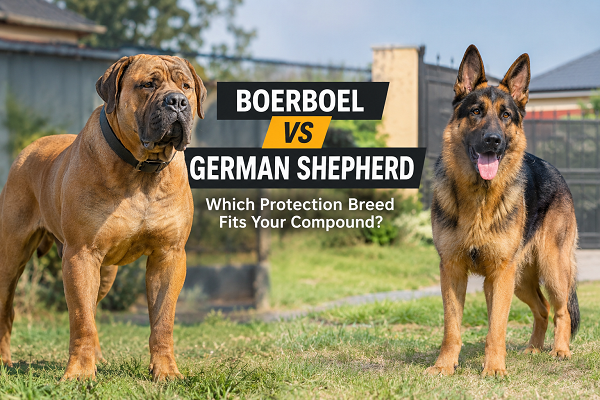
The Boerboel is a South African mastiff-type guardian (males 150-200 lbs / 68-90 kg) bred to protect farmsteads against large predators. It’s calm indoors, territorial by instinct, and doesn’t need constant activity, but it’s slow to mature (2-3 years), can be dog-aggressive, and is a serious liability if under-socialized. The German Shepherd is a mid-size, high-drive working breed (66-88 lbs / 30-40 kg) built for close handler partnership, it’s what most police and military K9 units use worldwide, it’s faster to train formally, but it needs daily mental and physical work or it becomes destructive and anxious. For a compound with kids, staff, and visitors, the Shepherd’s trainability usually wins. For a large rural property where the dog needs to hold territory with less oversight, the Boerboel’s raw size and instinct often wins.
Table of Contents
- Breed Origins: Farm Guardian vs. Working Herder
- Size, Strength, and Bite Force, What the Numbers Actually Mean
- Temperament and Protective Style
- Trainability and Timeline: How Long Until They’re “Reliable”?
- Health, Lifespan, and Grooming
- Cost Breakdown: Puppy Price to Lifetime Ownership
- Compound Size, Family Life, and Insurance Realities
- Real-World Case Comparisons
- Which One Fits YOUR Compound? A Decision Framework
- FAQs
- Conclusion
Introduction
I’ve handled working dogs for years, and this is, hands down, the question I get asked the most on WhatsApp and in the comments: “Should I go for a Boerboel or a German Shepherd for my compound?”
So here’s the short answer, straight up, before we go anywhere: If you want a dog that patrols, obeys complex commands, and works closely with a handler, get a German Shepherd. If you want a lower-energy, naturally territorial guardian that holds ground with minimal direction, get a Boerboel. Both breeds show up on insurance companies’ restricted-breed lists, both need real training (not YouTube videos and vibes), and both can fail badly in the wrong hands. The “right” one depends on your property size, your family, your budget, and how much time you’re honestly willing to put in.
Now let’s get into the details, because that one-paragraph answer hides a LOT of nuance you need before you spend $2,000+ on a puppy.
Breed Origins: Farm Guardian vs. Working Herder
You can’t understand how these two breeds behave on your property without knowing what they were actually bred to do, this is the part most comparison articles skip, and it’s the part that explains almost everything else.
The Boerboel was developed by Dutch, French, and German settlers in South Africa from the 17th century onward, crossed with local African guarding dogs (like the now-extinct Boerboel-type dogs kept by the Khoikhoi) and later Bullmastiff and Bulldog lines. “Boerboel” literally translates roughly to “farmer’s dog” in Afrikaans. Its job was brutal and specific: protect isolated homesteads from leopards, baboons, and human intruders, often without a handler standing next to it. That’s why the breed still shows up as naturally suspicious of strangers and comfortable making its own decisions, nobody was there every day to tell it what to do. The South African Boerboel Breeders’ Society (SABT) still maintains the breed standard and appraisal system used by most reputable breeders today, and the breed only entered the American Kennel Club’s Miscellaneous Class (a step toward full recognition) in 2015.
The German Shepherd Dog (GSD) has a completely different job history. Captain Max von Stephanitz standardized the breed in Germany starting in 1899, not as a guardian, but as an all-purpose herding and working dog prized for trainability and partnership with a handler. That DNA is why the breed transitioned so smoothly into police work, military service, search and rescue, and guide-dog work through the 20th century. Today, GSDs (and their close cousin the Belgian Malinois) make up the backbone of most Western police K9 units and are still used by military working dog programs worldwide, including units within the Nigerian Army and Nigeria Police Force.
What this means for your compound: a Boerboel is built to guard territory somewhat independently. A German Shepherd is built to work with you. Neither is “better”, they’re built for different jobs, and your compound is either more like an isolated farmstead or more like an active household with staff and visitors coming and going.
Size, Strength, and Bite Force, What the Numbers Actually Mean
This is where a lot of blog content online gets sloppy, so let me be precise.
Size comparison:
| Trait | Boerboel | German Shepherd |
|---|---|---|
| Male weight | 150-200 lbs (68-90 kg) | 66-88 lbs (30-40 kg) |
| Female weight | 110-150 lbs (50-68 kg) | 49-71 lbs (22-32 kg) |
| Height (male) | Up to 27 in (68.5 cm) at shoulder | 24-26 in (60-65 cm) |
| Coat | Short, low-moderate shedding | Double coat, heavy seasonal shedding |
| Life expectancy | 9-11 years | 9-13 years |
The Boerboel is essentially double the German Shepherd’s mass. That matters for a compound because sheer body weight changes what a dog can physically do, a 180 lb Boerboel can pin and hold a grown man against a wall without even biting; a 70 lb Shepherd relies more on speed, agility, and bite-and-hold technique.
Now, about bite force, here’s what most articles get wrong. You’ll see “Boerboel bite force: 450 PSI!” repeated across dozens of sites. I want to be straight with you: no independent lab has ever actually measured a Boerboel’s bite force. That 450 PSI figure traces back to informal estimates, not a controlled study, the actual peer-reviewed literature on dog bite force is thin, and where it exists, it’s usually reported in Newtons (N), not PSI, which don’t convert cleanly.
The one real study I can point you to that’s directly relevant to working dogs measured actual police dogs biting a sensor-fitted sleeve after a 25-meter run: German Shepherds recorded a median bite force of 360.4 N, and Belgian Malinois came in at 247.0 N. That’s a controlled, real-world number for a trained working GSD, worth far more than a viral PSI figure with no source.
My honest take as a handler: bite force numbers are the least useful metric for choosing a protection dog. What actually matters is bite technique (does the dog grip and hold, or bite-and-release?), commitment under stress, and whether the dog was trained to release on command. A Shepherd with proper protection training and moderate bite force is far more useful and far safer for your household, than an untrained Boerboel with a theoretically bigger bite.
Temperament and Protective Style
This is the section that decides most people’s choice, so let’s be specific instead of generic.
Boerboel temperament in practice:
- Calm, low-key indoors once past puppyhood, many owners describe them as “couch potatoes” at home
- Naturally wary of strangers without needing to be trained into it
- Slow to mature, most Boerboels don’t show full adult guarding behavior until 2-3 years old, which means the “cute goofy puppy” phase lasts longer than owners expect, and the guarding instinct can arrive suddenly
- Same-sex dog aggression is a documented, common failure point. Many Boerboels, especially intact males, will not tolerate another dog of the same sex once they hit sexual maturity around 18-24 months, and this can appear suddenly and escalate fast. If you already have a dog on your compound, plan for this before you buy.
- Independent decision-maker, a Boerboel will often decide on its own whether a situation calls for action, which is exactly what you want in an isolated guard dog and exactly what you don’t want if you can’t 100% trust its judgment around visitors, delivery staff, or children’s friends
German Shepherd temperament in practice:
- Higher energy, more “on”, needs a job or it invents one (usually a destructive one)
- Extremely handler-focused; bonds tightly to whoever trains and works it daily
- Alert barking and territorial behavior develop early, often by 6-8 months, and are easy to shape with training
- Generally more predictable and easier to “read” because the breed was selected for cooperative work with humans, not independent judgment calls
- Can develop anxiety or reactivity if under-exercised or under-stimulated, this is the single most common behavior complaint I hear from GSD owners
Here’s a mental model I give clients: a Boerboel is a deterrent that also protects. A German Shepherd is a partner that also deters. If your compound has staff, gardeners, drivers, and children’s friends constantly coming through the gate, a dog that makes its own snap judgments about who’s a threat is a liability. If your compound is large, rural, and mostly quiet except at night, a dog that holds ground independently is exactly what you need.
Trainability and Timeline: How Long Until They’re “Reliable”?
Owners almost always underestimate this part, so let me give you real timelines based on what I see in actual training programs.
German Shepherd training timeline:
- 8-16 weeks: basic socialization, house manners, name recognition, crate training
- 4-6 months: foundational obedience (sit, down, stay, recall, loose-leash walking), most GSDs pick this up fast because of high biddability
- 6-12 months: advanced obedience, off-leash reliability, controlled alerting
- 12-24 months: formal protection or patrol-style training if desired (bite work, controlled release, handler protection), this is specialist work and should only be done with a certified protection trainer, not DIY
- Organizations like Schutzhund/IGP (International Gebrauchshund Prüfung) clubs and KNPV (Koninklijke Nederlandse Politiehond Vereniging) in the Netherlands run structured, internationally recognized protection and working titles that many serious GSD owners pursue
Boerboel training timeline:
- 8-16 weeks: socialization is non-negotiable and time-sensitive, this is the single biggest predictor of whether your adult Boerboel is safe or dangerous. Miss this window and no amount of later training fully fixes it.
- 4-8 months: basic obedience, Boerboels rate slightly lower on formal trainability scores than GSDs (roughly 3/5 vs. 4/5 on most breed comparison scales) because they’re bred to think for themselves, not because they’re less intelligent
- 8-18 months: continued structured socialization, especially around other dogs, to manage the same-sex aggression risk mentioned above
- 2-3 years: full guarding maturity, this is genuinely when most Boerboels “come into” their protective instinct, so don’t judge a young Boerboel’s guarding ability yet
My honest recommendation either way: budget for a minimum of 6-12 months of consistent structured training regardless of breed, and use a professional for anything beyond basic obedience. If you’re not sure how to vet a trainer, I wrote a full walkthrough on how to choose a qualified dog trainer, it applies whether you’re training a Boerboel or a Shepherd.
Both breeds also need daily physical and mental engagement to stay stable, though the Shepherd needs noticeably more. I put together a practical guide on how much exercise a working dog actually needs if you want the full breakdown by age and job type.
Health, Lifespan, and Grooming
Boerboel health concerns:
- Hip and elbow dysplasia (reputable breeders health-test with OFA, Orthopedic Foundation for Animals, clearances)
- Cardiac issues in some lines
- Bloat (gastric dilatation-volvulus), a real risk in large, deep-chested breeds; know the emergency signs
- Shorter lifespan (9-11 years) is typical of giant breeds generally
- Low-moderate shedding, short coat, easier grooming than a Shepherd
German Shepherd health concerns:
- Hip and elbow dysplasia (extremely well-documented in the breed, always ask for OFA or PennHIP scores)
- Degenerative myelopathy (a genetic spinal condition, DNA testing is available)
- Heavy seasonal “coat blow” twice a year, plus regular year-round shedding, this is the #1 daily-life complaint from GSD owners I talk to
- Slightly longer average lifespan (9-13 years)
For either breed, ask breeders directly for hip, elbow, and (for Boerboels) cardiac clearance documentation before you pay a deposit. If a breeder can’t produce paperwork, that’s your answer.
Cost Breakdown: Puppy Price to Lifetime Ownership
This is the section nobody wants to talk about honestly, so here are real 2026 numbers.
Boerboel costs:
- Puppy from a reputable, health-tested breeder: $1,500 – $5,000 (majority land between $2,500-$3,500; imported South African bloodlines can run higher)
- First-year cost (food, vet, supplies, training): $4,500 – $9,000
- Ongoing monthly cost: $200 – $450
- Lifetime cost (9-11 years): commonly $25,000 – $50,000+
German Shepherd costs:
- Puppy from a reputable breeder: $1,500 – $4,500 (working-line or imported dogs can exceed $5,000; shelter/rescue adoption typically $50-$600)
- Lifetime cost estimate: $15,000 – $30,000
Notice the Boerboel’s lifetime cost tends to run higher, that’s the giant-breed tax: more food, bigger vet bills for anesthesia and medication dosing, larger equipment (crates, beds, collars), and higher-cost surgery if hip or elbow issues develop.
Budget tip from experience: don’t buy the cheapest puppy you can find of either breed. A Boerboel or GSD priced dramatically below market ($500-$800) almost always means no health testing, no early socialization, and a much higher chance of expensive problems, medical or behavioral, down the road. The upfront premium for a reputable breeder is cheaper than the alternative.
Compound Size, Family Life, and Insurance Realities
Here’s the part that almost no comparison article covers, and it genuinely affects your decision: insurance and liability.
In the US and several other countries, both breeds commonly appear on homeowners’ and renters’ insurance restricted-breed lists. Insurers don’t always ban coverage outright, but many will either exclude liability coverage for dog-related incidents or raise your premium if you own a Boerboel or German Shepherd. A few US states have gone as far as restricting German Shepherd ownership through local ordinances. This isn’t a reason to avoid either breed but it is a reason to call your insurer before you bring the dog home, confirm exactly what your policy covers, and consider a standalone pet liability endorsement. Average dog-bite liability claims in the US now run into the tens of thousands of dollars, so this isn’t a paperwork formality, it’s real financial exposure.
Matching breed to compound type:
- Small-to-medium urban compound with staff and regular visitors → German Shepherd. You need a dog that can be called off, redirected, and trusted to distinguish “gate visitor” from “gate threat” under your direction.
- Large rural or semi-isolated property with a substantial perimeter → Boerboel. Its size alone is often enough deterrence, and it’s naturally suited to patrol territory with less constant handler input.
- Household with young children → Either breed CAN work, but both need airtight socialization and supervision, never leave any large protection breed unsupervised with small kids, full stop. The Boerboel’s slower maturation means you’re managing a very large, still-developing adolescent for longer.
- First-time large-breed owner → German Shepherd is generally more forgiving because of its higher trainability score and larger network of experienced trainers and breed-specific resources worldwide.
- Budget-conscious owner → German Shepherd, given the lower average lifetime cost and wider availability through rescues.
If you want the fuller picture on protection-specific breeds beyond just these two, I put together a broader breakdown of top guard and protection dog breeds and the ground rules for owning one that’s worth a read before you commit.
Real-World Case Comparisons
Case 1 — The rural compound. I’ve worked with a family on a two-acre rural property with a long, poorly-lit perimeter and no live-in staff. They went with a Boerboel after their previous small-breed dog failed to deter a break-in attempt. Eighteen months later, the dog’s mere presence at the gate, no bite required, has been enough to turn away two separate late-night intrusion attempts they know of. That’s the Boerboel’s core value proposition: size as deterrence.
Case 2 — The active household. A different client runs a compound with daily staff turnover, a home office with client visits, and two school-age kids. They chose a German Shepherd specifically because it could be trained to hold a “watch” position on command, ignore expected visitors, and alert distinctly for unexpected ones, something that requires the tight handler-partnership the Shepherd breed is built for. A Boerboel’s more independent judgment would have been a liability with that much daily foot traffic.
Case 3 — The cautionary tale. I’ve also seen a Boerboel purchased by a first-time owner who skipped structured socialization between 8-16 weeks because “he seemed friendly enough as a puppy.” By 20 months, the dog had developed serious same-sex aggression toward a neighbor’s dog and had to be rehomed to an experienced single-dog household. This is the exact failure mode breed data warns about, and it’s entirely preventable with early, consistent socialization.
Which One Fits YOUR Compound? A Decision Framework
Ask yourself these questions honestly:
- Do you have 1-2 hours a day for training and structured exercise, especially in year one? If no, lean Shepherd, it adapts to a job faster and rescues are widely available. If you genuinely can’t commit real daily time to either breed, honestly, reconsider a large protection breed altogether.
- Is your compound large and relatively isolated, or busy with regular visitors and staff? Isolated → Boerboel. Busy → Shepherd.
- Do you already own another dog, especially of the same sex? If yes, think very carefully about a Boerboel, or commit to expert-guided introduction and lifelong management.
- What’s your climate? Boerboels handle heat reasonably well with their short coat; German Shepherds’ heavy double coat needs more cooling consideration in consistently hot climates.
- Have you called your insurer? Do this before you buy, not after.
- Are young children a daily presence? Either breed demands supervision, but factor in the Boerboel’s longer adolescence and greater raw strength.
If you want a deeper, book-length walkthrough of raising and managing a serious protection or working dog from puppyhood through maturity, training philosophy, real handler stories, and the mistakes most owners make, I put a lot of that experience into my e-book, Beyond the Bark. It’s the resource I wish existed when I started handling.
FAQs
1. Can a Boerboel and German Shepherd be trained to work together on one compound?
Yes, but it takes deliberate, gradual introduction and management, especially if the Boerboel is male and intact, given the breed’s documented same-sex aggression tendency. Many compounds do run mixed-breed teams successfully, a Shepherd for alert/patrol work and a Boerboel for perimeter deterrence, but you should work with an experienced trainer for the introduction phase rather than doing it unsupervised.
2. Which breed is safer around children, Boerboel or German Shepherd?
On standardized child-compatibility comparisons, German Shepherds tend to score slightly higher on average, largely due to predictability and trainability. That said, individual temperament, socialization, and supervision matter far more than breed averages. Neither breed should ever be left unsupervised with young children.
3. Do Boerboels or German Shepherds cost more to insure?
Both frequently appear on homeowners’ and renters’ insurance restricted-breed lists in the US and other markets. Coverage and premium impact vary significantly by insurer and state, so always confirm directly with your provider before bringing either breed home.
4. How old does a Boerboel or German Shepherd need to be before it can actually protect a compound?
A German Shepherd typically shows reliable alert and territorial behavior by 8-12 months and can be functionally trained for structured protection work by 18-24 months. A Boerboel usually doesn’t reach full guarding maturity until 2-3 years old, even though its size makes it look “ready” much earlier.
5. Is a Boerboel more dangerous than a German Shepherd?
Neither breed is inherently “more dangerous”, outcomes depend overwhelmingly on socialization, training, and management. What’s true is that the Boerboel’s independent decision-making and greater size mean mistakes have higher consequences, which is why early socialization (8-16 weeks) is non-negotiable for the breed.
Conclusion
There’s no universal winner between the Boerboel and the German Shepherd, there’s only the right dog for your specific compound, family, and lifestyle. If you need a dog that thinks for itself and holds ground on a large or isolated property, the Boerboel’s raw size and natural territorial instinct deliver real value. If you need a dog that works closely with you, handles a busy household with visitors and staff, and trains predictably, the German Shepherd is the stronger fit for most people.
Whichever you choose, three things aren’t optional: start socialization in the first 16 weeks, invest in a real training program rather than guesswork, and confirm your insurance situation before the dog comes home. Get those three right, and either breed can become exactly what you’re looking for, a protector your family and property can actually rely on.
Sources referenced include breed data from the South African Boerboel Breeders’ Society (SABT), American Kennel Club records, published bite-force research on working police dogs, U.S. pet insurance industry reports (2026), and current breeder pricing data.

Her work centers on applied training across obedience, detection, protection, and operational readiness, with a strong focus on Military Working Dogs (MWDs) and security K9 programs. Rather than relying on theory alone, Rofiat emphasizes proven training methods built on repetition, consistency, and real-world conditioning principles that prepare both dogs and handlers for high-pressure tasks.
Through articles, training content, and documentaries, she shares experience-based insights from the field, highlighting how structured training, clear communication, and trust between handler and dog directly impact performance and reliability.
Drawing from years of frontline experience, she is also the author of “Beyond the Bark: Inside a Pro Handler’s Playbook for Raising the Ideal Dog,” a practical guide designed to help dog owners and handlers apply professional training principles in everyday situations.
She remains committed to responsible K9 development, continuous skill refinement, and practical education for handlers, trainers, and dog professionals.
- Boerboel vs German Shepherd: Best Protection Dog? - September 14, 2026
- How to Leash Train a Puppy: Complete Step-by-Step Guide - September 13, 2026
- Essential Dog Agility Equipment for Home Training - September 13, 2026