K9 Dog Training: 5 Basic Security Steps
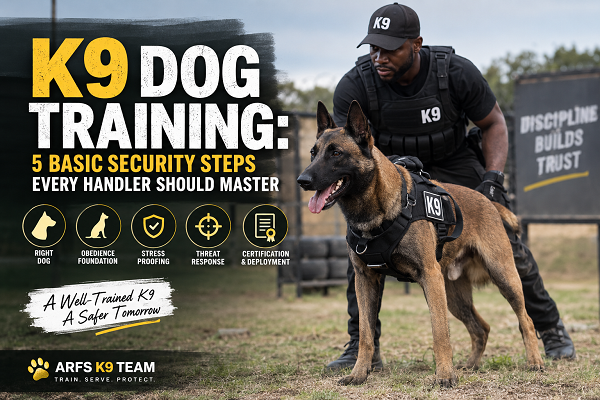
Training a K9 for security work comes down to five core steps: selecting a dog with the right drive and temperament, building rock-solid foundational obedience, stress-proofing the dog to real-world environments, developing controlled aggression and threat response, and certifying the dog-handler team through recognized testing. Done properly, this process takes 12 to 24 months and costs anywhere from $3,000 for owner-trained programs to $65,000+ for a fully certified, imported protection dog.
If you only remember one thing from this article, remember that: security dog training isn’t about teaching a dog to be scary. It’s about teaching a dog to be reliable under pressure. Big difference and it’s the difference that gets handlers and their dogs through real incidents instead of getting someone hurt or sued.
Table of Contents
- What Is K9 Security Training, Really?
- Step 1: Select the Right Dog
- Step 2: Build Foundational Obedience
- Step 3: Environmental Stress-Proofing
- Step 4: Controlled Aggression & Threat Response
- Step 5: Certification & Real-World Deployment
- Common Mistakes Handlers Make
- Realistic Timeline: How Long Does It Take?
- What Does It Actually Cost?
- About This Guide
- FAQs
- Conclusion & Next Steps
Introduction
Here’s a scenario I’ve seen play out more times than I can count: someone buys a German Shepherd or a Belgian Malinois, watches a bunch of YouTube videos, and decides their dog is “trained for protection” after a few weeks of bite-sleeve games in the backyard. Then something actually happens, a stranger at the door at 2 a.m., a break-in attempt, a genuinely threatening encounter and the dog either freezes, overreacts, or bites the wrong person entirely.
That’s not a training failure of the dog. That’s a failure of process.
Real K9 security training, the kind used by police departments, private security firms, and professional protection-dog trainers from Belgium to Texas, follows a specific sequence. Skip a step, and you don’t just get a weaker dog, you get an unpredictable one, which is far more dangerous than an untrained one.
In this guide, I’m walking you through the five basic steps that form the backbone of legitimate K9 security training worldwide. Whether you’re a security company building an in-house K9 unit, a private handler working toward IPWDA or NAPWDA certification, or a homeowner considering a personal protection dog, you’ll come away knowing exactly what the process looks like, how long it takes, what it costs, and just as important, where most people go wrong.
What Is K9 Security Training, Really?
A lot of articles online blur the line between “obedience training” and “security training,” so let’s clear that up first.
Basic obedience training teaches a dog to sit, stay, come, heel, and behave politely around people. Any family dog can (and should) learn this.
K9 security training builds on top of that obedience foundation and adds three things obedience alone never touches:
- Threat discrimination — the ability to tell the difference between a genuine threat and a normal, harmless situation (a mail carrier vs. an intruder, for example)
- Controlled response under pressure — acting decisively when needed, and just as importantly, stopping on command
- Environmental stability — staying calm and functional in loud, chaotic, or high-stress settings where an untrained dog would panic or shut down
This is why the Belgian Malinois has largely overtaken the German Shepherd as the top choice for professional K9 units over the past two decades, not because Malinois are “better dogs,” but because their drive and recovery speed hold up better under the intensity of real security work. That said, German Shepherds, Dutch Shepherds, and Rottweilers remain excellent choices depending on the role.
Fun bit of history: organized K9 policing isn’t a modern invention. The Ghent Police Department in Belgium ran the first formal police dog program back in 1899, training Belgian sheepdogs for night patrol. Germany followed in 1920 with a dedicated training school in Greenheide that helped establish the German Shepherd as a working standard. Over 125 years later, the core principles from those early programs, obedience first, then controlled response, then certification, are still exactly how modern K9 units are built.
Step 1: Select the Right Dog
You cannot train your way out of a poor genetic match. This is the step most beginner guides skip entirely, and it’s the one that determines everything downstream.
What to Look For
A suitable security/protection candidate should show:
- Prey and defense drive — genuine interest in chasing, gripping, and engaging, not just reacting out of fear
- Nerve strength — recovers quickly from a startling noise or sudden movement (a dog that startles at a dropped pan and stays rattled for 10 minutes is not a security dog candidate)
- Environmental soundness — comfortable on different surfaces, around traffic, crowds, and unfamiliar sounds
- Handler focus — bonds well and takes direction, rather than working independently
Breeds Most Commonly Used
| Breed | Common Role | Why |
|---|---|---|
| Belgian Malinois | Patrol, apprehension, military/police | High drive, agility, fast recovery |
| German Shepherd | Patrol, personal protection, detection | Versatile, strong bite, trainable |
| Dutch Shepherd | Patrol, protection | Durable, high stamina, less health issues than GSD lines |
| Rottweiler | Personal/property protection | Natural guarding instinct, imposing presence |
| Doberman Pinscher | Personal protection | Fast, intelligent, historically used by the U.S. Marine Corps in WWII |
According to the American Veterinary Medical Association, dogs live in roughly 38% of U.S. households, but only a tiny fraction of those dogs have the genetic makeup to handle real security work. Most professional trainers will tell you that out of an average litter, only 1 to 3 puppies show the drive and nerve profile needed for protection or patrol work. This is exactly why reputable K9 vendors temperament-test dogs as young as 8 weeks and again at 12–18 months before clearing them for security training.
Expert tip: If a breeder or seller can’t walk you through a temperament test or show documented working-line pedigree, that’s a red flag, not a bargain.
Step 2: Build Foundational Obedience
This is the step everyone recognizes, but most people underestimate how deep it needs to go for security work.
Standard household obedience covers sit, stay, come, and heel. Security-level obedience goes further and needs to be reliable off-leash, under distraction, and at a distance because in a real deployment, you might be 30 feet away shouting a command over noise, not standing next to your dog with a treat.
Core Skills at This Stage
- Positional commands (sit, down, stand) held for extended periods without breaking
- Recall under distraction — coming immediately even when chasing a scent or reacting to movement
- Loose-leash and off-leash heel
- Place/stay commands — critical for situations where the dog needs to hold position while the handler manages a scene
- Impulse control exercises — leaving food, ignoring other animals, waiting at doors and thresholds
Most certified trainers use positive reinforcement paired with clear, consistent correction (a “balanced” training approach) rather than pure reward-based methods for security dogs, because the dog needs to respond reliably in situations where treats aren’t a realistic motivator, like during an actual confrontation.
Timeframe: 8 to 12 weeks of consistent daily work (15–30 minutes, 2–3 sessions a day) typically gets a dog to a dependable obedience baseline, assuming you started with a sound, trainable dog from Step 1.
Step 3: Environmental Stress-Proofing
This is the step that separates a dog that’s “trained” on paper from one that actually performs when it matters and it’s the step most owner-trained protection dogs never get enough of.
Stress-proofing (also called desensitization or environmental conditioning) exposes the dog, gradually and safely, to:
- Loud noises (gunfire, fireworks, slamming doors, alarms)
- Crowds and unfamiliar people
- Different terrain and surfaces (stairs, slick floors, grates, vehicles)
- Sudden movement and physical contact from strangers
- Other animals
Professional K9 units use gunfire desensitization protocols that start with the sound at a significant distance and muffled, gradually moving closer over weeks, never introducing full-volume gunfire near an untested dog, which can cause permanent sound sensitivity or “gun-shyness.”
I’ve watched otherwise well-obedience-trained dogs completely fall apart the first time they encountered a shouting crowd or a slammed car door, simply because this step got rushed. A dog that panics in a parking lot isn’t going to hold it together during an actual security incident.
Real-world example: TSA’s canine explosive detection program runs dogs through months of controlled exposure to airport environments, jet engines, moving crowds, luggage carousels, before a dog is ever cleared for live deployment. That same layered exposure principle applies whether you’re training a K9 for airport security or a personal protection dog for your home.
Step 4: Controlled Aggression & Threat Response
This is the step people get most excited about and the one that causes the most accidents when rushed or mishandled.
Controlled aggression training is not about making a dog more aggressive. It’s about teaching an already-confident, stable dog:
- When a bite or engagement is appropriate (on command, or in response to a genuine physical threat to the handler)
- How to grip properly and hold without thrashing (protects both the dog’s teeth and the “decoy’s” safety in training)
- When to release, the “out” command, arguably the single most important command in this entire discipline, because a dog that won’t release on command is a liability, not an asset
- How to disengage the moment the threat stops
Typical Bite Work Progression
- Puppy tug and prey games (early foundation, months before real bite work begins)
- Sleeve introduction with a padded bite sleeve
- Suit work with a full bite suit, introducing more realistic pressure and movement
- Muzzle work and civil agitation, testing the dog’s threat discrimination without a bite equipment cue, so the dog learns to respond to actual threatening behavior, not just the sight of a sleeve
- The “out” (release) command, drilled relentlessly until it’s automatic
A properly trained protection dog should release a grip within 1–2 seconds of the command, every time, without exception. If your trainer can’t demonstrate this reliably, that program isn’t ready for real deployment, full stop.
This stage should only be done under a qualified decoy/trainer, never attempted solo at home. Bite work done incorrectly is how you end up with a dog that either bites indiscriminately or won’t bite when it actually matters, both are dangerous outcomes.
Step 5: Certification & Real-World Deployment
The final step is proving the dog-handler team actually performs to standard, not just in the training yard, but under evaluation.
Recognized Certifying Bodies (International)
- NAPWDA (North American Police Work Dog Association) — patrol and detection certifications used across the US and Canada
- USPCA (United States Police Canine Association) — one of the oldest K9 certifying bodies in the US, running regional and national trials
- IPWDA (International Police Work Dog Association) — patrol, tracking, and search & rescue certifications, with testing events held across multiple US states annually
- IGP/Schutzhund (IPO) — the German-originated three-phase test (tracking, obedience, protection) used globally as a benchmark for working-dog temperament and ability
- AKC Canine Good Citizen (CGC) — not a security certification, but often used as a baseline behavioral benchmark before advancing to protection-specific testing
Certification trials typically test the dog on obedience under distraction, a controlled bite-and-release scenario, agility/obstacle work, and for patrol dogs, search and apprehension scenarios. Handlers usually pay $150–$550 per certification event depending on the organization and number of disciplines tested.
Why this step matters: A dog that “seems ready” based on your own observation is not the same as a dog that’s been tested by an independent evaluator against a documented standard. Insurance providers, employers, and courts (in the event of an incident) take certification seriously, informal training does not hold up the same way.
Common Mistakes Handlers Make
Most articles on this topic stop at “here are the steps.” Here’s what actually goes wrong in practice, based on patterns I’ve seen repeatedly:
- Skipping temperament testing and picking a dog based on looks or breed reputation alone
- Rushing bite work before obedience and impulse control are solid
- Under-socializing the dog to people and environments, creating a dog that’s reactive rather than discriminating
- Inconsistent handler commands — different family members using different words or hand signals confuses the dog and weakens reliability
- Neglecting the “out” command — trainers spend so much time on the bite that release training gets shortchanged, which is a serious liability
- Assuming training is “done” — security dogs need ongoing maintenance training for life, not a one-time course
- Using punishment-heavy methods that damage the dog’s confidence instead of building controlled drive.
Realistic Timeline: How Long Does It Take?
| Stage | Typical Duration |
|---|---|
| Selection & temperament testing | 1–4 weeks |
| Foundational obedience | 8–12 weeks |
| Environmental stress-proofing | Ongoing, 3–6 months concentrated |
| Controlled aggression/bite work | 6–12 months |
| Certification-ready | 12–24 months total |
Most professional K9 programs (police and military) run initial training academies of 8 months to 1 year before a dog and handler are cleared for active duty and even then, dogs go through recertification annually for the rest of their working life, which typically runs 6–9 years.
What Does It Actually Cost?
Costs vary enormously depending on whether you’re training the dog yourself, sending it to a board-and-train program, or buying a dog already trained.
| Option | Approximate Cost (USD) |
|---|---|
| Owner-trained (classes + equipment, DIY) | $3,000–$8,000 |
| Professional board-and-train protection program | $10,000–$25,000 |
| Fully trained, certified imported protection dog | $30,000–$65,000+ |
| Certification event/trial fees | $150–$550 per event |
| Ongoing maintenance training (annual) | $1,000–$3,000 |
Be wary of anyone selling a “fully trained protection puppy” for a few hundred dollars, legitimate working-line puppies with documented temperament testing generally start around $2,000–$3,500 before any training has even begun.
About This Guide
This article was put together drawing on established K9 industry standards, publicly documented certifying-body requirements (NAPWDA, USPCA, IPWDA, IGP/Schutzhund), and hands-on patterns seen across working K9 programs, not recycled blog content. Our team at ARFS K9 Team works directly with handlers on obedience-through-certification training pathways, including hands-on work with Military Working Dogs at events like NADCEL. For deeper dives into specific stages of this process, check out these related guides:
- Guard Protection Dogs: Top Breeds & Essential Rules — more on picking the right dog for Step 1
- Dog Obedience vs. Instinct: How to Balance Drive and Control — a deeper look at Step 2’s foundation
- Learn 10 Essential Protection Dog Commands Every Owner Should Master — including the “out” command covered in Step 4
- Dog Dominance vs. Discipline: Professional K9 Training Secrets — why the mistakes in the section above happen
- How Are Military Working Dogs Trained? — a real-world look at Step 5’s deployment standards
If you want a deeper, structured walkthrough you can follow at your own pace, including drills, timelines, and handler exercises, our companion resource, The K9 Handler’s Field Guide, expands on everything covered here with step-by-step training breakdowns.
FAQs
1. How long does it take to train a K9 for security work?
Most dogs need 12 to 24 months to go from selection to certification-ready, depending on the dog’s starting temperament and how many hours per week go into training.
2. What’s the best dog breed for security or protection training?
Belgian Malinois, German Shepherds, and Dutch Shepherds are the most widely used worldwide due to their drive, trainability, and nerve strength, though Rottweilers and Dobermans also perform well in personal protection roles.
3. Can I train my own dog for security work, or do I need a professional?
You can handle foundational obedience and basic socialization yourself, but controlled aggression/bite work should always involve a qualified professional decoy or trainer, mistakes at this stage create serious safety risks.
4. How much does it cost to get a K9 fully certified?
Total costs range from $3,000 for an owner-trained dog using group classes and equipment, up to $65,000+ for a fully trained and imported, certified protection dog. Certification trial fees typically run $150–$550 per event.
5. What is the “out” command and why does it matter so much?
The “out” command teaches the dog to immediately release a bite or grip on cue. It’s arguably the most important command in security dog training because a dog that won’t release reliably is a legal and safety liability, regardless of how well it performs everything else.
Conclusion & Next Steps
Real K9 security training isn’t a weekend project, and it’s not something you can shortcut by skipping straight to bite work because that’s the exciting part. The five steps, selection, obedience, environmental stress-proofing, controlled aggression, and certification, build on each other in a specific order for a reason. Skip one, and the whole structure gets shaky.
If you’re just starting out: invest the time in Step 1 and Step 2 before you even think about bite work. A dog with the wrong temperament or shaky obedience will never make a reliable security dog, no matter how much bite training you throw at it later.
If you’re further along: don’t let certification be an afterthought. Testing your dog against a recognized standard, NAPWDA, USPCA, IPWDA, or IGP, is what turns “I think my dog is trained” into a documented, defensible fact, which matters enormously if that dog is ever involved in a real incident.
Take it one step at a time, work with qualified professionals for the higher-risk stages, and give the process the 12–24 months it actually needs. That’s how you end up with a dog you can genuinely trust, not just one that looks intimidating.

Her work centers on applied training across obedience, detection, protection, and operational readiness, with a strong focus on Military Working Dogs (MWDs) and security K9 programs. Rather than relying on theory alone, Rofiat emphasizes proven training methods built on repetition, consistency, and real-world conditioning principles that prepare both dogs and handlers for high-pressure tasks.
Through articles, training content, and documentaries, she shares experience-based insights from the field, highlighting how structured training, clear communication, and trust between handler and dog directly impact performance and reliability.
Drawing from years of frontline experience, she is also the author of “Beyond the Bark: Inside a Pro Handler’s Playbook for Raising the Ideal Dog,” a practical guide designed to help dog owners and handlers apply professional training principles in everyday situations.
She remains committed to responsible K9 development, continuous skill refinement, and practical education for handlers, trainers, and dog professionals.
- How Many Teeth Do Dogs Have? Puppy vs Adult Chart - September 22, 2026
- What Colors Do Dogs See? (Dog Vision Spectrum) - September 22, 2026
- Is Cinnamon Bad for Dogs? Safe Dosage by Weight - September 21, 2026