Can Any Dog Be a Search and Rescue Dog? The Real Answer
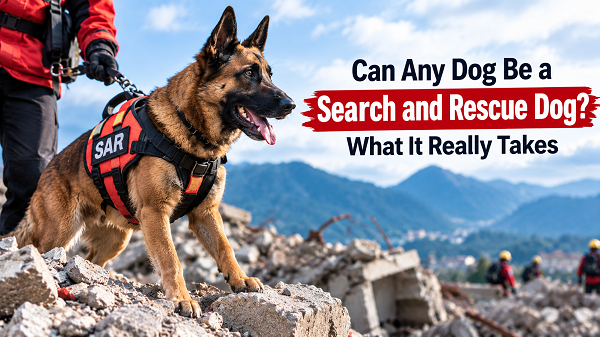
No, not every dog can become a search and rescue (SAR) dog, but it has almost nothing to do with breed and everything to do with drive, nerve, and physical soundness. A SAR candidate needs an obsessive desire to work (usually for a toy or a game), rock-solid confidence around noise, height, and instability, a body built to survive months of rubble, mud, and mountain trails, and 800 to 2,000+ hours of training before certification. Programs like the National Disaster Search Dog Foundation evaluate roughly 30 dogs for every one that makes it through.
If you’ve ever watched footage of a dog scrambling across a collapsed building or trotting through the Alps with a rescue kit strapped to its back and thought, “my dog could do that”, I get it. I’ve had that same thought about half the dogs I’ve trained over the years. But here’s the thing: wanting to help and being built to help are two very different things.
Table of Contents
- The Short Answer (And Why It Surprises People)
- What Actually Makes a Dog Good at Search and Rescue Work
- The Best Dog Breeds for Search and Rescue and the Surprising Exceptions
- Dogs That Usually Don’t Make the Cut
- How Search and Rescue Dogs Are Actually Trained
- The Different Types of SAR Work
- Certifying Organizations Around the World
- Real Search and Rescue Dogs Who Made History
- What It Costs (In Time and Money) to Get Into SAR
- How to Actually Get Started (Not Just “Contact a Team”)
- Is Your Dog SAR Material? A Quick Self-Check
- About the Trainer Behind This Guide
- FAQs
- Conclusion
The Short Answer (And Why It Surprises People)
Search and rescue organizations worldwide agree on one thing: breed is not the deciding factor. The International Search and Rescue Dog Organisation (IRO), which certifies teams across Europe, puts it plainly, almost any healthy, medium-sized dog with strong nerves and a genuine drive to work can be trained for SAR. What actually knocks a dog out of the running is temperament, health, and a lack of that borderline-obsessive motivation to search.
That’s a different message than what most articles tell you. A lot of the content ranking on page one right now leans hard on “German Shepherds and Labradors are the best SAR breeds” and stops there. That’s true as far as it goes, but it skips the more useful and more honest, question: what specific traits are handlers and evaluators actually screening for, and why do so many “perfect” dogs still wash out? That’s what we’re digging into here.
What Actually Makes a Good Search and Rescue Dog
Forget the coat color and the papers for a second. Every working SAR evaluator I’ve spoken with over the years is looking for the same handful of traits, regardless of breed.
1. Obsessive Drive (Not Just Energy)
A hyper dog isn’t automatically a working dog. What SAR programs want is prey drive and hunt drive channeled into a single obsession, usually a tennis ball or a tug toy. The National Disaster Search Dog Foundation (SDF) actually recruits many of its dogs straight out of animal shelters, specifically because the same “annoying” traits that get a dog surrendered, won’t stop chewing, escapes every yard, can’t settle down, are exactly what a search dog needs.
“The exact same behavior that we look for in these dogs are usually the ones that land them on the unadoptable or euthanasia list,” an SDF spokesperson has explained. “They’re highly energetic. They’re super-focused, laser-focused.”
That’s not a throwaway line. It’s the whole recruiting philosophy of one of the most respected SAR programs in the United States.
2. Nerve Strength
A SAR dog has to walk across a see-saw of rubble, hear a chainsaw fire up six feet away, get lowered by harness from a helicopter, and still keep working. Dogs that startle badly, freeze, or shut down under stress are screened out early, no amount of training reliably fixes a genuinely fearful temperament.
3. Physical Soundness
The dog needs to be:
- Large enough to climb, jump, and push through debris or deep snow
- Small and light enough to be carried by the handler when needed (many trainers use roughly 20–40 kg / 45–90 lbs as a comfortable working range, though this varies by discipline)
- Free of hip, joint, or respiratory issues that would fail under repeated impact and endurance work
- Physically mature, most programs won’t start certification testing before 18 months old
4. An Independent, Problem-Solving Mind
Unlike an obedience dog that waits for instruction, a SAR dog often has to work 100+ metres away from its handler, off-leash, making its own decisions about where the scent is strongest. Dogs that need constant direction don’t do well here.
5. Trainability and Handler Focus
Drive without trainability just gets you a dog that runs off chasing rabbits. The dog also needs to want to work with a person, take direction, and reliably perform a trained alert (a sit, a bark, a dig) the moment it finds a scent source.
If you’re working through foundational obedience and focus exercises before attempting anything SAR-related, it helps to follow a structured system rather than winging it, our complete guide to basic K9 training techniques breaks down the same foundational drills military and working dog trainers use before any scent-specific work begins.
The Best Dog Breeds for Search and Rescue and the Surprising Exceptions
While breed alone doesn’t disqualify or qualify a dog, statistically, certain breeds show up again and again in SAR units because they combine the traits above more consistently.
Air-Scenting Breeds (Working Off-Leash, Covering Open Ground)
- German Shepherd Dog — the most common SAR and disaster-dog breed in North America and Europe
- Labrador Retriever — a favorite for both wilderness search and disaster work thanks to a stable temperament and strong food/toy drive
- Border Collie — exceptional problem-solving and stamina; heavily used across the UK and Europe
- Golden Retriever — reliable, biddable, and increasingly used in cadaver and wilderness search
- Belgian Malinois and Dutch Shepherd — high drive, athletic, increasingly common in urban disaster response (Diesel, a Dutch Shepherd, is a well-known FEMA-tested urban search dog in New York)
Trailing / Tracking Breeds (Following a Specific Scent on a Line)
- Bloodhound, still considered the gold standard for scent discrimination and mantrailing
- German Shepherd and Labrador Retriever also cross-train well for trailing work
Cold-Weather and Water-Rescue Specialists
Most “best SAR breeds” lists stop at Shepherds and Labs and completely skip the specialist end of the spectrum, which is a shame, because these breeds are the reason mountain and marine rescue units exist at all:
- Saint Bernard — the original avalanche dog, historically used by monks at the Great St Bernard Hospice in the Swiss Alps to locate travellers buried in snow
- Bernese Mountain Dog — thick double coat and natural strength make it a solid cold-weather and load-carrying candidate in European alpine units
- Newfoundland — a webbed-footed, naturally buoyant breed still used in water rescue today; its coat sheds cold water and its size lets it physically tow a person to shore
The Wildcards Nobody Talks About
Here’s where a lot of “best breeds” articles fall short, they skip the exceptions that actually prove the “any dog” rule:
- Shelter mixed-breed dogs. SDF’s own numbers say it best: before their structured screening program, only about 15% of dogs entering SAR training actually became certified. After refining their evaluation and training methods, that success rate jumped to roughly 85%, using largely rescued, unwanted shelter dogs.
- Small breeds in confined-space and rubble work. In Japan, a 6.6 lb (3 kg) Chihuahua named Momo became the smallest dog ever certified for police search-and-rescue duty, proof that size is a factor, not a hard rule, especially in tight urban collapse environments where a smaller dog can access voids a Shepherd never could.
- Border Collies and Springer Spaniels are increasingly used across UK lowland and mountain rescue teams specifically because their working-line drive rivals traditional guarding breeds.
Quick-Reference Breed Table
| Breed | Best Discipline | Why It Works |
|---|---|---|
| German Shepherd | Air-scent, disaster, HRD | Balanced drive, trainability, athletic build |
| Labrador Retriever | Disaster, water, wilderness | Stable temperament, strong toy/food drive |
| Bloodhound | Trailing/mantrailing | Unmatched scent discrimination on a line |
| Border Collie | Wilderness, lowland rescue | High stamina and problem-solving |
| Belgian Malinois / Dutch Shepherd | Urban disaster, agility-heavy rubble work | Extreme drive and athleticism |
| Newfoundland | Water rescue | Natural buoyancy, strength, cold-water coat |
| Saint Bernard / Bernese Mountain Dog | Avalanche, alpine rescue | Cold tolerance, size, historical working lines |
| Mixed-breed / shelter dogs | Disaster search (SDF model) | Selected purely on drive and nerve, not pedigree |
Dogs That Usually Don’t Make the Cut
To be fair to readers (and to Google’s “helpful content” standards), let’s talk about the dogs that typically get screened out, while still being honest that these are trends, not absolute rules:
- Brachycephalic (flat-faced) breeds like Bulldogs and Pugs, breathing limitations make sustained physical work and heat regulation dangerous
- Toy breeds bred purely for companionship, without working drive, most simply lack the obsessive search instinct, even if Momo shows exceptions exist
- Dogs with poor nerve strength, regardless of breed, a nervous or noise-sensitive dog rarely improves enough through training alone
- Dogs with existing joint, hip, or cardiovascular issues, the physical demands are simply too high
- Older dogs starting from scratch, most programs prefer dogs under 2–3 years old at the start of training, since the process itself takes 8 months to 2+ years.
How Search and Rescue Dogs Are Actually Trained
This is the part most articles gloss over, and it’s honestly the most important piece for understanding why “any dog” is technically true but practically misleading.
The Realistic Timeline
- Foundation training (puppy to ~12 months): basic obedience, agility over unstable surfaces, hide-and-seek scent games, confidence-building around noise and new environments
- Scent imprinting and formal search training (12–24 months): the dog learns to associate finding human scent with a reward, then progresses to longer, more contaminated, more distracting search problems
- Certification prep (final months): full mock disaster or wilderness scenarios under evaluation conditions
Handlers in FEMA’s Urban Search and Rescue (US&R) system typically log around 800 to 2,000+ hours of combined training before a canine/handler team is ready to sit a national certification test, a process that generally spans close to a year of dedicated work, and sometimes several years for advanced disciplines like human remains detection.
What Certification Actually Looks Like
A FEMA US&R certification test, for example, requires the dog to locate multiple hidden “victims” scattered across a 15,000+ square foot simulated disaster site, while deliberately ignoring distractions like food, toys, and even human remains scent placed to test discrimination. Handlers get roughly 20 minutes per site and must accurately report how many people were found and where.
Once certified, teams aren’t done, re-certification is required every three years, and monthly training never stops for as long as the dog is active.
If you’re building or supporting a training program from scratch, our breakdown of how to start a K9 training program covers the accreditation, staffing, and curriculum pieces that also apply to civilian SAR unit development.
The Numbers That Tell the Real Story
- Fewer than 250 FEMA-certified disaster search dogs actively serve the entire United States at any given time, spread across 28 task forces
- The National Disaster Search Dog Foundation has certified 229+ teams since 1996, working almost exclusively with shelter and donated dogs
- A working SAR dog’s active career typically runs 6 to 9 years before retirement
- Roughly 1 in 1,000 dogs has the combination of traits and trainability to complete disaster-dog certification, according to search-and-rescue advocacy groups tracking the US shortage of qualified teams.
The Different Types of SAR Work
“Search and rescue dog” isn’t one job, it’s an umbrella term covering several very different disciplines, and most dogs specialize in one or two rather than all of them.
- Air-scent search — works off-leash, scanning for any human scent carried on the wind across a defined search sector. Non-discriminating: the dog will find anyone in the area, not a specific person.
- Trailing (mantrailing) — works on a harness and long line, following the specific scent trail of one missing person from a scent article (a piece of clothing, for example).
- Urban disaster/rubble search — trained to climb, balance, and search unstable collapsed structures for live victims, ignoring the scent of the deceased.
- Human remains detection (HRD / cadaver) — trained specifically to alert on deceased human scent, used in both disaster response and criminal investigations.
- Water search — detects human scent rising through water, typically worked from a boat or shoreline; heavily used by UK water search units.
- Avalanche search — trained to locate people buried under snow; an experienced avalanche dog can locate a person buried up to 10 metres (about 33 feet) deep, according to IRO data, and can search an area in minutes that would take a 20-person probe line hours.
Understanding these role distinctions matters for the same reason understanding military working dog roles and duties matters in that world, a dog trained for one specialty isn’t automatically ready for another, even within the same broad “working dog” category.
Certifying Organizations Around the World
If you’re serious about getting your dog into SAR work, you’ll be training toward one (or more) of these standards depending on where you live:
United States
- Federal Emergency Management Agency (FEMA), Urban Search and Rescue (US&R) certification
- National Disaster Search Dog Foundation (SDF)
- National Association for Search and Rescue (NASAR)
- Search and Rescue Dogs of the United States (SARDUS)
- American Rescue Dog Association (ARDA)
United Kingdom & Ireland
- Search and Rescue Dog Association (SARDA), England, Wales, Scotland, and Ireland chapters
- National Search and Rescue Dog Association (NSARDA), covers air-scent, water, and trailing dogs across the UK and Isle of Man
- Lowland Rescue (search dog units)
Europe & International
- International Search and Rescue Dog Organisation (IRO), founded 1993, coordinates certification standards and deployment across member countries
- International Commission for Alpine Rescue (ICAR), sets formal welfare, fitness, and competency requirements for both dog and handler across alpine rescue organizations
- Mountain Rescue Association affiliates across the Alps, Scandinavia, and beyond
The American Kennel Club also offers a Search and Rescue Title program, letting FEMA- or SUSAR-certified dogs add an official AKC title to their record, a nice way to formally recognize the achievement, even though it’s not a working certification itself.
A signal most competing articles skip entirely: SAR training isn’t just informal best practice, it’s governed by published technical standards. ASTM International maintains ASTM F1847, the Standard Guide for Minimum Training of Search Dog Crews or Teams, and ASTM F1867, the Standard Guide for Demonstrating Obedience and Agility in Search and Rescue Dogs. Many US task forces and evaluators reference these standards when building or assessing a training curriculum, which is worth knowing if you want to sound (and actually be) credible when talking to a real SAR unit.
Real Search and Rescue Dogs Who Made History
Numbers are convincing, but stories are what actually stick. A few worth knowing:
- Ground Zero, September 11, 2001 — around 300 dog-handler teams responded, though only about 100 were fully prepared for a disaster of that scale, which is part of why the National Disaster Search Dog Foundation exists at all today.
- Wilma Melville and Murphy — after searching the rubble of the 1995 Oklahoma City bombing and realizing only 15 certified canine-human teams existed nationwide, retired schoolteacher Wilma Melville founded the National Disaster Search Dog Foundation. She set a goal of training 168 teams, one for every life lost in that bombing and hit it in 2020.
- Haiti, 2010 — FEMA canine teams located babies trapped in wreckage among widespread destruction, a scenario evaluators say is nearly impossible to replicate in training, which is exactly why real deployment experience matters so much.
- Surfside condo collapse, Florida, 2021 — FEMA US&R canine teams, including handlers from New York’s task force, were deployed within hours to search the rubble for survivors.
- Momo the Chihuahua, Japan — at 6.6 lbs, Momo became the smallest dog to qualify for police search-and-rescue duty, a reminder that “any dog” isn’t just a slogan.
What It Costs (In Time and Money) to Get Into SAR
This is the part that surprises people who assume SAR work is government-funded and salaried. In most countries, it isn’t.
- Almost all handlers are unpaid volunteers. In the UK, NSARDA is explicit that members cover their own fuel, equipment, and travel, there’s no reimbursement.
- Training investment runs into the thousands of dollars/pounds once you count equipment, travel to training weekends, seminars, and certification testing fees.
- Time commitment is enormous, handlers frequently log close to 1,000 hours themselves before their dog is field-ready, on top of ongoing monthly training for the dog’s entire working life.
- SDF has stated it costs roughly $10,000 just to begin the process of evaluating and starting to train a single shelter dog for their program, long before certification is even in sight.
Good equipment isn’t optional, either, a poorly fitted harness or the wrong tracking line can undo months of training. Our essential K9 training equipment guide covers the gear worth investing in early, much of which overlaps directly with SAR training needs. Keeping the dog physically sound through years of this work also matters more than people expect — see our notes on maintaining good health in working dogs for the conditioning routines that extend a working dog’s career.
If you want a single, structured resource that walks through temperament testing, drive assessment, and early training decisions in one place rather than piecing it together from forum posts, my e-book on working dog selection and training is built exactly for handlers at this stage.
How to Actually Get Started (Not Just “Contact a Team”)
Most guides tell you to “find a local SAR team” and stop there. Here’s the real sequence, based on how most volunteer units and mountain rescue associations actually onboard new dog-handler pairs:
- Get your dog’s basic obedience rock-solid first. No unit will evaluate a dog that can’t reliably sit, stay, recall, and walk politely on and off leash around distractions.
- Find a local, recognized unit through NASAR, SARDUS, ARDA (US), SARDA/NSARDA (UK), or your national mountain rescue association, not a random Facebook group.
- Request a temperament and drive evaluation. Most reputable units test this for free before accepting a dog-handler pair into training. Be honest about your dog’s fears, reactivity, or health issues; hiding them wastes everyone’s time.
- Commit to a probationary training period. Expect to attend weekly or biweekly group training sessions for several months before anyone discusses certification timelines.
- Budget for gear, travel, and testing fees early, rather than being surprised by them halfway through, see the cost breakdown above.
- Sit an official certification test (FEMA US&R, NASAR SARTECH, SARDA, or your national equivalent) once your evaluator confirms the team is ready, usually 8 months to 2+ years in.
- Keep training after certification. Re-certification cycles (commonly every 1–3 years) and ongoing monthly proficiency training are mandatory, not optional, for as long as the dog is active.
If your dog doesn’t pass the initial evaluation, that’s not a dead end, many units will suggest alternative working roles (therapy work, tracking sports, scent-detection hobby sports) where the same drive can be channeled safely.
Is Your Dog SAR Material? A Quick Self-Check
Before you contact a local SAR unit, run through this honestly:
- Does your dog get more excited, not less, the longer a game of fetch or tug goes on?
- Can your dog handle a genuinely loud, chaotic environment (a busy market, a construction site, a fireworks display) without shutting down or panicking?
- Is your dog physically healthy, with no hip, joint, or breathing concerns, and under roughly 3 years old?
- Will your dog work independently at a distance from you, off-leash, without needing constant direction?
- Can you personally commit 10–15+ hours a week, for a year or more, plus ongoing monthly training after certification?
- Do you have the flexibility (job, family, finances) to respond to a real callout with little notice?
If you answered yes to most of these, it’s worth contacting a local SAR or mountain rescue association for a temperament evaluation, most will assess your dog for free before you commit to a training pathway.
About the Trainer Behind This Guide
This guide was put together by the training team at ARFS K9 Team, drawing on hands-on experience training military, protection, and detection dogs, cross-referenced against published standards from FEMA, IRO, NSARDA, and the National Disaster Search Dog Foundation. We work daily with handlers evaluating drive, nerve, and trainability in working-line dogs, the exact same criteria SAR programs use, which is why we’ve focused this piece on the traits that actually predict success, not just the breed list every other site repeats.
Frequently Asked Questions
1. Can any dog breed become a search and rescue dog?
Technically yes, SAR organizations like IRO confirm that breed is not a disqualifying factor. What matters far more is drive, nerve strength, trainability, and physical soundness. That said, certain breeds (German Shepherds, Labradors, Border Collies, Belgian Malinois) show up disproportionately because they combine these traits more reliably.
2. How long does it take to train a search and rescue dog?
Most programs report 8 months to 2 years for initial certification, with roughly 800–2,000+ hours of combined dog-and-handler training. Advanced specialties like human remains detection or avalanche search can take longer.
3. Can a rescue or shelter dog become a SAR dog?
Yes, and many of the best ones do. The National Disaster Search Dog Foundation recruits almost exclusively from shelters, specifically targeting dogs with high energy and obsessive toy drive, the same traits that often get dogs surrendered in the first place.
4. What age is too old to start SAR training?
Most programs prefer to begin formal training before age 2–3, since the certification process itself can take a year or more, and physical demands are significant. Dogs must typically be at least 18 months old before attempting certification testing.
5. How much does it cost to train a search and rescue dog?
Costs vary widely, but volunteer handlers commonly spend thousands of dollars on equipment, travel, and certification fees over the life of a working dog, on top of an enormous personal time investment, most SAR handlers worldwide are unpaid volunteers.
Conclusion
So, can any dog be a search and rescue dog? In the strictest sense, yes, breed alone will never make or break a SAR candidate. But “any dog” quietly hides a lot of screening: the drive has to be near-obsessive, the nerves have to be unshakeable, the body has to hold up to months of punishing training, and the handler has to be ready to give up hundreds of unpaid hours before the dog ever gets near a real search.
If you’re evaluating your own dog, don’t start with the breed question, start with the drive and temperament questions instead. And if your dog checks those boxes, reach out to a certified SAR or mountain rescue organization near you for a proper evaluation rather than trying to self-certify from online guides (including this one). The dogs that end up saving lives got there through structured, expert-guided training, not shortcuts.

Her work centers on applied training across obedience, detection, protection, and operational readiness, with a strong focus on Military Working Dogs (MWDs) and security K9 programs. Rather than relying on theory alone, Rofiat emphasizes proven training methods built on repetition, consistency, and real-world conditioning principles that prepare both dogs and handlers for high-pressure tasks.
Through articles, training content, and documentaries, she shares experience-based insights from the field, highlighting how structured training, clear communication, and trust between handler and dog directly impact performance and reliability.
Drawing from years of frontline experience, she is also the author of “Beyond the Bark: Inside a Pro Handler’s Playbook for Raising the Ideal Dog,” a practical guide designed to help dog owners and handlers apply professional training principles in everyday situations.
She remains committed to responsible K9 development, continuous skill refinement, and practical education for handlers, trainers, and dog professionals.
- How Many Teeth Do Dogs Have? Puppy vs Adult Chart - September 22, 2026
- What Colors Do Dogs See? (Dog Vision Spectrum) - September 22, 2026
- Is Cinnamon Bad for Dogs? Safe Dosage by Weight - September 21, 2026