Understanding Military Working Dog Ranks, Roles and Duties
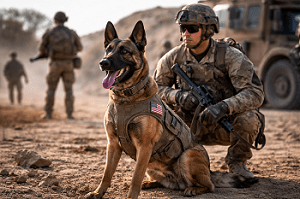
Military working dogs (MWDs) don’t hold official commissions, but in the U.S. military they’re traditionally treated as noncommissioned officers (NCOs), usually one rank above their handler. Their duties fall into three groups: single-purpose dogs (explosives, narcotics, search, mine or tracking work), dual-purpose dogs (patrol plus one type of detection), and multi-purpose canines that support special operations. Most U.S. dogs train for about 120 days at Joint Base San Antonio-Lackland in Texas before they join a unit.
Table of Contents
- Introduction
- Do Military Working Dogs Really Have Ranks?
- The Real Rank Ladder: Who Runs a Dog Team
- Military Working Dog Roles and Duties
- What an MWD Actually Does All Day
- How Military Working Dogs Are Trained and Certified
- Which Breeds Do the Work?
- Medals, Honors and Famous War Dogs
- Life After Service: Retirement and Adoption
- What a Working Handler Wants You to Know
- Frequently Asked Questions
- Final Thoughts
Introduction
Ever heard that a military dog outranks the soldier holding the leash? It’s one of the most repeated “facts” about working dogs online. It’s also half true, half myth, and most articles on the topic don’t tell you which half is which.
Here’s the problem. Search for military working dog ranks and you’ll find three kinds of pages. Some repeat the “dogs always outrank handlers” line with no source. Others list jobs like “sniffs bombs” without explaining the real job titles. A few talk about history and skip how the system works today.
This guide fixes that. You’ll learn what the rank tradition really says (and what nobody has proven), the actual job categories MWDs fill, the career ladder for the humans who run dog teams, how dogs get trained and certified, and what happens when they retire. I wrote it for both curious dog owners and people who handle working dogs for a living, so I’ll keep the language plain.
Do Military Working Dogs Really Have Ranks?
Short answer: Not official ones. In the U.S. military, working dogs are traditionally called noncommissioned officers (NCOs), and a dog’s honorary rank usually matches or sits one step above its handler’s. No regulation we could find orders this. It’s a custom.
That’s the part most pages get wrong in one of two directions. Some say “dogs have no rank at all.” Others say “dogs always outrank handlers, it’s the rule.” Neither is quite right.
What the NCO Tradition Actually Says
A TRADOC blog post on army.mil describes every military working dog as an NCO “in tradition at least.” Fact-checkers at Snopes later confirmed the U.S. Army website says dogs on active duty are traditionally NCOs. They also found no primary source proving why the custom exists.
An Air Force officer who commanded the 341st Training Squadron gave a clear explanation to HowStuffWorks. Most handlers start between E-3 (Private First Class) and E-5 (Sergeant), depending on the service. Because the dog is an NCO, it would match or outrank the handler. He said mutual respect between the two would, in theory, discourage mistreatment.
Notice the words “in theory.” That’s honest wording, and it’s the best summary of where the evidence stands.
Does the Dog Always Outrank the Handler?
Not always. Look at how the numbers work:
| Handler’s rank | Dog’s honorary NCO status | Who “outranks”? |
|---|---|---|
| E-3 (Private First Class) | NCO (for example, Sergeant) | Dog |
| E-4 (Specialist/Corporal) | NCO | Dog |
| E-5 (Sergeant) | NCO, often one step higher | Dog or equal |
| E-6 or above (supervisors) | Dog’s rank may be lower | Handler |
The table shows how the custom plays out in practice. It isn’t a regulation.
The “always one rank higher” version spreads because it’s easy to remember. Real units vary. A senior handler on a long-serving dog can easily hold the higher number.
Why the Tradition Exists (and What’s Myth)
You’ll often read that handlers would face prison for hitting a dog because the dog “outranks” them. Snopes looked into this. Striking a superior NCO falls under Article 91 of the Uniform Code of Military Justice, and that charge covers human NCOs. Mistreating a military dog would fall under other rules. So the idea that the rank itself protects the dog is a story, not a legal fact.
The better reason is cultural. Handlers who see their dog as a fellow NCO treat it like a teammate. A Military Working Dog School superintendent told Army writers the custom came from handlers who saw the dog as a partner. She said it’s growing stronger, and you can see that in recent stories about dogs getting promotions and funeral honors.
What About Other Countries?
The “dog outranks handler” idea is mostly an American tradition. The British Army handles things differently. Its 1st Military Working Dog Regiment, part of the Royal Army Veterinary Corps, gives each dog a name, a service number, a health and training record, and its own military veterinarian. In other words, the dog is tracked like a soldier even without a formal rank. Australia, Canada and other allies run their own programs with their own customs.
The Real Rank Ladder: Who Runs a Dog Team
Here’s something most competitors skip. The ranks that matter day to day belong to the people. A dog team has a clear human chain behind it.
- Handler: Cares for, trains and deploys one assigned dog. Handlers usually start around E-3 to E-5.
- Kennel master: Runs the kennel, schedules training, manages vet visits and keeps records. The 341st Training Squadron offers a dedicated Kennel Master Course.
- Trainer/instructor: Prepares dogs and handlers at schools such as Lackland.
- Supervisor/program manager: Sets policy and decides how dog teams support each command. The Army has MWD program managers at major commands.
Each U.S. service has its own handler career field. The Army made handler its own job (MOS 31K) in 2014. The Marine Corps uses MOS 5812. The Navy places handlers in the Master-at-Arms rating, and the Air Force trains them through Security Forces. Today’s Military describes handler duties as law enforcement, physical security, anti-terrorism and detecting explosives or drugs with an assigned dog.
An Army instructor told AUSA that MWD handlers are “held to a higher standard than most soldiers.” That makes sense. A handler often deploys as a pair, not in a large unit, so they work with less supervision and carry full responsibility for the dog’s health and behavior.
Military Working Dog Roles and Duties
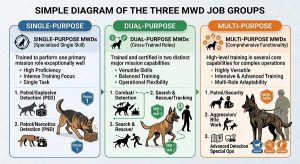
U.S. military dogs fall into three buckets. This is the framework you won’t find on most “ranks and roles” pages.
Single-Purpose Dogs
Single-purpose dogs do one specialized job. Detection dogs search for drugs or explosives, never both. Keeping the jobs separate means a handler doesn’t have to guess what the dog is alerting to.
- Explosive Detector Dog (EDD): Works mainly with military police at checkpoints, traffic stops and inspections. Usually on leash.
- Narcotics Detector Dog (NDD): Searches vehicles, luggage, buildings and people’s belongings for drugs.
- Specialized Search Dog (SSD): Works off leash at a distance, using hand signals and voice commands to clear routes and areas.
- Mine Detection Dog (MDD): Finds landmines and other buried explosives.
- Combat Tracker Dog (CTD): Follows a person’s trail over long distances.
Dual-Purpose Dogs
Dual-purpose dogs are the backbone of the program. A Patrol Explosive Detector Dog (PEDD) or Patrol Narcotics Detector Dog (PNDD) does patrol work, including controlled bites, plus one type of detection. Installations that can’t afford many specialist teams love them. One dog covers two needs.
Multi-Purpose Canines (MPCs)
Multi-purpose canines work with special operations units. They do what a PEDD does, but in tough, remote conditions. Some train to rappel from helicopters or parachute with their handler. Many wear tactical vests and cameras so handlers can see what the dog sees from a distance.
The most famous MPC is Cairo, a Belgian Malinois who joined the 2011 raid in Abbottabad, Pakistan, that killed Osama bin Laden. A later dog, Conan, gained worldwide attention eight years after Cairo.
Quick Comparison
| Role | Main job | Typical handler | Works off leash? |
|---|---|---|---|
| EDD | Explosives at checkpoints | Military police | Usually no |
| NDD | Drug searches | Military police/security | Usually no |
| SSD | Route and area clearance | Specialist handler | Yes |
| MDD | Landmines | Engineers/specialist | Varies |
| CTD | Trailing people | Specialist handler | Varies |
| PEDD/PNDD | Patrol + one detection | Military police/security | Mixed |
| MPC | Special operations support | Special operations handler | Yes |
What an MWD Actually Does All Day
Movies make it look like constant combat. Real life looks different.
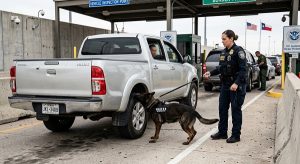
On a home base, a patrol dog team might walk a perimeter at night, check gates and sweep buildings. The dog’s presence alone changes behavior. Most people avoid places where a trained dog and a handler stand watch.
On deployment, the same team may search roads, vehicles and compounds, escort convoys or respond to a security breach. Soldiers’ Angels notes that early war dogs served as sentries, scouts, messengers and mine detectors, and those jobs have grown ever since.
The part nobody films is kennel life. Handlers feed, groom, exercise and check their dog every single day. They keep training logs and watch for small changes in energy or appetite. A detection dog that’s slightly off can miss a find. So handlers treat daily care as part of the mission.
Dogs also work outside combat. Military school staff train working dogs for other federal agencies and allies too. The skills carry over to airports, borders, police work and disaster response. If you want to see how scent skills hold up in odd places, check our guide on whether military dogs can smell explosives through water or metal.
How Strong Is a Dog’s Nose, Really?
You’ll see claims that dogs smell 10,000 to 100,000 times better than people. Researchers like Alexandra Horowitz have cited that range, and it’s a useful ballpark. Treat it as an estimate, not a lab constant, because sensitivity changes with the odor, the dog and the conditions.
How Military Working Dogs Are Trained and Certified
Most U.S. dogs start at JBSA-Lackland, home of the 341st Training Squadron. It trains MWDs and handlers for the Department of Defense and other government agencies and allies. The base averages roughly 800 dogs at a time, and the 341st has said it has over 800 dogs without 800 caretakers, which is why it started an enrichment program in 2024.
Where the Dogs Come From
Lackland started a breeding program in 2005, and its only breed is the Belgian Malinois. Dogs also come from European vendors and other sources. Many dogs enter Lackland’s “canine high school” around seven months old, when they’re coming out of adolescence.
The 120-Day Program
The Military Working Dog Training Program lasts about 120 days. Dogs learn patrol work plus one detection discipline, either explosives or drugs. Typical lessons include:
- Obedience: Sit, down, heel, recall and stay, with distractions.
- Detection: The dog learns target odors and gets rewarded for finding them. Rewards build the habit.
- Patrol skills: Searching, guarding, controlled aggression and releasing on command.
- Environmental conditioning: Gunfire, helicopters, crowds, slippery floors and tight spaces.
- Team training: Handler and dog train together so they read each other’s signals.
For a closer look at the methods, see how military working dogs are trained: the real techniques.
Many Dogs Don’t Make the Cut
An Army article on Lackland explained the math: to produce 100 serviceable dogs a year, the program tries to train about 200. That’s roughly half. Detection and patrol work demand a rare mix of drive, nerve and health, so washouts are normal. Many washed-out dogs find work in law enforcement or homes.
Certification
Dogs get tested before they deploy and again every year. One summary reports explosive detection dogs must hit 95 percent proficiency and drug dogs 90 percent. Treat those numbers as reported figures and not official policy text. What’s certain is that teams have to keep proving they can do the job. A dog that stops performing doesn’t stay on the line.
Cost matters too. A museum summary from the Hawaii Army Museum Society puts the cost of training one dog at around $150,000 and credits the dogs with 98 percent accuracy. Those are widely quoted numbers, and real costs shift over time. Use them as a rough guide.
Which Breeds Do the Work?
Four breeds do most of the work, each for good reasons.
- Belgian Malinois: High drive, fast, athletic and easy to move around. The favorite for patrol and special operations. Cairo, Kuga and Mali were all Malinois.
- German Shepherd: Strong, steady and versatile. German Shepherds served in World War I and held the top spot in the Army for decades. They still excel at patrol, tracking and detection.
- Dutch Shepherd: Tough, adaptable and a good all-purpose patrol and detection dog.
- Labrador Retriever: The gap in most competitor articles. Labs often work explosive and narcotic detection and search tasks. Their friendly manner suits crowds, aircraft and ships.
A good MWD isn’t just a “tough breed.” It’s a dog with stable nerves, a strong play or food drive and good health. I’d take a calm, focused dog from a less famous line over a flashy dog that panics at loud noise.
Medals, Honors and Famous War Dogs
Rank isn’t the only way militaries honor dogs. Medals matter too.
The Dickin Medal
The PDSA Dickin Medal is the best-known animal gallantry award, often called the animals’ Victoria Cross. The PDSA says it’s been awarded 75 times since 1943, with recipients including 38 dogs, 32 pigeons, four horses and one cat.
Recent dog recipients include Lucca, a U.S. Marine Corps explosive detection dog (2016), Mali, a Royal Army Veterinary Corps Malinois (2017), Chips (2018), and Kuga, an Australian SASR Malinois (2018). Lucca reportedly led nearly 400 patrols in Iraq and Afghanistan and found about 40 IEDs.
The U.S. Now Has Its Own Medal
The Animals in War & Peace Medal of Bravery began in 2019 as an American equivalent of the Dickin Medal. A second honor, the Distinguished Service Medal, came in 2022.
Chips: A Story Often Told Wrong
Many articles say Chips “earned several medals.” The real story is messier. Chips was a sentry dog with the Army’s 3rd Infantry Division. During the 1943 invasion of Sicily, he went after a machine-gun nest. His unit recommended the Distinguished Service Cross, Silver Star and Purple Heart, but those awards were later revoked because of an Army policy against officially commending animals.
Chips waited more than 70 years. In 2018 he became the 70th recipient of the Dickin Medal. That tells you something about how military thinking about dogs has changed.
Sergeant Stubby
Stubby, a Bull Terrier mix who served in World War I with the 102nd Infantry, is often named as the first dog to earn a rank. Sources disagree on details, so I’d call him the best-known early example of a dog promoted to sergeant, not a settled “first.”
Life After Service: Retirement and Adoption
It used to be common for dogs to be left behind or put down when their service ended. Robby’s Law, signed in 2000, changed that and let retiring dogs go to former handlers, law enforcement agencies or other qualified homes. A 2016 defense law added further protections, including handler priority in adoption. Check the current statute text if you need exact legal wording.
Most dogs retire after years of work for age, injury or health reasons, not just a calendar date. Many go home with their former handlers, and some move on to law enforcement work.
What a Working Handler Wants You to Know
Experience note (E-E-A-T): This site’s author, Cpl. Rofiat Muritala, is a Nigerian Army military working dog instructor and handler with more than 14 years of experience at the Nigerian Army Dog Centre. Her background covers dog selection, foundation training, behavior shaping and performance evaluation. She represented the Dog Centre at the Nigerian Army Day Celebration (NADCEL) 2026, leading demonstrations in obedience, explosive detection, agility and tactical movement.
Here are the lessons that matter most from that kind of hands-on work:
- Rank is symbolic. Care is real. Honorary rank only works if the handler feeds, rests and checks the dog properly every day.
- Obedience comes first. A detection dog that won’t listen under stress is a risk. That’s why basic commands get drilled in loud, busy places.
- Short, frequent sessions beat long ones. Dogs learn faster and stay keen.
- Match the dog to the job. A Malinois that thrives on patrol may bore itself silly on a quiet gate. The right job saves dogs from stress.
Want to go deeper on building these habits at home? Beyond the Bark: Inside a Pro Handler’s Playbook for Raising the Ideal Dog breaks down professional handler methods in everyday terms. Get Beyond the Bark here.
For protection-style work, our guide to essential protection dog commands shows the control skills patrol dogs rely on.
Frequently Asked Questions
1. Do military working dogs have official ranks?
No. Dogs don’t hold formal commissions. In the U.S. military they’re traditionally treated as NCOs, and their honorary rank usually matches or sits above their handler’s. It’s a tradition, not a regulation.
2. Why do military dogs outrank their handlers?
The best-documented reason is respect. An NCO title encourages handlers to treat the dog as a teammate. Some sources say it also deters mistreatment, but Snopes found no primary source confirming that purpose.
3. What jobs do military working dogs do?
They fall into three groups: single-purpose (explosive, narcotics, specialized search, mine and combat tracking), dual-purpose (patrol plus one detection skill) and multi-purpose canines that support special operations.
4. How long does it take to train a military working dog?
The core U.S. program lasts about 120 days at JBSA-Lackland, after dogs reach roughly seven months of age. Roughly half the dogs the program starts don’t become serviceable.
5. Which breeds are used most?
Belgian Malinois, German Shepherds, Dutch Shepherds and Labrador Retrievers. Malinois dominate patrol and special operations work, and Labradors often handle detection.
Final Thoughts
Military working dog ranks make a great story, but the real value lies in what the dogs do. The NCO tradition is a custom that builds respect. The jobs are very real: explosive detection, narcotics searches, patrol, tracking, and special operations support. Behind every dog sits a trained handler, a kennel master, a trainer and a long program that works only about half the time.
If you remember three things, make them these. First, honorary rank is tradition and not law. Second, the three job groups explain almost everything an MWD does. Third, the best teams succeed because of daily care and trust, not titles.
Want more handler-tested guides like this one? Subscribe to our weekly articles roundup newsletter at https://arfsk9team.com.ng/newsletter/ and get the best new posts in your inbox every week.
Sources Used
- Soldiers’ Angels, “Dogs of Duty: The Story and Legacy of Military Working Dogs”
- U.S. Army (army.mil/TRADOC blog and “Guardians of the Night” article)
- Snopes fact check on Army dogs outranking handlers (July 2024)
- HowStuffWorks, “U.S. Military Dogs Usually Outrank Their Handlers”
- AUSA, “Ruff and Ready: Military Working Dogs Serve Unique Roles”
- Today’s Military, “Military Dog Handlers”
- 37th Training Wing / JBSA news on the 341st Training Squadron
- PDSA, Dickin Medal roll of honour and Chips announcement
- Wikipedia: 1st Military Working Dog Regiment; Animals in War & Peace Medal of Bravery
- Hawaii Army Museum Society, “A History of Military Working Dogs”

Her work centres on obedience, detection, protection and operational readiness. She favours proven methods built on repetition, consistency and real-world conditioning, so that both dogs and handlers are prepared for high-pressure tasks.
Rofiat represented the Nigerian Army Dog Centre at the Nigerian Army Day Celebration (NADCEL) 2026, where she led demonstrations in obedience, explosive detection, agility and tactical movement. Through articles, training content and documentaries, she shares field-based insight into how structured training, clear communication and trust between handler and dog affect performance and reliability.
She is the author of Beyond the Bark: Inside a Pro Handler's Playbook for Raising the Ideal Dog, a practical guide that helps dog owners and handlers apply professional training principles in everyday situations.
- Dog Agility Course Layout: Easy DIY Setup - October 7, 2026
- Local Dog Breeds: Temperament, Health & Training Guide - October 6, 2026
- How Long Do Military Working Dogs Serve? Full Guide - October 5, 2026