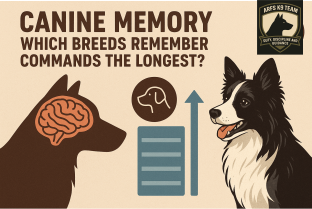
Canine Memory: Which Breeds Remember Commands the Longest?
When people talk about intelligent dogs, they often focus on how quickly a dog can learn a new command. While learning speed is impressive, it is only one part of canine intelligence. Equally, if not more important is memory retention: a dog’s ability to remember commands, routines, and behaviors over long periods of time.
This distinction matters greatly in real-world situations. A dog that learns a command in five minutes but forgets it after a week is far less reliable than a dog that learns more slowly but remembers the command for years. For working dogs involved in obedience training, security operations, police and military service, search-and-rescue missions, therapy work, or assistance roles, long-term memory is essential. Even for family pets, strong memory improves safety, communication, and bonding.
Dogs are not just instinct-driven animals. Through thousands of years of domestication and selective breeding, they have developed sophisticated cognitive abilities. Many breeds are capable of remembering commands, people, locations, scents, and routines for months or even years, sometimes for life.
In this article, we will explore how canine memory works, the factors that influence it, and which dog breeds are best known for remembering commands the longest. We will also share practical tips to help any dog improve memory retention, regardless of breed.
Understanding How Canine Memory Works
Canine memory operates differently from human memory, but it is highly functional and purpose-oriented. Dogs do not typically recall memories as detailed stories the way humans do. Instead, they store information based on associations, repetition, and emotional relevance.
Dogs remember what matters to survival, work, and relationships. Commands linked to rewards, routines, or strong emotional experiences are far more likely to be retained than neutral or inconsistent information.
Short-Term Memory in Dogs
Short-term memory (STM) allows dogs to process immediate information. Research suggests that a dog’s short-term memory may last anywhere from a few seconds to several minutes, and in some cases, up to a few hours.
Short-term memory helps dogs with tasks such as:
- Remembering where a toy or treat was just hidden
- Responding to a command that was recently given
- Associating a recent action with praise or correction
- Navigating short sequences of behavior during training
This type of memory is critical during training sessions. However, without reinforcement, information stored in short-term memory fades quickly. This is why repetition and immediate rewards are so important when teaching new commands.
Long-Term Memory in Dogs
Long-term memory (LTM) is where dogs truly shine. When commands, behaviors, or experiences are consistently reinforced, they are transferred into long-term memory. These memories can last for months or even years.
Long-term memory allows dogs to remember:
- Basic and advanced obedience commands
- Complex work routines
- Scent patterns and tracking paths
- Familiar people, including handlers and family members
- Places associated with safety, fear, excitement, or reward
This explains why a well-trained dog can return to work after a long break and still perform effectively. It also explains why dogs can recognize former owners after years of separation.
Types of Long-Term Memory in Dogs
Canine long-term memory can be broadly divided into two main categories, both of which play a role in command retention.
1. Procedural Memory
Procedural memory refers to a dog’s ability to remember how to perform tasks. This is often compared to “muscle memory” in humans.
Examples include:
- Sitting or lying down on command
- Responding to hand signals
- Tracking scents
- Jumping obstacles
- Performing protection or agility routines
Once procedural memory is well established, behaviors become almost automatic. The dog no longer needs to consciously think about the command, it simply responds. This type of memory is especially strong in working breeds and is one reason trained dogs can perform under pressure or stress.
2. Declarative (Associative) Memory
Declarative memory in dogs is less about facts and more about associations. Dogs remember people, objects, places, and experiences by linking them to emotions.
Examples include:
- Recognizing a former handler after years apart
- Remembering a place where something frightening occurred
- Associating a specific sound with feeding time
- Remembering which door leads outside
Although dogs may not recall events in detail, emotional associations greatly strengthen memory retention. Commands learned in positive, emotionally engaging environments are far more likely to be remembered.
Factors That Affect Memory Retention in Dogs
Not all dogs remember commands equally. Several factors influence how well a dog retains learned behaviors.
1. Breed and Genetics
Selective breeding has played a major role in shaping canine memory. Breeds developed for herding, guarding, hunting, or service work were specifically chosen for traits such as focus, responsiveness, and long-term retention.
These genetic advantages give certain breeds a natural edge when it comes to remembering commands.
2. Training Methods
Training style has a massive impact on memory. Dogs trained using positive reinforcement like treats, praise, play, and consistency tend to show stronger long-term retention.
Harsh or fear-based methods may produce short-term obedience, but they often weaken memory over time. Stress interferes with learning and can cause confusion rather than clarity.
3. Age and Cognitive Development
Puppies absorb information quickly, but their memory is still developing. Without reinforcement, young dogs may forget commands easily.
Adult dogs, when trained correctly, often display stronger and more stable long-term memory. Senior dogs can also retain commands well, although learning new behaviors may take longer.
4. Motivation and Drive
Dogs remember what matters to them. High-drive dogs and working breeds tend to retain commands better because training fulfills their natural instincts.
Food motivation, play drive, social bonding, and a sense of purpose all strengthen memory formation.
Dog Breeds Known for Exceptional Long-Term Memory
Certain breeds consistently stand out for their ability to remember commands over long periods.
1. Border Collie
Border Collies are widely considered the most intelligent dog breed in the world. Bred for complex herding tasks, they possess extraordinary focus, problem-solving ability, and procedural memory.
They can remember hundreds of commands and complex sequences, even with minimal reinforcement. Border Collies excel in obedience, agility, and advanced working roles where memory precision is critical.
2. German Shepherd
German Shepherds are legendary for their reliability in police, military, and security work. Their strong memory allows them to retain commands, patrol routines, and tactical behaviors for years.
They combine intelligence with emotional stability, making them capable of performing under stress while still responding accurately to commands learned long ago.
3. Labrador Retriever
Labradors are not just friendly family dogs, they are among the most reliable working breeds. Their eagerness to please, combined with strong long-term memory, makes them ideal for guide dog work, detection tasks, and search-and-rescue missions.
Well-trained Labradors often retain obedience and service commands for life.
4. Golden Retriever
Golden Retrievers are calm, intelligent, and emotionally intuitive. Their ability to remember commands, routines, and people makes them excellent therapy dogs, assistance dogs, and rescue workers.
They respond especially well to positive reinforcement, which strengthens memory retention.
5. Poodle (Standard and Miniature)
Poodles are often underestimated, but they are among the smartest dog breeds. They excel at learning abstract commands and remembering them long-term when training is structured.
Their intelligence and adaptability make them strong performers in obedience and service roles.
6. Belgian Malinois
Belgian Malinois are elite working dogs used extensively in military and special operations. Their intense focus, drive, and memory retention allow them to perform complex tasks under extreme conditions.
They are capable of remembering tactical commands with precision, even in high-stress environments.
Lesser-Known Breeds With Strong Memory Retention
Some breeds do not get as much attention but still demonstrate excellent memory.
- Australian Shepherds – Exceptional at remembering multi-step herding commands
- Shetland Sheepdogs – Highly responsive with strong cue recognition
- Papillons – Small in size but impressive in intelligence and memory
These breeds prove that size does not determine cognitive ability.
How to Improve Memory Retention in Any Dog
Even dogs without strong genetic advantages can develop excellent memory with the right approach.
Use Consistency
Always use the same verbal commands and hand signals. Inconsistency confuses dogs and weakens memory formation.
Practice Repetition Correctly
Short, frequent training sessions are more effective than long, exhausting ones. Repetition strengthens neural pathways.
Rely on Positive Reinforcement
Rewards create strong emotional associations, which improve long-term memory.
Provide Mental Stimulation
Puzzle toys, scent games, and problem-solving tasks keep the brain active and support cognitive health.
Train in Different Environments
Practicing commands in new locations helps dogs generalize behaviors, making memory more durable.
Conclusion
Canine memory varies by breed, training, and experience, but dogs bred for intelligence, cooperation, and work consistently demonstrate superior long-term command retention. Border Collies, German Shepherds, Labradors, Golden Retrievers, and Belgian Malinois represent some of the best examples of dogs that remember commands for years.
However, memory is not determined by genetics alone. With consistent training, positive reinforcement, and meaningful engagement, nearly any dog can develop strong, reliable memory. Ultimately, the secret to a dog that remembers commands for life lies in patience, clarity, emotional connection, and purposeful training.

Her work centers on applied training across obedience, detection, protection, and operational readiness, with a strong focus on Military Working Dogs (MWDs) and security K9 programs. Rather than theory alone, Rofiat emphasizes proven training methods, repetition, consistency, and real-world conditioning that prepare dogs and handlers for high-pressure tasks.
Through articles, training content, and documentaries, she shares experience-based insights drawn from the field, highlighting how structured training, clear communication, and trust between handler and dog directly impact performance and reliability.
She remains committed to responsible K9 development, continuous skill refinement, and practical education for handlers, trainers, and dog professionals.
- Detection Tactics Every Dog Owner Should Know to Prevent Counter-Surveillance and Tracking - February 11, 2026
- STOP Feeding Your Dogs These Common Human Stews - February 9, 2026
- German Shepherd vs Belgian Malinois: Which Breed Is More Intelligent for Working and Security Roles - February 6, 2026