Pro Indoor Drills for High Energy & High Drive Dogs
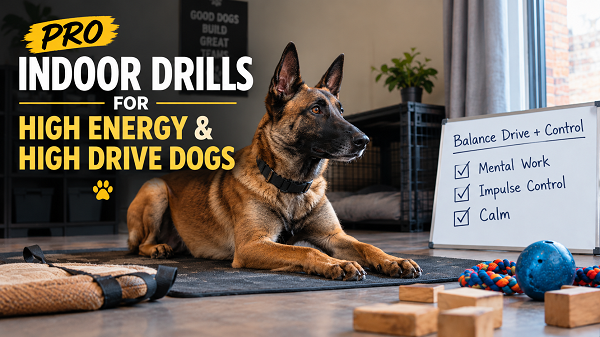
The best indoor drills for high energy dogs mix three things: brain work (scent games, discrimination), control work (impulse control, place, door manners) and calm work (mat settling). Use short 3–5 minute sessions, 3–5 times a day. Always finish with a settle exercise. Physical exercise alone makes a fitter dog. Structured thinking, followed by a taught “off-switch,” makes a calmer one.
Table of Contents
- Energy vs. Drive: Why Your Dog Isn’t Just “Hyper”
- Before You Start: Safe Indoor Setup
- The Charge–Channel–Calm Loop (The Part Most Guides Skip)
- 12 Pro Indoor Drills (Step by Step)
- Which Drills Fit Which Breed or Drive Type
- The 7-Day Indoor Training Plan
- How to Tell If It’s Working
- Troubleshooting: “My Dog Gets More Wound Up”
- Handler Field Notes (Why Trust This Guide)
- FAQs
- Final Thoughts
Introduction
You come home. Your Malinois, Shepherd or Border Collie is pacing the hallway. The cushion is shredded. It’s raining, the park is closed, and you’ve got 20 minutes before your next task.
Sound familiar?
Here’s the problem. Most advice says “just add more exercise.” But if you’ve tried that, you know what happens. You get a dog who needs two hours instead of one. You’re building an athlete, not a calm companion.
I’ve worked with high-drive working dogs for years, and the fix isn’t more running. It’s structure. In this guide, you’ll learn how to read your dog’s drive, set up a safe indoor space, run 12 handler-tested drills, and use a simple loop that teaches your dog to switch off. You’ll also get a 7-day plan you can start tonight.
Energy vs. Drive: Why Your Dog Isn’t Just “Hyper”
Many owners use “high energy” and “high drive” like they mean the same thing. They don’t.
- Energy is how much fuel the dog has. A Labrador puppy has lots of it.
- Drive is what the dog wants to do with that fuel. It’s the inner motor that says “chase,” “search,” “tug,” or “guard.”
A high-energy dog bounces around. A high-drive dog locks on. If you’ve seen a Malinois stare at a ball like it owes him money, that’s drive.
Working-dog programs select for exactly this. At the US military’s Lackland training center, the Belgian Malinois is the only breed in the breeding program, and only puppies that show strong drive, adapt well to new environments, and respond to reward-for-work motivation move into pre-training. Those are the same traits that make these dogs hard to live with in a flat.
Here are the drives you’ll meet most often:
| Drive | What it looks like | Best indoor outlet |
|---|---|---|
| Prey drive | Staring, stalking, chasing moving things | Controlled flirt pole, tug with rules |
| Search/hunt drive | Nose down, can’t stop sniffing | Scent games, box searches |
| Play drive | Loves toys, wants to engage with you | Tug, toy-name games |
| Pack/handler drive | Watches you constantly, wants jobs | Place work, heel patterns, tricks |
| Defense drive | Barking at sounds, guarding doors | Door drills, place under distraction |
Once you know which drive leads your dog, you can pick drills that feed it in a controlled way. That’s the difference between a random game and a drill.
Before You Start: Safe Indoor Setup
Most blogs skip this. Please don’t. I’ve seen more strained shoulders from slippery floors than from any outdoor sport.
Your floor checklist:
- Grip first. Tile and laminate are risky for fast turns. Put down a rubber-backed rug or yoga mat for any drill that involves speed.
- Clear a 2m x 2m zone (about 6 x 6 feet). That’s all you need.
- Pad the sharp corners. Move coffee tables and low furniture.
- Pick one training spot. Dogs learn “this place = work mode” fast.
Safety rules I follow:
- Warm up. Do 60 seconds of slow walking and a few sits and downs before any fast game.
- No long hallway sprints. Repeated hard stops on a hard floor are tough on joints. Short bursts with calm breaks are better.
- Protect growing dogs. Large-breed puppies are still developing joints well into their first year or more. Skip repeated jumping and high obstacles. Ask your vet when your pup can start higher-impact work.
- Watch the signals. Heavy panting, dropping out of the game, or wobbly movement means stop.
- Mind the neighbors. If barking is an issue, favor quiet drills (scent work, place work, mat settling) in the evening.
The Charge–Channel–Calm Loop (The Part Most Guides Skip)
Here’s the thing that changed my training the most.
Most owners run games that only wind the dog up. They never teach the wind down. So the dog learns: “Excitement is fun, and nothing ever ends it.”
Professional handlers train in a loop:
- Charge: a short burst of excitement (30–60 seconds of tug, a toy chase, an energetic “ready” cue).
- Channel: a thinking task that needs control (scent search, place, heel pattern).
- Calm: a settle exercise on a mat, ending with real rest.
Every session of 3–5 minutes follows this order. You charge the engine, point it somewhere useful, then teach the brake.
Research on this is limited, so I won’t promise exact numbers. But practitioners see the same pattern. One dog trainer reports better results from three 8-minute training sessions than from one long indoor fetch session. The same source warns that too many high-energy games, such as hallway fetch, can leave a dog overstimulated, barking, mouthing, and unable to settle. That matches what I see in the field.
Rule of thumb: for every minute of “charge,” spend at least two minutes on “channel” and “calm.”
12 Pro Indoor Drills (Step by Step)
Do 3–5 minutes per drill. Pick one from each group per session.
Group A: Brain Drills (Scent and Thinking)
Why scent? A dog can have up to 300 million scent receptors, compared with about 5 million in a human, and the brain area for analyzing smell is about 40 times larger. When you ask a dog to search, you’re using the biggest part of the machine. (Receptor counts vary by breed, but the point stands: the nose is the dog’s main tool.)
Here’s my honest take. You’ll see claims online like “10 minutes of nose work equals an hour-long walk.” No study gives that exact exchange rate. What I can say from the field is that scent work makes dogs settle faster afterward, especially when you follow it with a mat settle.
Drill 1: The Find-It Ladder
Goal: Build search drive and focus.
Setup: A handful of pea-sized treats.
- Level 1: Toss a treat on the floor and say “Find it.”
- Level 2: Drop three treats in a small area, then step away.
- Level 3: Ask for a “Wait” (out of sight), hide treats across the room, release with “Find it.”
- Level 4: Hide treats high (on a low chair) and low (behind a table leg).
- Level 5: Hide treats in a different room.
Common mistake: Making it too hard, too fast. If your dog wanders off, go back one level.
Drill 2: Three-Box Search
Goal: Teach discrimination (picking the right thing).
Setup: Three cardboard boxes, one treat.
- Put the treat in one box with the lids open. Let your dog find it.
- Close the flaps partly. Let your dog nose or paw it open.
- Hide the treat in a different box each round.
- Advanced: Use a favorite toy as the reward instead of food.
Tip: Use a marker word (“Yes!”) the moment your dog’s nose touches the right box.
Drill 3: Toy-Name Game
Goal: Build memory and handler focus.
Setup: Three different toys.
- Pick one toy. Say its name every time you give it (“Rope!”).
- After 3–5 days, put two toys on the floor and ask for “Rope.”
- Reward only the correct pick.
- Add a third toy.
Why it works: The dog has to listen to words, not just chase. It’s brain work with almost no movement.
Group B: Control Drills (Impulse Control)
Drill 4: It’s Your Choice
Goal: Teach the dog that waiting makes good things happen.
- Hold a treat in your closed fist. Let your dog sniff, lick or paw.
- The moment he pulls away, mark “Yes!” and give a treat from your other hand.
- Once he backs off right away, open your hand slightly. Close it if he lunges.
- Final level: put the treat on the floor under your hand, then uncover it.
Time to learn: Most dogs get Level 1 in two or three sessions.
Drill 5: Door Threshold Wait
Goal: Calm manners at doors, a big deal for defense-driven and excited dogs.
- Hold the door handle. If the dog moves forward, stop.
- When he pauses with all four paws still, open the door an inch.
- Open further only while he stays calm.
- Release with a clear word (“Okay!”) after he’s waited a full 3 seconds.
- Build up to opening the door fully and stepping through first.
Drill 6: The Place Ladder
Goal: A rock-solid “go to your bed and stay.”
Setup: A raised cot or a distinct mat.
- Day 1–2: Reward the dog for stepping onto the mat.
- Day 3–4: Ask for “Down” on the mat. Reward every 5 seconds.
- Day 5–7: Add distance and duration (30 seconds, then 1 minute).
- Week 2: Add distractions. Drop a pen, walk past, knock at the door.
- Week 3+: Build to 5 minutes while you move around the room.
Pro tip: Always release the dog. Never let him decide when it’s done.
Drill 7: Tug With Three Rules
Goal: Use play drive and teach “out” under excitement.
- Rule 1: The dog needs a calm sit before the game starts.
- Rule 2: The dog only takes the toy on your word (“Take it”).
- Rule 3: When you say “Out,” the dog lets go. You then ask for a sit and restart.
If the dog won’t drop it, trade for a treat or a second toy. Never yank. Training programs often use toys as the main reward for working dogs. For example, the military program at Lackland is built on positive rewards, usually a ball or rubber toy rather than food.
Group C: Body Drills (Small-Space Movement)
Drill 8: Floor Ladder (Broomstick Poles)
Goal: Body awareness and slow, careful footwork.
Setup: 4–5 broomsticks or poles lying flat on the floor, about a foot apart.
- Walk your dog slowly over the poles on leash.
- Reward calm, careful steps.
- Once he’s good, do it off leash, then from a distance.
Note: Keep poles flat, not raised. This is about thinking with his feet, not jumping.
Drill 9: Perch Pivot
Goal: Rear-end awareness and focus. This is a classic working-dog foundation exercise.
Setup: A sturdy, non-slip box or low stool, about 4–6 inches high.
- Reward your dog for putting two front paws on it.
- Hold a treat near his hip and lure his back legs to step sideways.
- Mark and reward each step around the box.
- Aim for a full circle in both directions.
Why it works: The dog has to control his whole body in a tiny space.
Drill 10: Figure-8 Heel
Goal: Handler focus and tight control.
Setup: Two chairs about 1.5 metres apart.
- Walk a figure-8 around the chairs with your dog at your left side.
- Reward whenever he stays glued to your leg.
- Change speed and direction to keep him thinking.
Drill 11: Controlled Flirt Pole
Goal: Burn prey drive safely, with rules.
Setup: Non-slip surface, a short flirt pole.
- Ask for a sit. Start the toy moving low and slow.
- Let him chase for 20–30 seconds only.
- Say “Out.” Stop the toy completely. Wait for a sit.
- Let him “win” the toy at the end, then trade it for a treat.
Caution: Keep sessions short and avoid sharp pivots on slippery floors. This is a high-intensity drill, so always end with Drill 12.
Group D: Calm Drills (The Off-Switch)
Drill 12: Mat Settle
Goal: Teach the dog to relax on cue, which is the skill most owners are missing.
- Place the mat. When your dog lies on it by himself, quietly drop a treat between his paws.
- Keep rewarding for lying still. Slowly stretch the time between treats.
- Add a cue (“Settle”) as he’s already lying down.
- Reward deep signs of relaxation: a hip roll, a long sigh, a head down.
- Finish with a long-lasting chew or lick mat on the mat.
Pro tip: Practice this when the dog is already a bit tired at first. Settling a wired dog is a later skill.
Which Drills Fit Which Breed or Drive Type
| Dog type | Lead drive | Best starter drills | Watch out for |
|---|---|---|---|
| Belgian Malinois / Dutch Shepherd | Prey, play | 1, 7, 9, 12 | Frustration, mouthing when over-aroused |
| German Shepherd | Handler, defense | 5, 6, 10, 12 | Barking at door sounds |
| Border Collie / Australian Shepherd | Herding, handler | 3, 8, 10, 12 | Obsessive staring, fixation |
| Blue Heeler / Cattle Dog | Herding, prey | 4, 7, 11, 12 | Nipping when excited |
| Labrador / Retriever mixes | Play, search | 1, 2, 7, 12 | Overeating treats, so use kibble |
| Husky / Husky mixes | Independent, prey | 1, 2, 8, 12 | Boredom, lose interest fast |
If you own a Heeler, read our Blue Heeler training guide for nipping fixes that pair well with these drills.
The 7-Day Indoor Training Plan
Run 3–5 mini-sessions a day of 3–5 minutes each. Use the Charge–Channel–Calm loop each time.
| Day | Focus | Drills | Goal |
|---|---|---|---|
| 1 | Foundations | 1 (Level 1–2), 12 | Dog finds treats, lies on mat |
| 2 | Control | 4, 12 | Dog backs off the fist |
| 3 | Brain | 1 (Level 3), 2 | Dog solves a 3-box search |
| 4 | Doors + place | 5, 6 | 30 seconds of calm at the door |
| 5 | Body | 8, 9 | Dog completes poles and perch |
| 6 | Play with rules | 7, 11, 12 | “Out” works mid-game |
| 7 | Combine | Mix one from each group | A full 5-minute loop, start to finish |
A realistic schedule for a busy owner:
- Morning (5 min): Find-It ladder + mat settle before you leave
- Lunch or after work (5 min): Control drill + tug
- Evening (5–10 min): Box search or toy names, ending with place work during your dinner
What to expect, based on field experience: Most dogs show a small change in the first week (they find the mat, they wait for the door). Noticeable calm usually shows up in weeks 2 to 3. Reliable settling, even with distractions, typically takes 4 to 6 weeks of steady practice. Young, very high-drive dogs can take longer. That’s normal.
For the bigger picture on daily exercise needs (walks, runs, rest days), see our guide on how often to exercise a working dog.
How to Tell If It’s Working
Most guides never tell you how to measure progress. Here’s what I track:
- Settle time: How long after a game until he lies down on his own? Aim to cut it by half over 3 weeks.
- Recovery after a trigger: The doorbell rings. How quickly does he go back to calm? Time it.
- Response speed: When you say “Sit” mid-excitement, does he respond in 1 second or 5?
- Destruction count: Chewed items per week. This number should drop.
- Quality of rest: A deep sigh and a hip roll mean real relaxation. A stiff, alert lie-down does not.
Keep a simple note on your phone. Two weeks of numbers will tell you more than a gut feeling.
Troubleshooting: “My Dog Gets More Wound Up”
The dog goes crazy after tug or flirt pole.
You’re charging more than channeling. Shorten the charge to 20 seconds and add a control drill right away.
He whines or barks during scent games.
Frustration. The puzzle’s too hard. Go back a level.
He ignores treats.
He’s over-aroused. Try a quieter environment or wait 10 minutes. Or use his favorite toy as the reward.
He won’t settle on the mat.
You’re likely asking too much, too soon. Reward the tiniest moves toward lying down. Use a long-lasting chew to help.
He’s still destructive when you leave.
Mental work helps, but if he panics when alone, it may be separation distress. A crate routine can help; see our crate training guide. If it’s severe, talk to a qualified behaviorist or your vet.
Biggest handler mistake: Inconsistent rules. If “Out” works on Monday but you let him keep the toy on Tuesday, he learns nothing. Our post on common dog training mistakes covers the habits to fix first.
Handler Field Notes (Why Trust This Guide)
This guide comes from ARFS K9 Team and Cpl. Rofiat Muritala, a Nigerian Army military working dog instructor and handler with more than 14 years at the Nigerian Army Dog Centre. Her work covers dog selection, foundational training, behavior shaping and performance evaluation. She has completed advanced obedience, K9 patrol and explosive detection courses. In 2026 she led obedience, explosive detection, agility and tactical movement demonstrations at the Nigerian Army Day Celebration (NADCEL).
What shaped this approach in the field:
- Working dogs spend long hours in kennels or quarters. The ones that stay stable are the ones taught when to switch off.
- Structure beats volume. Short, clear sessions held attention better than long ones.
- The settle is trained, not hoped for.
I’m not a vet. If your dog has sudden behavior changes, limping, or signs of pain, see a veterinarian first.
Frequently Asked Questions
1. What are the best indoor drills for high energy dogs?
The most effective mix is scent games (Find-It, box search), impulse-control drills (It’s Your Choice, door wait), and a settle on a mat. Add short, controlled tug or flirt pole sessions for prey-driven dogs. End every session with calm work.
2. How do I tire out a high energy dog inside without a yard?
Use short, structured sessions, 3–5 minutes, 3–5 times a day. Combine a brief burst of play, a thinking task like scent work, and a settle. This tires the brain and teaches the dog to rest. Long hallway fetch alone tends to build fitness and excitement, not calm.
3. How long does it take to calm a high drive dog with indoor training?
Based on my experience, you’ll see small changes in week one and clearer calm in weeks 2 to 3. Reliable settling with distractions often takes 4 to 6 weeks. Age, breed, and consistency all change the timeline.
4. Is mental stimulation better than physical exercise for working breeds?
They do different jobs. Physical exercise keeps the body healthy. Mental work builds focus and self-control. High-drive dogs need both, plus a taught off-switch. Don’t swap one for the other.
5. Can a Belgian Malinois or German Shepherd live happily in an apartment?
Yes, if the owner meets their needs every day with outdoor exercise, structured training and real rest. Apartment life fails when the dog has no job and no off-switch. It works when the dog has both.
Final Thoughts: Space Doesn’t Limit You, Structure Does
You don’t need a big yard. You need a plan.
Here’s the short version:
- Know your dog’s drive. Pick drills that fit it.
- Make the space safe. Grip, clear zone, no long sprints.
- Use the loop. Charge, channel, calm. Never skip the calm.
- Start small. One group of drills, one week, 3–5 minutes at a time.
- Track progress. Settle time and recovery tell you the truth.
Tonight’s challenge: Teach the mat settle (Drill 12) for 5 minutes. That one skill changes everything else.
Want the full system? Many of the principles here (impulse control, handler communication, building a calm dog) are explained in more depth in our book, Beyond the Bark: Inside a Pro Handler’s Playbook for Raising the Ideal Dog.
Get one useful K9 training article a week. Subscribe to our weekly roundup at arfsk9team.com.ng/newsletter.

Her work centres on obedience, detection, protection and operational readiness. She favours proven methods built on repetition, consistency and real-world conditioning, so that both dogs and handlers are prepared for high-pressure tasks.
Rofiat represented the Nigerian Army Dog Centre at the Nigerian Army Day Celebration (NADCEL) 2026, where she led demonstrations in obedience, explosive detection, agility and tactical movement. Through articles, training content and documentaries, she shares field-based insight into how structured training, clear communication and trust between handler and dog affect performance and reliability.
She is the author of Beyond the Bark: Inside a Pro Handler's Playbook for Raising the Ideal Dog, a practical guide that helps dog owners and handlers apply professional training principles in everyday situations.
- K9 Advantix Dosage Chart & Safety Guide for Dogs - October 19, 2026
- How to Set Up & Use Bousnic Dog Training Collar - October 18, 2026
- Westminster Dog Show 2026: Winners & Full Results - October 17, 2026