Basic Protection Commands for the Family Pet: Teaching Your K9 to Be an Asset, Not a Liability
When most people hear the phrase “protection dog,” they immediately picture something extreme: military-style training, bite suits, intimidating commands, and dogs bred or conditioned for confrontation. While those highly specialized protection dogs absolutely have a role in law enforcement and professional security, they are not what most families need and in many cases, not what families should want.
For the average household, real protection does not come from aggression. It comes from control, clarity, and reliability.
A family dog that responds instantly to commands, understands boundaries, and can remain calm under pressure is far more valuable than one trained to react unpredictably. In fact, a poorly controlled “guard dog” is often more of a liability than an asset legally, behaviorally, and emotionally.
At ARFS K9 Team, our philosophy centers on one simple truth:
A protected family is a family whose dog is guided, disciplined, and responsive, not reactive.
This article explores how any family dog, regardless of breed or size, can be trained using basic obedience-based protection commands that enhance household safety without promoting aggression. These commands are practical, ethical, legally responsible, and effective in real-world situations.
Understanding Family Protection vs. Aggression Training
Before diving into commands, it’s important to clarify a critical distinction that many dog owners overlook.
What Family Protection Is Not
- It is not bite training
- It is not attack-on-command behavior
- It is not encouraging your dog to confront strangers
- It is not creating fear-based or dominance-based reactions
What Family Protection Actually Is
- Early warning and awareness
- Clear communication between handler and dog
- The ability to secure the dog instantly during stressful situations
- Strategic positioning that discourages threats without escalation
True family protection focuses on prevention and deterrence, not engagement. In most real-life scenarios, the safest outcome is one where nothing happens at all because the situation never escalates.
Why Non-Aggressive Protection Is Crucial for Modern Families
Training a dog for non-aggressive protection isn’t just a personal preference, it’s a responsible decision, especially in today’s legal and social environment.
1. Legal Safety
Dogs trained or encouraged to bite can expose owners to:
- Lawsuits
- Criminal charges
- Insurance denial
- Mandatory euthanasia after incidents
A dog trained in control commands, on the other hand, demonstrates responsible ownership.
2. Behavioral Stability
Aggression-based training often creates:
- Anxiety
- Unpredictable reactions
- Over-guarding behaviors
- Increased bite risk
Control-based training builds confidence and clarity, not fear.
3. Family Compatibility
Children, visitors, delivery personnel, and neighbors all interact with your dog. Commands that emphasize calm obedience allow your dog to integrate safely into everyday life.
📚 Recommended Books for Basic Obedience & Control
If you’re serious about teaching your dog reliable control and discipline, the foundation of a safe and confident family pet these books offer proven guidance from experienced trainers:
1. Dog Training Books: The Basics, Obedience & House Training — Ideal for beginner-focused and first-time owners building foundational skills.
2. Train the Trainer (Basic Obedience Dog Training Manual) — A structured, step-by-step approach to command reliability.
3. Dog Training Handbook: A Step-by-Step Guide — Practical lessons you can apply immediately at home.
(Each linked to Amazon for easy access and purchase.)
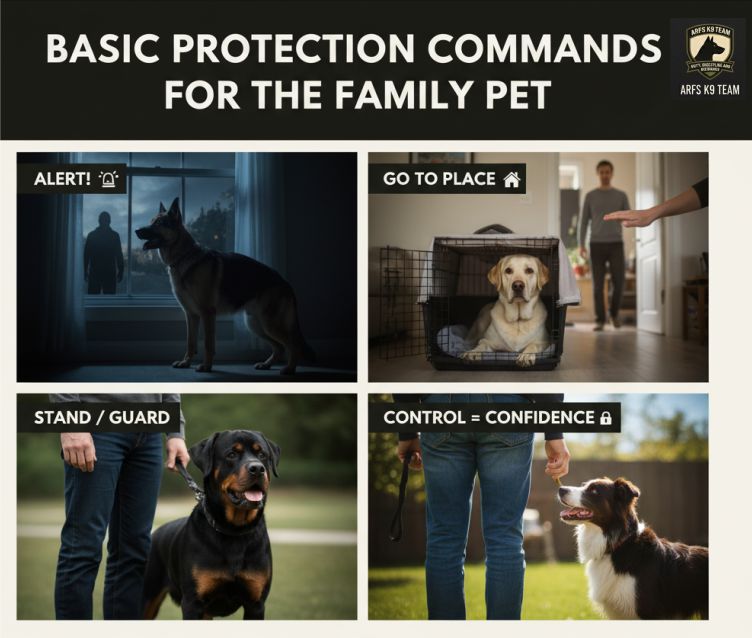
Command 1: “Alert!” – The Focused Warning System
Most dogs bark—it’s natural. The problem is that random barking quickly becomes background noise. Neighbors ignore it. Owners ignore it. And intruders don’t take it seriously.
The “Alert!” command transforms uncontrolled noise into a purposeful security signal.
The Goal of the Alert Command
Teach your dog when to bark
Teach them why they’re barking
Teach them when to stop
A controlled bark is far more effective than constant noise.
How to Train the “Alert!” Command
Step 1: Capture Natural Behavior
When your dog naturally barks at something unusual,, an unfamiliar sound, movement, or person clearly say “ALERT!”
ARFS K9 Tip:
Choose a unique command word. Avoid using “Speak” if that’s already a trick command.
Step 2: Mark and Reward
Immediately reward your dog while they are barking after the command. High-value treats work best.
Why This Works:
The reward links the command to focused awareness, not random barking.
Step 3: Add the Silence Command
After 2–3 barks, issue a calm but firm “Quiet” or “Enough.”
Reward silence immediately.
This step is critical.
A dog that cannot stop barking is not controlled and control is the foundation of protection.
Step 4: Proof the Command
Practice with controlled scenarios:
A trusted friend approaching outside
Someone knocking at an unusual time
A new sound near your home
Sequence:
Alert → Reward → Quiet → Reward
Security Benefit
Your dog becomes an early warning system that you can turn on and off instantly. This alone deters many potential threats.
Command 2: “Place” – The Emergency Anchor Command
In real emergencies, chaos escalates quickly. Someone is yelling. The doorbell is ringing aggressively. You may be injured, stressed, or distracted.
In those moments, your dog must know exactly where to go.
The “Place” command creates an automatic safety zone.
What “Place” Means
“Place” is not just “sit” or “stay.”
It means:
Go to your designated spot and remain there until released.
This could be:
A dog bed
A mat
A crate
A specific corner of the room
Training the Place Command
Step 1: Define the Place
Choose one object and never change it.
Consistency builds confidence.
Step 2: Build Duration
Send your dog to Place and gradually increase:
Time
Distance
Distractions
Start simple. Progress slowly.
Step 3: Add Real-Life Distractions
Doorbell ringing
Knocking
Raised voices
You moving quickly
Step 4: Emergency Drills
Practice while:
Tossing keys
Moving fast
Speaking urgently
Your tone matters. The command must hold up under stress.
Security Benefit
Your dog is secured, visible, and out of harm’s way. This prevents escalation and allows you to handle the situation safely.
Command 3: “Stand” or “Guard” – The Silent Deterrent
This command is subtle, powerful, and often underestimated.
Unlike “Alert,” this command is non-vocal. It relies on presence and positioning, not noise.
The Position
Your dog moves into a controlled stand or sit beside your dominant leg, facing the same direction as you.
They remain there until released.
Training the Command
Step 1: Perfect the Heel
A clean heel position is the foundation.
Step 2: Add the Command
Take one step forward, stop, and issue “STAND” or “GUARD.”
Reward stillness and focus.
Step 3: Teach Focus
Encourage your dog to look at what you are looking at.
Reward calm, intense attention.
When This Is Useful
Approached by a suspicious person
Standing near your car at night
Walking in low-visibility areas
Facing aggressive body language
Security Benefit
A calm dog, positioned confidently at your side, sends a powerful non-verbal message:
You are aware. You are not vulnerable. You are not alone.
Most threats disengage at this stage, without a word being spoken.
Common Mistakes to Avoid
Even well-meaning owners can undermine protection training by making these errors:
❌ Encouraging uncontrolled barking
❌ Using fear or punishment-based methods
❌ Skipping foundational obedience
❌ Training commands without proofing under stress
❌ Expecting instant reliability without repetition
Protection is not rushed. Reliability is built through consistency.
Conclusion: Control Equals Confidence
Real family protection is quiet, controlled, and intentional.
By mastering these three commands Alert, Place, and Stand/Guard, you give your dog:
Clear purpose
Calm confidence
Defined boundaries
And you give your family:
Early warning
Reduced risk
Increased peace of mind
A dog that is controlled is a dog that is safe.
A dog that is safe is a dog that protects by preventing problems before they begin.
Final Thought
How reliable is your dog’s “Place” command under pressure?
If the answer isn’t “100%,” that’s your starting point.
Building reliability starts with the basics and the right resources make that journey smoother. Explore the recommended books above to deepen your training knowledge and strengthen your K9 team’s confidence, discipline, and performance.

Her work centers on applied training across obedience, detection, protection, and operational readiness, with a strong focus on Military Working Dogs (MWDs) and security K9 programs. Rather than theory alone, Rofiat emphasizes proven training methods, repetition, consistency, and real-world conditioning that prepare dogs and handlers for high-pressure tasks.
Through articles, training content, and documentaries, she shares experience-based insights drawn from the field, highlighting how structured training, clear communication, and trust between handler and dog directly impact performance and reliability.
She remains committed to responsible K9 development, continuous skill refinement, and practical education for handlers, trainers, and dog professionals.
- Detection Tactics Every Dog Owner Should Know to Prevent Counter-Surveillance and Tracking - February 11, 2026
- STOP Feeding Your Dogs These Common Human Stews - February 9, 2026
- German Shepherd vs Belgian Malinois: Which Breed Is More Intelligent for Working and Security Roles - February 6, 2026


