Understanding Dog Body Language: Your K9’s Early Warning System Against Threats
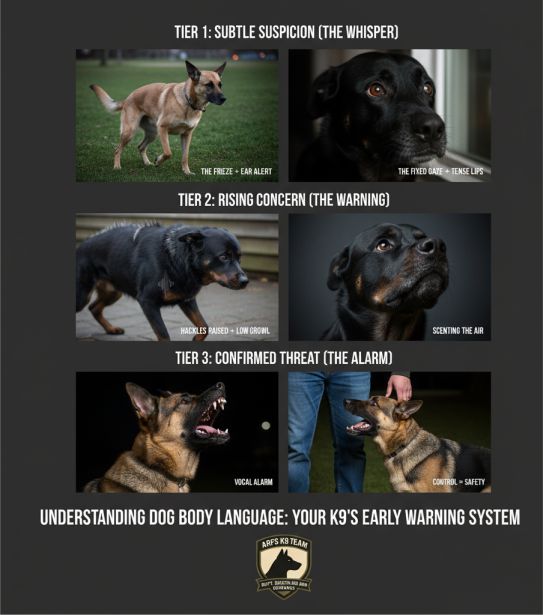
Dogs have guarded human homes, families, and communities for thousands of years. Long before modern alarms, cameras, or motion sensors existed, people relied on canine instincts to detect danger. Even today, with advanced technology everywhere, a well-trained dog remains one of the most reliable early warning systems available.
As members of the ARFS K9 Team, your dog is not just a companion, they are a living, breathing security asset. Their senses operate on a level humans simply cannot match. Dogs hear frequencies far beyond human hearing, detect scent particles at incredibly low concentrations, and notice environmental changes such as pressure shifts, vibrations, and temperature variations long before we do.
But here’s the key truth many dog owners miss:
A dog’s alert does not usually begin with barking.
Most real alerts start quietly with a pause, a subtle change in posture, a focused stare, or a momentary freeze. These early signals are your dog’s way of saying “Something is different. Pay attention.” Learning to recognize and interpret these subtle cues can give you precious seconds, sometimes minutes to assess a situation and act before a potential threat escalates.
This article will help you understand dog body language as a layered communication system and show you how to recognize your K9’s pre-alert signals, turning instinct into actionable family protection.
Why Dog Body Language Is a Critical Security Tool
Humans communicate primarily through words. Dogs communicate primarily through body language. While barking is the most obvious signal, it is actually one of the last stages of alert behavior.
Before any sound is made, your dog’s nervous system has already detected something unusual. Muscles tense. Senses sharpen. Attention narrows. These physical changes happen automatically and honestly, dogs do not fake them.
For security-conscious families, this makes dog body language incredibly valuable. Unlike electronic systems, dogs:
- Do not rely on electricity
- Are not limited to a fixed detection zone
- Can differentiate between familiar and unfamiliar stimuli
- Continuously assess their environment in real time
When you learn to read your dog’s early warning signs, you effectively gain an advanced alert system with built-in threat assessment.
The Goal: Recognizing the Pre-Alert Phase
Most dog owners are familiar with the Active Threat Phase:
- Loud, repetitive barking
- Raised hackles
- Lunging or aggressive posturing
At this stage, the situation is already intense. The dog is reacting, not observing.
The true advantage lies in recognizing what happens before that, the Pre-Alert Phase.
What Is the Pre-Alert Phase?
The pre-alert phase is the quiet moment when your dog has noticed something unusual but has not yet decided whether it is a threat.
Think of it as your dog saying:
“I smell something unfamiliar.”
“I hear movement that doesn’t belong.”
“Something has changed — stay alert.”
This phase offers the most valuable resource in any security situation: time.
At ARFS K9 Team, the goal is not to encourage uncontrolled aggression, but controlled awareness and response. A dog that alerts early and responds to commands is far more effective — and safer — than one that explodes into action without direction.
The Three Tiers of K9 Alert Signals
Dog alerts develop in stages. Understanding these tiers allows you to respond appropriately and maintain control.
Tier 1: Subtle Suspicion (The “Whisper”)
Tier 1 signals are quiet, easily missed, and often misunderstood. Many owners ignore them until the dog suddenly escalates.
These cues indicate your dog has detected an anomaly and is gathering information.
Common Tier 1 Signals
1. The Freeze
Your dog suddenly stops mid-movement such as walking, chewing, playing and becomes rigid for a brief moment. The head may lower slightly, and the body appears tense.
Security implication:
Your dog has heard or sensed something faint that overrides all other stimuli. This is your cue to stop what you’re doing and pay attention.
2. Single Ear Twitch or Turn
One ear rotates backward or sharply forward, often away from you.
Security implication:
Your dog is triangulating sound, often at frequencies humans cannot hear. This can indicate distant footsteps, movement behind walls, or activity outside the property.
3. Fixed Gaze
The dog stares intently at a specific location like a window, door crack, fence line, or dark corner. Blinking may stop or slow.
Security implication:
Visual confirmation of something unusual. The dog is waiting for movement or confirmation before escalating.
4. Closed Mouth and Tense Lips
The dog stops panting. The mouth closes. Facial muscles tighten.
Security implication:
This indicates a shift from relaxed to focused awareness. The dog is preparing mentally, even if no sound is made.
What You Should Do at Tier 1
- Pause your activity
- Look in the same direction as your dog
- Listen carefully
- Acknowledge calmly without excitement
Ignoring Tier 1 signals teaches your dog that subtle alerts are useless, often leading to louder, more explosive reactions later.
Tier 2: Rising Concern (The “Warning”)
Tier 2 signals mean your dog has processed the information and now believes the stimulus could be a threat.
This is the most important intervention stage.
Common Tier 2 Signals
1. Stiff, Forward Posture
The dog’s body becomes erect. Weight shifts forward. The tail may be raised and still (not wagging).
Security implication:
Your dog is preparing to challenge or engage if necessary. This is the moment for command intervention.
2. Piloerection (Raised Hackles)
Hair stands up along the shoulders or spine.
Security implication:
This involuntary response indicates adrenaline, fear, or high arousal. It does not always mean aggression but it should never be ignored.
3. Low Growl or Rumble
A deep, quiet sound from the chest, often without opening the mouth.
Security implication:
This is a warning, not a loss of control. Your dog is assessing whether escalation is necessary.
4. Muzzle Lift or Air Scenting
The dog lifts its nose, inhaling rapidly.
Security implication:
Scent confirmation. Dogs can identify unfamiliar humans, animals, or objects through airborne scent alone.
What You Should Do at Tier 2
- Issue a trained control command (“Alert,” “Place,” or “Heel”)
- Increase distance from the perceived threat if possible
- Maintain calm, confident body language
- Avoid yelling or panicking
Tier 2 is where good training prevents bad outcomes.
Tier 3: Confirmed Threat (The “Alarm”)
Tier 3 is full engagement. At this point, the dog believes the threat is real and immediate.
Common Tier 3 Behaviors
- Loud, repetitive barking
- Lunging or rapid movement toward the threat
- Bared teeth or lip lifting
- Highly defensive posture
Security implication:
The dog is now attempting to scare away the threat and alert everyone nearby. Your focus must shift to managing the situation safely and preventing injury or escalation.
The ARFS K9 Action Plan: How to Respond to Pre-Alert Signals
Recognizing signals is only half the equation. Your response determines whether the situation remains controlled.
Step 1: Acknowledge and Verify (Tier 1)
When you see subtle suspicion:
- Place a calm hand on your dog
- Whisper their name
- Say something neutral like “I see it”
This reassures your dog that their alert has been noticed without increasing emotional intensity.
Step 2: Issue a Control Command (Tier 2)
As posture stiffens:
- Use your trained command (“Alert,” “Place,” or “Quiet”)
- Maintain steady tone
- Avoid repeating commands excessively
Consistency builds trust and clarity.
Step 3: Use Distance as a Tool
If outside or near strangers:
- Increase space between you and the stimulus
- Move behind a barrier if necessary
- Allow your dog room to de-escalate
Distance reduces pressure for both dog and human.
Step 4: Reward Calm Resolution
If the stimulus turns out harmless:
- Command relaxation
- Reward calm behavior
- Avoid punishing the alert itself
This teaches your dog that controlled alerting is correct behavior, not something to suppress.
Common Mistakes That Undermine Your Dog’s Alerts
- Ignoring subtle cues
- Punishing growling instead of managing it
- Encouraging constant barking
- Failing to train clear control commands
A dog that feels unheard may escalate faster next time.
Conclusion: Trusting Your K9’s Instincts
Your dog is constantly reading the environment far more accurately than most people realize. Their body language is an honest, real-time communication system designed to protect the pack.
By learning to recognize the pre-alert phase, you gain:
- Earlier awareness
- Greater control
- Reduced escalation
- A calmer, more confident K9 partner
You are no longer reacting to danger, you are anticipating it.
With training, observation, and trust, your ARFS K9 team member becomes more than a pet. They become a reliable, disciplined, and highly intelligent guardian.
What is the most subtle pre-alert signal your dog gives you?
Pay attention, they may already be speaking to you every day.

Her work centers on applied training across obedience, detection, protection, and operational readiness, with a strong focus on Military Working Dogs (MWDs) and security K9 programs. Rather than theory alone, Rofiat emphasizes proven training methods, repetition, consistency, and real-world conditioning that prepare dogs and handlers for high-pressure tasks.
Through articles, training content, and documentaries, she shares experience-based insights drawn from the field, highlighting how structured training, clear communication, and trust between handler and dog directly impact performance and reliability.
She remains committed to responsible K9 development, continuous skill refinement, and practical education for handlers, trainers, and dog professionals.
- Detection Tactics Every Dog Owner Should Know to Prevent Counter-Surveillance and Tracking - February 11, 2026
- STOP Feeding Your Dogs These Common Human Stews - February 9, 2026
- German Shepherd vs Belgian Malinois: Which Breed Is More Intelligent for Working and Security Roles - February 6, 2026


