How K9 Units Uncover Hidden Compartments in Smuggling Operation
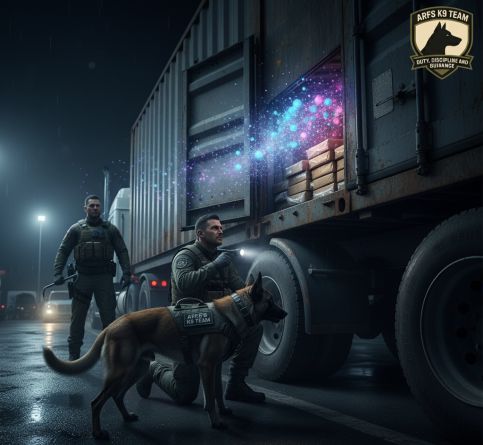
In the relentless global fight against drug trafficking, smugglers are constantly innovating. As law enforcement agencies strengthen border controls and invest in advanced detection technologies, criminal networks respond by developing increasingly complex concealment techniques. Ordinary vehicles, shipping containers, luggage, and consumer goods are transformed into sophisticated mobile fortresses engineered to evade inspection.
From false vehicle panels and hydraulic compartments to chemically shielded packaging and industrial-grade concealment systems, smugglers rely on misdirection, engineering, and human error to move illicit substances across borders undetected. Yet despite these evolving tactics, one countermeasure continues to outperform even the most advanced machines: professionally trained drug detection K9 units.
Detection dogs often trained and deployed by elite organizations such as ARFS K9 Team routinely uncover hidden compartments that escape the notice of scanners, sensors, and human inspection. This article explores how K9 units expose concealed smuggling systems, why traffickers consistently underestimate them, and why detection dogs remain one of the most powerful and irreplaceable assets in modern counter-narcotics operations.
The Invisible Threat: Smugglers’ Ever-Evolving Ingenuity
Drug traffickers invest enormous financial and technical resources into concealment strategies designed to defeat routine inspections. These hidden compartments often referred to as traps, are carefully engineered to appear factory-original or structurally inaccessible.
Modern smuggling operations are rarely improvised. They involve mechanics, engineers, logistics experts, and chemists who collaborate to design concealment systems that can survive long-distance travel, avoid detection, and protect the product from damage or loss.
Common Smuggling Concealment Methods
1. Vehicle Modifications
Vehicles remain one of the most common tools for domestic and cross-border drug transport. Common modifications include:
- False floors in trucks, vans, and SUVs
- Reinforced door panels and roof linings
- Modified dashboards and center consoles
- Fuel tanks redesigned to hold narcotics alongside fuel
- Tires, bumpers, wheel wells, and chassis cavities packed with drugs
- Electrically or hydraulically operated hidden compartments
Many of these systems are invisible without disassembly and are designed to withstand vibration, heat, and casual inspection.
2. Cargo and Freight Concealment
Large-scale trafficking often relies on commercial shipping:
- Drugs hidden inside legitimate consumer goods
- Hollowed furniture, sealed machinery, or construction materials
- Palletized shipments designed to disrupt odor dispersion
- Frozen food, agricultural produce, or bulk commodities used as masking agents
Because global trade depends on volume and speed, traffickers exploit the sheer scale of freight movement to hide illegal cargo in plain sight.
3. Human Body Concealment
While less common for bulk shipments, smugglers may transport smaller quantities by:
- Swallowing drug-filled capsules
- Strapping packages to the body
- Concealing substances in clothing or footwear
This method carries extreme health risks and is often used by low-level couriers rather than major trafficking organizations.
Despite the diversity of these methods, the objective remains the same: move narcotics undetected while fueling organized crime, addiction, and social instability.
Why Technology Alone Isn’t Enough
Law enforcement agencies increasingly rely on advanced technologies such as:
- X-ray imaging systems
- Density scanners
- Chemical trace detectors
- Automated risk-profiling software
While these tools are valuable, they have limitations. Machines depend on patterns, thresholds, and known indicators. Skilled smugglers exploit these constraints by using layered materials, legal cargo masking, odor suppressants, and unconventional compartment designs.
Technology also requires interpretation. Human operators must decide what looks suspicious, and fatigue, time pressure, or information overload can reduce effectiveness.
This is where K9 units provide a decisive biological advantage that no machine can replicate.
The K9 Advantage: A Nose That Never Lies
Drug detection dogs possess one of the most powerful sensory systems in the animal kingdom.
- Humans: Approximately 6 million scent receptors
- Dogs: Up to 300 million scent receptors
In addition to sheer receptor count, dogs have a specialized olfactory structure that allows them to analyze scent particles independently from breathing. This enables them to identify, isolate, and follow specific odors even in complex environments.
What Makes K9 Detection So Effective?
Trace Detection
K9s can detect microscopic drug particles and residual odors left behind from previous transport. Even if drugs are removed, cleaned, or repackaged, scent traces often remain.
Scent Discrimination
Well-trained detection dogs can distinguish specific narcotics such as cocaine, heroin, methamphetamine, marijuana, MDMA, and opioids from thousands of background odors. They are trained not to react to food, fuel, chemicals, or other distractions.
Barrier Penetration
Drug molecules release scent vapors that escape through plastic, rubber, metal, fiberglass, and even sealed containers. While humans perceive these barriers as airtight, K9s detect the escaping odor effortlessly.
Unpredictability for Smugglers
No two K9 searches are identical. Dogs work dynamically, adapting to wind, temperature, and environment. This makes it nearly impossible for traffickers to design foolproof concealment strategies.
Inside a K9 Operation: How Hidden Compartments Are Exposed
A K9-assisted drug interdiction follows a structured, professional, and legally compliant process designed to ensure reliability and admissibility.
1. Initial Indicators
K9 deployment is often prompted by observable factors such as:
- Nervous or evasive behavior
- Inconsistent travel documents
- Unusual vehicle modifications
- Suspicious cargo configurations
- Intelligence-led targeting
These indicators justify further inspection.
2. Controlled K9 Deployment
The handler introduces the dog to the vehicle, container, or luggage in a calm, systematic manner. Professionally trained dogs such as those developed by ARFS K9 Team—work with focus and discipline, showing no aggression.
3. The Alert
When the dog detects narcotics odor, it performs a trained response, known as an alert. This may include:
- Sitting
- Staring intensely
- Freezing at the source
- Pawing or scratching (depending on training method)
These passive alerts are non-destructive and widely recognized as legally valid indicators of probable cause.
4. Precision Targeting
Experienced handlers interpret subtle behavioral changes to pinpoint the exact source of odor often a location that appears solid, sealed, or factory-installed.
5. Physical Inspection and Discovery
Using specialized tools such as:
- Borescopes
- Panel removal equipment
- Structural access tools
Officers open concealed compartments and uncover illicit substances.
6. Seizure and Documentation
What appeared ordinary is revealed as a sophisticated drug transport system, sometimes containing narcotics worth millions. Evidence is documented to support prosecution.
Why Smugglers Consistently Underestimate K9 Units
Many traffickers falsely believe that:
- Vacuum sealing eliminates odor
- Masking agents confuse dogs
- Complex compartments block scent
- Technology will be the primary detection method
In reality, these assumptions consistently fail. Scent cannot be fully contained, and dogs are trained in environments that simulate real-world concealment tactics.
Every time smugglers adapt, K9 training evolves alongside them.
Real-World Impact: Why K9 Units Remain Irreplaceable
Across borders, highways, ports, and airports, K9 units consistently:
- Intercept large-scale drug shipments
- Disrupt organized trafficking networks
- Reduce the flow of narcotics into communities
- Support successful prosecutions with reliable evidence
- Deter future smuggling attempts
Their presence alone often alters criminal behavior, forcing traffickers to take greater risks and increasing the likelihood of detection.
The Role of Professional K9 Training
The effectiveness of a detection dog depends entirely on the quality of its training and handling. Professional organizations such as ARFS K9 Team emphasize:
- Selection of high-drive, disciplined working dogs
- Realistic scenario-based training
- Advanced scent discrimination techniques
- Strong handler-dog communication
- Legal reliability and operational standards
These dogs are not pets, they are precision-trained detection assets operating at the highest professional level.
Conclusion: The Ultimate Counter to Hidden Crime
Hidden compartments may fool cameras, scanners, and human intuition but they rarely fool a trained K9.
With unmatched scent detection, disciplined behavior, and expert handling, K9 units remain one of the most powerful tools in the fight against drug trafficking. Their ability to uncover the unseen continues to save lives, dismantle criminal networks, and protect communities worldwide.
In the ongoing chess match between smugglers and law enforcement, the K9 nose remains the decisive move traffickers never see coming.

Her work centers on applied training across obedience, detection, protection, and operational readiness, with a strong focus on Military Working Dogs (MWDs) and security K9 programs. Rather than theory alone, Rofiat emphasizes proven training methods, repetition, consistency, and real-world conditioning that prepare dogs and handlers for high-pressure tasks.
Through articles, training content, and documentaries, she shares experience-based insights drawn from the field, highlighting how structured training, clear communication, and trust between handler and dog directly impact performance and reliability.
She remains committed to responsible K9 development, continuous skill refinement, and practical education for handlers, trainers, and dog professionals.
- Detection Tactics Every Dog Owner Should Know to Prevent Counter-Surveillance and Tracking - February 11, 2026
- STOP Feeding Your Dogs These Common Human Stews - February 9, 2026
- German Shepherd vs Belgian Malinois: Which Breed Is More Intelligent for Working and Security Roles - February 6, 2026


