Your Dog Isn’t Stubborn, You’re Using the Wrong Reinforcement (Here’s What Actually Works)
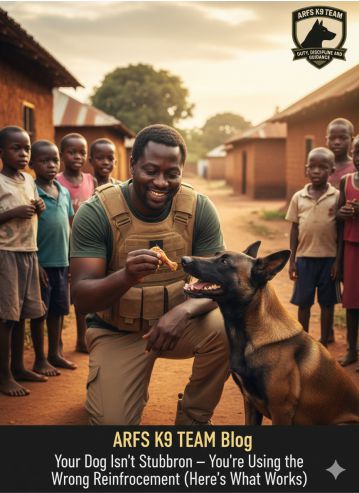
If you’ve ever felt frustrated while training your dog, you’re in very good company. Almost every dog owner reaches a breaking point at some stage. You ask your dog to sit for the tenth time. Your voice becomes sharper. You repeat the command. You wave a treat inches from their nose. And still, nothing happens.
Your dog looks away.
They sniff the ground.
They stare at you like you’re speaking an unfamiliar language.
Eventually, many owners reach the same conclusion:
“My dog is stubborn.”
It feels logical. After all, the dog clearly heard you, understood the command, and still chose not to respond. But here’s the truth, one that professional trainers, working-dog handlers, and canine behaviorists understand deeply:
Your dog isn’t stubborn. They’re simply not motivated by what you’re offering.
At ARFS K9 Team, we’ve trained dogs across an extremely wide spectrum from high-drive working K9s operating in demanding, real-world environments to family pets learning basic obedience at home. Regardless of breed, age, temperament, or role, one principle never changes:
Dogs work for value.
When the value of the reward does not outweigh the difficulty of the task or the pull of distractions, the dog opts out. Not out of defiance. Not out of attitude. Out of logic.
Once you understand this, dog training stops being emotional and starts being strategic.
Why “Stubbornness” Is a Human Misunderstanding
Stubbornness is a human concept. It implies ego, emotional resistance, or a deliberate refusal to cooperate. Dogs do not operate with these motivations.
Dogs live in the present moment and make decisions based on a very simple question:
“What do I gain from doing this right now?”
If the answer is unclear, delayed, or unimportant compared to what’s happening around them, the behavior doesn’t happen.
When your dog ignores a command, they are not challenging your authority or trying to frustrate you. They are making a perfectly reasonable calculation. The smell of another dog, the movement of a squirrel, the sound of children playing, or the excitement of a new environment simply carries more value than your reward.
This doesn’t mean your dog is difficult. It means your reinforcement strategy is being outcompeted.
Understanding this shifts training from blame to problem-solving and that shift alone changes everything.
The Professional Handler’s Advantage: Motivation, Not Force
Professional K9 handlers whether in military, police, or advanced sport environments do not rely on shouting, repeating commands endlessly, or assuming the dog is being “hard-headed.”
Their dogs perform complex tasks under pressure, in chaotic, noisy, and unpredictable environments, because the reinforcement system is clear, powerful, and consistent.
These handlers do not simply use “treats.”
They use:
- The right reinforcer
- At the right intensity
- At the right moment
- For that specific dog
This is the difference between casual obedience and reliable performance.
The good news? You don’t need professional equipment or advanced credentials to apply the same principles. You just need to understand how motivation works.
1. Discover Your Dog’s True Currency
Every dog has a personal economy. Some dogs are food-driven, others are play-driven, and some are motivated by access to things they love in the environment.
The biggest mistake owners make is assuming that any treat, toy, or praise should work.
It won’t.
High-Value Food Rewards
Food is often the easiest motivator to start with, but not all food carries the same value.
Dry kibble may work in a quiet living room, but it often fails the moment distractions appear. High-value food rewards include:
- Cooked chicken or turkey
- Cheese (used sparingly)
- Hot dogs
- Liver treats or pâté
- Freeze-dried meat
The goal is not what you think your dog should like. The goal is to identify what makes your dog visibly more engaged. If their eyes widen, their body becomes alert, and their focus locks onto you, you’ve found valuable currency.
Toys as Reinforcement
For many dogs, especially working breeds play is more powerful than food.
Tug toys, squeaky toys, and favorite balls can create intense motivation. These dogs don’t want a snack; they want action. Training becomes a game, and the reward is the opportunity to play.
When used correctly, toy rewards can build speed, enthusiasm, and long-term engagement that food alone often cannot.
Praise and Affection
Praise does matter, but it is rarely strong enough on its own, especially during early training or in distracting environments.
Verbal praise and physical affection should support reinforcement, not replace it. Over time, praise gains value through association, but expecting it to compete with real-world distractions too early sets your dog up to fail.
Environmental Rewards
One of the most powerful and underused reinforcers is access.
Sniffing a lamppost, greeting another dog, running freely, exploring new ground, or continuing a walk are all highly valuable rewards to many dogs.
When used intentionally, environmental rewards teach your dog that listening to you is the fastest way to get what they already want.
2. Match the Reward to the Difficulty of the Task
Reinforcement is not one-size-fits-all. Think of it on a scale from 1 to 10.
Low Difficulty, Low Distraction
Asking for a sit in your living room may only require mild reinforcement like kibble or calm praise.
Moderate Difficulty or New Environments
Asking for obedience at the park requires higher value such as meat, cheese, or an exciting toy.
High Difficulty, High Distraction, Critical Behaviors
Recalls around other dogs, impulse control around prey, or obedience in busy environments demand your dog’s best reward.
If your dog ignores you, it’s usually because you’re offering a level-three reward in a level-eight situation.
That’s not disobedience.
That’s poor economics.
3. Timing Turns Rewards Into Learning
Even the best reward loses its power if delivered too late.
Dogs learn through immediate association. The reward must occur within one to two seconds of the correct behavior. Anything later becomes unclear.
Equally important is how you deliver the reward:
- Be enthusiastic, your energy adds value
- Deliver rewards in the correct position (at your side for heel, directly to you for recall)
- Make success obvious and rewarding
Clear timing creates clear understanding. Clear understanding builds confidence and reliability.
4. Variety Prevents Burnout and Builds Engagement
Using the same treat repeatedly causes it to lose value. Dogs habituate quickly, just like humans.
Rotating reinforcers keeps training exciting. One session might focus on food, another on toys, and another on a mix of both. Occasionally surprise your dog with a jackpot reward like a handful of treats or an extended play session for exceptional effort.
This unpredictability maintains motivation. Your dog stays engaged because working with you is consistently rewarding and occasionally spectacular.
5. Control the Environment Before Expecting Control From Your Dog
One of the most common training mistakes is expecting advanced behavior in environments the dog is not prepared for.
Training should progress in stages:
- Start in quiet, familiar spaces
- Master behaviors with minimal distractions
- Gradually increase difficulty
- Increase reinforcement value as challenges increase
If your dog fails, it isn’t disobedience, it’s information. It means the environment is too difficult or the reward is not valuable enough yet.
A Critical Rule: Never Punish Confusion
Punishing a dog for not responding damages trust and motivation. It does not teach clarity; it teaches uncertainty.
Instead of reacting emotionally, ask yourself:
- Was the reward valuable enough?
- Was my timing clear?
- Did I ask for too much, too soon?
When motivation replaces frustration, learning accelerates dramatically.
The Real Truth About “Stubborn” Dogs
Your dog is not trying to make your life harder.
They are navigating a world full of competing stimuli and responding honestly to what matters most to them.
When you learn to speak your dog’s motivational language, training becomes cooperative instead of confrontational. Your dog becomes focused, eager, and confident not because they fear consequences, but because working with you consistently pays off.
At ARFS K9 Team, we believe every dog has the potential to be a willing, reliable partner. The key is not force, repetition, or dominance. The key is understanding value.
Find your dog’s currency.
Use it intelligently.
And you’ll discover that the “stubborn” dog you thought you had was actually waiting for you to make training worth their while.

Her work centers on applied training across obedience, detection, protection, and operational readiness, with a strong focus on Military Working Dogs (MWDs) and security K9 programs. Rather than theory alone, Rofiat emphasizes proven training methods, repetition, consistency, and real-world conditioning that prepare dogs and handlers for high-pressure tasks.
Through articles, training content, and documentaries, she shares experience-based insights drawn from the field, highlighting how structured training, clear communication, and trust between handler and dog directly impact performance and reliability.
She remains committed to responsible K9 development, continuous skill refinement, and practical education for handlers, trainers, and dog professionals.
- Detection Tactics Every Dog Owner Should Know to Prevent Counter-Surveillance and Tracking - February 11, 2026
- STOP Feeding Your Dogs These Common Human Stews - February 9, 2026
- German Shepherd vs Belgian Malinois: Which Breed Is More Intelligent for Working and Security Roles - February 6, 2026


