Best Dog for Security and Family: Top 7 Breeds
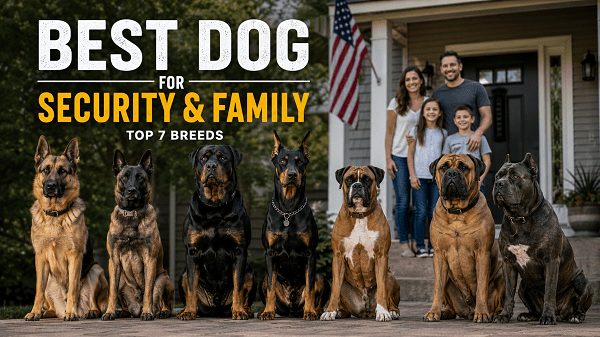
The best dog for security and family is one that pairs natural protective instinct with a stable, trainable temperament, not just size or bark. Based on AKC registration data, working-line temperament studies, and real handler experience, the German Shepherd, Belgian Malinois, Rottweiler, Doberman Pinscher, Boxer, Bullmastiff, and Cane Corso consistently top the list because they combine genuine guarding ability with a proven track record as loving, kid-safe family companions when properly bred, socialized, and trained.
Table of Contents
- Introduction
- What Actually Makes a Dog Good at Both Security and Family Life
- Guard Dog vs. Protection Dog vs. Watchdog: Know the Difference
- Top 7 Breeds for Security and Family
- Side-by-Side Breed Comparison Table
- Real Training Timelines and Costs
- Insurance, Legal Restrictions, and Liability
- Common Mistakes Families Make With Guard Dogs
- Trainer’s Experience Notes
- FAQs
- Conclusion and Next Steps
Introduction
Here’s a scene I’ve walked into more times than I can count: a family calls me in a bit of a panic after a break-in attempt (sometimes successful, sometimes not), and the first thing they say is, “We need a dog that’ll scare people off, but we’ve got a 6-year-old and a cat, can that even work?”
The honest answer is yes, it absolutely can. But most of what people read online conflates “big and scary-looking” with “actually good at protecting a family,” and that’s where things go wrong. A dog that’s all bark and no training is a liability, not security. And a dog that’s all bite and no off-switch is a danger to your own kids.
In this guide, you’re going to get a straight, no-fluff breakdown of the seven breeds that genuinely earn their place as the best dog for security and family life, not because a blog says so, but because of documented temperament testing, decades of use in police and military K9 programs, and real registration and insurance data. You’ll also get honest training timelines, what it actually costs to raise or buy a properly trained protection dog, and where the legal landmines are (insurance bans, breed-specific legislation, and liability).
If you’ve been Googling “best dog for security and family” and getting the same recycled list of Rottweiler-German-Shepherd-Doberman with no real numbers behind it, this is the version with the receipts. (If you want the broader rundown of guard breeds and the ground rules around owning one, our guide to guard protection dogs and essential rules is a solid companion read.)
What Actually Makes a Dog Good at Both Security and Family Life
Before we get to the breed list, let’s set the criteria, because this is where most articles skip the homework.
A genuinely good family protection dog needs to check five boxes:
- Discernment — the ability to tell the difference between the mail carrier and an actual threat. This is a trained and bred trait, not something that shows up on its own.
- Trainability — how quickly and reliably the dog responds to obedience and impulse-control work. Intelligence without trainability just gets you a smart dog doing the wrong thing confidently.
- Bite inhibition and off-switch — the capacity to disengage instantly on command. Every professional protection dog trainer I know says this matters more than raw bite force.
- Family bonding drive — genetic loyalty toward the household rather than aloof independence.
- Physical presence — size, bark, and build do matter as a deterrent, since most break-ins are opportunistic and a dog’s presence alone stops a huge share of them before any confrontation happens.
One thing worth saying clearly: breed is only part of the equation. Two German Shepherds from different breeders can have wildly different temperaments depending on bloodline (working line vs. show line), early socialization, and how the owner handles the first year. Breed tells you the potential; raising and training determine the result. If you want a deeper look at how instinct and obedience actually interact in a working dog’s brain, we break it down in Dog Obedience vs. Instinct: How to Balance Drive and Control.
Guard Dog vs. Protection Dog vs. Watchdog: Know the Difference
People use these terms interchangeably, and that’s part of why so many families end up with the wrong expectations.
- Watchdog — alerts you to something unusual by barking. Doesn’t intervene physically. Think Beagles, Chihuahuas.
- Guard dog — naturally territorial and will position itself between you and a threat, often without formal bite training. This is instinct-driven.
- Protection dog — has gone through structured bite work, controlled aggression, and obedience training so it acts only on command or in a genuine threat scenario, then disengages cleanly.
For most families, what you actually want is a dog with strong natural guarding instinct plus enough obedience training to make that instinct controllable. A fully trained personal protection dog (the kind sold by specialist kennels) is a different tier entirely, both in ability and price, we’ll get to real numbers on that shortly.
Top 7 Breeds for Security and Family
1. German Shepherd Dog
German Shepherds hold the No. 4 spot on the American Kennel Club’s 2025 breed popularity list, and there’s a reason they’ve stayed in the AKC’s top five for years running, they’re arguably the most well-rounded working breed on the planet.
- Size: 22–26 inches, 50–90 lbs
- Lifespan: 9–13 years
- Trainability: Exceptional, this is the backbone breed of police, military, and service dog programs worldwide
- Family fit: High, with early socialization
- Grooming/upkeep: Moderate-heavy shedding, needs regular exercise
German Shepherds became the gold standard for K9 work over a century ago, and that working pedigree is exactly why they double so well as family guardians, they were bred from the start to think independently while still taking direction from a handler. The catch: working-line German Shepherds (as opposed to show-line) have serious drive and need real structure, daily mental work, and a job to do, or that energy turns into destructive behavior.
Handler tip: If your household is more laid-back, look for breeders producing moderate-drive lines rather than pure working/Schutzhund lines, you still get the guarding instinct without the intensity that some families aren’t ready to manage.
2. Belgian Malinois
The Malinois has exploded in popularity, it now sits at No. 32 on the AKC list, a huge jump from where it sat even a decade ago, largely thanks to visibility from elite military and police units.
- Size: 22–26 inches, 40–80 lbs
- Lifespan: 12–14 years
- Trainability: Extremely high, arguably higher drive than the GSD
- Family fit: Moderate to high, but best for active, experienced households
- Grooming/upkeep: Low-maintenance coat, very high exercise needs
I’ll be straight with you: the Malinois is not a beginner’s family dog. It’s an athlete with a job-or-bust mentality, if you don’t give it consistent training and physical outlets, that drive turns into anxiety or destructive habits fast. But for active families who want a genuinely elite protector and are willing to put in daily structured work, there’s no breed with a sharper mind or faster reaction time. Malinois are increasingly the top pick at personal protection dog training centers precisely because they combine speed, bite work capability, and biddability better than almost anything else out there.
3. Rottweiler
Rottweilers sit at No. 8 in the AKC’s 2025 rankings, holding that exact spot for several years running, a sign of a stable, loyal fanbase rather than a passing trend.
- Size: 22–27 inches, 80–135 lbs
- Lifespan: 8–10 years
- Trainability: High, with a confident, sometimes stubborn streak
- Family fit: High, genuinely affectionate and gentle with their own kids once socialized
- Grooming/upkeep: Low grooming, moderate exercise
Rottweilers descend from Roman cattle-driving dogs and have guarded property and livestock for roughly two thousand years, which explains why territorial guarding is baked so deeply into the breed. What surprises new owners is how gentle a well-raised Rottweiler is at home, they’re famously described by breed clubs as “clowns” in the household, all goofiness with their own family and total business with strangers who overstep. The critical window is 8 weeks to 6 months: Rottweilers that miss proper socialization in that period can become reactive rather than discerning.
4. Doberman Pinscher
The Doberman ranks No. 15 on the AKC 2025 list and was purpose-built in the 1890s by a German tax collector, Karl Friedrich Louis Dobermann, specifically to protect him on his rounds, a guard dog by original design brief.
- Size: 24–28 inches, 60–100 lbs
- Lifespan: 10–13 years
- Trainability: Very high, one of the smartest breeds by working-dog rankings
- Family fit: High, famously affectionate, sometimes called a “velcro dog” for how closely they bond
- Grooming/upkeep: Minimal grooming, moderate-high exercise
Modern breeding has softened the Doberman considerably compared to their early-20th-century temperament, today’s lines are bred for a sharper, more biddable, less hair-trigger disposition. The tradeoff families need to know about: Dobermans are prone to separation anxiety and don’t do well left alone for long stretches, and the breed carries a higher-than-average risk of dilated cardiomyopathy, so a cardiac screening from the breeder matters more here than with most breeds on this list.
5. Boxer
Sitting at No. 18 in AKC’s 2025 rankings, the Boxer is the outlier on this list in one important way: it’s rarely named on home insurance breed-restriction lists, which quietly makes it one of the more practical choices for families worried about coverage.
- Size: 21–25 inches, 50–80 lbs
- Lifespan: 10–12 years
- Trainability: High but can be stubborn as puppies (they stay puppyish mentally until 2–3 years old)
- Family fit: Excellent, consistently rated one of the best breeds with children
- Grooming/upkeep: Minimal grooming, high exercise needs
Boxers were originally bred in Germany as hunting and guard dogs and later served extensively as messenger, pack-carrier, and attack dogs in both World Wars, there’s real substance behind that goofy, bouncy exterior. What makes the Boxer stand out for family security specifically is the combination of a genuinely intimidating bark and build with a temperament that’s remarkably patient with children, plus far less insurance and municipal red tape than most of the “classic” guard breeds.
6. Bullmastiff
The Bullmastiff was engineered in 19th-century England for one very specific job: silently tracking and pinning poachers on large estates without mauling them. That “hold, don’t maul” instinct is still visible in the breed today.
- Size: 25–27 inches, 100–130 lbs
- Lifespan: 7–9 years
- Trainability: Moderate, intelligent but independent-minded
- Family fit: High, calm, low-energy, patient temperament
- Grooming/upkeep: Minimal grooming, low-moderate exercise
If your household wants serious size and presence without a high-energy dog needing hours of exercise, the Bullmastiff is one of the best-kept secrets on this list. They’re naturally quiet unless there’s a real reason to react, which makes them a strong choice for families in suburban settings who don’t want a dog barking at every passerby. The tradeoff is a shorter lifespan and a tendency toward hip dysplasia and bloat common to giant breeds, so diet and vet monitoring matter.
7. Cane Corso
Cane Corsos have surged to No. 11 on the AKC’s 2025 popularity list, remarkably close to cracking the top 10 for a breed that was still a rarity in most Western countries just two decades ago.
- Size: 23–28 inches, 88–120 lbs
- Lifespan: 9–12 years
- Trainability: High, but needs an experienced, confident handler
- Family fit: Moderate to high, with firm, consistent leadership
- Grooming/upkeep: Minimal grooming, moderate exercise
Descended from Roman war dogs and later used across Italian farms as an all-purpose guardian, the Cane Corso combines an imposing physical presence with a calm, watchful demeanor most of the time. This is not a first-dog breed, Corsos need an owner who’s genuinely comfortable being the clear leader of the household, or the dog will happily take that role itself. Done right, though, a well-socialized Corso is famously gentle and patient with the children in its own family while remaining naturally wary of unfamiliar people.
Side-by-Side Breed Comparison Table
| Breed | AKC 2025 Rank | Weight | Trainability | Family/Kid Fit | Best For |
|---|---|---|---|---|---|
| German Shepherd | #4 | 50–90 lbs | Exceptional | High | Balanced first-time guard dog owners |
| Belgian Malinois | #32 | 40–80 lbs | Extremely High | Moderate–High | Active, experienced handlers |
| Rottweiler | #8 | 80–135 lbs | High | High | Families wanting a calm, devoted guardian |
| Doberman Pinscher | #15 | 60–100 lbs | Very High | High | Owners wanting a sleek, agile protector |
| Boxer | #18 | 50–80 lbs | High | Excellent | Families prioritizing insurance-friendliness |
| Bullmastiff | Top 45 | 100–130 lbs | Moderate | High | Low-energy households wanting size/presence |
| Cane Corso | #11 | 88–120 lbs | High | Moderate–High | Confident, experienced owners |
Real Training Timelines and Costs
This is the part most articles gloss over, and it’s the part that actually shapes your decision. (And whichever breed you land on, the trainer you choose matters just as much as the dog, here’s what to look for in finding a qualified dog trainer for K9 obedience work.)
Basic obedience (essential baseline for any family guard dog):
- Group classes: roughly $150–$300 for a six-week block
- Private lessons: roughly $100–$250 per hour
- Timeline: 8–12 weeks for a reliable foundation (sit, stay, recall, leash manners, impulse control)
Board-and-train residency programs (faster, more intensive):
- Standard programs: $2,000–$3,500
- Premium/specialized programs: $3,500–$6,000+
- Timeline: 2–6 weeks of immersive, daily repetition
Personal protection dog (PPD) training, bite work, threat discernment, controlled aggression:
- Add-on protection training for your own dog: often $2,000–$5,000 on top of obedience work
- Timeline: 6–12 months minimum, sometimes longer for full reliability
- Once your dog reaches this stage, it also needs a solid command vocabulary, see our breakdown of 10 essential protection dog commands every owner should master
Buying an already-trained personal protection dog:
- Fully trained adult protection dogs from specialist kennels commonly run $30,000–$80,000+, with some programs pricing basic obedience-plus-protection packages starting around $12,000–$20,000 depending on breed, bloodline, and level of training
- These dogs typically come with a health guarantee, a performance guarantee, and a handover/integration course so your family learns to work with the dog properly
My honest recommendation for most families: raise a puppy from a reputable breeder (expect $1,500–$4,000 for a well-bred working-line pup), invest in solid obedience training in year one, then add structured protection work once the dog is 12–18 months old and has the maturity for it. It’s slower, but you build a much deeper bond, and it’s a fraction of the cost of buying a fully finished protection dog.
Insurance, Legal Restrictions, and Liability
Here’s something that catches families off guard every year: your dog’s breed can affect your homeowners or renters insurance before it ever affects your safety.
According to the Insurance Information Institute and State Farm, U.S. insurers paid out roughly $1.6 billion in dog-related injury claims in 2024, across more than 22,600 claims, a jump of nearly 19% from the year before, with the average payout climbing to about $69,000 per claim. That surge has made insurers increasingly cautious about certain breeds.
Breeds commonly named on home insurance breed-restriction lists include Pit Bulls, Rottweilers, German Shepherds, Doberman Pinschers, Akitas, and a handful of others. This doesn’t mean you can’t get coverage, many insurers assess dogs individually rather than by a blanket ban, and some U.S. states restrict insurers from denying coverage purely on breed. But you should:
- Call your insurer before you bring the dog home, not after
- Ask specifically whether they require a liability waiver or a separate dog liability policy
- Keep documentation of any training or certifications, since some insurers factor that into risk assessment
- Check local or municipal breed-specific legislation (BSL), which still exists in parts of the U.S., U.K., and several European countries and can restrict ownership entirely regardless of your insurer’s stance
If you’re set on a Boxer, Bullmastiff, or Cane Corso, you’ll generally run into fewer insurance hurdles than with a Rottweiler or Doberman, worth factoring in if minimizing paperwork headaches matters to you.
Common Mistakes Families Make With Guard Dogs
- Skipping socialization because “the dog needs to be protective.” Under-socialized dogs don’t become better protectors, they become unpredictable ones that can’t tell friend from foe.
- Leaving a young child unsupervised with any dog, guard breed or not. Even a perfectly trained protection dog should never be the substitute for adult supervision around small kids.
- Choosing a breed based on looks alone. A dog that looks intimidating but has poor nerve stability under stress is often worse than a smaller, steadier dog.
- Under-exercising high-drive breeds. A bored Malinois or working-line German Shepherd doesn’t become calmer, it becomes destructive or anxious.
- Assuming size equals capability. A 130-lb Bullmastiff without training is less useful in a real incident than a well-trained 60-lb Doberman that responds instantly to commands.
Trainer’s Experience Notes
Over years of evaluating dogs for family placement, testing temperament, running impulse-control drills, and following up with families months and years after placement, the pattern that holds up again and again is this: the dogs that succeed long-term aren’t the ones with the most raw drive, they’re the ones whose owners committed to consistent, ongoing training well past the puppy stage. A protection-capable dog is not a “set it and forget it” purchase; it needs continued structure for its entire working life, typically 6–8 years of active guarding ability depending on the breed.
If you’re serious about combining real security with a genuinely safe family environment, that ongoing relationship with a qualified trainer or K9 team matters more than which of these seven breeds you ultimately choose.
FAQs
1. What is the best dog for security and family with young children?
The Boxer and Rottweiler are frequently recommended for households with young kids because both breeds are known for patience and gentleness with children alongside strong natural guarding instinct, provided they’re socialized early.
2. Do guard dogs need special training to be safe around a family?
Yes. Even naturally protective breeds need structured obedience training and early socialization to reliably distinguish between real threats and everyday visitors — without it, guarding instinct can become unpredictable reactivity.
3. How much does a trained protection dog cost?
Basic obedience training runs roughly $150–$6,000 depending on program intensity, while a fully trained personal protection dog from a specialist kennel typically costs between $30,000 and $80,000 or more.
4. Will owning a guard dog breed affect my home insurance?
It can. Some insurers restrict or add premiums for breeds like Rottweilers, German Shepherds, and Doberman Pinschers, though policies vary by company and by state or country, so it’s worth calling your insurer before adopting.
5. What’s the difference between a watchdog, a guard dog, and a protection dog?
A watchdog only alerts by barking, a guard dog acts on natural territorial instinct, and a protection dog has undergone formal training to respond to threats on command and disengage cleanly afterward.
Conclusion
The best dog for security and family life isn’t the biggest, loudest, or most intimidating-looking breed, it’s the one whose natural instincts match your household’s energy level and your genuine willingness to train consistently. German Shepherds and Belgian Malinois suit active, hands-on families. Rottweilers and Boxers are outstanding with kids and, in the Boxer’s case, easier on your insurance. Dobermans bring speed and devotion. Bullmastiffs and Cane Corsos offer size and presence for calmer households that still want serious deterrence.
Whichever breed you choose, treat training as a long-term relationship, not a one-time purchase, check your local insurance and legal restrictions before you commit, invest in real socialization from week one, and never treat a guard dog as a substitute for supervising young children. Get that foundation right, and you end up with exactly what you were looking for in the first place: a dog that’s a genuine protector and a genuinely loved member of the family.
If a giant, gentler breed is more your family’s speed than the seven above, it’s worth reading Is a Saint Bernard Breed Dog Right for Your Family? before you decide.
Want a deeper, step-by-step framework for evaluating and raising a family protection dog from puppyhood? Check out our recommended guide here for a practical breakdown you can start applying today.

Her work centres on obedience, detection, protection and operational readiness. She favours proven methods built on repetition, consistency and real-world conditioning, so that both dogs and handlers are prepared for high-pressure tasks.
Rofiat represented the Nigerian Army Dog Centre at the Nigerian Army Day Celebration (NADCEL) 2026, where she led demonstrations in obedience, explosive detection, agility and tactical movement. Through articles, training content and documentaries, she shares field-based insight into how structured training, clear communication and trust between handler and dog affect performance and reliability.
She is the author of Beyond the Bark: Inside a Pro Handler's Playbook for Raising the Ideal Dog, a practical guide that helps dog owners and handlers apply professional training principles in everyday situations.
- Lagos Dog Carnival 2026: Full Guide, Dates & Events - October 25, 2026
- 10 Red Flags to Avoid When Hiring Local Dog Groomers - October 24, 2026
- Can You Handle a Cane Corso Puppy? 7 Hard Truths - October 23, 2026