Malamute vs Husky: Which One is Actually Right for You?
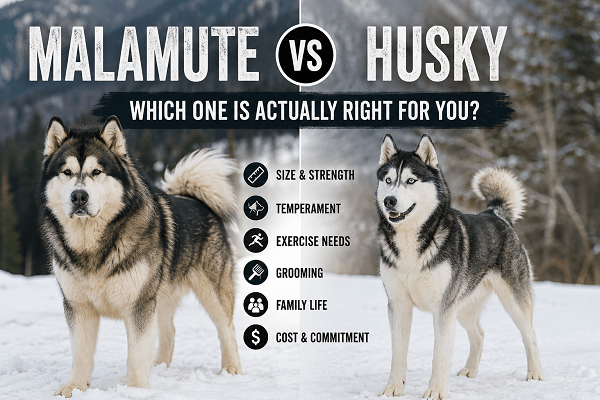
What’s the difference between a Malamute and a Husky? The Alaskan Malamute is a big, heavy freighting dog (75 to 100 lb) built to haul heavy loads. The Siberian Husky is a lighter, faster racing dog (35 to 60 lb) built to run long distances with light loads. Pick the Malamute if you want a powerful, people-loving giant and can handle a strong, dominant dog. Pick the Husky if you want a smaller, social athlete and can outsmart a world-class escape artist.
Both breeds shed heavily, need 1.5 to 2+ hours of exercise a day, struggle in hot weather, and are poor guard dogs. Neither suits a casual first-time owner.
Table of Contents
- Introduction
- Where They Come From: Two Different Jobs
- How to Tell a Malamute From a Husky (Quick ID Guide)
- Malamute vs Husky at a Glance
- Temperament: People, Dogs and Small Pets
- Size, Strength and Leash Handling
- Exercise and Training
- Escaping, Howling and Destruction
- Grooming and Shedding
- Health and Lifespan
- Can They Live in a Hot Climate?
- Real Cost of Ownership
- A Handler’s Note: What I See in Real Homes
- Which Dog Fits Your Life? (A 5-Question Test)
- Frequently Asked Questions
- Conclusion
Introduction
You see a photo of a gorgeous Arctic dog with a thick coat, a wolfish face and a happy grin. You think, “I want one.” Then someone asks, “Husky or Malamute?” and you freeze.
So here’s the thing. These two breeds look alike, but they live very differently. One is a 90-pound freight hauler that can pull you off your feet. The other is a lighter runner that can open a gate latch and be three streets away before you notice. Choosing wrong doesn’t just mean a bad fit. It often means a dog that ends up in a shelter, because these breeds are among the most surrendered when owners underestimate them.
In this guide, you’ll learn how to tell the two apart at a glance, how they compare on size, temperament, exercise, shedding, health and real costs, and how they handle heat, children and small pets. You’ll also get a simple 5-question test to make the final call. I’ve written it for both casual dog owners and handlers, so you can use it whether this is your first dog or your fifth.
Where They Come From: Two Different Jobs
To understand any working breed, start with the job it was built for. That one fact explains almost everything about how the dog behaves in your living room. (If the term is new to you, our guide on what it means when a dog is a working dog is a good primer.)
The Siberian Husky came from northeastern Siberia, where the Chukchi people bred them to pull light loads quickly over huge distances on very little food. Huskies reached Alaska in 1908 for racing. They became famous in the 1925 serum run to Nome, when relay teams of sled dogs carried diphtheria antitoxin roughly 674 miles (about 1,085 km) in around five and a half days. The AKC recognized the breed in 1930.
The Alaskan Malamute is named after the Mahlemut people, an Inupiat group of Alaska’s Kotzebue Sound area. It was bred to haul heavy loads, such as camp gear, seal and game, over shorter distances in brutal cold. It’s one of the oldest Arctic breeds, and the AKC recognized it in 1935. Genetic work in 2015 showed that the Malamute, the Siberian Husky and the Alaskan husky all share close roots with Siberian sled dogs.
The Siberian Husky Club of America’s president compared it nicely: the Husky is a marathon runner, light and nimble, while the Malamute is the weightlifter, big and strong.
That’s your first big clue:
- Husky = speed, stamina, escape skills, and a love of running.
- Malamute = power, pulling strength, and a stubborn, steady personality.
How to Tell a Malamute From a Husky (Quick ID Guide)
Small female Malamutes and big male Huskies get mistaken for each other all the time. This is the checklist I use. Most pages skip it, but it’s the question many people search first.
| Feature | Alaskan Malamute | Siberian Husky |
|---|---|---|
| Eye color | Always brown | Blue, brown, or one of each |
| Head and muzzle | Broad, heavy, bear-like | Narrower, fox-like |
| Ears | Smaller, set wider apart | Taller, closer together, more triangular |
| Bone and body | Heavy bone, deep chest, powerful | Lighter bone, lean and athletic |
| Tail | Big “waving plume” curled over the back | Fox-brush tail, sickle curve when alert, trails when relaxed |
| Face markings | Often a cap and mask, or open face | Often a bold mask and “goggle” pattern |
| Colors | Light gray through black, sable and red, with a white underbody | Wider range, including agouti, white and piebald |
| How it moves | Strong, steady, powerful stride | Light, quick, effortless trot |
The fastest tell is the eyes. If you see blue eyes, it’s a Husky. Malamutes have brown eyes, and the breed standard treats blue eyes as a fault.
Malamute vs Husky at a Glance
| Trait | Alaskan Malamute | Siberian Husky |
|---|---|---|
| Original job | Heavy freighting and hauling | Light-load, long-distance racing |
| Height | About 23 to 25 in (58 to 64 cm) | About 20 to 23.5 in (51 to 60 cm) |
| Weight (breed standard) | 75 lb females, 85 lb males (many reach 90 to 100 lb) | 35 to 50 lb females, 45 to 60 lb males |
| Lifespan | About 10 to 14 years (many sources say 10 to 12) | About 12 to 15 years |
| Exercise | At least 2 hours a day (PDSA) | Plan for 1.5 to 2 hours, plus mental work |
| Shedding | Heavy, with two big coat blows a year | Heavy, with two big coat blows a year |
| With other dogs | Lower tolerance, same-sex tension is common | Usually more dog-friendly |
| Prey drive | High | High |
| Escape risk | Moderate (digs, forces fences) | Very high (climbs, jumps, digs, slips collars) |
| Training difficulty | Hard (stubborn, powerful) | Hard (clever, bored easily) |
| Good guard dog? | No | No |
| Rough lifetime cost | Over £17,000 (PDSA estimate) | Often a little lower, mostly due to size |
Here’s a short way to read the table. If you want size, presence and a calmer “off switch” after exercise, lean Malamute. If you want a lighter, faster, more playful dog and you’re ready for escape drama, lean Husky.
Temperament: People, Dogs and Small Pets
With People
Malamutes are affectionate and loyal, and they tend to bond with the whole family instead of one person. Many are calm indoors once they’ve burned off their energy. But don’t mistake “sweet” for “easy.” They’re strong-willed, and if you’re inconsistent, they’ll quietly take over.
Huskies are famously friendly, even with strangers. They’re clever, playful and independent. They love people, but they don’t live to please you. If something more interesting comes along, such as a squirrel, a gap in the fence or a snack on the counter, you lose their attention.
With Other Dogs
This is a difference many articles blur. Huskies, being pack-oriented sled dogs, usually get along with other dogs well. Malamutes are more likely to show dominance, especially toward dogs of the same sex. That doesn’t make them aggressive by default, but it does mean early, careful socialization matters a lot more. If you already own a dog, think hard about this one.
With Cats and Small Animals
Both breeds carry a high prey drive. Rabbits, chickens, hamsters and outdoor cats can all look like targets. Some Arctic dogs raised with a cat from puppyhood live peacefully with that one cat, then chase the neighbor’s cat without thinking. I wouldn’t trust either breed alone with small pets, and I’d never leave either off-leash near livestock.
As Guard Dogs
If you’re hoping for protection, look elsewhere. Neither breed is a natural guard dog. Huskies tend to greet intruders like long-lost friends. Malamutes look intimidating and may bark or howl, but they’re not bred to protect property. For real security, you’d want a breed selected for that work. Our readers who want a working protection dog usually end up looking at shepherd-type breeds instead.
Size, Strength and Leash Handling
The Malamute really separates itself here. Picture steering a shopping cart with a loose wheel, only the cart weighs 90 pounds and sees a rabbit. That’s walking an untrained adult Malamute.
A Husky is lighter, so you can physically manage one more easily. But a Husky pulls in a different way. It leans into the harness and keeps going for miles. Both breeds were literally built to pull, so “don’t pull” is a skill you must teach, not a thing they’ll learn on their own.
A few practical points from the handler side:
- Start leash skills at 8 to 10 weeks. A 15-pound puppy is easy to guide. A 70-pound teenager is not.
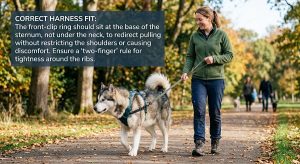
- Use the right equipment. A well-fitted, strong harness gives you control without putting pressure on the neck. We break down what experienced handlers look for in our guide to the best tactical K9 harness for maximum control.
- Teach loose-leash walking with rewards and timing. Our step-by-step lesson on how to stop a dog pulling on the leash works well for northern breeds.
- Redirect the pulling urge. Once the dog walks politely on a normal walk, you can allow pulling in a harness for sports like canicross, bikejoring or skijoring. A dog that knows when it’s allowed to pull is far easier to live with.
Apartment living is possible with either breed, but it’s harder with a Malamute. Even a Husky in a small flat needs 1.5 to 2 hours of real exercise outside, not just a balcony.
Exercise and Training
Let’s be honest. A 30-minute walk around the block won’t cut it for either breed. The PDSA says Malamutes need at least two hours a day, and most Husky experts say the same or close to it. If you skip the exercise, you’ll pay for it in chewed sofas, dug-up gardens and howling at 2 a.m. For a deeper look at the numbers, read our guide on how often to exercise a working dog.
What a Good Week Looks Like
- Daily: two walks plus one longer “job” session (a run, hike or pulling work)
- 2 to 3 times a week: scent games, find-it games, puzzle feeders or short obedience drills
- Weekly: one big outing such as a long hike or a run on varied terrain
- Always: a safe place to sniff and explore
Sports That Suit Each Breed
- Malamute: weight pulling (done carefully), carting, backpacking with a dog pack, and slower long hikes
- Husky: canicross, bikejoring, skijoring, sledding and fast trail running
A Realistic Training Timeline
- 8 to 16 weeks: Socialize widely and safely, start name response and recall, and begin crate and alone-time practice.
- 4 to 8 months: Build impulse control and loose-leash walking. Expect “teenage brain” and testing.
- 8 to 18 months: Proof skills in busy places, and be firm and consistent. This is when many owners give up. Don’t.
- 2 to 3 years: Many northern breeds don’t settle until here. Keep training going.
A note on method. These dogs don’t respond well to harsh correction. They respond to clear rules, high-value rewards and short, varied sessions. Make obedience worth their while, because they’ll always ask, “What’s in it for me?”
New to high-energy breeds? My book, Beyond the Bark: Inside a Pro Handler’s Playbook for Raising the Ideal Dog, walks you through the training, leadership and daily management methods used by professional handlers.
A word on recall: don’t trust either breed off-leash in an unfenced space. Even a well-trained Husky may chase a scent for miles. That’s instinct, not disobedience.
Escaping, Howling and Destruction
This is the part many blogs skip, and it’s the part owners complain about most.
Escaping. Huskies are legendary for it. They dig under fences, climb over them, squeeze through gaps and learn to work latches. Plan for a fence of at least 6 feet (1.8 m), buried wire or a concrete footing, and double-check gates. Malamutes escape too, but they usually do it with brute force or digging. A bored, under-exercised Malamute can rip through weak panels.
Howling and “talking.” Both are vocal but they rarely bark much. Huskies chat, whine and sing in long, dramatic howls. Malamutes have their own “woo-woo” style. If you share a wall with neighbors, think about this honestly.
Digging. Arctic dogs dig cooling hollows. Give them a legal digging spot, like a sandpit, or accept that your lawn is theirs.
Destruction. It almost always comes from boredom, isolation or too little exercise. These dogs are social and don’t do well left alone for 8 to 10 hours.
Grooming and Shedding
Neither breed is for you if hair bothers you. Both have a thick double coat: a soft, dense undercoat under longer guard hairs.
- Year-round: expect moderate daily shedding.
- Twice a year: both “blow” their undercoat, usually for two to four weeks. You’ll pull out handfuls of fluff.
- Brush: several times a week normally, daily during a blow.
- Bathe: only when needed, since frequent baths dry the skin.
- Tools: an undercoat rake, a slicker brush and a powerful vacuum.
The Malamute is a bigger job simply because there’s more dog. Some listings rate the Husky as lower-maintenance for grooming, and that’s fair, but “lower” still means a lot.
Never shave either one. Many owners in warm places shave their dogs to “keep them cool.” It does the opposite. The double coat insulates against heat as well as cold, and shaving can damage regrowth and expose the skin to sunburn.
Health and Lifespan
Both breeds are generally sturdy, but each has its own checklist. Always ask a breeder for proof of health testing on the parents.
| Condition | Malamute | Husky |
|---|---|---|
| Hip and elbow dysplasia | Common concern in large dogs | Less common, still screened |
| Inherited polyneuropathy | Reported in the breed (DNA test available) | Not a typical concern |
| Day blindness | DNA test available | Not typical |
| Cataracts | Hereditary cataracts reported | Juvenile cataracts can appear from 6 to 12 months |
| PRA and corneal dystrophy | Eye problems reported, including PRA | PRA and corneal dystrophy recognized |
| Hypothyroidism | Yes | Yes |
| Zinc-responsive dermatosis | Less common | Seen more often, causes skin and coat problems |
| Bloat (GDV) | A risk in deep-chested dogs, so avoid big meals before exercise | Lower risk |
| Diabetes | Increasing concern in Arctic breeds, often middle-aged | Possible |
Lifespan: Huskies tend to live a little longer, typically 12 to 15 years, while Malamutes often live 10 to 12 and sometimes up to 14. That’s normal, since larger dogs usually have shorter lives.
Smart buyer tip: Ask for hip scores, eye certificates and the DNA tests for polyneuropathy and day blindness for Malamutes. A breeder who can’t show them isn’t one to trust. Be wary of unusually cheap puppies, too, because they often come from puppy farms.
Can They Live in a Hot Climate?
This section is something most top-ranking pages barely touch, yet readers in Australia, the southern US, the Middle East, India and Africa ask it constantly.
Both breeds were built for cold. They can live in warm places, but only with serious management. If I’m being blunt, I’d think very hard before choosing either one if your average summer day tops 30 °C (86 °F) with high humidity.
If you do go ahead:
- Exercise at dawn and after sunset only. Skip midday walks completely.
- Provide cool shade, fresh water and air conditioning or a strong fan indoors. An air-conditioned room is not a luxury for these breeds.
- Never shave. (See above.)
- Know the signs of heatstroke: heavy panting, drooling, bright red gums, weakness, vomiting or collapse. It’s an emergency, so cool the dog gradually with room-temperature water and head to a vet right away.
- Watch the pavement. If it’s too hot for your hand, it’s too hot for their paws.
In my experience, the Husky’s smaller body makes it slightly easier to keep cool. A Malamute’s mass holds heat, so it needs even more careful planning.
Real Cost of Ownership
Prices vary a lot by country, breeder and bloodline, so treat these as ballpark figures.
- Malamute puppy: often about $1,500 to $3,000 from a good breeder in the US. Rescue adoption fees are far lower.
- Husky puppy: often about $600 to $1,300 in some breed guides, though well-bred pups from health-tested parents can cost more.
- Ongoing care (Malamute): the UK’s PDSA estimates at least £105 a month and over £17,000 across a lifetime, covering food, insurance, training and routine care.
- Husky: typically a bit less for food and gear, but add fence upgrades, escape-proofing and possibly a dog walker or sitter.
Budget extra for the things people forget: a strong harness and lead, a good vacuum, a secure fence, joint-friendly bedding, boarding costs (many kennels charge more for big, hairy dogs) and emergency vet bills.
The better question isn’t, “Can I afford the puppy?” It’s, “Can I afford this dog comfortably for 10 to 14 years?”
A Handler’s Note: What I See in Real Homes
I’ve spent more than 14 years as an instructor and handler at the Nigerian Army Dog Centre, working with dogs in structured, high-pressure environments. That background has taught me one rule: a dog’s behavior is mostly a reflection of how well its needs are met.
Once you view a Malamute or Husky through that lens, the pattern is clear. Most “problem” dogs aren’t bad dogs. They’re working-line dogs with nothing to do. When owners add structure, daily exercise and mental tasks, the same dogs become calm, loyal companions.
Also, I’m not a vet, so please talk to your own veterinarian about health testing, diet and heat management for your dog. The breed health information in this article comes from breed clubs and veterinary sources such as the AKC, the PDSA and the Alaskan Malamute Club of America, and prices vary by region.
Which Dog Fits Your Life? (A 5-Question Test)
Answer these honestly. Don’t answer the way you wish your life looked.
1. How much space and fencing do you have? Tiny flat and no fence: Husky, but only with serious daily outings. A big, secure yard: either breed.
2. Do you already own a dog or small pets? Another dog of the same sex: lean Husky. Cats, rabbits or poultry: think twice about both.
3. How much dog can you physically handle? If a 90-pound dog could knock you down on a leash, choose the Husky or a different breed.
4. What activities do you actually enjoy? Fast running, cycling or skijoring: Husky. Heavy-duty hiking, carrying a pack or slower endurance work: Malamute.
5. What’s your climate? Cool or cold: either breed. Hot and humid: neither, unless you can air-condition and adjust your routine.
Choose a Malamute If You…
- Want a large, powerful, people-loving Arctic dog
- Have experience with strong, stubborn breeds
- Can provide 2+ hours of exercise a day
- Have no other dog of the same sex, or can manage introductions well
- Have the strength and space to handle a 90-pound dog
Choose a Husky If You…
- Want a lighter, faster, more social dog
- Love running, cycling or other fast outdoor sports
- Can build an escape-proof yard
- Don’t need a guard dog and can live with howling
- Want a dog that usually gets along better with other dogs
Skip Both If You…
- Work long hours with nobody home
- Want a dog that listens off-leash
- Hate hair, noise or mess
- Live somewhere very hot and can’t cool a dog properly
- Want a first dog that’s easy to train
Still unsure? Here’s my honest take: if you’re a first-time owner, think hard about whether either breed is realistic. If you’re set on one, the Husky is usually a bit easier to physically manage, while the Malamute is often the calmer dog indoors. Neither is easy.
Stay in the Loop
Want weekly training tips, breed guides and handler insights? Subscribe to our weekly articles roundup newsletter and get the best of ARFS K9 Team in your inbox.
Frequently Asked Questions
1. Which is bigger, a Malamute or a Husky?
The Malamute is clearly bigger. Breed standards give about 75 to 85 pounds for Malamutes, though many reach 90 to 100 pounds, while Huskies usually weigh 35 to 60 pounds. Malamutes also have heavier bone, broader heads and deeper chests.
2. Which is the better family dog, a Malamute or a Husky?
Both can be good family dogs in the right home. Huskies are usually more social and a bit easier to handle physically. Malamutes are affectionate but large and powerful, so they suit families with older children and adults who can manage them. With both breeds, supervise all play with young kids, since their size and energy can lead to accidents.
3. Which is easier to train, a Malamute or a Husky?
Neither is easy, and both are poor choices for most first-time owners. Huskies are clever but easily bored and prone to ignoring commands. Malamutes are strong-willed and may test every rule. Start early, keep sessions short and rewarding, and stay consistent for at least the first two years.
4. Which sheds more, a Malamute or a Husky?
Both shed heavily, and both blow their undercoat twice a year. A Malamute produces more hair simply because it’s larger, so the cleanup feels bigger. Daily brushing during a coat blow is realistic for either breed.
5. Can a Malamute or Husky live in a hot climate?
They can, but it’s difficult and it needs careful management. Exercise only in the cool hours, provide air conditioning or strong cooling indoors, never shave the coat, and learn the signs of heatstroke. If you can’t do all of that, a breed built for warm weather is a kinder choice.
Conclusion
The Malamute vs Husky choice comes down to one question: which dog’s original job matches your lifestyle?
If you want a big, powerful, affectionate dog and you have the strength, space and experience to handle it, the Malamute is a remarkable companion. If you want a lighter, faster, more social dog and you’re ready to outsmart a world-class escape artist, the Husky is a joy.
Here’s what to do next:
- Be honest about your time, space, climate and experience.
- Meet adult dogs of both breeds before you commit, ideally through a breed club.
- Ask for health tests and meet the puppy’s parents.
- Fence first, dog second. Secure your yard before the puppy arrives.
- Start training on day one, especially leash manners and impulse control.
Get the match right, and you’ll have a loyal, beautiful and entertaining dog for over a decade. Get it wrong, and you’ll feel the strain every day. Choose with your head first, then let your heart fall for the dog.
Got a Malamute or Husky story? Share it in the comments, and don’t forget to subscribe to our weekly newsletter for more breed guides and training tips.

Her work centres on obedience, detection, protection and operational readiness. She favours proven methods built on repetition, consistency and real-world conditioning, so that both dogs and handlers are prepared for high-pressure tasks.
Rofiat represented the Nigerian Army Dog Centre at the Nigerian Army Day Celebration (NADCEL) 2026, where she led demonstrations in obedience, explosive detection, agility and tactical movement. Through articles, training content and documentaries, she shares field-based insight into how structured training, clear communication and trust between handler and dog affect performance and reliability.
She is the author of Beyond the Bark: Inside a Pro Handler's Playbook for Raising the Ideal Dog, a practical guide that helps dog owners and handlers apply professional training principles in everyday situations.
- Can You Handle a Cane Corso Puppy? 7 Hard Truths - October 23, 2026
- How to Train a Stubborn Pug: A K9 Trainer’s Real Guide - October 22, 2026
- Dog Hotel Prep: 7 Must-Haves Before Boarding - October 21, 2026