12 Reasons Dogs Bite and How to Stop Them (Trainer Guide)
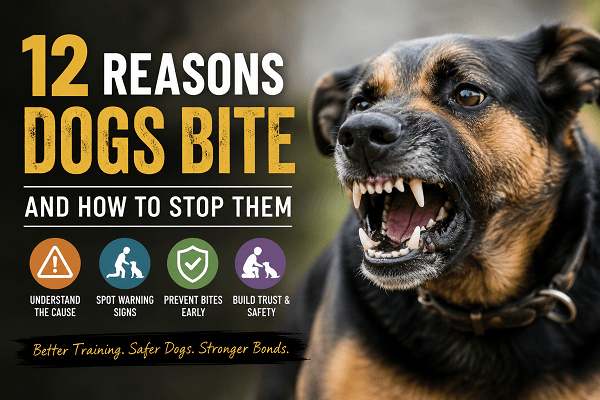
Dogs bite mainly because of fear, pain, guarding, surprise, or too much excitement. A bite is almost always the last step in a chain of warnings that people missed or punished. To stop it, find the trigger, remove or manage it, teach the dog a safer response, and bring in a vet and a qualified behavior professional if the bite is new, repeated, or breaks skin.
How to stop a dog from biting (the short version):
- Rule out pain with a vet exam.
- Identify the trigger (fear, food, handling, excitement, and so on).
- Manage the environment so the dog can’t practice biting.
- Reward calm behavior and teach an alternative, like “drop it,” “go to your mat,” or “walk away.”
- Never punish growling. Get expert help for Level 3+ bites.
Table of Contents
- Quick Summary
- Introduction
- How Common Are Dog Bites? (The Numbers)
- The Dunbar Bite Scale: Not All Bites Are Equal
- The 12 Reasons Dogs Bite (And the Fix for Each)
- Why a “Calm” Dog Suddenly Bites: Trigger Stacking
- Warning Signs: The Ladder Dogs Climb Before a Bite
- Dogs, Kids, and Bites: What the Research Shows
- How to Stop Biting: A 5-Step Plan
- What to Do Right After a Dog Bite
- Muzzles, Management, and When to Call a Professional
- A Handler’s Perspective
- FAQs
- Conclusion
Introduction
Nobody expects their dog to bite. Then it happens: a snap over a chew bone, a nip when you reach to lift the dog off the sofa, a lunge on a walk. Your heart drops, and the same questions pop up. Why did my dog do that? Is it going to happen again? Is my dog dangerous?
Here’s the problem. Most advice online gives you a short list of causes and a line like “train your dog.” That’s not enough when you’re standing there with a dog that just bit someone.
In this guide, you’ll learn why dogs bite (all 12 real causes), how to read bite severity with the Dunbar scale, how to spot warning signs early, what to do in the first hour after a bite, and a practical plan to stop it. I’ve written it for casual dog owners and professional handlers alike, so you won’t need a dictionary.
How Common Are Dog Bites? (The Numbers)
Let’s start with the facts, because they change how you think about this.
- A CDC study published in Injury Prevention estimated that about 4.5 million people are bitten by dogs every year in the US. Of those, around 885,000 (19%) needed medical attention.
- The same study found that child bite rates fell by about 47% compared with a 1994 survey. That’s good news, and it shows prevention work pays off.
- It also found that having a dog in the home raised bite risk, and more dogs meant more risk. Multi-dog households need extra care.
- Worldwide, the WHO says dogs cause up to 99% of human rabies cases, and rabies kills an estimated 59,000 people a year, mostly in Africa and Asia. About half of those cases are in children under 15.
- Researchers believe many bites never get reported, so the real number is probably higher.
Now the part that matters most: the US has roughly 90 million pet dogs, so the vast majority of dogs never bite anyone. Biting is a behavior with causes. And causes can be found and fixed.
The Dunbar Bite Scale: Not All Bites Are Equal
Most articles skip this, but it’s the first thing a behavior professional will ask about. Dr. Ian Dunbar, a veterinarian and behaviorist, created a six-level scale to describe how serious a bite was. Vets, trainers, and insurers all use it.
| Level | What happens |
|---|---|
| 1 | Dog snarls, growls, or lunges. Teeth never touch skin. |
| 2 | Teeth touch skin, but no puncture. You may see a scratch or small mark. |
| 3 | One to four punctures from a single bite, none deeper than half the length of the dog’s canine tooth. |
| 4 | One to four punctures, at least one deeper than half the canine length. Often deep bruising or slashing if the dog held on or shook. |
| 5 | A multiple-bite attack with at least two Level 4 bites. |
| 6 | The victim dies. |
Here’s why this matters for you. The large majority of bites sit at Levels 1 and 2. Behaviorists commonly say these dogs have a good outlook with training and management. A Level 3 bite means you need a professional plan, not just a YouTube video. Level 4 and above is a serious safety decision that should involve a veterinary behaviorist.
If your dog has bitten, write down which level it was. That one note makes every conversation with your vet or trainer faster and more useful.
The 12 Reasons Dogs Bite (And the Fix for Each)
For each reason, you’ll get what it looks like, why it happens, and how to stop it.
1. Fear
Fear is the number one driver. A frightened dog that can’t escape will fight. Think of a dog backed into a corner at the vet, grabbed by a stranger, or hugged by a toddler.
What it looks like: Ears back, tail tucked, body low, whale eye (you see the whites), lip licking, then a quick snap or “bite and run.”
How to stop it:
- Give the dog space. Distance is your best training tool.
- Use desensitization and counter-conditioning. That’s a fancy way of saying: show the scary thing from far enough away that the dog stays calm, then pair it with great food. Move closer over days or weeks, never faster than the dog can handle.
- Never force a scared dog to “face its fear.” Flooding makes bites worse.
- Always let a dog choose to approach people, not the other way around.
2. Pain or Illness
A dog in pain may bite even if it has never shown aggression before. Arthritis, dental disease, ear infections, anal gland problems, injuries, and neurological conditions can all make a normally gentle dog snap when touched.
What it looks like: A sudden change. The dog bites when you touch a certain spot, lift it, groom it, or move it off the bed.
How to stop it: Book a vet exam first. This is the most skipped step, and it’s the one that fixes the most “behavior problems.” If the dog needs pain relief, behavior often improves quickly. When you handle a sore dog, move slowly and let the dog tell you where it hurts.
3. Resource Guarding
Dogs guard what they value: food, bones, toys, beds, stolen socks, even people. It’s a normal survival behavior, but it turns dangerous when someone ignores the warnings. It’s one of the most common reasons family dogs bite.
What it looks like: Freezing over a bowl, stiffening, hard stare, hovering over a chew, a low growl, eating faster, then a snap if you get closer.
How to stop it:
- Never take things by force. You’ll teach the dog that people are a threat to its stuff.
- Teach a trade. Offer something better (chicken beats a dry biscuit), then give the original item back when you can.
- Teach a solid “drop it” and “leave it” using low-value items first.
- Feed the dog in a quiet spot. Keep children away from bowls, bones, and crates.
- If the guarding is intense, get a qualified behavior professional. Jean Donaldson’s book Mine! is a well-regarded guide for owners.
4. Startle (Sleeping and Surprise Bites)
Ever been woken suddenly and swung out in confusion? Dogs do the same. A dog that’s startled from sleep or approached from behind may bite before it’s fully awake.
What it looks like: A bite that seems to come “from nowhere” when someone touches, hugs, or steps over a sleeping dog.
How to stop it:
- Wake your dog by calling its name from a distance, not by touching it.
- Give the dog a bed in a quiet corner, away from foot traffic.
- Teach children: let sleeping dogs lie. Researchers who study child bites say a very common scenario is a family dog resting while a child walks up to it.
- Older or deaf dogs startle more easily, so give them extra space.
5. Territorial and Protective Behavior
Dogs defend their home, yard, car, and family. A dog that barks at the gate may bite someone who walks in uninvited, or even a guest who walks in with the owner’s permission.
What it looks like: Barking, hackles up, body forward, blocking the door, charging at fences.
How to stop it:
- Manage the entry points. Use a baby gate, crate, or a leash before you open the door.
- Teach a “go to your mat” cue for when visitors arrive.
- Ask guests to ignore the dog and let it settle first.
- Don’t encourage the dog to “guard” in a pet home. A pet that is rewarded for aggression will keep practicing it.
A quick note from my work with trained dogs: a protection-trained working dog bites on cue and lets go on cue. A territorial pet that bites out of worry is a totally different animal. Controlled bite work takes years of training and strict handling. Don’t try to copy it at home.
6. Redirected Aggression and Frustration
Sometimes a dog is upset by one thing but bites something else. A dog barking at a passing dog over the fence may whirl around and bite the person who grabs its collar. Two dogs getting riled up at the door may turn on each other.
What it looks like: Intense arousal at a trigger (fence, window, other dog), then a fast bite at the nearest target.
How to stop it:
- Never grab or pull a dog that’s in a high-arousal state. Use a leash, a door, or a barrier instead.
- Block the view. Use window film or move the dog away from the fence line.
- Teach frustration tolerance: wait at doors, sit before the leash goes on, and reward calm.
- If it keeps happening, keep the dog separate from the triggers until you have a plan.
7. Overexcitement (Play That Goes Too Far)
Some dogs get so wound up in play that their mouth takes over. Squealing kids, tug games, rough wrestling, and zoomies can all push a dog past self-control.
What it looks like: Frantic mouthing, jumping, grabbing sleeves, ignoring cues, wide eyes.
How to stop it:
- Use the pause game. Every 20 to 30 seconds, stop play, ask for a sit, then restart. Dogs that can pause stay in control.
- End play when the dog gets frantic, before the bite.
- Skip rough games with hands. Use toys.
- Add enough daily exercise and mental work so the dog isn’t saving all its energy for the next burst.
8. Prey Drive
Chase is wired into dogs. Running kids, bikes, joggers, squealing small pets, and flapping clothes can all trigger a “grab” response, especially in herding and hunting breeds. It looks like aggression, but it’s different. The dog isn’t angry. It’s hunting.
What it looks like: Silent stalking, fixed stare, crouching, then a fast chase and grab.
How to stop it:
- Control movement. Keep dogs on a leash or long line near running kids and cyclists.
- Build a rock-solid recall in low-distraction places first, then increase difficulty.
- Replace the chase with an approved outlet like flirt-pole play, fetch, or scent games.
- Teach children to stand still like a tree if a dog is chasing, instead of running.
- For more on how instinct and obedience work together, see our guide on obedience vs. instinct in dogs.
9. Puppy Mouthing and Teething
Puppies explore with their mouths. Puppies have 28 baby teeth, and they get 42 adult teeth by about six or seven months. During teething, the gums hurt and everything gets chewed, including hands.
Here’s the thing most people miss: puppies also learn bite inhibition (how hard they can bite) from play with other puppies and from you. The most important learning window runs from roughly 3 to 16 weeks.
How to stop it:
- When teeth touch skin, say “ouch” in a calm voice, stop playing for 10 to 20 seconds, then restart. Don’t yell or pull your hand away fast, because that makes it a game.
- Always keep a toy within reach and swap your hand for it.
- Offer frozen chew toys for sore gums.
- Plan nap times. Overtired puppies bite more. A structured routine helps, and our guide on how to crate train a puppy shows how to build one.
- Puppy classes with other puppies help them learn gentler mouths.
10. Maternal Protection
A mother dog with newborn puppies may bite anyone who comes too close, even people she trusts. It’s instinct, not a character flaw.
How to stop it:
- Give her a quiet, private whelping area.
- Limit visitors, and keep children and other pets away.
- Handle puppies only when needed, and let her see you.
- If you must check on the litter, ask someone she trusts to distract her with food or a short walk.
11. Senior Dogs: Confusion and Sensory Loss
Older dogs may lose hearing, sight, and sometimes cognitive function. A senior dog may not recognize a family member in a dim room, or may get confused and snap when touched. Pain from arthritis adds to the problem.
What it looks like: Disorientation, staring at walls, night waking, new irritability, bites when touched without warning.
How to stop it:
- See your vet. Cognitive decline and pain can often be managed.
- Approach in the dog’s line of sight, speak softly, and let it sniff you first.
- Use soft lights at night and keep furniture where it is.
- Keep young children and the senior dog supervised, and give the senior dog a safe retreat.
12. A Growl That Got Punished (and Bites That Worked)
This one rarely appears in other bite lists, and I think it’s one of the biggest.
A growl is a dog’s way of saying “please stop.” If an owner yells at, hits, or corrects the dog for growling, the dog doesn’t stop feeling uncomfortable. It just stops warning you. The next time, you may get a bite with no growl at all.
And there’s a second layer. If a bite makes the scary thing go away (the child stops hugging, the vet backs off, the stranger leaves), the dog learns that biting works. It will use it sooner next time.
How to stop it:
- Never punish a growl. Thank the dog (calmly), give space, and then figure out what caused it.
- Reward the signals you want: a turn of the head, a walk away, a calm sit.
- Stay away from “alpha” or “dominance” methods. Modern veterinary behaviorists don’t recommend them. If you want to see why, read dominance vs. discipline: what K9 trainers know that pet owners don’t.
Why a “Calm” Dog Suddenly Bites: Trigger Stacking
“He’s never bitten anyone before!” I hear that all the time, and it’s usually true. But a dog’s stress works like a bucket. Every small stressor adds a bit of water: a loud morning, a missed walk, a vet visit, guests in the house, a child grabbing a toy. Most days the bucket doesn’t overflow. Then one more small thing happens and it spills.
Trainers call this trigger stacking. It explains why:
- A dog tolerates a hug on Monday and bites on Friday.
- A normally friendly dog snaps after a stressful day.
- Owners say it came “out of nowhere” when it really built up.
What to do: Keep a simple log for two weeks. Write down what happened before each growl, snap, or bite: time of day, who was there, what the dog had been through, whether it was in pain. Patterns show up fast. Behaviorists call this tracking A-B-C: Antecedent, Behavior, Consequence.
Warning Signs: The Ladder Dogs Climb Before a Bite
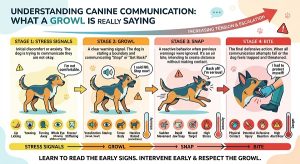
Dogs rarely skip straight to biting. They send signals in steps. Behaviorist Kendal Shepherd described this progression as the “ladder of aggression.” Learn the lower rungs and you’ll prevent most bites.
Early (stress):
- Lip licking, yawning, blinking
- Looking away, turning the head
- Sniffing the ground suddenly
- Shaking off like a wet dog
Middle (discomfort):
- Freezing, stiff body
- Whale eye
- Closed mouth, hard stare
- Moving away or hiding
Late (warning):
- Curled lip, showing teeth
- Growling
- Air snap
Last: Bite.
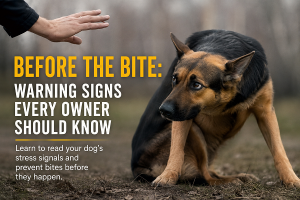
Here’s the golden rule: when you see any of these, stop what you’re doing and give the dog room. For a deeper checklist, read our guide on warning signs every owner should know before the bite.
A wagging tail doesn’t always mean friendly. A tail wag can show excitement, tension, or uncertainty. Always read the whole body.
Dogs, Kids, and Bites: What the Research Shows
Children are the most common victims, and the details may surprise you.
- Bite rates are highest in children aged 5 to 9, according to the CDC.
- In a Denver children’s hospital study of 537 facial dog bites, 68% happened in kids aged 5 and under, and 3-year-olds had the highest rate. About half of the biting dogs were the child’s own family dog.
- Researchers say about 80% of severe bites in children involve the head and neck, since a child’s face is at a dog’s level.
- Many bites happen with an adult in the room.
- A common scenario is a resting family dog and a child who walks up to it.
So the old advice “my dog is great with kids” isn’t enough. Here’s what actually works:
- Supervise actively. That means eyes on the dog and child, not just in the same room.
- Teach kids three rules: don’t hug or kiss dogs, don’t bother a dog that’s eating, sleeping, or chewing, and ask an adult before touching any dog.
- If a dog takes a child’s toy or snack, the child should tell an adult and never try to snatch it back.
- Give the dog a safe place (a crate, mat, or gated area) that children are never allowed to enter.
- Teach “be a tree”: if a strange dog approaches, stand still with arms folded and look away. If knocked down, curl into a ball and cover your face.
- Separate when you can’t watch. A baby gate takes two seconds and prevents an injury that lasts a lifetime.
How to Stop Biting: A 5-Step Plan
Whatever the reason, this plan works as a framework.
Step 1: Get a vet check. Rule out pain and illness first, always.
Step 2: Manage the environment. Management stops the dog from practicing biting while you train. Use gates, leashes, crates, closed doors, and muzzle training (more below). Training takes weeks, but management works today.
Step 3: Identify the trigger. Use your log. Is it food? Handling? Visitors? Excitement? Fear?
Step 4: Teach a better response. Dogs need an alternative. For guarding, that’s a trade. For fear, that’s more distance and positive associations. For excitement, that’s the pause game and calm rewards. Obedience cues like “sit,” “leave it,” “drop it,” and “place” give your dog a job to do instead of biting.
Step 5: Get expert help early. Don’t wait for a third bite.
Don’t expect overnight results. Fear and guarding cases often take weeks to months. Progress is rarely a straight line, and that’s normal.
What to Do Right After a Dog Bite
Most blogs skip this, but it’s the part people need most when it happens.
If someone has been bitten:
- Stay calm and separate the dog. Put the dog in another room or a crate. Don’t punish it, since that just adds stress.
- Wash the wound right away. The WHO recommends washing with soap and plenty of running water for about 15 minutes, especially where rabies is present. Don’t skip this even when the bite looks small.
- Apply an antiseptic such as povidone iodine after washing, and cover with a clean dressing for a minor wound if your doctor advises (WHO advises against tight bandaging of rabies-risk wounds).
- Get medical care. Go to a clinic or ER for any puncture, deep wound, bite to the face, hand, or joint, or if the person is a child, elderly, or has a weak immune system. Deep bites can injure muscle, nerves, and bone even when the skin looks fine.
- Ask about tetanus and rabies. If the dog’s rabies vaccine status is unknown or the bite happened abroad, treatment (vaccine, and sometimes immunoglobulin) may be needed quickly.
- Report it if required. Many places require animal control or health authorities to be told. Most areas ask for the dog to be observed for about 10 days to check rabies status. Check your local rules.
- Write it down. Note the time, place, what happened beforehand, and the Dunbar level. Take photos of the injury.
- Call your vet and a behavior professional about the dog within a day or two.
This article isn’t medical or legal advice. Laws about owner liability differ between countries and states, so check your local rules or speak to a lawyer.
Muzzles, Management, and When to Call a Professional
Muzzles aren’t a punishment
A well-fitted basket muzzle, introduced slowly, is a safety tool. Dogs can pant, drink, and take treats while wearing one. Here’s the basic method:
- Hold the muzzle with a treat inside. Let the dog put its nose in by choice.
- Click or say “yes” and feed through the front. Repeat for several days.
- Slowly add time with the strap closed, starting with seconds.
- Pair the muzzle with fun things: walks, food, and play.
Never rush it or force it on. A muzzle-trained dog is much safer at the vet and in public.
Who to call
- Your vet first, for pain and medical causes.
- A veterinary behaviorist (a DACVB in the US) for serious or complex cases. These are vets with extra specialty training who can also prescribe medication.
- A certified behavior consultant or trainer who uses reward-based methods. In the US, look for credentials like CAAB, CPDT-KA, or IAABC. In the UK, look for ABTC or APBC members.
- Avoid anyone who guarantees a quick fix, uses shock or prong tools on a fearful dog, or says your dog just needs to “know who’s boss.”
Call a professional right away if:
- The bite was Level 3 or higher
- Your dog has bitten more than once
- Your dog bites during handling, grooming, or vet visits
- Your dog guards food or objects intensely
- Your dog has bitten a child
- The biting is sudden and new
A Handler’s Perspective
I’ve spent over 14 years as a military working dog instructor and handler at the Nigerian Army Dog Centre. Here’s what that work taught me about bites, in plain terms.
1. Stable dogs are made, not born. Good temperament comes from early socialization, clear routines, and fair handling. When a dog bites a family member, the cause is almost always something about its health, stress, or environment that people missed.
2. Handlers are trained to read the dog first. In professional kennels, handlers learn to read posture, eyes, and breathing before they touch a dog. Pet owners can borrow this habit. Watch before you reach.
3. Consistency beats intensity. Short, calm, repeated sessions build reliability. Yelling doesn’t.
4. We never ignore a change in behavior. In a working dog, a sudden attitude change triggers a vet check. Pet owners should treat it the same way.
5. Training doesn’t replace supervision. Even the best-trained dog is still a dog. I never assume a dog “would never” bite.
If you’d like to go deeper into how professional handlers build calm, reliable dogs at home, my e-book covers it step by step: Beyond the Bark: Inside a Pro Handler’s Playbook for Raising the Ideal Dog.
Frequently Asked Questions
Why did my dog suddenly bite me?
A “sudden” bite is usually not sudden. Pain, illness, stress build-up (trigger stacking), or a missed warning are the most common causes. Start with a vet exam, then look at what happened in the hours before the bite.
Can you train a dog to stop biting?
In most cases, yes, especially for Level 1 and 2 bites. Training works best when you remove the trigger, teach a calm alternative, and keep everyone safe while the dog learns. Dogs with Level 3+ bites need a professional plan, and some high-risk cases can’t be made fully safe.
What should I do right after a dog bite?
Separate the dog, wash the wound with soap and running water for about 15 minutes, apply antiseptic, and get medical care for anything beyond a very minor scrape. Ask about tetanus and rabies, report the bite if your local law requires it, and write down what happened.
Is puppy biting normal?
Yes. Puppies mouth and nip while they explore and teethe, and most outgrow it with consistent redirection and good socialization. Worry if a young puppy freezes and stiffens over objects, bites hard and keeps going when you stop play, or shows fear aggression. Ask a trainer early.
Which dog breeds bite the most?
Any dog can bite. The AVMA states that breed alone doesn’t determine bite risk. Bigger, stronger dogs can cause more damage per bite, but that’s about size, not temperament. Early socialization, training, health, supervision, and how people treat the dog matter much more than the label on its pedigree.
Conclusion
Dogs bite because something feels wrong to them: fear, pain, guarding, surprise, too much excitement, or a warning nobody listened to. Almost every bite has a reason, and almost every reason can be managed.
Here’s what to remember:
- Get a vet check first. Pain is the most overlooked cause.
- Learn the warning ladder and respect the early signals.
- Never punish a growl.
- Supervise kids actively and teach them the three golden rules.
- Use management now and training over time.
- Call a qualified professional early, especially after a Level 3+ bite.
If you take just one action today, make it this: write down what happens before your dog’s next stress signal. That tiny habit turns a mystery into a plan.
Want practical dog-handling tips in your inbox every week? Subscribe to our weekly articles roundup newsletter here: https://arfsk9team.com.ng/newsletter/
Sources & Further Reading
- CDC / Injury Prevention, “Dog bites: still a problem?” (Gilchrist et al., 2008)
- American Veterinary Medical Association (AVMA), dog bite prevention resources
- World Health Organization (WHO), Rabies fact sheet
- Ian Dunbar, Dog Bite Scale (Association of Professional Dog Trainers)
- Nationwide Children’s Hospital / Ohio State University, study on dog bite injuries to children’s faces (2019)
- University of Colorado / Children’s Hospital Colorado, pediatric facial dog bite study (2003 to 2008 cases)

Her work centres on obedience, detection, protection and operational readiness. She favours proven methods built on repetition, consistency and real-world conditioning, so that both dogs and handlers are prepared for high-pressure tasks.
Rofiat represented the Nigerian Army Dog Centre at the Nigerian Army Day Celebration (NADCEL) 2026, where she led demonstrations in obedience, explosive detection, agility and tactical movement. Through articles, training content and documentaries, she shares field-based insight into how structured training, clear communication and trust between handler and dog affect performance and reliability.
She is the author of Beyond the Bark: Inside a Pro Handler's Playbook for Raising the Ideal Dog, a practical guide that helps dog owners and handlers apply professional training principles in everyday situations.
- Dog Agility Course Layout: Easy DIY Setup - October 7, 2026
- Local Dog Breeds: Temperament, Health & Training Guide - October 6, 2026
- How Long Do Military Working Dogs Serve? Full Guide - October 5, 2026