5 Hardest Toy Dog Breeds to Housebreak (And Fixes)
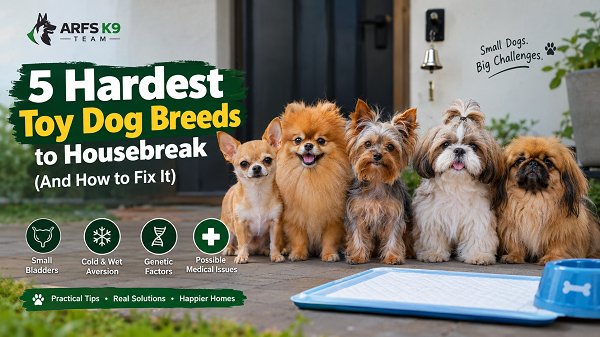
The 5 hardest toy dog breeds to housebreak are the Chihuahua, Pomeranian, Yorkshire Terrier, Shih Tzu, and Pekingese. They’re difficult for three real, physical reasons, not just “stubbornness”: tiny bladders that hold urine for a fraction of the time a medium dog’s can, a genetic predisposition to liver shunts that mimics potty training failure, and a strong aversion to cold, wet ground that makes them “hold it” until they sneak back inside. Most of these breeds can be reliably housebroken in 4 to 8 weeks with a crate, a fixed schedule, and a doorbell signal system, though full bladder maturity (and zero accidents) can take up to 8 months.
Table of Contents
- Why Toy Breeds Are Genuinely Harder to Potty Train (It’s Not “Just Stubbornness”)
- The 5 Hardest Toy Dog Breeds to Housebreak
- Chihuahua
- Pomeranian
- Yorkshire Terrier
- Shih Tzu
- Pekingese
- The Hidden Medical Reason Toy Breeds “Fail” Potty Training
- The Fix: A Toy-Breed-Specific Housebreaking System
- Trainer Note: Why This Advice Is Different
- FAQs
- Conclusion
Why Toy Breeds Are Genuinely Harder to Potty Train (It’s Not “Just Stubbornness”)
Ever wonder why your friend’s Labrador was fully housebroken in three weeks, but your Pomeranian is still leaving surprises behind the couch at five months? It’s not that your dog is dumber, or that you’re doing something wrong. Toy breeds face a stacked deck.
Here’s the thing most articles on this topic skip: potty training difficulty in small dogs isn’t really a personality trait. It’s math and biology.
A widely used vet rule of thumb says a puppy can hold its bladder for roughly one hour per month of age, up to a ceiling of about 8 hours once fully grown. But that rule was built around dogs in general, not around a 4-pound Chihuahua with a bladder the size of a grape. Toy breeds have a much higher metabolic rate per pound of body weight than medium or large dogs, which means they process food and water faster and simply need to go more often, at every age and life stage, not just as puppies.
Add three more factors most “top hardest breeds” lists never mention, and you’ll see why toy breeds dominate nearly every potty-training difficulty ranking:
- Surface-area-to-volume ratio. Small dogs lose body heat faster than large ones, so a cold or wet yard is genuinely more unpleasant for a 5-pound dog than a 50-pound one. Many toy breeds will hold their bladder for hours rather than step onto damp grass, then have an accident indoors the moment you turn your back.
- Tiny “accidents” are easy to miss. A Great Dane puddle is impossible to ignore. A Yorkie’s is the size of a coin and can soak into carpet fiber unnoticed, so owners unintentionally reinforce the indoor habit simply because they never catch it in the act.
- Toy breeds are carried more. Owners instinctively pick up small dogs, which cuts down on the independent leash walks that build a dog’s internal “outside means bathroom” association.
None of this means toy breeds can’t be housebroken well. It means the standard advice (take them out every few hours, use a crate, be patient) has to be adjusted for their size, not just applied at a smaller scale.
The 5 Hardest Toy Dog Breeds to Housebreak
A quick note on the list itself: a lot of “hardest to potty train” roundups lump in breeds like the Dachshund, Jack Russell Terrier, and Beagle. They’re genuinely tough to housebreak, but none of them are AKC Toy Group breeds; a Dachshund is a Hound, a Jack Russell and Beagle are Terrier/Hound classifications. This list sticks strictly to true toy breeds, so you’re comparing dogs that actually share the same size-driven and genetic challenges.
1. Chihuahua
AKC weight standard: not exceeding 6 lbs Realistic housebreaking timeline: 4 to 6 months for full reliability
Chihuahuas top nearly every difficulty list, and for good reason. At under 6 pounds, a Chihuahua’s bladder capacity is small even by toy-breed standards, so the “hold it” window is short at every age. Layer on the breed’s famous distrust of cold weather (Chihuahuas evolved in warm climates and have almost no undercoat) and you get a dog that will actively resist going outside on a chilly morning, then have an accident indoors twenty minutes later.
Chihuahuas are also prone to submissive and excitement urination, small leaks that happen during greetings or scolding and have nothing to do with bladder training at all. Punishing these accidents doesn’t just fail to fix them, it actively makes them worse by adding anxiety to the mix.
The fix: Skip outdoor-only training in cold climates and start with an indoor litter box or turf pad near the door, then gradually move it closer to the exit and eventually outside once the weather cooperates. Use a lightweight jacket for cold-weather potty breaks rather than fighting the dog’s instinct. Never scold submissive urination; instead, keep greetings low-key and calm for the first few minutes home.
2. Pomeranian
AKC weight standard: 3 to 7 lbs Realistic housebreaking timeline: 4 to 6 months
Pomeranians combine a tiny bladder with a thick double coat that can trick owners into thinking they’re more cold-hardy than they are. In reality, the coat insulates the body but does nothing for cold paws on concrete or frost, and Poms are notorious for planting their feet at the door the moment the ground is uncomfortable.
There’s also a behavioral piece specific to this breed: Pomeranians are intelligent and easily convinced they’re in charge of the household. Trainers and vets frequently describe them as “small dog syndrome” candidates: owners let boundary-pushing behavior slide because the dog is cute and tiny, and the dog learns that its own rules apply, indoor bathroom habits included.
The fix: Treat a Pomeranian’s house rules exactly as you would a 60-pound dog’s. Use a consistent crate schedule, remove access to soft furniture and rugs until the dog is reliable, and pair every successful outdoor elimination with a high-value reward within 2 to 3 seconds, timing matters more with fast, easily distracted toy breeds than with slower large breeds.
3. Yorkshire Terrier
AKC weight standard: up to 7 lbs Realistic housebreaking timeline: can run 4 to 8+ months; some owners report longer
Yorkies show up on almost every “hardest to potty train” list, and this is the one breed on our list where a real medical condition can be part of the picture. Yorkshire Terriers are one of the breeds most overrepresented for congenital portosystemic shunts (commonly called liver shunts), a condition where blood bypasses the liver’s filtering function. One documented symptom cluster is increased thirst and urination, along with disorientation or odd behavior after meals. It’s uncommon, but it’s exactly the kind of thing that gets misdiagnosed as “this dog just won’t potty train” for months before an owner mentions the other symptoms to a vet.
Setting the medical outlier aside, most Yorkies are simply stubborn, terrier-bred dogs with a strong prey drive and short attention span, and their tiny size means the same missed-signal problem as the Chihuahua: the accidents are small enough to go unnoticed and uncorrected.
The fix: Rule out anything medical first if a Yorkie over 6 months old is still having frequent accidents alongside increased thirst, vomiting, or behavior changes, then move to a strict schedule. Because Yorkies are so easily distracted outdoors, keep potty walks separate from play or exploration walks for the first two months; go out, get business done, reward, then come back in for playtime.
4. Shih Tzu
AKC weight standard: 9 to 16 lbs Realistic housebreaking timeline: can take up to 8 months for full reliability
The Shih Tzu was bred as a companion lapdog for Chinese royalty, and that ancestry shows up directly in its potty training profile. This is a breed built to be indoors, close to people, and comfortable, which means a rainy or cold yard is treated as an inconvenience to avoid rather than a routine.
Shih Tzus are also famously good at reading and working their owners. Trainers frequently note that this breed can make you feel progress is going well right up until you realize the “good behavior” was really the dog waiting you out, holding it during a walk and then going the moment you’re back inside and distracted. The AKC itself flags Shih Tzu training as something that can be equal parts amusing and frustrating, since the breed tends to charm its way into leniency, which then undermines consistency.
The fix: Keep every potty outing on-leash and undistracted for at least 10 minutes before you give up and go back inside; Shih Tzus are patient enough to outwait a 3-minute walk. Their flat face (brachycephalic build) also means overheating cuts both ways with cold aversion; avoid extremes of temperature during training walks, and use a consistent verbal cue (“go potty”) paired with the same door and same route every time.
5. Pekingese
AKC weight standard: not exceeding 14 lbs Realistic housebreaking timeline: 5 to 8 months
The Pekingese rounds out the list with a personality trainers describe as dignified, independent, and famously difficult to motivate with food alone, which removes the single easiest housebreaking tool (high-value treats) for a meaningful chunk of the population. Like several other breeds on this list, Pekingese are also named among the breeds at elevated risk for congenital liver shunts, so the same medical caveat from the Yorkshire Terrier entry applies here too.
Pekingese have a heavy, low-slung build and a flat face, which makes long walks physically uncomfortable, especially in heat or humidity. A dog that dreads the walk itself will resist going outside at all, which directly undermines a schedule-based housebreaking method.
The fix: Shorten potty outings to the minimum needed (a few minutes, several times a day) rather than combining them with longer exercise walks, and separate the two entirely during the training window. Because food rewards land inconsistently with this breed, experiment with praise, a favorite toy, or access to a preferred person as the reward instead of defaulting to treats.
The Hidden Medical Reason Toy Breeds “Fail” Potty Training
This deserves its own section because almost no competing article covers it in real depth. Three of the five breeds above (Yorkshire Terrier, Shih Tzu, and Pekingese) sit on the list of breeds at higher-than-average risk for congenital portosystemic shunts, along with other toy and small breeds like the Maltese, Havanese, and Toy Poodle. A liver shunt is a blood vessel abnormality that lets waste bypass the liver’s filtering process, and one of its recognized symptom clusters includes increased thirst, increased urination, and behavioral changes like disorientation, especially after meals.
The practical takeaway for owners isn’t to panic; most toy breed potty training struggles are completely normal and have nothing to do with liver function. But if a puppy from one of these breeds is still having frequent accidents well past 6 months, alongside symptoms like slow growth, vomiting, unusual lethargy, or acting “spaced out” shortly after eating, that combination is worth a conversation with your vet before you assume it’s purely a training gap. A simple bile acid blood test can rule it out.
The Fix: A Toy-Breed-Specific Housebreaking System
Here’s a step-by-step approach that accounts for everything above, rather than a generic “take them out every two hours” plan copied from large-breed advice.
- Calculate a realistic bladder window. Use age in months as the starting point, then subtract roughly 25 to 30% for a true toy breed under 10 pounds. A 3-month-old Chihuahua modeled at “3 hours” by the standard rule is more realistically a 2-hour dog.
- Pick one indoor fallback and stick with it. Especially in cold or high-rise living situations, a litter box, turf pad, or training pad isn’t cheating, it’s realistic. Fighting a toy breed’s cold aversion with sheer willpower rarely wins.
- Install a doorbell signal. A hanging bell the dog nose-bumps or paws to “ring” before going outside solves the biggest toy-breed problem: their scratch or whine at the door is too quiet or too low to notice. This single tool resolves more “silent accident” cases than any schedule change.
- Separate potty time from play time. For toy breeds especially, combining a bathroom break with an exciting walk teaches the dog to hold it for the fun part. Go out, handle business, reward within 3 seconds, then either extend the walk or go back inside.
- Track it for two weeks. A simple notebook or phone note of every accident’s time and location reveals patterns (usually 20 to 30 minutes after meals, or first thing after naps) that a schedule alone won’t show you.
- Rule out medical causes at the 6-month mark if reliability still hasn’t clicked, particularly for Yorkies, Shih Tzus, Pekingese, Maltese, and Havanese.
If your household is also working on baseline obedience and structure alongside potty training, our guide on crate training a puppy walks through the timing and setup that makes the crate step above actually work, rather than becoming another source of whining and anxiety.
Trainer Note: Why This Advice Is Different
I’m Rofiat Muritala, a certified working dog trainer with 14+ years handling and training K9s, most of that spent with large working breeds where a missed bathroom cue means a much bigger mess. Toy breeds actually taught me the most about reading a dog rather than just scheduling around it, because their signals are so much subtler than a German Shepherd’s. The bladder-math approach in this guide, and the emphasis on a doorbell signal over pure scheduling, comes directly from applying working-dog communication training to companion-sized dogs, not from a generic potty-training checklist.
If you’re building out a toy or companion breed’s training routine and want the fuller obedience-and-structure picture used with working dogs, my e-book, Beyond the Bark, walks through the same communication-first methods scaled for home use.
FAQs
Which toy dog breed is easiest to potty train, for comparison?
Breeds that are eager to please and food-motivated tend to housebreak fastest. Within the Toy Group, the Papillon and Toy Poodle are consistently rated among the easier ones, largely because both are highly food-driven and form strong eye contact and attention habits early.
How long does it really take to housebreak a toy breed?
Most toy breeds reach basic reliability (occasional supervised accidents only) in 4 to 6 months, but full independent reliability, including unsupervised time and overnight, commonly takes 6 to 8 months. This is longer than most medium and large breeds, which often reach full reliability by 4 to 5 months.
Why does my toy breed puppy pee immediately after playing, even right after a walk?
This is almost always excitement urination, not a training failure. It’s common in puppies under 6 months and typically fades as the dog matures, provided you don’t add stress by scolding it, since anxiety makes excitement urination worse, not better.
Should I use pee pads for a toy breed, or is that a bad habit?
Indoor pads or turf boxes aren’t a bad habit for toy breeds specifically; they’re a legitimate long-term solution for owners in apartments, cold climates, or with limited mobility. The key is picking one method and staying consistent, rather than switching between pads and outdoor training, which confuses the dog about which surface is “correct.”
Can a liver shunt really cause potty training problems in toy breeds?
Indirectly, yes. A liver shunt itself doesn’t cause “bad” potty training, but its symptoms (increased thirst, increased urination, and disorientation after eating) can look identical to a training failure for months. It’s worth ruling out with a vet if a predisposed breed (Yorkshire Terrier, Maltese, Shih Tzu, Pekingese, Havanese, Toy Poodle) shows accidents alongside poor growth or unusual behavior after meals.
Conclusion
Toy breeds aren’t harder to housebreak because they’re less intelligent or more defiant than bigger dogs; they’re harder because their bladders are smaller, their comfort threshold for cold and wet ground is lower, and their accidents are easy for even attentive owners to miss. The Chihuahua, Pomeranian, Yorkshire Terrier, Shih Tzu, and Pekingese each add their own twist on that core problem, from cold aversion to a genuine (if rare) medical overlap with liver shunts.
The fix isn’t more patience alone, it’s a system built for their size: a realistic bladder window, one consistent indoor or outdoor method, a doorbell signal to catch the quiet cues, and potty time kept separate from play. Give it 4 to 8 weeks of real consistency before judging progress, and loop in your vet if a predisposed breed is still struggling well past the 6-month mark.
Want more toy and companion breed guides like this one? Check out our roundup of low-maintenance toy and companion breeds if you’re still deciding which breed fits your household, or read our guide to choosing a dog behavior therapist if stubborn accidents are paired with other behavior concerns like anxiety or aggression.
And if you’d like housebreaking tips, breed guides, and gear reviews like this one sent straight to your inbox every week, subscribe to our newsletter.
Recommended gear for toy breed housebreaking
- Simple Solution Puppy Training Pads — This is a Dog Training Pads are made for maximum absorbency, with 6 layers of leakproof quilting and InstaShield technology; Imagine how easy it will be to house-train a puppy with a pad that can hold up to 6 full cups of liquid.. A 5-to-6-layer, leak-proof pad with a built-in attractant scent, useful for the indoor-fallback step in the system above.
- A hanging door bell/potty bell — Soft Ring Dog Bells to Go Outside with Stable Long-Range Signal – Equip your dog with an easy way to communicate using the Soft Ring dog door bell. The 1000ft wireless range ensures you can hear your dog’s signal clearly from anywhere in your home—ideal for reliable dog potty training.

Her work centres on obedience, detection, protection and operational readiness. She favours proven methods built on repetition, consistency and real-world conditioning, so that both dogs and handlers are prepared for high-pressure tasks.
Rofiat represented the Nigerian Army Dog Centre at the Nigerian Army Day Celebration (NADCEL) 2026, where she led demonstrations in obedience, explosive detection, agility and tactical movement. Through articles, training content and documentaries, she shares field-based insight into how structured training, clear communication and trust between handler and dog affect performance and reliability.
She is the author of Beyond the Bark: Inside a Pro Handler's Playbook for Raising the Ideal Dog, a practical guide that helps dog owners and handlers apply professional training principles in everyday situations.
- 5 Hardest Toy Dog Breeds to Housebreak (And Fixes) - October 12, 2026
- National Puppy Day 2026: Ultimate Puppy Checklist - October 11, 2026
- Small Dog Types: 10 Best Breeds for Apartments - October 10, 2026