K9 Handler Toys: 5 Unbreakable Picks for Power Chewers
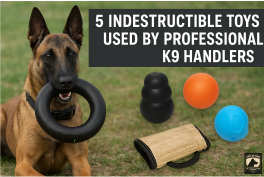
K9 handlers don’t rely on one magic toy. They use a small toolkit: a solid rubber ball or tug as the “paycheck” for work, a flexible rubber chew like a Goughnuts or KONG Extreme for downtime, and a fire hose tug for interactive play. Every good option flexes instead of cracking teeth, and the handler controls when the dog gets it. No toy is truly indestructible, so smart handlers pick toys with wear indicators or guarantees and inspect them before every session.
Table of Contents
- Introduction
- What Toys Do K9 Handlers Actually Use?
- Reward Toy vs. Chew Toy: The Difference Most Guides Miss
- Why “Tough” Toys Still Fail (and Why Teeth Pay the Price)
- Quick Comparison: 5 Unbreakable Toys at a Glance
- The 5 Toys K9 Handlers Trust
- Goughnuts MaXX Chew Toys
- KONG Extreme (Black)
- Fire Hose Tug Toys
- West Paw Zogoflex Jive Ball
- Jute and French Linen Bite Pillows
- How to Pick the Right Size
- When to Throw a Toy Away: The 60-Second Inspection
- How Handlers Use Toys Every Day
- Toys K9 Handlers Avoid
- Special Cases: Puppies, Seniors, and Multi-Dog Homes
- What This Costs (and Why Cheap Toys Cost More)
- Why You Can Trust This Guide
- Frequently Asked Questions
- Final Thoughts
Introduction
Your dog killed another “indestructible” toy. It took eleven minutes. Now you’re staring at a pile of shredded rubber and wondering what toys K9 handlers use that actually survive.
Here’s the part nobody tells you. Surviving isn’t the only test. Some of the toughest toys on the shelf are so hard that they crack your dog’s teeth before the toy gives up. Working dogs like Belgian Malinois, German Shepherds, and Dutch Shepherds chew with serious force, so the wrong pick hurts twice: your wallet and your dog’s mouth.
In this guide, you’ll learn how professional handlers actually use toys, why they split them into reward toys and chew toys, which five options they trust most, and how to inspect a toy so it never turns into a vet bill. You’ll also get a size guide, a retirement checklist, and a simple “out” drill that keeps toy play under control.
Affiliate note: some links below are Amazon affiliate links. We earn a small commission if you buy, at no extra cost to you. We only list gear we’d put in a working dog’s mouth.
What Toys Do K9 Handlers Actually Use?
Short answer: handlers use different toys for different jobs. They don’t hand a dog one toy and hope for the best.
Walk onto almost any police or military training field and you’ll see the same pattern. The dog finds the hidden odor, the person, or the suspect. Then the handler pays the dog with a toy. That’s the whole system. Officer Jeremy O’Connor of a Minnesota-area department put it plainly when a local news crew visited: “All of our K-9s are all toy reward.” An Associated Press report on Oregon police dog training noticed the same thing. Tennis balls and jute ropes showed up everywhere, because those toys are the dog’s paycheck.
A North Carolina magazine profile of K9 teams in New Hanover County described the rewards as balls and tug toys, usually not food. One handler explained it like this: the dog isn’t thinking “that’s narcotics.” He’s thinking “that’s the smell that makes the ball appear.”
So what’s in a handler’s bag? Usually these four roles:
- The reward toy. A ball or tug that the dog loves more than anything. It’s the “pay” for good work.
- The chew toy. A flexible rubber toy for downtime, decompression, and crate time.
- The tug. A fire hose or similar tug for interactive play and grip building.
- The fetch ball. A tough, tooth-friendly ball for retrieving and conditioning.
Sport and protection handlers add a fifth tool: the bite pillow, used only in controlled sessions.
That’s the whole list. Once you understand these jobs, the five picks below make a lot more sense.

Reward Toy vs. Chew Toy: The Difference Most Guides Miss
Most “best toys for power chewers” articles throw everything into one pile. Handlers don’t. They split toys into two very different categories, and that split protects both the dog’s drive and the dog’s teeth.
The reward toy
A reward toy is special. It comes out of the handler’s pocket or bag only when the dog earns it. Then it goes back. The dog doesn’t carry it around all day, and it never sits in the yard.
Why does that matter? Because scarcity creates value. A dog that can chew a toy any time won’t work very hard to earn it. A dog that only sees the toy after a perfect search will pull your arm off to get it.
The research backs up the basic idea. A Frontiers for Young Minds article on police dog learning explains that dogs repeat behaviors that earn rewards, and that toys work like food does because tug games are rewarding. Handlers also pair the toy with a marker word or sound so the dog knows the payment is coming, even if the toy isn’t in the handler’s hand yet.
There’s a catch, though. Erie (Pennsylvania) police K9 trainer Ken Pietras, writing in Police1, warned that play drive shouldn’t become the boss in bite work. He described dogs that let go of a bite early because they were looking for the toy. That’s a sign play drive is running the show. The lesson applies to pet owners too: toys should support the job, not replace it.
The chew toy
A chew toy is the opposite. It’s for downtime. Think of it as a stress outlet after a long training session or a calm activity in the crate. The dog can have it with less handler involvement, but you still supervise, especially at first.
Mixing the two ruins both. If your reward ball becomes a floor toy, it loses its power. If your chew toy gets used for tug-of-war, it can wear out fast and teach rough habits.
Handler rule of thumb: If it’s a reward toy, you control it. If it’s a chew toy, the dog can settle with it, but you still inspect it.
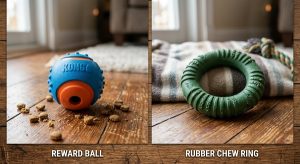
For a deeper look at how drive and control work together, read our guide on Dog Obedience vs. Instinct: How to Balance Drive and Control. Toy handling is one of the fastest ways to build that balance.
Why “Tough” Toys Still Fail (and Why Teeth Pay the Price)
Let’s clear up two myths.
Myth 1: Bite force numbers tell you which toy to buy
You’ve probably seen charts that say a German Shepherd bites at about 238 PSI, a Belgian Malinois at about 195 PSI, and a Rottweiler at about 328 PSI. Those numbers get repeated everywhere. But they’re rough estimates. Different studies measure bite force in different ways, and even the sites that publish the charts admit the figures can be off. One police dog study used bite sleeves with force sensors and reported results in newtons, not PSI.
So don’t shop by PSI. What actually destroys toys is repeated chewing, twisting, and leverage over hours, not one peak number. That’s why the best toys are designed to spread force and reduce leverage instead of just being harder.
Myth 2: Harder means safer
This one costs people real money. Veterinary dentists have raised alarms for years about hard chews. A review in Veterinary Times reports that tooth fractures show up in roughly 20% to 27% of dogs seen in clinics, and many owners never notice. Dentists have also pointed to antlers and nylon bones as common culprits.
A University of Pennsylvania study, discussed in that review and in a British Veterinary Dental Association presentation, tested the upper fourth premolar, the big carnassial tooth that does the heavy crushing. The tooth cracked under forces that a normal dog can produce. The takeaway from the vets is simple: any chew that won’t give or break under that load could fracture a tooth.
A board-certified veterinary dentist describes the classic injury as a “slab fracture” of that upper fourth premolar. It often comes from antlers, bones, and hard nylon. Another vet article notes that dog enamel is thinner than human enamel, which makes the problem worse. And that same article points to a better path: durable rubber that flexes enough to protect teeth.
The handler’s test: Press your thumbnail into the toy. If it doesn’t dent at all and has no give, treat it with suspicion. Rubber that flexes and rebounds is what you want.
That’s the real reason professionals love the toys below. They’re tough, but they give a little.
Quick Comparison: 5 Unbreakable Toys at a Glance
| Toy | Main job | Best for | Supervision | Watch out for |
|---|---|---|---|---|
| Goughnuts MaXX (rings, sticks) | Chew / decompression | Heavy chewers that destroy rubber toys | Yes, especially at first | Red safety layer showing |
| KONG Extreme (black) | Chew, food work, bounce | Mental work, crate time, fetch | Yes | Wrong size (too small is a choking risk) |
| Fire hose tug | Reward and tug | Obedience rewards, grip work | Always | Loose seams, torn handles |
| West Paw Zogoflex Jive | Fetch and retrieve | Dogs that destroy tennis balls | Yes | Treating it like a chew toy for hours |
| Jute or linen bite pillow | Bite-work tool | Experienced handlers only | Always, handler-controlled | Unsupervised chewing |
The 5 Toys K9 Handlers Trust
1. Goughnuts MaXX Chew Toys
If handlers argue about the toughest chew toy on the market, Goughnuts is usually in the first sentence.
Goughnuts makes rings, sticks, and tugs from dense, reinforced natural rubber. The company designs them to reduce the leverage a dog’s jaw can apply, which lowers the pressure on the toy itself. Their MaXX Stick, for example, is about 11.75 inches long and 2.2 inches thick, and the maker recommends it for aggressive chewers between 60 and 100 pounds. It’s made in the USA.
The feature handlers talk about most is the red safety indicator. Inside the toy sits a red layer. If your dog chews through the black outer layer and red shows, it’s time to stop. Goughnuts says it will replace the toy if a dog bites through to the red.
Why it earns a spot:
- Flexes instead of cracking teeth
- Wear indicator tells you when to retire it
- Built for dogs that destroy KONGs, ropes, and nylon
Best for: Adult working dogs with strong chewing habits, kennel downtime, and decompression after training.
Handler tip: Match the size to the dog. Goughnuts sells different sizes and strengths, so check the weight guide before you order. Too small is a swallowing risk. Too big, and your dog may lose interest.
Recommendation: Check Goughnuts sizes and pricing on Amazon
2. KONG Extreme (Black)
The KONG has a great origin story. Its inventor, a man in Colorado, noticed his dog loved chewing on a rubber Volkswagen bumper stop. He used that idea to create a toy. Decades later, KONG Extreme is still one of the most common toys you’ll see in police and military kennels.
KONG says its black Extreme rubber is the toughest in its lineup and is used by police, drug enforcement, and military K-9 teams worldwide. It comes in five sizes, from small to XXL.
Why handlers like it:
- The odd bounce keeps prey drive up during fetch
- You can stuff it with food and freeze it for longer sessions
- It helps dogs learn to “switch off” in the crate
Here’s a handler hack. Some K9 supply shops sell braided nylon rope handles designed to thread through a KONG. That turns a chew toy into a quick tug reward, handy for dogs that love a grip. Remember, once you turn it into a tug, it becomes an interactive toy, so supervise.
A fair warning: The black Extreme is a step up from the red Classic, but it isn’t magic. Some dogs still chew through it. Check it often, and size up rather than down. A KONG that’s too small for the dog is the one that gets swallowed.
Best for: Dogs that need mental work, food puzzles, crate training, and off-duty relaxation.
Recommendation: See current KONG Extreme price and reviews on Amazon
3. Fire Hose Tug Toys
Fire hose tugs are a staple in obedience rewards, drive building, and sport work. Handlers love them because the woven hose material resists shredding better than jute or rope. Plenty of trainers even make their own from old hose, which tells you something about how well it holds up.
These are not chew toys. They’re interactive tools, built to handle hard pulls, head shakes, and repeated grips. A good one has strong stitching, a solid handle, and no loose threads.
Why handlers like fire hose:
- Tough layered material that doesn’t fray like rope
- Encourages full-mouth grips and controlled pressure
- Works as a quick reward after a good rep
Safety reminder: Never leave a tug in the yard or crate. Put it away after play. That keeps its value high and protects the seams from solo chewing.
Best for: Reward-based obedience, engagement games, and grip training.
Recommendation: Shop fire hose tug toys on Amazon
4. West Paw Zogoflex Jive Ball
Here’s a toy handlers use when a dog destroys every tennis ball in under a week.
Tennis balls have a fuzzy surface that many vets say can wear down enamel over time. They can also come apart. The West Paw Jive replaces that with Zogoflex, a flexible, non-toxic material made in Bozeman, Montana. It’s BPA-free and latex-free, floats on water, and goes in the top rack of the dishwasher. The small Jive is about tennis-ball size at 2.5 inches, and the large is 3.25 inches. The small one fits most standard ball throwers.
West Paw labels it “built for tough chewers” and calls it its most durable toy. I’d still treat it as a fetch ball first and a chew toy second. Use it for retrieves and water work, not for two hours of gnawing.
About the guarantee: West Paw’s Love It Guarantee typically offers a one-time replacement or refund per household if the toy gets damaged. It’s helpful, but it’s not a lifetime promise. Read the terms before you count on it.
Best for: Fetch, retrieve training, water conditioning, and dogs that wreck tennis balls.
Recommendation: Check the latest West Paw reviews on Amazon
5. Jute and French Linen Bite Pillows
Now we’re in specialist territory.
Bite pillows aren’t toys in the usual sense. They’re training tools used in IGP/IPO, KNPV, police, and military programs. The pillow gives a dog something solid to grip during controlled sessions, which helps build confidence and a calm, full-mouth bite. Many programs use it as a step before sleeve work.
They’re also the least “unbreakable” item on this list. Jute and linen wear down with use. That’s normal. What matters is that a handler controls the session, inspects the pillow, and puts it away afterward.
Warning: Don’t give a bite pillow to a dog to chew alone. Misuse can create bad grips and bad habits. And if you’re new to bite work, find a qualified trainer or decoy first. This tool doesn’t replace experience.
Best for: Experienced handlers doing structured grip and targeting work.
Recommendation: Browse training bite pillows on Amazon
How to Pick the Right Size
Size mistakes cause more toy injuries than anything else. Here’s how handlers think about it.
- Too small: The dog can swallow it or wedge it in the throat.
- Too big: The dog can’t grip it, gets frustrated, and may start destroying it from the edges.
- Right size: The dog can carry it comfortably but can’t fit the whole thing behind the back teeth.
Most Belgian Malinois weigh roughly 55 to 75 pounds, and German Shepherds usually fall between 50 and 90 pounds. For both, you’ll normally land in the large or extra-large range, but always check the maker’s weight chart. Sizing differs by brand. Goughnuts, for example, publishes weight ranges for each product, and KONG offers sizes from small to XXL.
When in doubt, go up one size. A slightly big toy is safer than a slightly small one.
When to Throw a Toy Away: The 60-Second Inspection
No toy lasts forever. Handlers check gear before every session, and you should too. It takes about a minute.
- Look for cracks or splits. Flex the toy with your hands. Open cracks mean it’s failing.
- Check for missing chunks. Missing rubber ended up somewhere, and you don’t want it in your dog’s stomach.
- Check wear indicators. If you see red on a Goughnuts toy, retire it.
- Inspect seams and handles on tugs. Loose stitching or frayed edges mean it’s time for a new one.
- Check the size. A toy worn down to half its original size is now a swallowing risk.
- Look for sharp edges. Run your fingers around the toy. Anything rough can cut gums.
If any item fails, replace the toy. It’s cheaper than an emergency visit.
How Handlers Use Toys Every Day
Buying the right toy is half the job. Using it well is the other half.
Keep the reward toy special
Store the reward toy out of sight. Bring it out for training, then put it away. This keeps the value high and avoids the “dog owns the toy” problem.
Teach a clean “out” first
A dog that won’t release is a problem for everyone. Here’s a simple drill:
- Play and trade. After a few seconds of tug, offer a treat or a second toy near the dog’s nose. Most dogs drop the first toy to grab the better offer.
- Add the word. Say “out” just as the dog opens the mouth. Reward right away.
- Restart the game. Give the toy back immediately. This teaches the dog that “out” doesn’t end the fun. It starts more.
- Add challenge. Practice when the dog is more excited, then at a short distance, then after a command like “sit.”
If your dog freezes, clamps down, or turns possessive, stop and get help from a qualified trainer.
Rotate toys
Keep two or three toys in use and rotate them every few days. A toy that disappears for a week feels new when it comes back.
Match the toy to the energy level
Use the chew toy after hard work, not before. A tired, calm dog settles with a chew. A hyped-up dog treats it like prey.
Build toy drive the right way
If your dog doesn’t care about toys yet, don’t force it. Short, exciting games with a rag, rope, or ball can build interest over time. Our e-book Beyond the Bark: Inside a Pro Handler’s Playbook for Raising the Ideal Dog walks through the foundation work professional handlers use to build drive, focus, and reliable behavior at home.
Don’t skip the exercise
A bored, under-exercised dog destroys toys faster. If your power chewer is shredding everything, check whether it’s getting enough structured activity. We cover that in How Often Should You Exercise a Working Dog?
Toys K9 Handlers Avoid
You’ll notice the “avoid” list looks different from most blogs. Handlers skip anything that’s too hard, too soft, or too easy to swallow.
- Antlers and real bones: Vet dentists name them among the most common causes of fractured carnassial teeth.
- Hard nylon bones: Some dogs do fine, but dentists see fractures from them often enough to call them risky.
- Cow hooves and other rock-hard chews: Same fracture risk.
- Tennis balls: The fuzzy outer layer wears enamel, and the ball can split.
- Plush toys with stuffing: They get shredded fast, and the stuffing is a swallowing hazard.
- Squeakers: They distract working dogs, and a dog can swallow a squeaker.
- Thin rubber toys: They tear and leave sharp edges.
- Frayed rope: Loose fibers can wrap up in the gut.
Not every dog gets hurt by these items, but the risk is real. A flexible rubber toy gives you the same satisfaction with far less downside.
Special Cases: Puppies, Seniors, and Multi-Dog Homes
Puppies
Puppies need softer, age-appropriate toys. Their adult teeth aren’t in yet, and their jaws are still growing. Don’t hand a puppy the same hard chew a seven-year-old Malinois uses. Start with puppy-rated toys and build up as the dog matures.
Senior dogs
Older dogs often have worn or sensitive teeth. A flexible toy like a West Paw Jive or a softer KONG often suits them better than a dense chew. If your senior dog suddenly avoids chewing, ask your vet to check for a dental problem.
Multi-dog homes
Toys can start fights. Give each dog its own, and pick them up when play ends. Reward toys are especially likely to spark resource guarding, so keep those under your control.
What This Costs (and Why Cheap Toys Cost More)
Prices change by size and store, but here’s what retailers listed in 2026:
- KONG Extreme: roughly $15 to $29, depending on size
- Goughnuts MaXX Stick: around $33 at one retailer
- West Paw Small Jive: around $17
That sounds like a lot compared to a $5 plush toy. But run the numbers. If a cheap toy dies in a day, you buy a new one every week. A $30 toy that lasts several months costs less per month and carries less risk.
And remember the bigger cost. A cracked carnassial tooth may need a root canal or extraction at a specialist, which can run into the thousands. A good toy is cheap insurance.
Why You Can Trust This Guide
This guide pulls from three kinds of sources: working handler practice, veterinary dentistry, and manufacturer specifications.
- Handler practice: Police K9 trainers and agencies describe toy rewards as the core payment system, including reporting from the Associated Press, local news, and Police1.
- Veterinary dentistry: The tooth fracture data comes from Veterinary Times and a University of Pennsylvania study summarized by veterinary dental specialists.
- Product facts: Sizes, materials, and guarantees come from the manufacturers and retailers listed above. Check current terms before you buy, because they can change.
Rofiat Muritala is a Nigerian Army military working dog instructor and handler with more than 14 years of experience at the Nigerian Army Dog Centre. Her work covers obedience, detection, protection, and operational readiness.
This article is general education, not veterinary advice. If your dog cracks a tooth, swallows a toy, or shows pain while chewing, call your vet.
Frequently Asked Questions
What toys do police K9 handlers use?
Most police handlers use balls and tug toys as rewards, plus durable rubber toys like the KONG Extreme for downtime. Many agencies describe their dogs as “toy reward” dogs, meaning the toy is the main payment for finding odor or completing a task. Handlers usually choose toys without squeakers and keep them under their own control.
Are any dog toys truly indestructible?
No. Some toys last far longer than others, but a determined dog can eventually damage almost anything. That’s why good makers add wear indicators or guarantees, and why handlers inspect every toy before use. If a toy is cracked, chunked, or worn small, replace it.
Can I leave a tough chew toy with my dog alone?
It depends on the toy and the dog. A flexible rubber chew like a Goughnuts toy is the type many handlers allow during supervised downtime. Reward toys, tugs, and bite pillows should never be left alone with the dog. For any new toy, watch the first few sessions and check it afterward.
Are tennis balls bad for power chewers?
Tennis balls aren’t ideal. The fuzzy covering can wear enamel over time, and aggressive chewers can tear the ball apart. A solid, tooth-friendly ball like a West Paw Jive is a safer swap for fetch.
How often should I replace my dog’s toys?
Replace a toy as soon as you see cracks, missing chunks, a visible red indicator layer, frayed seams, or a size small enough to swallow. There’s no calendar rule. For hard chewers, check the toy before every session.
Final Thoughts
So, what toys do K9 handlers use? They use a system. A reward toy that stays special, a flexible rubber chew for downtime, a fire hose tug for interactive play, a tooth-friendly ball for fetch, and, for experienced handlers, a bite pillow under strict control.
Here’s your action plan:
- Pick one job at a time. Decide whether you need a reward, a chew, a tug, or a fetch toy.
- Choose flexible over rock-hard. Use the thumbnail test and skip antlers, bones, and hard nylon.
- Size up. When two sizes look possible, choose the bigger one.
- Inspect before every session. Look for cracks, chunks, red indicators, and loose seams.
- Control the good toys. Keep reward toys and tugs in your hands, and put them away after play.
Do those five things and your dog gets better focus, safer chewing, and fewer destroyed toys.
Want more handler-tested gear guides and training tips? Join our weekly articles roundup and get the best of ARFS K9 Team in your inbox: Subscribe to the newsletter.
Looking for gear to match your toy setup? See our guide to Essential K9 Training Equipment Every Military Working Dog Handler Needs.
Sources and Further Reading
- Veterinary Times, “Exploring tooth fracture risks in canine patients” (2019): https://www.vettimes.co.uk/exploring-tooth-fracture-risks-in-canine-patients
- British Veterinary Dental Association, fracture forces study presentation: https://bvda.co.uk/images/pdf/Fracture%20Forces%20Study%20Presentation.pdf
- Veterinary Practice News, “Advise clients ‘durable’ treats are not worth the risk of tooth fractures, tissue injuries”: https://www.veterinarypracticenews.com/?p=51596
- WellPets, “What Is a Slab Fracture in Dogs”: https://www.wellpets.com/blog/slab-fracture-in-dogs/
- Police1, “Using your K-9’s play drive in bite work” (Ken Pietras): https://www.police1.com/k-9/articles/using-your-k-9s-play-drive-in-bite-work-OuwRaPf5irGaHFMp/
- Frontiers for Young Minds, “How Do Police Dogs Learn to Do Their Job?”: https://kids.frontiersin.org/articles/10.3389/frym.2020.00109
- WDIO, “Volkswagen and Kong Toys donate to local dogs”: https://www.wdio.com/?p=552053
- Goughnuts MaXX Stick product details (Ray Allen): https://www.rayallen.com/goughnuts-black-maxx-stick/
- KONG Extreme product details: https://reberranch.com/products/kong-extreme-dog-toy
- West Paw Jive product details: https://www.vetnpetdirect.com.au/collections/dog-toys-fetch/products/west-paw-zogoflex-jive-ball-for-tough-chewers

Her work centres on obedience, detection, protection and operational readiness. She favours proven methods built on repetition, consistency and real-world conditioning, so that both dogs and handlers are prepared for high-pressure tasks.
Rofiat represented the Nigerian Army Dog Centre at the Nigerian Army Day Celebration (NADCEL) 2026, where she led demonstrations in obedience, explosive detection, agility and tactical movement. Through articles, training content and documentaries, she shares field-based insight into how structured training, clear communication and trust between handler and dog affect performance and reliability.
She is the author of Beyond the Bark: Inside a Pro Handler's Playbook for Raising the Ideal Dog, a practical guide that helps dog owners and handlers apply professional training principles in everyday situations.
- Westminster Dog Show 2026: Winners & Full Results - October 17, 2026
- 10 K9-Approved Tricks to Teach Your Dog (Step-by-Step) - October 16, 2026
- COBA National Dog Championship 2026: Full Guide - October 15, 2026