Train Your Dog to Find a Missing Family Member by Scent
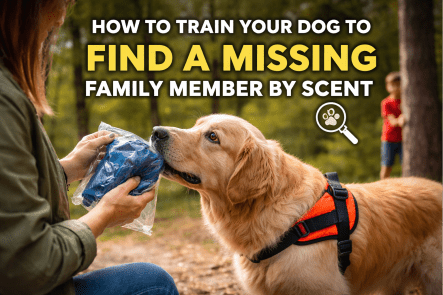
You can train your dog to find a missing family member by scent in five steps. Motivate your dog with a “run-away” game, teach them to smell a clean scent article, then run short trails and make them longer and older over time. Add turns, different surfaces and a second person’s trail so your dog learns to follow one person. Most dogs show real skill after 8 to 12 weeks of short sessions. This is a family safety tool, not a replacement for calling the police.
Table of Contents
- Introduction
- How Dogs Find People by Scent (Trailing vs Tracking vs Air Scenting)
- Why This Skill Matters: The Numbers
- Before You Start: Dog, Gear and Realistic Goals
- The Scent Article: Where Most Families Go Wrong
- Step-by-Step: How to Train Your Dog to Find a Person by Scent
- 12-Week Training Timeline
- Weather, Wind and Surfaces
- Common Mistakes (and Fixes)
- If Someone Really Goes Missing: What to Do
- Building a Layered Safety Plan
- A Handler’s Notes
- FAQs
- Final Thoughts
Introduction
Ever watched your dog stop dead on a walk, nose glued to a patch of grass? They’re reading a story you can’t see.
Here’s the problem. Children wander. Older relatives with dementia get confused. Some autistic children bolt without warning. When that happens, minutes matter, and most families have no plan beyond panic.
A dog that can follow one person’s scent gives you one more tool. It won’t replace the police or a trained search team. But it can teach your dog a job, calm your household, and give you a head start.
In this guide, you’ll learn:
- How dogs actually follow a human scent
- How to make a clean scent article (and why most families contaminate theirs)
- A step-by-step training plan with distances, ages of trail and a timeline
- What to do in a real emergency
- Where the common advice online falls short
I’m writing this the way we teach handlers at ARFS K9 Team: simple steps, honest limits, no hype.
How Dogs Find People by Scent
People use “tracking” for everything. Handlers don’t. There are three different jobs, and knowing which one you’re teaching saves months of confusion.
| Type | What the dog does | Best for |
|---|---|---|
| Trailing (mantrailing) | Follows one specific person’s scent, often nose-down, from a starting point | Finding your missing family member |
| Tracking | Follows the exact footsteps and crushed vegetation of a path | Police work, hunting, competitions |
| Air scenting | Works the wind to find any human scent in an area | Large area searches |
Search teams also split air-scenting dogs in two. Some find any human they smell. Others, called scent-specific dogs, can learn to identify individuals and locate them in the wild. A trailing dog, meanwhile, follows a specific scent path laid down by a missing person, working “nose down” from a scent article.
For a family, trailing is the right target. You give your dog a scent article, and they follow that one person’s trail.
Quick fact: Every person sheds skin cells, sweat, hormones and bacteria all day. This scent drifts on the air and settles on surfaces, and trails are usually very reliable for up to 36 hours, though dogs have followed older ones.
Why This Skill Matters: The Numbers
This isn’t just a fun trick. Look at who goes missing in real families.
Dementia wandering
- The Alzheimer’s Association says six out of ten people with Alzheimer’s or dementia will wander at some point, and many will do it repeatedly.
- If they aren’t found within 24 hours, up to half may suffer serious injury or death.
- The good news: many people who wander are found within about 1.5 miles of where they were last seen. That’s a very workable distance for a trailing dog.
Autism and wandering (elopement)
- A major study in Pediatrics found 49 percent of children with autism had tried to leave a safe place at least once after age 4, and 26 percent went missing long enough to cause real concern.
- The National Autism Association reports that accidental drowning caused 91 percent of wandering deaths between 2009 and 2011. That tells you where to look first: water.
Why a dog helps
A Florida sheriff’s office told a story that stuck with me. A woman with dementia had been missing about two hours. Her family had completed a scent kit two years earlier. A K9 named Ally and her handler found her in about five minutes. The deputy said it would likely have taken a couple of hours otherwise.
Speed is everything. The dog didn’t work magic. The clean scent article did half the job.
Before You Start: Dog, Gear and Realistic Goals
Which dogs can do it?
Almost any healthy dog can learn the basics. Mantrailing coaches say breed and age don’t stop a dog from learning, and they start puppies once they’re fully vaccinated. Bloodhounds, Belgian Malinois and German Shepherds are common working choices, but I’ve seen Labradors, Beagles and mixed breeds do great work.
What matters more than breed:
- Loves food or a toy (this is your paycheck)
- Curious about the ground
- Can stay calm enough to work on a leash
- No health problems that make sniffing or walking hard (get a vet check first)
Short-nosed (flat-faced) breeds can learn too. Just keep trails short and watch the heat, since they overheat faster.
What you need
- A comfortable harness (not a collar pull)
- A 15 to 30 foot (5 to 10 m) long line
- Small, smelly treats, or a favorite toy
- Clean zip bags or a glass jar with a lid, plus disposable gloves
- A patient helper (the “trail layer”)
- A notebook to log each session
A realistic goal
Be honest with yourself. Training a dog for full search and rescue takes about two years. We’re not aiming for that. Our goal is a dog who will reliably follow one family member’s scent over a short to medium distance and lead you back. That’s achievable in a few months.
If you want to go further, join a local mantrailing club or volunteer SAR group. For how professional teams build this foundation, read our guide on how military working dogs are trained.
The Scent Article: Where Most Families Go Wrong
Most online guides say “use a worn T-shirt.” That’s the weak link. Handlers say it again and again: a dirty shirt from the laundry basket carries the whole family.
A Kansas K9 training guideline puts it plainly: family scent is strong, and the item provided is often contaminated by other family members or taken from a hamper full of everyone’s clothes. Then the handler has to waste time “dismissing” the dog off the wrong scents.
Two ways to make a good scent article
Option 1: A scent preservation kit (best for real-life readiness).
Many sheriff’s offices and police departments give these away or sell them. The method is simple. You swipe a sterile gauze pad under the arm about ten times, seal it in a jar, and store it away from heat and sunlight. Agencies say these kits can last around seven years or more if left sealed. Ask your local police department if they offer one. It’s often free.
Option 2: A DIY training article (for practice).
- Wash your hands, and have the person wash theirs with unscented soap.
- Put on clean gloves.
- Have the person rub a sterile gauze pad or clean cotton cloth on their neck, wrists and under their arms for about a minute.
- Drop it straight into a clean glass jar or a new zip bag. Don’t touch it with bare hands.
- Label it with the name and date.
One American volunteer handler suggests storing such an article in the freezer, and says a properly labelled scent article can stay good for up to five years.
Make two sets, not one
- Training articles: Make several. Use them and replace them often.
- Emergency article: Seal this one. Never use it for practice. Hand it to responders only.
Trainer tip: Keep a separate jar for each person at risk. Label it, store it where every adult in the house knows to find it, and tell your local police it exists.
Step-by-Step: How to Train Your Dog to Find a Person by Scent
Quick answer for snippets: To train a dog to find a missing person by scent, (1) build a love for finding people with a run-away game, (2) introduce a clean scent article with a command, (3) lay short, fresh trails, (4) slowly add distance and age, (5) add turns and surfaces, and (6) teach the dog to ignore other people’s trails.
Step 1: Make finding a person the best thing in the world
Before any scent work, teach the why.
- Your helper shows your dog a toy or a tasty treat.
- The helper jogs 10 to 15 steps away and ducks behind a tree or door while the dog watches.
- You release the dog with a happy “Find!”
- The helper throws a party when the dog arrives: food, play, big praise.
Do 5 to 8 repeats per session. Then make the person harder to see: half hidden, then fully hidden. A strong “find the person” drive is the engine of everything that follows.
Rewarding comes from the found person, not from you. That tells your dog people are the jackpot.
Step 2: Introduce the scent article and the command
- Hold the open bag or jar about 2 inches from your dog’s nose. Let them take a good sniff, then pull it away.
- Say your cue, such as “Find Sarah” (use the real name, or “Find Mum”).
- Release the dog toward the hiding helper.
Use the same cue every time. Never pair the cue with a different person’s scent. Do 5 to 10 repeats, then stop. Short sessions beat long ones.
Step 3: Lay short, out-of-sight trails
Now the person disappears while the dog is waiting.
- Mark a start point (a mat, a cone or a flag). The helper stands there for a few seconds, then walks away.
- Start with a straight 30 to 50 ft (10 to 15 m) trail with a hide spot at the end.
- Walk your dog to the start. Present the scent article. Give your cue.
- Let your dog work. Hold the line loosely and follow behind them.
- At the end, the helper rewards big.
Increase to 100 ft, then 300 ft, before you ask for anything harder. Only make the trail longer after three clean successes in a row.
Step 4: Age the trail
An older trail is harder. In a real search, you’ll rarely start right after the person leaves.
Increase waiting time before you release the dog:
- 0 minutes (fresh)
- 2 to 5 minutes
- 10 minutes
- 20 to 30 minutes
- 60 minutes (advanced)
If your dog fails, drop back one level. That’s not failure. That’s good training.
Step 5: Add turns, surfaces and obstacles
Scent behaves differently on different ground. Practice on:
- Grass, then pavement, then gravel, then soil
- 90-degree turns and a long curve
- Around parked cars, trees, fences and buildings
- Up and down a slope
Change one thing at a time. If you add a new surface and a longer trail, you can’t tell why the dog struggled.
Step 6: Teach scent discrimination (the “ignore the others” step)
This is the step most guides skip, and it’s the difference between a game and a useful skill.
- Have two helpers walk separate trails that cross or run side by side.
- Scent your dog on only one person’s article.
- The dog should follow the matching trail and ignore the other.
- Reward big at the right person.
Then add a decoy: a family member walks part of the same path before the target hides. Your dog must stay on the target scent.
Later, work in places with busy foot traffic, like a park or a quiet street. Real life is messy.
Step 7: Teach a clear “I found them” signal
A dog that finds someone and stays silent doesn’t help you. Pick one:
- Return and lead: The dog runs back to you and takes you to the person (“Show me“). This is my first choice for families, since you need to reach the person.
- Bark alert: The dog barks at the found person until you arrive.
- Sit or down beside them: Calm and quiet.
Teach the signal on its own before you attach it to trailing. Our article on obedience vs instinct explains why you need both a dog’s natural nose and solid handler-taught behavior.
12-Week Training Timeline
Dogs vary, so treat this as a guide, not a rulebook.
| Weeks | Goal | Typical session |
|---|---|---|
| 1 to 2 | Build drive with the run-away game; add the scent article | 5 to 10 min, 5 to 8 reps |
| 3 to 4 | Short out-of-sight trails (30 to 100 ft) | 10 min, 2 to 3 trails |
| 5 to 6 | Longer trails (200 to 300 ft), first turns | 10 to 15 min |
| 7 to 8 | Age trails to 10 to 30 minutes; mix surfaces | 15 min, 2 trails |
| 9 to 10 | Add a second trail and decoys | 15 to 20 min |
| 11 to 12 | New locations, wind, a “show me” return | 20 min, 1 to 2 trails |
Train 3 to 4 days a week. Scent work is tiring brain work, and dogs need rest days. If you’re unsure how much total exercise your dog needs alongside this, see our guide on how often to exercise a working dog.
Weather, Wind and Surfaces
You can’t control weather, but you can learn to read it.
- Light rain can help scent stick to the ground. Strong wind can carry scent away from the actual trail, and hot tarmac can burn it off.
- Wind direction matters. Plan your hide spots so the dog works partly upwind.
- Hot days: Train early morning or evening. Carry water. Stop if your dog pants hard or slows down.
- Cold, calm mornings are great for beginners.
Make a note of weather in your training log. After a few weeks, you’ll spot patterns.
Common Mistakes (and Fixes)
| Mistake | Why it hurts | Fix |
|---|---|---|
| Using laundry-basket clothing | Carries every family member’s scent | Use a clean, gloved scent article |
| Handler walks ahead or steers | Dog follows you, not the trail | Stay behind, keep the line loose |
| Going too long too fast | Dog gets frustrated and quits | Drop back, win, then progress |
| Training only in one place | Dog learns the place, not the skill | Change locations weekly |
| Helper doesn’t reward well | Weak motivation | Teach helpers to “throw a party” |
| Punishing a wrong turn | Kills enthusiasm | Reset calmly; end on a win |
| Skipping decoy trails | Dog follows any person | Add Step 6 early |
If you often wonder why your dog does things you didn’t teach, our Beyond the Bark e-book breaks down how professional handlers shape everyday dog behavior at home.
If Someone Really Goes Missing: What to Do
This is the part most blogs ignore, and it’s the part that matters most. Training is practice. A real emergency follows different rules.
- Call emergency services first. For a child or a person with dementia or autism, call right away. The Alzheimer’s Association says that if you can’t find a person with dementia within 15 minutes, you should call 9-1-1. Use your local emergency number if you live elsewhere.
- Check the danger spots fast. For children, especially those with autism, check water first: pools, ponds, drains, streams.
- Protect the starting point. Don’t let people trample the last place the person was seen. Keep other family members and pets away from the doorway or bed.
- Hand over the emergency scent article. Give police the sealed one. Tell them you have a trained dog.
- Let the professionals decide. Police and SAR teams may welcome your dog or may ask you to wait. A volunteer dog that scrambles through the scene can ruin the trail for their K9.
- If you start before help arrives (for example, rural areas with long delays), use your harness and long line, keep the dog under control, and tell someone where you’re going. Never let a stressed dog run off alone near roads or water.
Your dog is one tool. Never let it delay the call.
Building a Layered Safety Plan
A dog’s nose is great. A plan built on one thing alone will fail. Combine layers:
- Prevention: Door alarms, gate locks, a secure yard, and clear rules for children
- ID: Tags, microchips for pets, medical ID bracelets for people at risk
- Tracking tech: GPS wearables where appropriate
- A written plan: Phone numbers, photos, medical info, favorite places
- Neighbors: Tell trusted neighbors what to do if they see your loved one alone
- Scent readiness: A sealed scent article per at-risk person, and a trained dog
Review the plan every few months. Replace scent articles for growing children as they get older.
A Handler’s Notes
At ARFS K9 Team, our training approach comes from Cpl. Rofiat Muritala, a Nigerian Army military working dog instructor and handler with more than 14 years at the Nigerian Army Dog Centre, with advanced obedience, K9 patrol and explosive detection courses behind her. The same principle runs through detection and trailing: dogs succeed when the job is clear, the reward is real and the handler stays calm.
Three things I tell every new handler:
- Trust the nose, not your eyes. Handlers who steer the dog toward where they think the person went teach the dog to wait for help.
- Keep it fun. A dog that loves the work will outwork one that’s merely obedient.
- Be honest about limits. If your dog can’t follow a 20-minute-old trail on a quiet street, don’t count on it in a crowded town.
Editor’s note: replace or add one short real story from your own handling career here to strengthen first-hand experience signals.
FAQs
1. Can any dog be trained to find a missing family member by scent?
Most healthy dogs can learn basic trailing. Bloodhounds, Malinois and German Shepherds are common working choices, but food-motivated pets of many breeds do well. Dogs that are very anxious, old, or have breathing or joint problems may need shorter, slower training. Always check with your vet first.
2. How long does it take to train a dog to find a person by scent?
Expect 8 to 12 weeks of regular short sessions for a reliable, short, fresh trail. Older trails, new locations and decoy scents take longer, often several months. Full search and rescue certification can take around two years.
3. What is the best scent article to use?
A sterile gauze pad swiped under the arm and sealed in a clean jar is best. It carries only that person’s scent. A worn shirt works for practice, but real clothing often carries other people’s scent too, which can confuse the dog.
4. What’s the difference between trailing, tracking and air scenting?
Trailing means following one person’s scent, often with the nose up and down along the drifting trail. Tracking means following the exact footsteps. Air scenting means searching an area for any human scent on the wind. For finding a family member, trailing is the most useful.
5. Should I use my own dog in a real emergency?
Call emergency services first, always. Hand over a sealed scent article and tell them you have a trained dog. Use your dog only if the police or search coordinators agree, or if help will be badly delayed and you can work safely on a long line.
Final Thoughts
Your dog already has the nose. Your job is to give that nose a purpose.
Here’s what to take with you:
- Make a clean scent article for each at-risk family member, and keep one sealed for emergencies.
- Train in small steps: run-away game, scent article, short trails, older trails, turns, decoys.
- Reward at the finish, from the person who was found.
- Know the limits. This adds a safety layer. It doesn’t replace supervision, ID or emergency services.
- Start today. Even one 10-minute game of hide-and-seek builds the foundation.
Want more practical K9 guides like this every week? Subscribe to our weekly articles roundup newsletter and get new training tips in your inbox.

Her work centres on obedience, detection, protection and operational readiness. She favours proven methods built on repetition, consistency and real-world conditioning, so that both dogs and handlers are prepared for high-pressure tasks.
Rofiat represented the Nigerian Army Dog Centre at the Nigerian Army Day Celebration (NADCEL) 2026, where she led demonstrations in obedience, explosive detection, agility and tactical movement. Through articles, training content and documentaries, she shares field-based insight into how structured training, clear communication and trust between handler and dog affect performance and reliability.
She is the author of Beyond the Bark: Inside a Pro Handler's Playbook for Raising the Ideal Dog, a practical guide that helps dog owners and handlers apply professional training principles in everyday situations.
- Local Dog Breeds: Temperament, Health & Training Guide - October 6, 2026
- How Long Do Military Working Dogs Serve? Full Guide - October 5, 2026
- National Puppy Day 2026: Date, Best Deals & Freebies - October 4, 2026