The King of All Dogs: 5 Most Powerful & Majestic Breeds

There’s no official king of all dogs, because no kennel club crowns one. But if you judge by the full picture (history, power, trainability, temperament and health), the German Shepherd earns the crown as the best all-round dog. If you judge only by size, ancient history and sheer presence, the English Mastiff takes the throne. The Tibetan Mastiff, Cane Corso and Doberman Pinscher round out the five most powerful and majestic breeds.
Table of Contents
- Introduction: Why Everyone Argues About the Crown
- Is There an Official “King of Dogs”?
- How We Judged: The 5-Point Crown Test
- The 5 Most Powerful and Majestic Dog Breeds
- English Mastiff: The King of Size and History
- German Shepherd: The King of Work
- Tibetan Mastiff: The Mountain Monarch
- Cane Corso: The Roman Guardian
- Doberman Pinscher: The Elegant Sentinel
- Side-by-Side Comparison Table
- The Bite Force Myth: Why PSI Numbers Can’t Crown a King
- Honorable Mentions
- The Final Verdict
- Which “King” Fits Your Life?
- Living With a Powerful Breed: A Reality Check
- A Handler’s Take
- Conclusion
- Frequently Asked Questions
Introduction: Why Everyone Argues About the Crown
Ask ten dog lovers to name the king of all dogs and you’ll get ten different answers. One swears by the German Shepherd. Another points at a 200-pound Mastiff and says, “Case closed.” Someone else mentions the Cane Corso, the Doberman or the lion-maned Tibetan Mastiff.
Here’s the problem. Most “king of dogs” articles just pick a favorite and call it a day. They don’t tell you how they decided, they repeat the same bite-force numbers, and they skip the stuff that matters when you actually live with a giant, powerful dog: lifespan, health bills and how hard these breeds are to handle.
So let’s do this properly. In this guide, you’ll learn:
- What “royal” really means in the dog world
- How the five top contenders score on a simple, fair test
- Real numbers on size, lifespan and price (some of them will surprise you)
- Why the famous bite-force rankings are shakier than they look
- Which breed truly deserves the crown, and which one is right for you
Is There an Official “King of Dogs”?
No. There’s no official title, no vote and no governing body that hands out the crown. The AKC alone recognizes around 200 breeds, and there are more than 340 known worldwide. Each one has its own standard and its own fans.
Still, the word “king” shows up in dog circles all the time. The Airedale Terrier is nicknamed the “King of Terriers” because it’s the biggest terrier. The King Charles Spaniel got its name from the English monarch who adored the breed. And Great Danes are often called the “king of dogs” because of their height.
So when people ask which breed is the king of all dogs, they’re really asking: which breed combines the most power, history, intelligence and dignity? That’s a fair question. It just needs a fair test.
How We Judged: The 5-Point Crown Test
We scored each breed from 1 to 5 in five areas:
- History: How long has the breed existed, and what did it do?
- Presence: Size, strength and that “turn every head” look.
- Versatility: How many real jobs can it do well?
- Temperament: Is its power steady and controllable?
- Health and longevity: How long does it usually live? A king who dies at six isn’t much of a ruler.
For longevity we used the Dogs Trust and Royal Veterinary College (RVC) 2024 life expectancy table, which is based on UK veterinary records, plus a global owner survey for the Tibetan Mastiff. The other scores are our own editorial judgment, so treat them as an informed opinion, not a lab result.
| Breed | History | Presence | Versatility | Temperament | Longevity | Total /25 |
|---|---|---|---|---|---|---|
| German Shepherd | 3 | 4 | 5 | 4 | 4 | 20 |
| English Mastiff | 5 | 5 | 2 | 4 | 2 | 18 |
| Tibetan Mastiff | 5 | 4 | 2 | 2 | 4 | 17 |
| Doberman Pinscher | 2 | 4 | 4 | 3 | 4 | 17 |
| Cane Corso | 4 | 4 | 3 | 3 | 1 | 15 |
The German Shepherd wins on balance. But the Mastiff owns two categories outright. We’ll come back to that in the verdict.
The 5 Most Powerful and Majestic Dog Breeds
1. English Mastiff: The King of Size and History
- Weight: about 120–230 lb (54–104 kg)
- Height: at least 27.5 in (70 cm) at the shoulder
- Origin: England
- Median lifespan (UK data): 9.0 years (commonly quoted range: 6–10)
The history is real, and it’s deep. Roman writers knew about the big fighting dogs of Britain, which they called Pugnaces Britanniae. The Greek writer Strabo noted that Britain exported hunting dogs and that Celts used them in war. The Roman poet Grattius went further and ranked British dogs above the famous Greek Molossus for courage. Mastiff-type dogs also show up in ancient Mesopotamian art, so this body type is very old.
The breed’s best-known battlefield story comes from the Battle of Agincourt in 1415. When Sir Piers Legh was wounded, his mastiff reportedly stood over him for hours. She went home to Lyme Hall in Cheshire and founded a bloodline that fed into the modern breed centuries later.
It nearly vanished. Here’s a fact most “king of dogs” articles skip. Both World Wars hit the Mastiff hard because a dog that eats as much as a person is tough to feed during rationing. After World War II, breeders reportedly had very few breeding-age dogs left, and many postwar puppies died of distemper. Dogs from North America, mainly Canada, helped rebuild the breed. Some kings had to be rescued.
The size record. The heaviest dog ever recorded was an English Mastiff named Aicama Zorba of La-Susa. He weighed about 314 lb (around 143 kg) in 1987, and reports from 1989 put him at up to 343 lb (about 155 kg), stretching roughly 8 ft 3 in from nose to tail. A quick correction to older versions of this article: the commonly cited 146 kg figure doesn’t match the Guinness numbers. Guinness stopped accepting heaviest-pet records around the turn of the century, so Zorba’s record stands for good.
Temperament. Mastiffs are calm, dignified and deeply attached to their family. “Gentle giant” is a fair label. But don’t confuse calm with easy. A 180-pound dog that won’t move off the sofa is a joke the first time and a back injury the fifth.
Watch-outs:
- Bloat (gastric dilatation-volvulus), a life-threatening emergency in deep-chested dogs
- Hip and elbow dysplasia
- A short life compared with most breeds
- Heat sensitivity and drooling (yes, a lot)
Best for: Calm households with space, a big budget and a love of giant breeds.
2. German Shepherd: The King of Work
- Weight: about 50–90 lb (22–41 kg)
- Height: 22–26 in (55–65 cm)
- Origin: Germany, 1899
- Median lifespan (UK data): 11.3 years, based on nearly 20,000 dogs
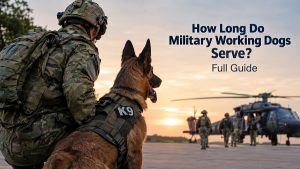
If the crown goes to the dog that does the most for people, there’s no contest. Captain Max von Stephanitz set out to build the perfect working dog and founded the German Shepherd breed club in 1899. Since then, GSDs have served as police dogs, military working dogs, search-and-rescue dogs, guide dogs, detection dogs and family guardians on every continent. If you want to see how that training works in practice, check out our guide on how military working dogs are trained.
Power without the pound count. A Shepherd weighs a fraction of a Mastiff, yet it often does the harder job. Real data backs that up. A study of 20 Finnish police dogs measured bite force on an instrumented sleeve and found a median of about 360 newtons for German Shepherds (seven dogs) and about 247 newtons for Belgian Malinois (13 dogs). It’s a small sample, but it shows something important: working dogs don’t need record-breaking jaws. They need control, and a trained Shepherd can bite, hold and release on command.
Smart in the way that counts. In Stanley Coren’s well-known intelligence ranking, the German Shepherd comes in third overall. That ranking measures how fast dogs learn commands and how reliably they obey, which is exactly what working roles demand.
Watch-outs:
- Hip dysplasia and degenerative myelopathy
- Bloat
- Working lines are very high-drive and need a real job. Show lines are usually calmer but can have more structural issues.
- A bored Shepherd invents its own work, usually by destroying your house
Best for: Active, committed owners who want a trainable, loyal, all-purpose dog. If you’re weighing a Shepherd against a mastiff-type guardian for protection, our Boerboel vs German Shepherd comparison breaks down the trade-offs.
3. Tibetan Mastiff: The Mountain Monarch
- Weight: roughly 70–150 lb (32–68 kg)
- Origin: Tibet and the Himalayas
- Median lifespan: 13.3 years in UK records (only 117 dogs, so treat it cautiously). A global owner survey put it at about 11.9 years.
Nobody looks more like royalty. The thick mane, the heavy bone and the slow, deliberate walk make the Tibetan Mastiff look like a lion that took up dog-sitting. Herders and monasteries across the high Himalayas used these dogs to guard camps and livestock against predators, often working through the night while people slept.
The million-dollar myth. Older versions of this article said Tibetan Mastiffs sold for “more than a million dollars,” and that’s true, but only half the story. A red puppy named Big Splash reportedly sold for about $1.5 million (10 million yuan) in 2011, and a golden puppy reportedly fetched nearly $2 million at a Chinese luxury pet fair in 2014. Then the bubble burst. Crossbreeding, temperament problems and falling demand crashed the market, and reports say the average asking price dropped to roughly $2,000, with many dogs abandoned. Treat those headline prices as breeder claims, not proof of value. They show how fashion, not quality, can crown a dog.
Temperament. This is the wild card. Tibetan Mastiffs think for themselves because they were bred to make decisions alone on a mountain. They’re aloof with strangers, often noisy at night and slow to mature, typically taking two to three years. They aren’t “disobedient.” They just don’t see why they should obey you unless you’ve earned it.
Watch-outs:
- Hip dysplasia and thyroid problems
- A heavy double coat that sheds hard once or twice a year
- Strong guarding instincts that need early, careful socialization
Best for: Experienced owners with a large, securely fenced property who value independence over obedience.
4. Cane Corso: The Roman Guardian
- Weight: about 88–110 lb (40–50 kg)
- Height: roughly 23.5–27.5 in (60–70 cm)
- Origin: Italy
- Median lifespan (UK data): 8.1 years (202 dogs)
The Cane Corso descends from the big working mastiffs of Italy, dogs that guarded farms, drove cattle and hunted large game, and that people link to Roman war dogs. By the 1970s the breed had nearly disappeared. Italian enthusiasts rebuilt it, Italy’s national kennel club recognized it in 1994, and the AKC followed in 2010. So the breed is ancient in spirit but very young in the show world.
Athletic, not just big. Compared with a Mastiff, the Corso is lighter, faster and more agile. It moves like a big athlete instead of a boulder. That mix of speed and power is a big part of its modern popularity.
Temperament. Corsos bond hard with their families and take protection seriously. Without early socialization and firm, fair training, that protectiveness can turn into suspicion of everyone else. This isn’t a breed to “see how it goes” with.
Watch-outs:
- The shortest median lifespan of our five contenders (8.1 years)
- Hip dysplasia and eyelid problems
- Needs a confident handler, since a hesitant owner gets pushed around
Best for: Experienced, consistent owners who want a loyal, athletic guardian and will invest in training from day one.
5. Doberman Pinscher: The Elegant Sentinel
- Weight: about 60–100 lb (27–45 kg)
- Height: 24–28 in (61–71 cm)
- Origin: Germany, 1880s–1890s
- Median lifespan (UK data): 11.2 years (over 3,500 dogs)
A German tax collector named Louis Dobermann wanted a loyal, fearless dog to walk with him on his rounds. He bred toward that goal in the late 1800s, using several breeds that are believed to include the Rottweiler and German Pinscher. The result was lean, fast, alert and fiercely devoted.
A war dog with a story. During the 1944 Battle of Guam, US Marine war dog platoons used Dobermans as scouts and sentries. One Doberman named Kurt is credited with saving about 250 Marines by alerting them to a hidden Japanese force. He was fatally wounded. Of the 60 Marine war dogs that landed on Guam, 25 died there, and the National War Dog Cemetery on the island honors them with a bronze Doberman statue.
Not as “calm” as older articles say. You’ll often read that Dobermans are calm and dignified. That’s only true after a lot of exercise and training. Modern Dobermans are energetic, sensitive and clingy, often called “velcro dogs.” They also feel the cold, thanks to that thin coat. Coren ranks them fifth in working intelligence, so they learn fast, which also means they get bored fast.
Watch-outs:
- Dilated cardiomyopathy (a serious heart condition) and von Willebrand disease (a bleeding disorder). Ask breeders for cardiac and blood screening.
- Bloat
- Separation anxiety if left alone for long stretches
Best for: Active owners who want a smart, devoted protector and have time to train, exercise and stay close to their dog.
Side-by-Side Comparison Table
| English Mastiff | German Shepherd | Tibetan Mastiff | Cane Corso | Doberman | |
|---|---|---|---|---|---|
| Weight | 120–230 lb | 50–90 lb | 70–150 lb | 88–110 lb | 60–100 lb |
| Median life (UK) | 9.0 yrs | 11.3 yrs | 13.3 yrs* | 8.1 yrs | 11.2 yrs |
| Origin | England | Germany | Tibet | Italy | Germany |
| Easiest to train | Medium | Very high | Low | Medium–high | High |
| Good for first-timers? | Sometimes | With effort | No | No | With effort |
| Crown score /25 | 18 | 20 | 17 | 15 | 17 |
*Small sample of 117 dogs. Owner survey median was about 11.9 years.
The Bite Force Myth: Why PSI Numbers Can’t Crown a King
Go online and you’ll find tidy rankings: one Turkish breed at 743 PSI, the Cane Corso at 700, the Rottweiler at 328, the German Shepherd at 238. They look scientific. They aren’t.
Here’s the catch. Real research on breed-wide bite force barely exists. One older study on 22 pet dogs found huge differences between individual dogs, from about 13 to 1,394 newtons. The Finnish police dog study we mentioned earlier measured only 20 dogs, and its authors cautioned against comparing breeds from such a small group. Meanwhile, many of the popular PSI charts don’t link to any breed-wide testing at all.
What does that mean for you?
- Treat PSI rankings as marketing, not science. If a site gives one exact number for every dog of a breed, be skeptical.
- Training matters more than jaw strength. A police dog that bites on command and lets go on command is more useful than a dog with a “stronger” bite and no control.
- Power is about the whole dog. Muscle mass, drive, confidence and handler skill decide what a dog can actually do.
So we left bite force out of the crown test on purpose. It couldn’t be measured fairly.
Honorable Mentions
These breeds didn’t make the top five, but they have real claims to the throne:
- Great Dane: The tallest dog breed, with record-holders measured in feet, not inches. Median UK lifespan is about 10.6 years.
- Saint Bernard: The legendary Alpine rescue breed. It’s huge, gentle and prone to the shorter lifespans of giant dogs (9.3 years median).
- Akita: Japan’s symbol of loyalty, dignified and powerful (11.4 years median). Akitas can be tough with other dogs and need experienced owners.
- Rottweiler: A powerful, confident guardian with a median life of about 10.6 years.
- Caucasian Shepherd Dog: Massive and fiercely protective. It also had the shortest median lifespan in the Dogs Trust table, just 5.4 years, though from a small sample of 52 dogs.
The Final Verdict
So who gets the crown? We’re giving out two:
The German Shepherd is the king of all dogs for all-round greatness. It scored highest on our test because it does everything well. It has the brains, the work ethic and a longer life than most giant guardians, and it can switch from family dog to police partner without missing a beat.
The English Mastiff is the king of majesty. Nothing matches its ancient history, enormous size and calm, regal presence. It just can’t match the Shepherd’s versatility or lifespan.
Our older version of this article crowned the Mastiff alone. We changed that, because once you put health and versatility on the scale, the Shepherd edges ahead. If you value pure presence above all else, though, the Mastiff will always have your vote.
Which “King” Fits Your Life?
The right breed isn’t the one that wins an internet argument. It’s the one that fits your daily life. Use this quick guide:
- You want a trainable, do-everything partner: German Shepherd
- You want a calm giant and you have space and money: English Mastiff
- You want a sleek, devoted protector who wants to be near you: Doberman Pinscher
- You want an athletic guardian and you’re an experienced owner: Cane Corso
- You want an independent mountain guardian on a big property: Tibetan Mastiff
Still not sure? Our dog breed selector guide walks you through scoring your lifestyle against the factors that matter most.
Living With a Powerful Breed: A Reality Check
Every dog on this list can be a wonderful companion. Every one of them can also be a problem in the wrong hands. Here’s what to plan for.
Training and Socialization
Power without training is a liability. Start socialization the day your puppy comes home, and aim to expose it to new people, sounds, surfaces and dogs in a calm, positive way before it’s about 14 to 16 weeks old. That’s when the main socialization window starts closing. Enroll in a puppy class early, and keep training going for the first two years.
For giant breeds, teach the basics first: a solid recall, “leave it,” loose-leash walking and a reliable “stay.” A 60-pound dog that pulls is annoying. A 160-pound dog that pulls can hurt you.
Health and Vet Costs
Big dogs cost more at every step. Food bills are bigger, medication doses scale with weight, and surgery and anesthesia cost more. Giant breeds also face higher bloat risk, so learn the warning signs: a swollen belly, unproductive retching, restlessness and drooling. If you see them, go to an emergency vet immediately.
Ask any breeder for health test results on the parents (hips, elbows, heart and eyes, depending on the breed). A good breeder will happily show them. A breeder who dodges the question has just answered it.
Space, Lifestyle and Rules
Think about the practical stuff too: a home with stairs, a car big enough for the dog, a landlord who accepts large breeds, insurance policies that may restrict certain breeds, and local laws. Always check the rules where you live before you commit.
A Handler’s Take
I’ve spent more than 14 years around working dogs at the Nigerian Army Dog Centre, and one lesson holds up across every breed: the dogs that struggle usually aren’t weak or “bad.” They’re mismatched with their handlers.
A powerful dog doesn’t need a harsh owner. It needs a consistent one. The handlers who get the best results are the ones who set clear rules early, reward the right behavior and keep training as a daily habit instead of a weekend project.
If you want the full framework I use, I’ve put it into my e-book, Beyond the Bark: Inside a Pro Handler’s Playbook for Raising the Ideal Dog. It’s built for everyday owners, not just professionals.
Conclusion
So, who is the king of all dogs? There’s no official answer, but there is a smart one.
Here’s the short version:
- There’s no official king. The crown depends on what you value.
- The German Shepherd wins on balance: intelligence, versatility, work record and a longer life.
- The English Mastiff wins on majesty: unmatched history and size, with a shorter lifespan to match.
- The Tibetan Mastiff, Cane Corso and Doberman each bring something special, but each needs the right owner.
- Skip the bite-force charts. Training and control matter far more than jaw numbers.
- Choose with your head, not your eyes. The best “king” is the one you can train, afford and keep healthy for its whole life.
Pick the dog that fits your life, put in the training time, and you’ll have your own royalty at home.
Want more expert dog advice every week? Subscribe to our weekly articles roundup newsletter at arfsk9team.com.ng/newsletter and get new breed guides and training tips straight to your inbox.
Frequently Asked Questions
1. What breed is considered the king of all dogs?
No breed holds an official title. The German Shepherd is the strongest all-round choice because of its intelligence, versatility and work record, while the English Mastiff is often named king for its size, ancient history and regal presence.
2. Why is the English Mastiff called the king of dogs?
It earns the nickname through its size and history. The English Mastiff is among the heaviest dog breeds, holds the record for the heaviest dog ever recorded (Zorba, up to about 343 lb), and descends from the Pugnaces Britanniae, the large fighting dogs the Romans met in Britain.
3. Is the German Shepherd better than the Mastiff?
It depends on what you need. The German Shepherd is more trainable, more versatile and typically lives longer (median 11.3 years versus about 9.0 for the Mastiff in UK data). The Mastiff wins on size, calm presence and ancient history.
4. Which dog breed has the strongest bite?
Nobody knows for sure. Popular charts give exact PSI figures, but there’s very little breed-wide scientific testing. One study of Finnish police dogs measured a median of about 360 newtons for German Shepherds and 247 for Malinois, and the authors cautioned against comparing breeds from such small samples.
5. Are these powerful breeds good for first-time owners?
Usually not. Tibetan Mastiffs and Cane Corsos need experienced handlers, and German Shepherds and Dobermans demand a lot of time and training. A calm, well-bred English Mastiff can suit a committed first-timer who has the space and budget, but it’s the exception, not the rule.
Sources referenced in the article: Dogs Trust and Royal Veterinary College, Life Expectancy of Dog Breeds (2024 table); “Reliability of a New Bite Force Measure and Biomechanics of Modified Long Attack in Police Dogs,” Animals (2021); Guinness World Records entries for Aicama Zorba of La-Susa; CBS News, CNBC and AFP coverage of Tibetan Mastiff sales (2011, 2014); Stanley Coren, The Intelligence of Dogs; US Marine Corps and National War Dog Cemetery records on the Battle of Guam (1944); AKC breed information.

Her work centres on obedience, detection, protection and operational readiness. She favours proven methods built on repetition, consistency and real-world conditioning, so that both dogs and handlers are prepared for high-pressure tasks.
Rofiat represented the Nigerian Army Dog Centre at the Nigerian Army Day Celebration (NADCEL) 2026, where she led demonstrations in obedience, explosive detection, agility and tactical movement. Through articles, training content and documentaries, she shares field-based insight into how structured training, clear communication and trust between handler and dog affect performance and reliability.
She is the author of Beyond the Bark: Inside a Pro Handler's Playbook for Raising the Ideal Dog, a practical guide that helps dog owners and handlers apply professional training principles in everyday situations.
- Therapy Dog Training Costs & Steps: 2026 Guide - October 8, 2026
- Dog Agility Course Layout: Easy DIY Setup - October 7, 2026
- Local Dog Breeds: Temperament, Health & Training Guide - October 6, 2026