Police Dog Breeds: 10 K9 Types and Their Real Roles
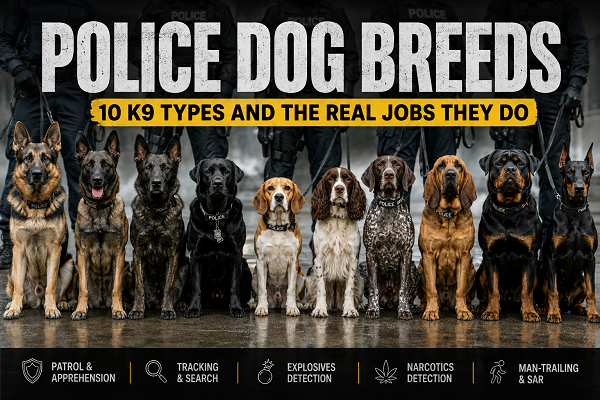
The most common police dog breeds are the German Shepherd, Belgian Malinois and Dutch Shepherd for patrol and catching suspects. Labradors, Springer Spaniels and Beagles handle detection, and Bloodhounds follow scent trails. Forces pick a breed for the job, not for a tough look. Real force records show the split clearly: bigger shepherd breeds on patrol, and spaniels and Labradors on drugs, cash, explosives and even hidden hard drives.
Table of Contents
- What Makes a Good Police Dog Breed?
- Police K9 Roles Explained (and Which Breeds Fit Each)
- The 10 Police Dog Breeds and Their Real Roles
- Honorable Mentions and Crossbreeds
- Breed Comparison Table
- What Real Force Data Shows
- How Much a Police Dog Costs
- How Long Police Dog Training Takes
- Real K9 Case Studies
- What Happens When a Police Dog Retires
- Police Dog Myths
- If You Want One of These Breeds at Home
- About the Trainer Behind This Guide
- FAQs
- Conclusion
Introduction
Ever watched a K9 team arrive and wondered why one scene gets a lanky Belgian Malinois and the next gets a bouncy spaniel? Those aren’t random picks. Each of the main police dog breeds earned its place because its nose, nerve, size or temperament fits one specific job.
Most breed lists stop at “smart, loyal, brave.” That doesn’t help you understand what these dogs do all day. So here’s the plan: I’ll match each breed to its real role, show you actual numbers from police forces, and cover things most guides skip, like costs, training time, the dogs that find hidden hard drives, and what happens at retirement. Whether you’re a new handler, a future K9 officer or just a dog lover, you’ll leave knowing which dog does what, and why.
What Makes a Good Police Dog Breed?
Here’s the thing most people miss: breed gets a dog into the interview, but it doesn’t get the dog the job. Trainers test each dog individually, and most fail.
How many fail? One UK handler once reported that West Yorkshire Police tested 170 dogs over 18 months and found only nine or ten suitable. West Yorkshire Police tested 170 dogs over 18 months and only nine or ten proved suitable. That’s roughly a 5–6% pass rate, and the dogs were all aimed at police work. It’s an older report, but it matches what handlers say about modern pass rates.
Trainers screen for five things:
- Drive: Does the dog genuinely want to work for a toy, food or praise?
- Trainability: Can it follow direction fast, even under pressure?
- Nerve strength: Does it stay calm around gunfire, crowds and noise?
- Physical soundness: Are the hips, joints and nose built to last?
- An off-switch: Can it go from full intensity to relaxed family dog at home?
Only a few breeds produce all five often enough to be worth the investment. That’s why you see the same names again and again. If you want to work with these dogs yourself, my guide on how to become a K9 dog handler shows what agencies look for in people, too.
Police K9 Roles Explained (and Which Breeds Fit Each)
Before we meet the breeds, you need the job list. Without it, breed names are just names.
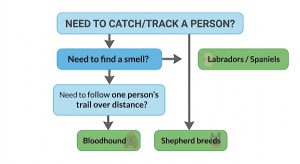
What does a police dog actually do? A police dog either works as a general-purpose dog (patrol, tracking, building searches and suspect apprehension) or as a specialist detection dog that finds a specific scent. General-purpose dogs usually come from shepherd breeds. Specialist dogs are usually Labradors and spaniels.
| Role | What the dog does | Breeds you’ll commonly see |
|---|---|---|
| General purpose / patrol | Tracks suspects, searches buildings, apprehends | German Shepherd, Belgian Malinois, Dutch Shepherd |
| Drugs, cash and firearms | Finds hidden contraband | Springer and Cocker Spaniels, Labradors |
| Explosives | Searches for bomb materials | Labradors, Springer Spaniels |
| Victim recovery | Locates human remains | Labradors (used this way by Police Scotland) |
| Trailing | Follows one person’s scent over distance | Bloodhound, German Shepherd |
| Search and rescue | Finds missing or trapped people | German Shepherds, Labradors |
| Electronic storage detection (ESD) | Finds hard drives, SD cards, phones | Mostly Labradors |
You can see this split in official records. Police Scotland’s 2023 disclosure lists its active general-purpose dogs as Shepherds, Malinois and Dutch Herders, while its drug, explosive and victim recovery dogs are Labradors. The Metropolitan Police says its general-purpose dogs are predominantly German Shepherds, with a few Dutch Herders and a few Belgian Malinois, and around 200 detection dogs.
The 10 Police Dog Breeds and Their Real Roles
1. German Shepherd
Real role: General-purpose patrol, tracking, building searches, apprehension, and sometimes search and rescue.
Germany picked the Shepherd as its ideal police breed and opened its first police dog training school in 1920 at Grünheide. That century of head start is why Shepherds still dominate patrol cars. In Police Scotland’s 2023 numbers, 36 of its active general-purpose dogs were German Shepherds, against 18 Malinois. The Met even trains some of its Shepherds in urban search and rescue: 10 USAR dogs support the London Fire Service, all trained from general-purpose German Shepherds.
Reality check: A show-line Shepherd and a working-line Shepherd are very different dogs. Some British forces once worried that show-bred dogs had gone “soft” and lacked courage for service work. Working lines matter more than the breed name.
2. Belgian Malinois
Real role: Fast pursuit, apprehension, and dual-purpose detection, especially in special units.
The Malinois is lighter and quicker than a Shepherd, and the shift toward it is real. In 2011, police in Germany’s North Rhine-Westphalia reported only 26 working German Shepherds compared with 281 Malinois. Officials there said the Malinois proved healthier and more courageous, and could also work as a sniffer dog.
Reality check: This breed needs a real job and an experienced handler. Without that, drive turns into frustration, destructive chewing and reactivity quickly. A Malinois is not a “Shepherd, but smaller.”
3. Dutch Shepherd
Real role: General-purpose patrol, tracking and suspect searches.
Dutch Shepherds (often called Dutch Herders in UK paperwork) are less common but steady performers. Police Scotland lists four active Dutch Herders in general-purpose roles, and West Midlands Police lists two. Handlers like them because they offer strong drive with good steadiness, and they respond well to fair, clear handling.
Reality check: They’re sensitive to handling style. A rough or inconsistent handler can lose a Dutch Shepherd’s trust quickly.
4. Labrador Retriever
Real role: Drugs, explosives, victim recovery and electronic storage detection.
The Labrador is the friendliest face in K9 work, and that’s a feature, not a flaw. A Lab can search luggage lines, crowds or schools without scaring anyone. Police Scotland assigns Labradors across its drugs, explosive detection and victim recovery teams.
Labradors also dominate a newer role: electronic storage detection (ESD). These dogs smell a chemical coating used in memory devices called triphenylphosphine oxide (TPPO). Handlers say that chemical is added during manufacturing to prevent overheating, which is why dogs can find USB sticks, SD cards, phones and hard drives.
Reality check: Labs are search machines, not bite dogs. Their whole training track is long, repetitive scent work.
5. English Springer Spaniel
Real role: Drugs, cash, firearms and explosives detection.
If you work in UK policing, the Springer is a star. West Yorkshire Police reported 12 spaniels and one Labrador in its detection team. West Midlands Police told one request in 2024 that its 81 operational dogs included 23 English Springer Spaniels and 14 German Shepherds.
Springers are small, tireless and obsessed with finding things. That’s why Surrey’s Sox managed over 1,000 drugs, cash and firearms searches, with her first-ever find a haul of more than 50,000 euros and £25,000 in cash.
Reality check: Springers have energy to burn. Without structured work, they’ll invent their own jobs, usually destructive ones.
6. Beagle
Real role: Airport, port and customs detection, mostly for prohibited food, plants and drugs.
A Beagle can squeeze through a crowded terminal, climb a luggage belt, and get lifted into tight spaces where a Shepherd simply can’t go. Its non-threatening look keeps travelers relaxed, too. The USDA’s Beagle Brigade is the best-known example.
Reality check: Beagles follow scent so strongly that they can ignore the handler. Recall and focus around distractions need constant proofing.
7. German Shorthaired Pointer
Real role: Detection and open-area searching.
You won’t see GSPs often, but they work. Training sources list Border Collies, German Shorthaired Pointers and mixed breeds among dogs sometimes used for detection. A Pointer’s stamina and range make it useful for covering large areas.
Reality check: This breed hates sitting around. If a unit can’t give it near-daily work, it will find trouble.
8. Bloodhound
Real role: Trailing, following one person’s scent over long distances.
Bloodhounds are scent specialists, with about 300 million scent receptors (humans have roughly 5 to 6 million). The idea isn’t new: London police used Bloodhounds in the 1888 hunt for Jack the Ripper.
Reality check: A Bloodhound is a one-job dog. It isn’t a patrol dog and won’t make a good apprehension dog. Trainers build independent trailing skills rather than obedience-heavy drills.
9. Rottweiler
Real role: Protection, apprehension and select patrol work.
Rottweilers bring raw power and a strong guarding instinct. But they’re rare in modern municipal units. North Rhine-Westphalia’s pack of 350 police dogs included just one Boxer and one Rottweiler.
Reality check: Rottweilers mature slowly and need a patient, consistent handler. Most forces choose lighter, faster dogs today.
10. Doberman Pinscher
Real role: Patrol and apprehension in some units, and a long history in guard and sentry work.
Dobermans are fast, alert and athletic. Modern municipal K9 units don’t use them much, though, and companion-line Dobermans often lack working drive. A department that wants a Doberman will usually source a working-line dog specifically.
Reality check: If you meet a “police-style” Doberman, ask about its breeding. The pet-line version rarely passes a real K9 selection.
Honorable Mentions and Crossbreeds
The top 10 doesn’t cover everything. Other breeds you’ll see include:
- Cocker Spaniel: West Midlands lists Cocker Spaniels in its drugs and digital media teams. Its digital media dogs include Cockers, Springerdors and Pointerdors.
- Springerdors and Sprockers: Crosses between spaniels and Labradors (or Cockers) that keep the nose and tone down the intensity.
- Boxer and Giant Schnauzer: Both appear on US and European working lists, though in small numbers.
- Rescue dogs: Some programs use shelter dogs with high drive to cut costs.
The big lesson? Forces care about the individual dog’s drive more than a pure pedigree.
Breed Comparison Table
| Breed | Main role | Typical use | Where it’s strongest |
|---|---|---|---|
| German Shepherd | General purpose | Patrol, tracking, apprehension | Versatility |
| Belgian Malinois | General purpose | Pursuit, apprehension | Speed, drive |
| Dutch Shepherd | General purpose | Patrol, tracking | Steady drive |
| Labrador Retriever | Detection | Drugs, explosives, ESD, victim recovery | Friendly, great nose |
| English Springer Spaniel | Detection | Drugs, cash, firearms | Stamina, compact size |
| Beagle | Detection | Customs, airports | Small size, strong nose |
| German Shorthaired Pointer | Detection | Open-area searches | Stamina and range |
| Bloodhound | Trailing | Missing people, suspects | Scent receptors |
| Rottweiler | Protection | Select patrol roles | Power, presence |
| Doberman | Patrol | Select units | Speed, alertness |
What Real Force Data Shows
Most guides repeat each other. Public records tell a clearer story, and they’re free to read. Here’s what UK and German records show:
- Police Scotland (2023): Active general-purpose dogs included 36 German Shepherds, 18 Malinois, four Dutch Herders and three Shepherd/Malinois crosses. That’s about 59% Shepherds and 30% Malinois.
- West Yorkshire Police (2023): 13 German Shepherds and 7 Malinois on patrol, with 12 spaniels and one Labrador on detection.
- Greater Manchester Police: German Shepherds are the main general-purpose dog, with Malinois also used, and Springers, Cockers and Labradors for specialist work.
- North Rhine-Westphalia (2011): 281 Malinois against 26 German Shepherds.
The pattern repeats: shepherd breeds on patrol, spaniels and Labradors on scent. The Malinois is gaining ground, but the Shepherd still leads in much of the UK.
US vs UK vs Europe in one line each:
- US: Mostly dual-purpose Shepherds and Malinois on patrol, with Labs and other breeds for detection.
- UK: A sharper split between general-purpose and detection dogs, with spaniels doing a huge share of detection.
- Continental Europe: Belgium and the Netherlands breed many of the Malinois and Dutch Shepherds that other countries import.
How Much a Police Dog Costs
Police dogs aren’t cheap, and the price tag explains why so many K9 units rely on donations and grants.
- Training: Fully training a traditional police dog can run upwards of $15,000, according to the National Police Dog Foundation.
- The dog itself: Cairo, the SEAL Malinois, had a price tag of about $10,000.
- Specialist dogs: A Delaware ESD Labrador cost police $10,600 after training.
- Whole-program budgets: An older US Office of Justice Programs analysis put a full drug-dog program near $55,000 once vehicles, kennels and a year of care were included. Today’s costs run higher.
- After service: Vet bills don’t stop. One retired Surrey police dog’s treatment has been supported with more than £10,000 from the Thin Blue Paw Foundation.
A commonly quoted ballpark for a fully operational US dog is $20,000 to $25,000. Treat it as a guide, not a rule.
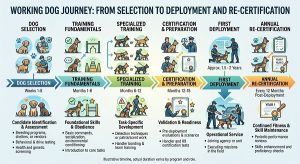
How Long Police Dog Training Takes
There’s no single timeline, but real examples help:
- Scotland’s Patch: Patch joined the force in 2008 after an eight-week training programme in Glasgow.
- France’s RAID dogs: Diesel’s handler described a three-month patrol course, after which only the best became assault dogs.
- Brewster the Springer: Fully trained and licensed as a drugs, cash and weapons dog within three weeks of joining. That works because the dog arrived with huge natural drive.
- Many US academies: Run closer to 4 to 6 months of intensive work for a dual-purpose team.
Whatever the timeline, certification isn’t the finish line. Teams re-certify every year, because scent skills and bite reliability fade without practice. For a full stage-by-stage look, read my breakdown of how K9 units train dogs from rescue to certification.
Real K9 Case Studies
Numbers only tell half the story. Here are four dogs worth knowing.
Cairo (Belgian Malinois, US Navy SEALs). Cairo was a 70-pound Malinois who took part in the May 2011 raid on Osama bin Laden’s compound. He belonged to a special group called combat assault dogs, so he’s a military crossover rather than a police dog. His handler, Will Chesney, later wrote a bestselling book about their partnership.
Diesel (Belgian Malinois, French RAID). Diesel was a seven-year-old RAID assault dog, killed in the Saint-Denis raid on 18 November 2015, and the first RAID dog killed on duty. She was due to retire the following spring. The PDSA later awarded her the 66th Dickin Medal.
Brewster (English Springer Spaniel, UK). Brewster is described as Britain’s longest serving police dog. He started active service in August 2005, retired in January 2016, and died in 2017. He also worked service stations on the M1 and M25 and at Luton airport.
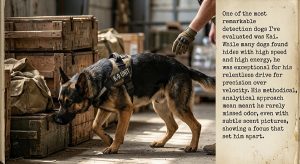
ESD dogs (mostly Labradors). When police searched a former Subway spokesman’s home for child abuse images without success, a sniffer dog found the hidden hard drive. These dogs are rare, and in 2017 only around 20 existed in the US.
What Happens When a Police Dog Retires
Most guides skip this, but readers ask about it constantly.
A working dog usually retires between about 8 and 10 years old. Sox, the Surrey spaniel, retired at age nine. Most police dogs live with their handler, so retirement often means going home for good.
In the US, “Robby’s Law,” signed in November 2000, allowed adoption of retired military working dogs. Police departments follow their own rules, and Texas voters recently approved a change that lets agencies transfer retired police dogs to their handlers. In the UK, charities like Thin Blue Paw help fund care for retired dogs.
For a deeper look at service length, read how long military working dogs serve.
Police Dog Myths
“All police dogs are German Shepherds.” The data above says no. Spaniels outnumber Shepherds in some detection teams.
“Only big, scary breeds work.” Labradors and spaniels do some of the most valuable work, because they search without scaring the public.
“Police dogs only obey a foreign language.” Many dogs begin with Dutch or German commands if they were bred there, but the idea that forces use a secret language to stop suspects controlling them is mostly a myth.
“The right breed guarantees the right dog.” It doesn’t. Remember the 5–6% pass rate.
If You Want One of These Breeds at Home
Love a working breed? Here’s how I’d approach it as a handler:
- Ask about working lines. Show-line and pet-line dogs often lack the drive and nerve of true working dogs.
- Check hips and elbows. Ask for health testing on both parents.
- Give it a job. A Malinois, Springer or Shepherd needs daily structured work, not just a walk.
- Teach the off-switch early. Practice calm settling in a crate or on a mat from day one.
- Socialize carefully. Controlled exposure to people, noise and surfaces builds the nerve K9 dogs need.
My e-book, Beyond the Bark, goes deeper on daily structure and handler mindset. You can grab a copy here.
About the Trainer Behind This Guide
This guide comes from Rofiat Muritala, a Nigerian Army military working dog instructor and handler with more than 14 years of experience at the Nigerian Army Dog Centre. She has completed advanced obedience, K9 patrol and advanced explosive detection certification courses. She represented the Nigerian Army Dog Centre at NADCEL 2026, where she led demonstrations in obedience, explosive detection, agility and tactical movement. Her background covers dog selection, foundational training, behaviour shaping and performance evaluation in real operational environments. She’s also the author of Beyond the Bark: Inside a Pro Handler’s Playbook for Raising the Ideal Dog.
FAQs
What dog breed do most police use?
The German Shepherd and Belgian Malinois are the most common patrol breeds worldwide. Police Scotland’s active general-purpose dogs were mostly Shepherds in 2023, while Germany’s North Rhine-Westphalia now uses far more Malinois. Detection teams rely mostly on Labradors and spaniels.
Is a Belgian Malinois better than a German Shepherd for police work?
Neither wins everywhere. Malinois are lighter, faster and more driven, which suits pursuit and special units. Shepherds are versatile and proven, and they still lead many UK forces. The right choice depends on the job, the handler’s experience and the dog’s individual nerve.
Why do police use Labradors and spaniels for detection?
They have excellent noses, strong play drive and a friendly look that keeps the public calm. A Labrador or Springer can search crowds, luggage and vehicles without alarming anyone. That’s why UK forces use them for drugs, cash, explosives and firearms.
Can any dog become a police K9?
No. Trainers test individual dogs for drive, nerve and soundness, and most fail. West Yorkshire once reported only nine or ten suitable dogs out of 170 tested over 18 months.
How much does a police dog cost and how long does training take?
Full training often costs $15,000 or more, and the dog itself can add roughly $10,000. Basic programs run anywhere from about 8 weeks to 6 months, and teams must re-certify every year.
Conclusion: Match the Dog to the Job
There’s no single “best” police dog breed, only the best breed for a specific job. Shepherds, Malinois and Dutch Shepherds handle patrol and apprehension. Labradors, Springers and Beagles find scents the human nose will never catch. Bloodhounds follow a single trail across long distances. And the dog’s individual drive and nerve matter more than its pedigree.
If you’re choosing a working dog, start with the job, not the breed. And if you want to keep learning, subscribe to our weekly roundup at arfsk9team.com.ng/newsletter.
Sources checked: Police Scotland FOI 23-2611 and 23-0482; West Yorkshire Police FOI 1819101/23; West Midlands Police FOI 279A/23 and 484A; Greater Manchester Police FOI 01/FOI/23/011404/Y; Metropolitan Police FOI (October 2023); Wikipedia “Police dog”; The Local (2011); Globe and Mail; Thin Blue Paw Foundation; PDSA/Dickin Medal coverage; AKC review of No Ordinary Dog; Nylabone; Dogster.

Her work centres on obedience, detection, protection and operational readiness. She favours proven methods built on repetition, consistency and real-world conditioning, so that both dogs and handlers are prepared for high-pressure tasks.
Rofiat represented the Nigerian Army Dog Centre at the Nigerian Army Day Celebration (NADCEL) 2026, where she led demonstrations in obedience, explosive detection, agility and tactical movement. Through articles, training content and documentaries, she shares field-based insight into how structured training, clear communication and trust between handler and dog affect performance and reliability.
She is the author of Beyond the Bark: Inside a Pro Handler's Playbook for Raising the Ideal Dog, a practical guide that helps dog owners and handlers apply professional training principles in everyday situations.
- How to Train a Stubborn Pug: A K9 Trainer’s Real Guide - October 22, 2026
- Dog Hotel Prep: 7 Must-Haves Before Boarding - October 21, 2026
- How to Enter the COBA National Dog Championship - October 20, 2026