King Shepherd vs German Shepherd: 5 Key Differences
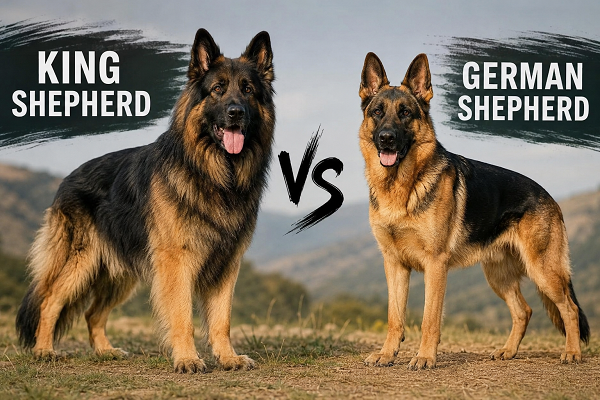
The biggest differences are size, breed status, coat, temperament and cost. A King Shepherd is a much larger, newer, unrecognized-by-the-AKC crossbreed that usually weighs 75-150 lbs and has a calmer, softer nature. A German Shepherd is a standardized breed recognized worldwide, weighs 50-90 lbs, and has the drive and sharpness that police and military programs want.
Short version: pick the German Shepherd for work, sport and proven performance. Pick a well-bred King Shepherd for a big, steady family companion, if you have the space and budget.
Table of Contents
- Introduction: Why People Confuse These Two Shepherds
- Meet the Breeds: A Quick Backstory
- Difference #1: Origin and Official Recognition
- Difference #2: Size, Build and Growth
- Difference #3: Coat, Shedding and Grooming
- Difference #4: Temperament, Trainability and Working Ability
- Difference #5: Health, Lifespan and Real Cost
- The Comparison Nobody Makes: Working-Line vs Show-Line German Shepherds
- Living With Each Breed: Space, Heat, Kids and Cars
- How to Choose a Good Breeder (Checklist)
- Which Should You Choose?
- Handler’s Notes: What Experience Teaches You
- FAQs
- Conclusion
Introduction: Why People Confuse These Two Shepherds
You’ve seen the photos. A huge, wolf-like shepherd with a black saddle, and the caption says “German Shepherd.” Then someone in the comments says, “That’s a King Shepherd.” Who’s right?
Both, sometimes. The two breeds share a lot of DNA, and a King Shepherd really does look like a German Shepherd that spent a few years at the gym. But when you live with them, they’re not the same dog. And if you’re searching for king shepherd vs german shepherd, you’re probably about to spend years and thousands of dollars on one of them.
So here’s the plan. I’ll walk you through five real differences: origin, size, coat, temperament and health with cost. Then I’ll cover things most comparison articles skip, like the working-line vs show-line split inside the German Shepherd breed, how to vet a King Shepherd breeder, and what each dog is like to live with day to day. By the end, you’ll know which one fits your life.
Meet the Breeds: A Quick Backstory
The German Shepherd goes back to 1899, when Captain Max von Stephanitz founded the breed club in Germany. He wanted one dog that could herd, work and think. Over a century later, the German Shepherd Dog (GSD) is one of the most registered breeds on earth and a backbone of police, military, search and rescue, and service dog work.
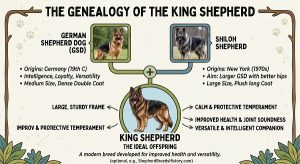
The King Shepherd is a much newer story. American breeders Shelley Watts-Cross and David Turkheimer started the line in the early 1990s. They were frustrated by health and temperament problems in some German Shepherd lines. Their plan was to cross German Shepherds with Shiloh Shepherds (itself a shepherd line developed with German Shepherd and Alaskan Malamute ancestry) to get a bigger, calmer, healthier dog. The American King Shepherd Club formed in 1995. Some breeders have since added other large breeds such as the Great Pyrenees or Akita to the mix, which is one reason Kings vary more between kennels than GSDs do.
Difference #1: Origin and Official Recognition
This is the root of every other difference, so let’s get it straight.
| German Shepherd | King Shepherd | |
|---|---|---|
| Started | 1899 (Germany) | Early-to-mid 1990s (USA) |
| Founders | Captain Max von Stephanitz | Shelley Watts-Cross, David Turkheimer |
| AKC | Recognized | Not recognized |
| FCI / UK Kennel Club | Recognized | Not recognized |
| ARBA (rare breed registry) | Recognized | Recognized, with a published standard |
| Main breed club | Many national clubs (SV in Germany, GSDCA in the US) | American King Shepherd Club (AKSC) |
| Type | Standardized breed | Crossbreed or developing breed |
What does that mean for you in real life?
- Predictability. A German Shepherd from a good breeder follows a century-old standard. You can ask for hip and elbow scores, working titles and pedigrees that go back generations. With a King Shepherd, the standard exists, but the pool is small and lines differ.
- Health testing rules. Major national clubs often have breeding requirements. A smaller registry may have fewer or looser ones, so the buyer has to do more homework.
- Dog sports and competition. You can’t enter a King Shepherd in AKC conformation shows. Some rare-breed events and some sport venues accept them, but check the rules before you commit.
- Travel and import. Many countries recognize GSD paperwork easily. King Shepherd paperwork is less widely understood, which can matter when you’re importing or insuring.
My take: “Not recognized by the AKC” doesn’t mean a bad dog. Plenty of good dogs come from smaller registries. It just means you are the quality control, not the club.
Difference #2: Size, Build and Growth
Size is the first thing people notice, and it’s a real difference, not marketing.
| Measurement | German Shepherd | King Shepherd |
|---|---|---|
| Male height | 24-26 in (61-66 cm) | 27-31+ in (69-79+ cm) |
| Female height | 22-24 in (56-61 cm) | 25-27 in (64-69 cm) |
| Male weight | 65-90 lbs (30-41 kg) | 90-150 lbs (41-68 kg) |
| Female weight | 50-70 lbs (23-32 kg) | 75-110 lbs (34-50 kg) |
A big male King can outweigh a male GSD by 60 lbs or more. That’s the weight of an extra medium-sized dog.
Build: Athlete vs. Tank
The classic German Shepherd has a lean, athletic frame and a visible slope from withers to rump (more on that in the working-line section). It’s built for quick turns, sprinting and long days of work. A King Shepherd has a heavier bone structure, a deeper body and a broader chest. Breed standards describe it as slightly longer than tall, with a sturdy, “planted” look.
Growth Timeline Matters More Than You Think
Big dogs don’t finish growing at one year, and this is where new owners slip up.
- GSDs: Most reach adult height by about 12 months, and fill out until around 2 years.
- King Shepherds: Most reach adult height closer to 12-18 months, but can keep adding muscle and weight until about 2-3 years.
That extra growing time means a longer period of soft growth plates and developing joints. The advice is the same for both breeds: no forced running, no repetitive jumping and no long jogging with a puppy under about 12-18 months. Short, controlled play is fine.
What the Size Gap Costs You
- Food: A 130-lb King can eat roughly 1.5 to 2 times what a 70-lb GSD eats. Exact amounts depend on the food and activity level, so follow your vet’s guidance.
- Gear: You’ll need a bigger crate, a bigger car and a stronger leash and harness. (Our guide on essential K9 training equipment every working dog handler needs covers what to buy and what to skip.)
- Medication and boarding: Many drugs are dosed by weight, and kennels often charge more for giant dogs.
- Control: A 70-lb dog pulling on a leash is a nuisance. A 140-lb dog pulling is a safety problem. Leash manners matter more with a King.
Difference #3: Coat, Shedding and Grooming
Both breeds have a double coat: a weather-resistant top layer and a thick, soft undercoat. Both “blow” their coat heavily once or twice a year. Neither is a low-shedding dog. If you hate dog hair on your couch, stop here and read about low-maintenance breeds instead.
Here’s how the coats differ:
- German Shepherd: Usually a medium-length double coat. Long-haired GSDs exist, but the long coat is considered a fault in AKC and FCI show standards. They shed all year, with heavy seasonal blowouts.
- King Shepherd: The ARBA standard describes two coat types, a straight type and a longer type with a slight wave. Many Kings look “fluffier” and have more feathering on the legs, chest and tail.
| Grooming task | German Shepherd | King Shepherd |
|---|---|---|
| Brushing | 2-3 times a week | 3-4 times a week (daily in coat-blow season) |
| Mat risk | Low, except long coats | Moderate: ears, chest, hindquarters |
| Bath | Every 6-8 weeks or as needed | Same, but drying a giant dog takes longer |
| Professional grooming | Optional | Helpful during heavy shed |
Handler tip: Don’t shave a double-coated shepherd in summer. The coat helps insulate against heat as well as cold, and shaving can damage regrowth and raise sunburn risk. Brush out the loose undercoat instead.
An undercoat rake or deshedding tool pays for itself with either breed, and more so with a King. The one I recommend for large dogs is the FURminator Large Dog deShedding tool, and you can check current pricing and availability on Amazon here.
Difference #4: Temperament, Trainability and Working Ability
This is where the two breeds feel different to live with.
The German Shepherd Temperament
GSDs are driven, alert and eager to work. They learn fast, love structure and bond closely with their people. That’s why they dominate police and military programs. The flip side: a bored, under-exercised GSD can get anxious, destructive or reactive. They’re often watchful and a bit reserved with strangers, and many show herding behavior like nipping at heels or circling kids.
The King Shepherd Temperament
The King was bred to keep the shepherd’s intelligence and loyalty while turning the volume down. Most owners and breed clubs describe Kings as calmer, softer and more people-friendly, often called “gentle giants.” They tend to settle faster indoors and recover more easily after excitement. They’re still alert and protective, but usually less intense.
Important caution: Because the breed is a mix and the gene pool is small, temperament varies between litters. One King may be mellow. Another may carry a lot of GSD drive or Malamute independence. Meet the parents. Always.
Side by Side
| Trait | German Shepherd | King Shepherd |
|---|---|---|
| Drive and intensity | High | Moderate |
| Trainability | Very high, loves repetition | High, prefers calm and patient sessions |
| With strangers | Reserved, watchful | Often friendlier, still alert |
| Herding habits | Common | Less common |
| Barking | Alert barker | Moderate |
| Exercise | 60-120 min plus mental work | 60-90 min, steadier pace |
| Alone time | Poor tolerance | Poor tolerance |
Can a King Shepherd Be a Working or Protection Dog?
This is a question most comparison articles dodge, so let me be direct.
King Shepherds have been used in search and rescue, therapy and personal protection roles, and a well-bred individual can do real work. But when police and military programs buy dogs by the thousands, they overwhelmingly choose German Shepherds and Belgian Malinois, plus Dutch Shepherds in some places. The reasons are practical: a long track record, testable drive, a smaller and more agile body, and breeding programs built around working traits. As far as I know, no major police or military program uses the King Shepherd as a standard source.
That’s not an insult to the King. It’s just that its goal was a better family dog, not a better patrol dog. If you want a protective deterrent at home, a King’s size and deep bark do a lot of the work. If you want serious bite work, detection or sport like IGP, a working-line GSD is the safer choice. For a wider look at what real K9 units choose, see our guide to police dog breeds and their real K9 roles.
Training Both Breeds
- Start early. Socialize both breeds between 8 and 16 weeks with people, surfaces, sounds and other dogs.
- German Shepherds: Give them a job. Scent games, obedience, tracking or sport. Teach an off switch too, such as a settle on a mat.
- King Shepherds: Keep sessions calm and short, and reward generously. Teach leash manners and “leave it” early, because their size makes mistakes expensive later.
- Both: Avoid harsh corrections. Shepherds read your mood, and a heavy hand creates anxious dogs.
If you want the full handler’s approach to raising a balanced large-breed dog, our e-book Beyond the Bark covers the training principles working handlers use, adapted for everyday owners.
Difference #5: Health, Lifespan and Real Cost
The King Shepherd was created to fix the German Shepherd’s health problems. So did it?
German Shepherd Health
- Hip dysplasia: The Orthopedic Foundation for Animals (OFA) reports that roughly one in five evaluated German Shepherds has some degree of hip dysplasia. Only a small share rate “Excellent” and about half rate “Good.”
- Elbow dysplasia is also common.
- Degenerative myelopathy (DM): A progressive spinal disease linked to the SOD1 gene. A DNA test exists, so ask breeders for results.
- Bloat (GDV): A life-threatening stomach twist in deep-chested dogs.
- Lifespan: Typically around 9-13 years, with many sources putting the average near 10-11 years.
King Shepherd Health
- Breeders targeted hip dysplasia on purpose, and a wider gene pool may help. But there’s no large, independent health database for Kings like OFA’s data for GSDs, so claims of “much healthier” are hard to prove.
- Still at risk: Hip and elbow dysplasia, bloat, degenerative myelopathy, allergies and von Willebrand’s disease (a bleeding disorder) are all reported in the breed.
- Lifespan: Breed clubs and guides often quote 10-14 years. Treat that as a hopeful range, not a guarantee. Giant dogs often live shorter lives than medium dogs.
Here’s the honest bottom line: A King Shepherd can be healthier than a poorly bred German Shepherd. It is not automatically healthier than a well-bred, health-tested GSD. The breeder matters more than the breed name.
What They Really Cost
Prices vary by country and breeder, so use these as rough planning ranges, not quotes:
| Cost | German Shepherd | King Shepherd |
|---|---|---|
| Puppy from a health-testing breeder | About $1,500-$3,500 (more for imported working lines) | About $1,500-$3,500+ (rarer, so fewer choices) |
| Food per month | About $60-$110 | About $90-$180 |
| Routine vet, vaccines, parasite control | About $500-$900 a year | About $600-$1,100 a year |
| Hip or elbow surgery (if needed) | Often $3,000-$7,000+ per joint | Often $4,000-$8,000+ per joint |
| Bloat emergency surgery | Often $3,000-$7,500+ | Often $3,500-$8,000+ |
The puppy price is the smallest part of the bill. Over a 10-year life, food and vet care will cost many times more than the purchase price. Big dogs also cost more to insure, so get quotes before you buy and read what the policy excludes for hereditary conditions.
Two Habits That Protect Joints and Stomachs
- Start joint support early. A joint supplement such as Nutramax Cosequin (glucosamine, chondroitin and MSM) is a common vet-approved starting point. You can see current options on Amazon. Ask your vet to confirm the dose for your dog’s weight.
- Slow down mealtime. A slow feeder bowl helps gulpers. This Outward Hound option works for both breeds. Also avoid hard exercise for an hour or so before and after meals.
For more on size, temperament and budget for the King specifically, read our full guide: King Shepherd Dog Breed: Size, Temperament & Costs.
The Comparison Nobody Makes: Working-Line vs Show-Line German Shepherds
Most articles treat “the German Shepherd” as one dog. It’s not. This is the part that surprises buyers most.
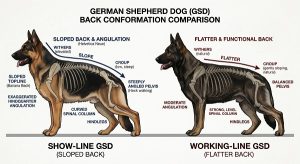
Within the GSD breed there are two very different types:
| Working-line GSD | Show-line GSD | |
|---|---|---|
| Bred for | Police, sport, protection, work | Conformation shows |
| Back shape | Straighter, flatter topline | More sloped, angled hindquarters |
| Drive | Very high | Moderate to high |
| Energy at home | Intense, needs a job | Often calmer |
| Joint risk | Often lower | Often higher (the angulation adds strain) |
| Best for | Experienced owners, sport, work | Family companions with active owners |
Why does this matter in a King Shepherd vs German Shepherd decision? Because:
- A working-line GSD is far more intense than a King. If you compare a King to a working-line GSD, the gap in drive is huge.
- A show-line GSD is closer to a King in energy, but may carry more joint risk.
- Many King Shepherd buyers actually want a “calm, sturdy shepherd.” A well-bred, moderate-drive GSD from health-tested parents might also give them that, at a lower price and with better paperwork.
So don’t ask, “King or German?” Ask, “What kind of German Shepherd am I comparing against?”
Living With Each Breed: Space, Heat, Kids and Cars
Spec sheets don’t tell you what Tuesday looks like. Here’s how it plays out.
- Apartments: A GSD can manage an apartment if you meet its exercise and mental needs. A 130-lb King in a small flat is hard: tight turns, little room to stretch, and tricky stairs for a heavy dog. A house with a yard suits a King better.
- Hot climates: Both have double coats. Kings, with their bulk and longer coats, may struggle more in extreme heat. Walk early or late, give shade and water, and learn heatstroke signs. If you live somewhere hot, think carefully.
- Kids: Both can be great with children when well socialized. GSDs may herd or nip at running toddlers, so supervise. Kings are usually patient, but a heavy, clumsy dog can knock over a small child by accident. Neither breed should be left alone with young kids.
- Other pets: Early socialization works for both. Kings are often more relaxed with other dogs. GSDs can be dog-selective as adults.
- Cars and travel: A big King needs an SUV or wagon with a proper crash-rated crate or barrier. Lifting a 120-lb dog into a car is also a back injury waiting to happen as he ages. Think about ramps.
- Aging: Large dogs get stiff. Plan for non-slip floors, an orthopedic bed and weight control from the start. Keeping your dog lean is the most effective joint-saver you have.
How to Choose a Good Breeder (Checklist)
This matters more than which breed you pick. Use this list for either dog:
- Health clearances for both parents: hip and elbow scores (OFA, PennHIP, or the European A-stamp systems), plus a DM DNA test.
- Proof, not promises: Ask to see certificates. “Vet checked” isn’t a hip score.
- Meet the mother (and the father if possible). Watch her temperament with strangers.
- Clear lineage: For a King, ask which breeds are in the pedigree and how many generations back the breeder can show.
- Raising practices: Puppies raised in the home or around people, with early handling and socialization.
- A written health guarantee and a take-back clause.
- Questions for you: A good breeder interviews you, too.
- No red flags: Always-available puppies, multiple breeds for sale, pressure to pay a deposit quickly or “rare colors” at a premium.
- Consider rescue: Both breeds and their mixes end up in shelters and breed rescues. Adult dogs come with a known temperament.
Which Should You Choose?
Here’s my no-fluff take.
Choose a German Shepherd if:
- You want serious protection, sport or detection work, or a dog with proven working lines
- You’re an experienced, active owner who can give daily structure and mental work
- You have moderate space, or want a lighter dog to handle, house and transport
- You want the widest choice of breeders, titles and health-tested pedigrees
Choose a King Shepherd if:
- You want a big, steady family companion and not a high-drive worker
- You have a house, a yard, a suitable vehicle and the budget for giant-dog bills
- You’re willing to travel to find a reputable breeder and wait for the right litter
- You’re comfortable with a less established breed and the extra homework that comes with it
Choose neither (yet) if:
- You work long hours with nobody home. Both breeds suffer when left alone for long stretches.
- You can’t afford a large emergency vet bill.
- You want a low-maintenance, low-shedding dog.
Handler’s Notes: What Experience Teaches You
After more than 14 years working with military working dogs, one lesson keeps repeating: the individual dog and the quality of its breeding matter more than the breed label. I’ve seen calm, stable GSDs and nervy ones from the same kennel type, and I’d expect the same spread in any young crossbreed like the King.
A few rules I give every owner of a large shepherd-type dog:
- Test temperament before you fall for looks. Look at how the parents handle noise, strangers and new places.
- Build the “off switch.” Teach your dog to settle on a mat for 20-30 minutes every day.
- Protect joints early. Keep puppies lean, avoid forced exercise, and don’t skip the vet’s hip checks.
- Train for the dog you’ll have at 120 lbs, not the cute 15-lb puppy. Leash manners, no jumping and a solid recall can’t wait.
FAQs
Is a King Shepherd just a bigger German Shepherd?
No. A King Shepherd is a separate, newer breed developed from German Shepherds and Shiloh Shepherds, and some lines add Great Pyrenees or Akita. It looks similar and shares ancestry, but it’s bred for a calmer temperament and a larger frame, not for working drive.
Are King Shepherds better than German Shepherds?
Not better, just different. King Shepherds are larger and usually calmer, which suits some families. German Shepherds are more proven, more widely recognized and better for police, sport or protection work. The better choice depends on your lifestyle and your breeder, not on the breed name.
Is a King Shepherd a good guard dog?
Somewhat, as a deterrent. Their size and deep bark scare off most intruders, and they’re loyal and alert. But they’re usually less intense than a German Shepherd, and they’re not the standard for serious protection or police work.
Do King Shepherds have fewer health problems?
They were bred to, and a wider gene pool may help. But they still face hip and elbow dysplasia, bloat and other large-breed problems, and there’s little independent health data. Always ask for hip, elbow and DM test results on both parents.
Which is more expensive to own, a King Shepherd or a German Shepherd?
A King Shepherd usually costs more overall. Puppies can be priced similarly or higher because of rarity, and the bigger body means higher food, medication, boarding and surgery costs over the dog’s life.
Conclusion
When you strip it down, the King Shepherd vs German Shepherd choice is about intensity versus size, and track record versus new promise. The German Shepherd gives you a proven, recognized working breed with a huge choice of breeders. The King Shepherd gives you a bigger, calmer shepherd-type companion, with a smaller gene pool and more homework before you buy.
Here’s what to do next:
- Decide whether you want a worker or a companion. Be honest.
- Check your space, your car, your budget and your daily schedule.
- Spend time with adult dogs of both breeds, and meet the parents of any puppy you consider.
- Ask for hip, elbow and DM results in writing.
- Start training and socialization the day your puppy comes home.
Get those steps right and either shepherd will pay you back with years of loyalty.
Want more guides like this? Subscribe to our weekly roundup newsletter at https://arfsk9team.com.ng/newsletter/ and get new K9 training and breed articles in your inbox.

Her work centres on obedience, detection, protection and operational readiness. She favours proven methods built on repetition, consistency and real-world conditioning, so that both dogs and handlers are prepared for high-pressure tasks.
Rofiat represented the Nigerian Army Dog Centre at the Nigerian Army Day Celebration (NADCEL) 2026, where she led demonstrations in obedience, explosive detection, agility and tactical movement. Through articles, training content and documentaries, she shares field-based insight into how structured training, clear communication and trust between handler and dog affect performance and reliability.
She is the author of Beyond the Bark: Inside a Pro Handler's Playbook for Raising the Ideal Dog, a practical guide that helps dog owners and handlers apply professional training principles in everyday situations.
- How to Enter the COBA National Dog Championship - October 20, 2026
- K9 Advantix Dosage Chart & Safety Guide for Dogs - October 19, 2026
- How to Set Up & Use Bousnic Dog Training Collar - October 18, 2026