King Shepherd Dog Breed: Size, Temperament & Cost

The King Shepherd is a giant, German Shepherd–based breed developed in the United States in the 1990s. Males stand about 26–31 inches (66–79 cm) and weigh 100–150 lb (45–68 kg). Females are slightly smaller. They’re usually calm, loyal and protective with their families. Puppies from health-testing breeders typically cost $1,200–$3,500 in the US, and a King Shepherd usually lives 10–12 years.
Table of Contents
- Introduction
- What Is a King Shepherd?
- Where the King Shepherd Came From
- King Shepherd Size and Growth Chart
- King Shepherd Temperament
- Are King Shepherds Good Family Dogs?
- Training and Exercise
- Health Problems and Lifespan
- King Shepherd Cost (Real Numbers)
- King Shepherd vs German Shepherd
- How to Spot a Fake King Shepherd
- Is a King Shepherd Right for You?
- FAQs
- Final Thoughts
Introduction
Ever looked at a German Shepherd and thought, “I love this dog, but what if it were bigger, calmer and tougher on the joints”? That’s the pitch behind the King Shepherd, and it’s why so many people search for it.
Here’s the problem. This breed is young and rare, and the internet is full of bad information about it. Some pages list heights that don’t match the breed standard. Others quote “studies” that don’t exist. And a lot of “King Shepherd” puppies for sale are just large German Shepherd mixes.
In this guide, I’ll walk you through the real King Shepherd size, honest King Shepherd temperament, and full King Shepherd cost from puppy price to vet bills. You’ll also get a growth chart, a breeder checklist and a red-flag list. Whether you’re a first-time giant-breed owner or a handler comparing working dogs, you’ll know by the end if this dog fits your life.
What Is a King Shepherd?
A King Shepherd is a large shepherd-type dog built on German Shepherd lines. Breeders added other big, sturdy breeds to get more size, better structure and a gentler temperament.
It isn’t a purebred in the classic sense. Major kennel clubs, including the AKC, UKC, FCI, Canadian Kennel Club and the UK Kennel Club, don’t recognize it. It is registered with groups like the American Rare Breed Association (ARBA), the American King Shepherd Club (AKSC) and the Continental Kennel Club.
Does “unrecognized” mean “bad”? No. It means the breed is still young and its gene pool is still being shaped. That’s why the breeder you choose matters so much.
Where the King Shepherd Came From
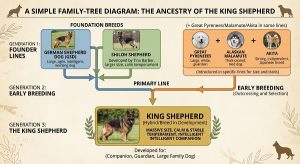
Two American breeders, Shelley Watts-Cross and David Turkheimer, started the breed in the 1990s. They were frustrated with the health decline in many German Shepherd lines, especially hip problems and steeply sloped backs.
Their plan:
- Cross German Shepherds (American and European lines) with the Shiloh Shepherd. The Shiloh is a larger GSD-type dog that itself includes Alaskan Malamute influence.
- Add other large breeds in some programs. Great Pyrenees is the one most sources mention, and a few lines include Akita.
- Breed back toward the German Shepherd look, with more size and a steadier nature.
The AKSC formed in 1995 to set a standard. A second group, the King Shepherd Club of America, started in 2015.
For comparison, Captain Max von Stephanitz began the German Shepherd program in 1899, and the breed took decades to settle. The King Shepherd is only about 30 years old. That explains why two dogs sold as “King Shepherds” can look and act quite different.
King Shepherd Size and Growth Chart
This is where the breed earns its name, and where most websites contradict each other. Here’s why: the breed standard and real-world dogs don’t always match, and breeders use different foundation dogs.
| Typical range (males) | Typical range (females) | |
|---|---|---|
| Height | 27–31 in (69–79 cm) | 25–29 in (64–74 cm) |
| Weight | 100–150 lb (45–68 kg) | 75–120 lb (34–54 kg) |
One breed-standard summary I found gives a tighter range: 26–29 in for males and 25–27 in for females. So if a breeder promises a 34-inch, 190-lb dog, be careful. That’s marketing, not breed standard.
For reference, a male German Shepherd usually stands 24–26 in and weighs 65–90 lb.
Rough growth guide (male)
| Age | Typical weight |
|---|---|
| 8 weeks | 15–25 lb (7–11 kg) |
| 3 months | 35–50 lb (16–23 kg) |
| 6 months | 70–90 lb (32–41 kg) |
| 12 months | 95–120 lb (43–54 kg) |
| 24 months | 110–150 lb (50–68 kg) |
These are rough guides based on general giant-breed growth. Ask your breeder for the parents’ weights and your vet for a growth curve.
Females run about 15–25% lighter at each stage.
Why growth speed matters
Giant breeds grow bones fast, but the growth plates stay open until roughly 14–24 months. In my work with large working dogs, the most common mistake I see is owners treating a 5-month-old that looks like an adult as if its joints were ready. They aren’t. Until your dog is close to 18 months:
- Avoid long runs on hard ground.
- Skip repetitive jumping and ball-chasing on slick floors.
- Limit stairs where you can.
- Keep your puppy lean. Extra weight hurts growing joints more than anything else.
Coat and colors
King Shepherds have a thick double coat, either medium-length or long. Common colors are sable, black and tan, black saddle, cream or silver, and solid black. Some breeders also sell solid white. They shed all year and “blow” the undercoat in spring and fall. If you want a low-shedding dog, look elsewhere.
For brushing routines that actually work with a thick coat, our essential dog grooming tips for a healthy puppy is a good place to start.
King Shepherd Temperament
I’ll be straight with you. “Gentle giant” is a fair description most of the time. But gentle doesn’t mean lazy, and it doesn’t mean easy.
Here’s what well-bred King Shepherds are usually like:
- Loyal and shadow-like. They follow you room to room.
- Protective but not twitchy. They bark at strangers and watch carefully, but a well-socialized dog doesn’t lunge at every passerby.
- Calmer than most GSDs. Many mature emotionally around 2–3 years old.
- Smart and quick. They learn commands fast, and bad habits just as fast.
- A little stubborn at times. Dogs with Great Pyrenees in their lines can show an independent streak.
Male vs. female
Males tend to be larger, more assertive and more territorial. Females are often a bit more sensitive to their owner’s mood and easier to train. Both can be excellent family dogs. Pick based on your home, not stereotypes.
The thing nobody tells you
Because the breed is so new, temperament changes by bloodline. A King Shepherd with more working-line GSD behind it may have higher drive and need more structured work. One with more Shiloh or Pyrenees influence may be cooler and more independent.
So here’s my advice: meet the parents. What the mother and father are like at 3 years old is the best preview you’ll get. Ask to see them around strangers and other dogs, not just in the yard.
Are King Shepherds Good Family Dogs?
Generally, yes. Gentleness with children was one of the goals of the breed. Well-socialized King Shepherds are patient, tolerant and loyal to the whole household.
A few real-life notes:
- Size is the risk, not aggression. A 120-lb dog can knock over a toddler with a tail wag. Always supervise.
- Other pets: They usually do fine with dogs and cats raised alongside them. Introduce small animals slowly.
- They need space. Not necessarily a huge yard, but definitely not a tiny flat with no daily outlet.
- Heat is a real issue. A thick double coat struggles in hot, humid climates. In warm countries, plan walks for early morning and evening, give shade and cool water, and never shave the coat. Shaving can damage how it insulates.
- Rentals can be tough. Many landlords limit dogs by weight. Check before you buy.
- Travel needs planning. A grown King Shepherd needs a large crate or a big car. Many airlines won’t take a dog this size in the cabin, and some cargo rules are strict.
Early socialization is non-negotiable. A protective giant that hasn’t met enough people by 16 weeks can grow wary. A good routine with a crate helps from day one, as I explained in our guide on how to crate train a puppy.
Training and Exercise
King Shepherds descend from working dogs, so they want a job. Most need 60–90 minutes of real exercise daily. That means walks, hikes, swimming, tracking games or structured play, not just a stroll to the corner.
Not sure what “enough” looks like? Our breakdown of how often you should exercise a working dog explains it clearly.
A realistic training timeline
| Age | Focus |
|---|---|
| 8–16 weeks | House training, crate, name, sit, come, gentle handling, socialization |
| 4–6 months | Leash manners, impulse control, calm greetings, meeting new places |
| 6–12 months | The teenage phase. Big body, big attitude. Stay consistent. |
| 12–24 months | Reliable recall, “place,” advanced obedience, optional scent work |
What works best
- Reward-based training. This breed responds well to praise, food and play. Harsh corrections create fear in a dog this size.
- Short sessions. Five to ten minutes, several times a day.
- Mental work. Nose games, puzzle feeders and “find it” drills tire them out faster than another long walk.
- No protection work as a hobby. A protective giant needs a very steady temperament and a trained handler. If you want that, work with a professional.
Beyond the Bark, my own e-book, Beyond the Bark: Inside a Pro Handler’s Playbook for Raising the Ideal Dog, walks through the same behavior framework I use with clients. It’s especially useful for owners of large, driven breeds where small mistakes grow quickly.
Health Problems and Lifespan
The health goal behind this breed was simple: fewer hip and back problems than many GSD lines. Many owners and breeders report that King Shepherds do better on joints, but here’s the honest caveat: no large, published study proves it. Be wary of any page that gives a precise percentage. Several websites I checked quoted exact figures (like “23% lower dysplasia risk”) with no real source.
What to screen for
- Hip and elbow dysplasia. Ask for OFA or PennHIP results on both parents.
- Bloat (GDV). A deep chest raises the risk. Feed 2–3 smaller meals, avoid hard exercise an hour before and after eating, and ask your vet about a preventive gastropexy, a surgery that tacks the stomach in place. It’s often done at spay/neuter.
- Degenerative myelopathy (DM). A spinal disease seen in GSDs. A DNA test exists, so ask if both parents were tested.
- Eye problems and allergies.
- Heart disease, which some sources list as a concern.
The CHIC gap
Many AKC breeds have a CHIC program that lists required tests. The King Shepherd doesn’t have one. That means health testing depends on each breeder’s honesty. Ask for documents, not promises.
Lifespan
Most sources say 10–12 years, and some say up to 14. For a dog this size, that’s long, since many giant breeds live 7–10 years. For context, the AKC lists the German Shepherd at 7–10 years.
King Shepherd Cost (Real Numbers)
Let’s talk money, because this is where most people get surprised.
Puppy price
| Source | Typical price (USD) |
|---|---|
| Hobby/small breeder, limited testing | $800–$1,500 |
| Reputable, health-tested breeder | $1,500–$3,500 |
| Rare colors or top bloodlines | $3,000–$4,000+ |
Outside the US, expect to pay more for shipping or import, and the breed is very rare in the UK and much of Europe, so you may wait or travel.
Under about $800? That’s a red flag. You may be buying a GSD mix with a “King” label.
First-year costs (beyond the puppy)
| Item | Estimated cost |
|---|---|
| Vaccines and vet visits | $300–$600 |
| Spay/neuter (giant dogs cost more) | $300–$700 |
| XL crate, bed, bowls, leash, harness | $200–$400 |
| Large-breed puppy food | $600–$1,000 |
| Training classes | $150–$500 |
| Microchip and registration | $50–$100 |
Yearly cost as an adult
Plan on $1,500–$2,800 per year for food, routine vet care, parasite prevention, grooming supplies and insurance. A 3–4 cup daily diet adds up. Expect to feed roughly a large bag every month or so.
The surprise bills
- Bloat emergency surgery: often several thousand dollars.
- Cruciate ligament or hip surgery: can reach into the thousands per joint.
- Pet insurance: worth strong consideration. Sign up while the dog is young and healthy.
Lifetime cost
Add it up over 10–12 years and the realistic total lands around $20,000–$35,000, depending on your country, vet prices and whether big health bills hit.
These are estimates. Prices change by region, so get local quotes from your vet before you buy.
King Shepherd vs German Shepherd
| Trait | King Shepherd | German Shepherd |
|---|---|---|
| Height (male) | 27–31 in (69–79 cm) | 24–26 in (61–66 cm) |
| Weight (male) | 100–150 lb (45–68 kg) | 65–90 lb (29–41 kg) |
| Lifespan | 10–12 yrs (some say up to 14) | 7–10 yrs (AKC) |
| Kennel club recognition | ARBA, AKSC, others; not AKC | AKC (since 1908), FCI, UK KC |
| Temperament | Calmer, more family-oriented | Higher drive, more intense |
| Best for | Families wanting a giant guardian | Sport, police and military work, active handlers |
| Puppy price | $1,200–$3,500 | $1,000–$3,000+ (working lines higher) |
Want to see how a GSD builds focus under pressure? Read our guide on military-style GSD commands.
For actual police, military and detection work, German Shepherds and Belgian Malinois are still the go-to choices. They have decades of tested working records. The King Shepherd is a family guardian, not a proven K9 breed. I’d rather say that plainly than oversell it.
How to Spot a Fake King Shepherd
Because this breed is rare and the name sounds impressive, scams and mislabeling are common. Here are the red flags I’d watch for:
- No parents on site or on video. Always ask to see both, or at least the mother.
- Price far below market. Under $800 should make you stop and ask questions.
- “AKC King Shepherd” claims. The AKC doesn’t recognize the breed. Our post on how to spot fake AKC registered dogs explains how these fakes work.
- No health documents. Ask for OFA or PennHIP results and a DM test.
- Pressure to wire money fast. That’s classic scam behavior.
- Promises of “giant” size. No one can promise a 160-lb adult.
- No written contract or return clause. A good breeder takes the dog back at any age.
Questions to ask any breeder
- What breeds are in the last three generations?
- Can I see health results for both parents?
- What’s the temperament of the mother and father around strangers?
- Do you register with AKSC, ARBA or another club?
- What’s your health guarantee?
- What happens if I can’t keep the dog?
Is a King Shepherd Right for You?
Be honest with yourself before you fall for those photos:
- Do you have space and a safe yard or access to open areas?
- Can you give 60–90 minutes of daily activity for over a decade?
- Can you handle heavy shedding and a big grooming routine?
- Can you afford $20,000+ over the dog’s life, including emergencies?
- Is your climate suitable for a thick double coat?
- Are you ready to socialize and train from day one?
- Can you find a reputable breeder, even if it means waiting or traveling?
If you answered yes to all seven, this could be one of the most loyal family guardians you’ll ever own.
FAQs
1. How big do King Shepherds get?
Males usually reach 27–31 inches (69–79 cm) and 100–150 lb (45–68 kg). Females run 25–29 inches and 75–120 lb. Some breed standards list slightly narrower ranges, so size varies by bloodline.
2. Are King Shepherds good with kids?
Yes, when raised and socialized well. They tend to be patient and protective. Their size means you should supervise young children at all times.
3. How much does a King Shepherd puppy cost?
Most reputable breeders charge $1,500–$3,500 in the US, with rare colors or top lines reaching $4,000. Prices under $800 are a warning sign.
4. How long do King Shepherds live?
Most live 10–12 years, and some reach 14. That’s longer than many giant breeds.
5. Is a King Shepherd the same as a Shiloh Shepherd?
No. The Shiloh Shepherd is a separate breed that helped create the King Shepherd. King Shepherds are generally larger and may include other breeds, like Great Pyrenees, in their background.
Final Thoughts
The King Shepherd is a big, calm and loyal take on the German Shepherd. It can make a wonderful family guardian if you have the space, time and money a giant breed needs.
Here’s my quick action list:
- Choose the breeder before the puppy. Health papers and parent temperament matter more than color.
- Budget for the whole life, not just the puppy price.
- Protect the joints until at least 18 months.
- Ask about bloat prevention at your first vet visit.
- Start socialization and training at 8 weeks.
Get those right, and the rest tends to fall into place.
📬 Want more guides like this? Subscribe to our weekly articles roundup at arfsk9team.com.ng/newsletter.

Her work centres on obedience, detection, protection and operational readiness. She favours proven methods built on repetition, consistency and real-world conditioning, so that both dogs and handlers are prepared for high-pressure tasks.
Rofiat represented the Nigerian Army Dog Centre at the Nigerian Army Day Celebration (NADCEL) 2026, where she led demonstrations in obedience, explosive detection, agility and tactical movement. Through articles, training content and documentaries, she shares field-based insight into how structured training, clear communication and trust between handler and dog affect performance and reliability.
She is the author of Beyond the Bark: Inside a Pro Handler's Playbook for Raising the Ideal Dog, a practical guide that helps dog owners and handlers apply professional training principles in everyday situations.
- How to Enter the COBA National Dog Championship - October 20, 2026
- K9 Advantix Dosage Chart & Safety Guide for Dogs - October 19, 2026
- How to Set Up & Use Bousnic Dog Training Collar - October 18, 2026