Bichon Poodle Cross: 7 Things to Know Before You Buy

A Bichon Poodle cross (also called a Bichpoo, Poochon or Bichon Poodle mix) is a small companion dog bred from a Bichon Frise and a Toy or Miniature Poodle. Most adults weigh 6 to 17 pounds, stand 9 to 15 inches tall and often live 12 to 16 years. It’s smart, friendly and low-shedding, but it needs brushing every other day, a professional trim every 4 to 8 weeks, patient housetraining and company for most of the day. And despite the marketing, no study supports calling it truly hypoallergenic.
Table of Contents
- Introduction
- Thing 1: There’s No Breed Standard, So Size and Coat Are a Lottery
- Thing 2: “Hypoallergenic” Is Mostly a Sales Word
- Thing 3: It’s a Velcro Dog (Separation Anxiety and Barking)
- Thing 4: Housetraining Is the Hardest Part
- Thing 5: The Coat Is a Part-Time Job
- Thing 6: Both Parents Share Health Risks
- Thing 7: The Real Cost and How to Buy Smart
- Is a Bichon Poodle Cross Right for You?
- Trainer’s Note: Why You Can Trust This Guide
- FAQs
- The Bottom Line
Introduction
If you’ve been scrolling puppy listings and keep landing on curly, teddy-bear-faced dogs labeled “Bichpoo” or “Poochon,” you’re not alone. The Bichon Poodle cross has become one of the most requested small designer dogs in the US, UK and Australia. But here’s the problem. Most guides repeat the same sales points: cute, smart, hypoallergenic, great with kids. They skip the parts that decide whether you’ll love this dog or feel stuck with it.
In this guide, I’ll walk you through the seven things I’d want any buyer to know before putting down a deposit. You’ll learn why puppies from the same litter can look very different, what the science says about allergies, how to handle separation anxiety and housetraining, what grooming and vet care really involve, and how to spot a bad breeder. No fluff, just what you need to decide with confidence.
Thing 1: There’s No Breed Standard, So Size and Coat Are a Lottery
The Bichon Poodle cross is a mixed breed. The American Kennel Club doesn’t recognize it, and no official standard says how big it should be or what its coat should look like. Breeders began crossing the two parents in the 1990s. Sources disagree on whether Australia or the US led the way, which tells you how loosely this “breed” was documented.
So what decides your puppy’s adult size? Mostly the Poodle parent.
| Parent | Typical height | Typical weight |
|---|---|---|
| Bichon Frise | About 9.5 to 11.5 inches | About 12 to 18 lb |
| Miniature Poodle | About 11 to 15 inches | About 10 to 15 lb |
| Toy Poodle | 10 inches or under | About 4 to 6 lb |
(Figures based on AKC breed standards; individual dogs vary.)
Do the simple math. A Bichon crossed with a Toy Poodle often lands around 6 to 12 pounds. A Bichon crossed with a Miniature Poodle often lands around 11 to 17 pounds, with a few reaching 20. Here’s my tip: ask the breeder for both parents’ actual weights, not just “toy” or “mini.” If they can’t tell you, they can’t predict your puppy’s size.
Generations matter more than most buyers realize
- F1: a first-generation cross (pure Bichon × pure Poodle). Looks vary the most.
- F1b: an F1 bred back to a Poodle or a Bichon. Breeders often choose this to nudge the coat in one direction.
- Multigenerational: both parents are already crosses. Looks tend to be more consistent, but not guaranteed.
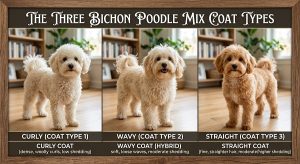
The three coat types you might get
- Poodle-like: tight curls, closer to hair than fluff.
- Bichon-like: soft, cottony and powder-puff round. Cute, but it mats fast.
- Wavy in-between: the most common outcome in my experience.
White, cream and apricot are popular, with red, black and gray less common. Some colors lighten as the puppy matures, so the shade you see at 8 weeks may not be the final one.
Thing 2: “Hypoallergenic” Is Mostly a Sales Word
This is the claim that sells more Bichpoo puppies than any other. It’s also the one with the weakest evidence.
In 2012, researchers at Utrecht University published a study in the Journal of Allergy and Clinical Immunology. They measured Can f 1, the main dog allergen, in the coats and homes of nearly 200 dogs, including Poodles and Labradoodles marketed as hypoallergenic. The result surprised many people. The “hypoallergenic” dogs actually had higher allergen levels in their coat samples, and Poodles were among the highest. Levels in the air of the homes showed no difference between breeds. The authors concluded there’s no evidence to call any breed hypoallergenic.
That doesn’t mean a Bichpoo can’t work for you. Some allergic people do better with low-shedding dogs, because less hair means less dander spread around the house. But it varies from dog to dog, even inside one litter.
How to test before you commit
- Spend real time with the exact dog or its parents. Do at least two visits, an hour or more each.
- Visit the breeder’s home, not a neutral spot, so you meet the allergen load where the dog lives.
- Ask your allergist about your specific triggers (dander, saliva or hair).
- Plan the home: hard floors, washable bedding and regular baths cut allergen levels. Carpet holds more, according to the AKC’s summary of the research.
If anyone in your home has asthma, treat “hypoallergenic” as a maybe, not a promise.
Thing 3: It’s a Velcro Dog (Separation Anxiety and Barking)
Here’s what most listicles skip. This is not a low-maintenance lapdog that’s happy being ignored. The Bichon was bred purely as a companion, and the Poodle side adds sharp intelligence and a need for attention. The result is a dog that wants to be in your lap, or at least in the same room.
That’s wonderful if you work from home. It’s hard if the house sits empty for nine hours. Under-stimulated Bichpoos often bark, chew and cry when left alone.
Build alone-time like a skill, not a surprise
This is the same “start small, add duration” method we use in handler training. Treat these timings as a sample, not a rulebook, and slow down if your dog panics.
- Days 1 to 3: Leave the room for 5 to 30 seconds. Return calmly. No big greeting.
- Days 4 to 7: Step outside for 1 to 3 minutes, with a food puzzle or chew.
- Week 2: Build to 10 to 20 minutes.
- Weeks 3 to 4: Add 30 to 60 minutes, then a short errand.
- Ongoing: If your dog whines or drools, you moved too fast. Drop back a step.
If the dog already shows true distress, such as destructive panic, nonstop howling or refusing food, talk to your vet or a qualified behaviorist. Don’t punish it.
Stop the barking habit early
Bichpoos often bark at doorbells, passing people and sudden noises. Reward quiet moments from week one. Teach a “go to your mat” cue for doorbell time. Short, positive sessions of 10 to 15 minutes work well, because this mix learns quickly and gets bored quickly.
Exercise and mental work
Plan for about 30 to 60 minutes a day, split into walks and play. Add puzzle feeders, sniff games and tricks. A tired brain matters as much as tired legs.
If you want a solid framework for impulse control and calm manners, I explain the professional-handler method in Beyond the Bark: Inside a Pro Handler’s Playbook for Raising the Ideal Dog. The principles work just as well for a nine-pound Bichpoo as for a police K9.
Thing 4: Housetraining Is the Hardest Part
Nobody puts this in the ad. The Bichon Frise has a long-standing reputation as one of the harder breeds to housetrain, a point even breed-specific sources and Bichon breeders acknowledge, though they say consistency and crate training work. Add tiny bladders and a clever, stubborn streak from the Poodle side, and you can see why many Bichpoo owners struggle at first.
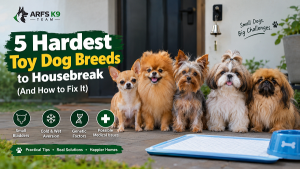
If you’re curious how the problem plays out across other small breeds, our guide on the hardest toy dog breeds to housebreak covers the shared causes and fixes.
A routine that works
- Take the puppy out often. After waking, after eating, after play and every 1 to 2 hours at first. A common rule of thumb is one hour per month of age between breaks, and tiny dogs often need less.
- Use a crate for rest and sleep, sized so the pup can stand and turn but not use one corner as a toilet. Our step-by-step crate training guide walks through it.
- Pick one toilet spot and one cue phrase. Reward within three seconds of finishing, outside.
- Clean accidents with an enzyme cleaner, since scent draws the dog back to the same spot.
- Supervise or confine. A small dog slipping behind the sofa is where most accidents happen.
- Never punish accidents. It teaches the dog to hide, not to hold it.
When “training failure” is really a health problem
This is the insight most guides miss. If a housetrained Bichpoo suddenly has accidents, pees small amounts often, strains, or you see blood in the urine, think urinary tract infection or bladder stones before you think “stubborn.” Bichons are known for both. If a male dog strains and produces little or no urine, that’s an emergency. Go to a vet immediately.
Also ask about portosystemic shunt (a liver blood-flow problem). UK and US breed health sources list the Bichon as more prone than average, and signs can include poor growth and odd behavior in young pups. A bile acid blood test screens for it.
Thing 5: The Coat Is a Part-Time Job
Low shedding doesn’t mean low maintenance. The hair keeps growing and tangles instead of falling out, so you either brush it out or pay to cut it out.
The routine
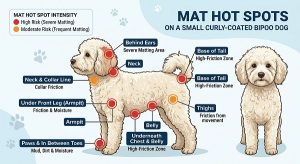
- Brush every other day with a slicker brush and a steel comb. Go down to the skin, not just across the top (this is called line brushing).
- Check mat hot spots: behind the ears, under the collar, in the armpits and between the back legs.
- Wipe the eyes daily. Hair and discharge collect around a Bichon’s eyes, and tear staining is common on white and cream coats.
- Brush teeth daily, or at least several times a week.
- Trim nails every 2 to 3 weeks and check the ears weekly.
- Book a professional groom every 4 to 8 weeks, depending on how short you keep the clip.
Skip brushing for even two weeks and you may face a full shave-down. It’s uncomfortable for the dog and a bigger bill for you. Start handling the paws, ears and mouth from the first week. Our puppy grooming tips guide shows how to make it calm rather than a wrestling match.
Thing 6: Both Parents Share Health Risks
Many guides say crossbreeds are healthier thanks to “hybrid vigor.” There’s some truth to it, but the effect is weaker than the marketing suggests. When both parents carry the same problems, mixing them doesn’t cancel anything out. The Bichon and the Poodle overlap on several.
| Condition | Seen in Bichons | Seen in Poodles (esp. Toy) | What to ask the breeder |
|---|---|---|---|
| Patellar luxation (slipping kneecap) | Yes | Yes | Vet patella exam on both parents |
| Dental disease | Yes, crowded teeth | Yes | Dental plan; avoid very tiny parents |
| Eye disease (cataracts, PRA) | Cataracts | PRA, cataracts | Eye exam and PRA DNA result |
| Legg-Calvé-Perthes (hip bone disease) | Yes | Yes | Hip check on parents |
| Bladder stones | Yes | Yes | Any stone history in the line |
| Liver shunt (PSS) | More prone | Less documented | Bile acid test results |
| Tracheal collapse (honking cough) | Less common | Yes | Use a harness |
| Heart valve disease (mitral) | Yes | Yes | Cardiac exam, especially in older parents |
| Von Willebrand disease (bleeding disorder) | Less common | Yes | DNA test result |
The old advice that Bichpoos inherit hip dysplasia mainly from the Bichon doesn’t hold up well for tiny breeds. The more typical orthopedic problems are slipping kneecaps and Legg-Calvé-Perthes, which often shows up as limping in young dogs.
Three habits that protect your dog
- Dental care. One veterinary clinic estimate suggests untreated dental disease could shorten a Bichon’s life by one to three years. That’s a clinic estimate, not a controlled study, but the direction is right. Budget for brushing and cleanings.
- Weight control. Extra pounds strain small joints and hearts.
- Harness, not a collar, for walks. It protects the windpipe if a tracheal-collapse tendency exists.
Lifespan
Toy Poodles are commonly listed at 10 to 18 years. Bichons are often quoted around 13 to 16. For the mix, 12 to 16 years is a reasonable expectation, and good dental care, a healthy weight and regular vet checks matter more than any label.
Thing 7: The Real Cost and How to Buy Smart
Puppy prices vary a lot by country, color, generation and breeder reputation. In the US, many listings from careful breeders fall roughly between $1,000 and $3,000, with some higher. A Canadian cost guide I reviewed puts prices for this mix well above that range, so always compare local listings. Treat every number below as a ballpark, then get real quotes in your area.
| Expense | Ballpark (US) |
|---|---|
| Puppy purchase | $1,000 to $3,000+ |
| Professional grooming | Often $50 to $100 per visit, every 4 to 8 weeks |
| Dental cleaning (under anesthesia) | Often $300 to $700 per visit |
| Food (small-breed kibble) | Often $25 to $50 per month |
| Pet insurance | Wide range; get several quotes |
| First-year vet care | Vaccines, spay/neuter and checks; ask your local vet for a quote |
Here’s a money tip I give every buyer: start pet insurance while the dog is young and healthy. Most plans exclude conditions that show up before cover starts, and this mix has several known risks.
Questions to ask every breeder
- Which Poodle size did you use, and what do both parents weigh?
- Can I see health test results for both parents (patellas, eyes, hips, and a heart check)?
- Can I meet the mother, and see where the puppies are raised?
- What generation are these puppies?
- Do you offer a written health guarantee and take the dog back if needed?
Red flags
- Several “designer” breeds for sale at once.
- Puppies sold without meeting the parents, or by shipping only.
- Prices far below the local norm. A cheap puppy often means cut corners on health testing.
- Pressure to pay a deposit by gift card or wire transfer. Puppy scams are common for popular breeds.
Don’t skip rescue
Bichon Frise rescues and small-dog shelters often have Bichon and Poodle mixes, including adults whose size, coat and temperament are already known. Adoption fees are usually much lower than breeder prices. For a first-time owner, an adult dog can also skip the hardest housetraining weeks.
Once your dog is home, use the first three days, three weeks and three months to build routines. Our guide to the 3-3-3 rule for dogs covers what to expect emotionally in that time.
Is a Bichon Poodle Cross Right for You?
This dog fits you if:
- You’re home most of the day, or can arrange company or daycare.
- You can brush every other day and pay for regular grooming.
- You’re patient with housetraining and happy to use a crate.
- You want an affectionate dog for an apartment or small house.
Think twice if:
- You’re away 8 to 10 hours daily with no backup plan.
- You have severe dog allergies or asthma and can’t test first.
- You want a tough, independent dog for rough play with small children. These dogs are sturdy for their size, but still small, so supervise young kids closely.
Trainer’s Note: Why You Can Trust This Guide
I’m Cpl. Rofiat Muritala, a Nigerian Army military working dog instructor and handler with more than 14 years at the Nigerian Army Dog Centre. My daily work is dog selection, foundation training and behavior shaping, so the sections on housetraining, separation training and temperament come from that handling experience. I’m a trainer, not a veterinarian, so for health questions, testing and treatment always work with your vet. The health and allergy sections draw on published research, breed-club guidance and veterinary breed resources, and the costs are estimates that you should confirm locally.
FAQs
Is a Bichon Poodle mix hypoallergenic?
Not reliably. The coat sheds little, which helps some allergic people, but a 2012 Utrecht University study found no evidence that any breed, including Poodles, is hypoallergenic. Spend time with the actual dog before you buy.
How big does a Bichon Poodle cross get?
Most adults stand 9 to 15 inches tall and weigh about 6 to 17 pounds, with a few reaching 20. A Toy Poodle parent usually means a smaller dog, and a Miniature Poodle parent usually means a larger one. Ask for both parents’ weights.
Are Bichon Poodle mixes easy to housetrain?
Not usually. They’re smart, but the Bichon side has a reputation for slow housetraining and small bladders. A strict schedule, a crate, and rewards right after toileting work, and sudden accidents should be checked by a vet.
How much does a Bichon Poodle puppy cost?
Many reputable breeders in the US charge roughly $1,000 to $3,000, though prices vary by region and breeder. Add ongoing costs for grooming every 4 to 8 weeks, dental care, food and insurance. Adoption usually costs far less.
How long do Bichon Poodle mixes live?
Often 12 to 16 years, with a wider range of 10 to 18 years reported for the parent breeds. Dental care, healthy weight and regular vet checks have the biggest effect you can control.
The Bottom Line
The Bichon Poodle cross is a charming, clever companion, but it’s not the effortless, allergy-proof lapdog the listings suggest. Size and coat vary, grooming never stops, housetraining takes patience, and the health risks overlap in both parents. Choose a breeder who shares real test results, or consider rescue, and you’ll get a loyal little shadow for well over a decade.
Your action plan:
- Test your allergies with the real dog before you pay a deposit.
- Ask for both parents’ weights and health test results.
- Line up a groomer, a vet and insurance before pickup day.
- Start crate and alone-time training in week one.
- Brush every other day, from day one.
Want more guides like this in your inbox? Subscribe to our weekly articles roundup newsletter for fresh training tips, breed guides and handler-tested advice every week.

Her work centres on obedience, detection, protection and operational readiness. She favours proven methods built on repetition, consistency and real-world conditioning, so that both dogs and handlers are prepared for high-pressure tasks.
Rofiat represented the Nigerian Army Dog Centre at the Nigerian Army Day Celebration (NADCEL) 2026, where she led demonstrations in obedience, explosive detection, agility and tactical movement. Through articles, training content and documentaries, she shares field-based insight into how structured training, clear communication and trust between handler and dog affect performance and reliability.
She is the author of Beyond the Bark: Inside a Pro Handler's Playbook for Raising the Ideal Dog, a practical guide that helps dog owners and handlers apply professional training principles in everyday situations.
- How to Enter the COBA National Dog Championship - October 20, 2026
- K9 Advantix Dosage Chart & Safety Guide for Dogs - October 19, 2026
- How to Set Up & Use Bousnic Dog Training Collar - October 18, 2026