Is a Mastiff a Guard Dog? Handler’s Honest Answer

Yes, the Mastiff is a guard dog, but a specific kind. It guards through size, presence and loyalty to its family, not through speed or trained aggression. Most Mastiffs will stand between a stranger and their people and use a deep bark to end trouble early. They are not trained protection dogs like Belgian Malinois or German Shepherds. If you want a dog that chases, bites and releases on command, a Mastiff is the wrong tool. If you want a calm, intimidating deterrent that loves your kids, it’s a great fit.
Table of Contents
- Is the Mastiff really the largest dog breed in the world?
- Watchdog vs. guard dog vs. protection dog
- So, is a Mastiff a guard dog? The honest answer
- Mastiff guarding scorecard (vs. other breeds)
- Temperament: how a Mastiff’s guarding instinct develops
- Mastiff-type breeds compared for guarding
- Training a Mastiff for guard work: what works
- The limits nobody mentions: health, heat, law and insurance
- Should you get a Mastiff for security? A quick checklist
- How I assess a guard dog (handler’s checklist)
- FAQs
- Final thoughts
Introduction
Picture this. A visitor walks into your yard, sees 180 pounds of wrinkled muscle get up off the porch, and suddenly remembers they’re late for something else. That’s the Mastiff’s reputation, and it’s not wrong.
But here’s the problem. Many families buy a Mastiff only for security, then get surprised by what they actually bring home. Some find a softie who greets burglars like old friends. Others find a giant, poorly socialised dog that’s hard to control. Neither group got the real picture.
So here’s what you’ll learn in this guide: what a Mastiff can and can’t do as a guard dog, how it compares with other mastiff-type breeds, how its guarding instinct develops by age, what training makes sense, and the health, legal and cost issues that rarely make it into other articles. I’ll also tell you who shouldn’t buy one.
Let’s start with the title question.
Is the Mastiff Really the Largest Dog Breed in the World?
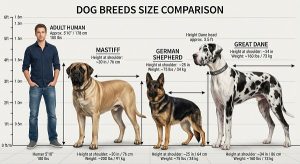
It depends on what you mean by “largest.” The English Mastiff is the heaviest breed. Great Danes usually win the tallest title. When people ask about the largest dog breed in the world, they almost always mean the Mastiff, because of its sheer mass.
Here are the numbers. The breed standard sets no maximum height or weight. It gives only a minimum shoulder height of 30 inches for males and 27.5 inches for females. Males typically weigh 160 to 230 pounds and females 120 to 170 pounds.
The record holder is a dog called Zorba. He set the record in November 1989 at 8 years old, standing 37 inches at the shoulder, measuring 8 feet 3 inches from nose to tail tip, and weighing 343 pounds. (Older versions of this story, including ours, said “over 300 pounds.” The accurate figure is 343.)
A quick history note, because it explains the guarding instinct. Mastiff-type dogs appear in Assyrian art dating back to about 2500 BC, and they went with Roman armies and fought in arenas. A famous story says a Mastiff stood over its wounded master, Sir Peers Legh, for hours at the Battle of Agincourt in 1415. Later, English estates kept them as property guards.
The modern Mastiff nearly vanished, too. When rationing hit during World War II, families couldn’t afford to feed the giant breed, and numbers fell to a tiny handful of dogs. Accounts differ on exact numbers, but breeders rebuilt the line with imports from North America. The AKC recognised the breed back in 1885.
Why does this matter? Because today’s Mastiff was rebuilt for calm companionship. The guarding instinct is old, but the fighting edge was bred out on purpose.
Watchdog vs. Guard Dog vs. Protection Dog
Most articles blur these three terms. That’s where bad buying decisions start.
- Watchdog: Barks to warn you. Its job ends when it makes noise. Size doesn’t matter. Many small dogs are excellent watchdogs.
- Guard dog: Uses size, bark and body position to deter threats. It acts on instinct, with no formal bite training.
- Protection dog: Trained to engage a threat on command and to stop on command. This is a learned skill set. Malinois, German Shepherds and Dutch Shepherds dominate this category.
Quick answer: A Mastiff is a natural guard dog (instinct and deterrence), not a trained protection dog. Turning one into a protection dog takes professional work, and few trainers recommend it.
I’ve seen owners mix these up many times. Someone wants a “protection dog,” buys a giant breed, and assumes size will do the job. Size does the deterring. Training and drive do the stopping. Those aren’t the same thing.
So, Is a Mastiff a Guard Dog? The Honest Answer
Yes, with realistic expectations.
What a Mastiff does well:
- Deterrence. Most people won’t test a dog this size. The confrontation often ends before it starts.
- Positioning. Many Mastiffs step between a stranger and their family without being told to.
- A credible alarm. Mastiffs don’t bark at every leaf. When one sounds off, owners tend to listen.
- Family bonding. The breed bonds deeply with its people. Dogster notes that Mastiffs are usually gentle giants but won’t hesitate to defend their family if threatened.
What a Mastiff usually doesn’t do:
- Chase a fleeing intruder. The breed lacks the endurance and strong prey drive that pursuit work needs.
- Perform controlled bite-and-release work.
- Stay alert 24/7. Many nap through a delivery truck and then react fast to someone actually entering uninvited.
That calm, “observe first” style is why sources disagree. PetHelpful calls English Mastiffs a little too calm for guard duties, while others call them perfect guard dogs. Both are partly right. It depends whether you want deterrence (Mastiff wins) or active intervention (Mastiff struggles).
My simple way to put it: you’re not buying a weapon. You’re buying a very large, very calm deterrent that happens to have teeth as a backup plan. For most homes, that’s the right balance. A dog that’s hostile to every guest becomes a liability, not an asset.
Mastiff Guarding Scorecard: How It Compares
Here’s a quick comparison from a handler’s point of view. These are my own ratings (1 = weak, 5 = excellent), not scientific scores. Individual dogs vary a lot.
| Guarding trait | English Mastiff | Bullmastiff | Neapolitan Mastiff | Cane Corso | Malinois / German Shepherd |
|---|---|---|---|---|---|
| Physical deterrence (size and look) | 5 | 4 | 5 | 4 | 3 |
| Warning bark | 4 | 3 | 4 | 4 | 5 |
| Willingness to step in untrained | 3 | 4 | 4 | 4 | 4 |
| Speed and pursuit | 1 | 3 | 2 | 3 | 5 |
| Trainability for controlled protection | 2 | 3 | 2 | 4 | 5 |
| Calm around family and kids | 5 | 4 | 3 | 3 | 3 |
What the table tells you: The Mastiff wins on presence and family calm. It loses on speed and trainability. That’s the trade-off in one glance.
Temperament: How a Mastiff’s Guarding Instinct Develops
Here’s something many owners miss. A Mastiff’s guarding doesn’t switch on at once. It builds with age.
| Age | What’s happening | What you should do |
|---|---|---|
| 3 to 16 weeks | Key socialisation window | Meet many calm people, sounds, floors and places safely |
| 4 to 6 months | Learning basics | Start sit, down, place, recall |
| 6 to 14 months | Adolescence and a possible second fear phase | Keep exposure gentle. Don’t force scary situations |
| 12 to 18 months | Protective behaviour starts to show | Reward calm alerts. Teach a “quiet” cue |
| 2 to 3 years | Full confidence and mental maturity | Review training and re-socialise |
The AKC says Mastiffs don’t reach full physical and mental maturity until about 3 years old. That’s slower than most working breeds.
The biggest mistake I see: under-socialising a giant puppy. A Mastiff that never meets new people can grow into a fearful adult. Fear plus 150 pounds is dangerous. A confident Mastiff is safe; an anxious one is not. If you ever see stiff posture, hard staring or a freeze before a lunge, read our guide on warning signs before a dog bite and act early.

Mastiff-Type Breeds Compared for Guarding
“Mastiff” is a loose label. Each breed guards differently.
English Mastiff
The calm giant. Best as a family deterrent and companion.
Bullmastiff
The AKC standard says the breed started as 60 percent Mastiff and 40 percent Bulldog, developed by English gamekeepers to deal with poachers. It’s lighter and more athletic, with males around 110 to 130 pounds. It’s often a better “active” guard than the English Mastiff, but needs an experienced owner.
Neapolitan Mastiff
The AKC standard describes it as bred to guard and defend its owner and property, with males averaging about 150 pounds. Expect more suspicion of strangers and a stronger need for socialisation.
Cane Corso
A different Italian breed from the mastiff family. The AKC recognised it in 2010, and one 2017 study of 232 dogs from 25 countries found an average lifespan of about 9.3 years. It’s more athletic and more trainable, so it’s the usual choice when someone wants a mastiff-type dog for real protection training.
Tibetan Mastiff
A livestock guardian by origin, independent and aloof. Strong guarding instinct, but not an easy first dog.
If you’re weighing options beyond mastiffs, see our list of the top 7 guard protection dogs for family safety.
Training a Mastiff for Guard Work: What Works
Here’s the plan I’d give any owner.
Step 1: Obedience first (months 2 to 6). A 200-pound dog has to listen. Sit, down, place, stay and a rock-solid recall come before anything else. Group classes usually run a few hundred dollars for a 6 to 8 week course (prices vary by country).
Step 2: Socialisation (birth to 18 months). This can’t be outsourced. Keep it calm and positive. Never “test” your puppy’s aggression.
Step 3: Control the alert. Teach “speak” and, more importantly, “quiet.” A guard dog that can’t stop barking becomes a neighbour problem.
Step 4: Place and boundary work. Teach your Mastiff to hold a spot by the door while you answer it. That makes a calm guard out of instinct.
Step 5: Decide on professional protection training or not. Honestly, for an English Mastiff I usually say no. Protection work needs speed, drive and quick on/off switching. If you truly need that, pick a breed built for it. Fully trained protection dogs from reputable programmes commonly cost five figures, which is another reason to match breed to need.
For the full progression, use our guide on how to train your dog for family protection. If you want the deeper handler mindset behind it, my book, Beyond the Bark: Inside a Pro Handler’s Playbook for Raising the Ideal Dog, covers the same foundations in a practical, step-by-step way.
A safe “real world” check (no aggression involved):
- Have a trusted friend approach the gate while your dog is on lead with you.
- Watch the dog’s body. Does it alert and look to you, or ignore the visitor?
- Give your quiet cue. Does it settle?
- End on a calm note with a treat.
You’re checking awareness and controllability, not trying to provoke a fight. If anything feels risky, hire a qualified behaviourist.
The Limits Nobody Mentions: Health, Heat, Law and Insurance
This is the section most competitors skip, and it’s where real-world guarding gets decided.
Health shortens the working life
The English Mastiff’s typical lifespan is just 6 to 10 years, and the breed is prone to bloat, elbow and hip dysplasia and heart disease such as dilated cardiomyopathy. In one study, around 7% of Mastiff deaths were caused by bloat. The breed is also prone to cystinuria (a kidney defect causing stones) and eyelid problems.
Think about what that means for guarding. A dog with painful hips can’t hold a doorway. A dog down with bloat is an emergency. A realistic guarding “prime” is roughly ages 2 to 6.
Bloat prevention basics: Vets advise several smaller meals, slow-feeder bowls, and no exercise for two hours before or after eating.
Growth needs gentle handling
Mastiff puppies can injure joints easily, so avoid jumping and stressful exercise until around 18 to 24 months. Your future guard dog needs a gentle puppyhood to stay sound.
Heat matters
Mastiffs have short muzzles and heavy bodies. If you live somewhere hot, plan for shade, water, cool rest areas and early-morning or late-evening activity. An overheated dog is a poor guard and a medical risk.
The law and your liability
You are responsible for what your dog does. Rules vary by country, so check yours.
- UK: The Dangerous Dogs Act bans certain types, including the Fila Brasileiro (Brazilian Mastiff). It also makes it an offence to let any dog be dangerously out of control. The standard Mastiff isn’t banned in the UK. If you use a dog to guard commercial premises in the UK, separate guard dog rules apply.
- Elsewhere: Some countries restrict or ban mastiff-type breeds. Lists have named Bullmastiffs and Neapolitan Mastiffs in places like Malaysia, and Neapolitan Mastiffs in Singapore. These lists change, so check current local law before importing or travelling.
- Insurance: Some home insurance policies restrict or add costs for large guardian breeds. Ask your insurer before you buy, not after.
Rough yearly budget (my estimate, varies by country)
Food, vet care, screening, insurance and training often add up to a few thousand US dollars a year for a giant breed. Over 6 to 10 years, that’s a serious commitment.
Should You Get a Mastiff for Security? A Quick Checklist
A Mastiff is a good fit if:
- You want a deterrent and a family companion
- You have space, a secure yard and a budget for giant-breed vet care
- You have kids and want calm, not hyper-reactive, protection
- You’ll commit to 18 months of patient socialisation
Choose another breed if:
- You need a dog that can pursue, apprehend or work off-lead in public
- You live in a small flat or a very hot climate with limited cooling
- You’re a first-time owner who wants “instant” protection
- You can’t afford emergency vet bills
The layered approach: Even the best guard dog is one layer. Pair it with good locks, lighting, a secure fence and an alarm. Layers beat any single defence.
Pros
- Powerful deterrent effect
- Calm, family-friendly nature
- Deep loyalty
- Fewer false alarms than reactive breeds
Cons
- Short lifespan (6 to 10 years)
- Slow and not built for pursuit
- Expensive health risks (bloat, joints, heart)
- Drool, shedding, space and food costs
- Not suited to high-level protection training
How I Assess a Guard Dog: Handler’s Checklist
When I evaluate any dog for guarding, I look at five things, in this order:
- Nerve and confidence. Does it recover quickly after a loud or sudden event?
- Discrimination. Can it tell a guest from a threat?
- Controllability. Will it respond to its handler under distraction?
- Physical soundness. Can its body handle the job for years?
- Handler fit. Can you manage this dog on its worst day?
Most Mastiffs score high on nerve and discrimination, medium on controllability and variable on soundness. That’s why breeder health testing matters so much. Ask for hip, elbow, heart and cystinuria screening results on the parents.
FAQs
1. Can a Mastiff protect you if you’re attacked?
Probably yes through deterrence and body-blocking, because most Mastiffs bond strongly and react to real threats to their family. But it won’t perform controlled attack-and-release work without extensive training. Treat it as a strong deterrent, not a security guard.
2. Is an English Mastiff aggressive?
No. A well-bred, well-socialised English Mastiff is calm and steady. Aggression toward family members or without cause is a serious fault. Poor breeding or under-socialisation is what makes giant dogs dangerous.
3. Mastiff vs. Bullmastiff: which is the better guard dog?
The Bullmastiff is usually the more active guard. It’s smaller, faster and was developed to deal with poachers. The English Mastiff is larger and calmer, so it’s the better pure deterrent and family companion.
4. At what age does a Mastiff start guarding?
Protective behaviour often appears around 12 to 18 months. Full confidence usually comes by 2 to 3 years, so be patient.
5. Do Mastiffs need protection training?
Not for general home deterrence. Obedience, socialisation and a good “quiet” cue are enough for most families. Formal protection training suits other breeds better, such as the Cane Corso, Malinois or German Shepherd.
Final Thoughts
So, is the largest dog breed in the world, the Mastiff, a guard dog? Yes, in its own way. It’s a calm, discerning, physically overwhelming presence rather than a trained attack tool.
Here’s what to do next:
- Decide whether you need deterrence or active protection. Be honest.
- If it’s deterrence, choose a health-tested Mastiff from a reputable breeder.
- Budget for 18 months of careful socialisation and lifelong giant-breed care.
- Check your local laws and your insurance first.
- Build a layered security setup around your dog, not just the dog itself.
Get that foundation right, and you’ll own one of the most quietly effective guardians in the dog world, probably napping at your door.
Want more practical K9 advice every week? Subscribe to our weekly articles roundup newsletter here.

Her work centres on obedience, detection, protection and operational readiness. She favours proven methods built on repetition, consistency and real-world conditioning, so that both dogs and handlers are prepared for high-pressure tasks.
Rofiat represented the Nigerian Army Dog Centre at the Nigerian Army Day Celebration (NADCEL) 2026, where she led demonstrations in obedience, explosive detection, agility and tactical movement. Through articles, training content and documentaries, she shares field-based insight into how structured training, clear communication and trust between handler and dog affect performance and reliability.
She is the author of Beyond the Bark: Inside a Pro Handler's Playbook for Raising the Ideal Dog, a practical guide that helps dog owners and handlers apply professional training principles in everyday situations.
- How to Enter the COBA National Dog Championship - October 20, 2026
- K9 Advantix Dosage Chart & Safety Guide for Dogs - October 19, 2026
- How to Set Up & Use Bousnic Dog Training Collar - October 18, 2026