Military-Style GSD Commands for Absolute Focus
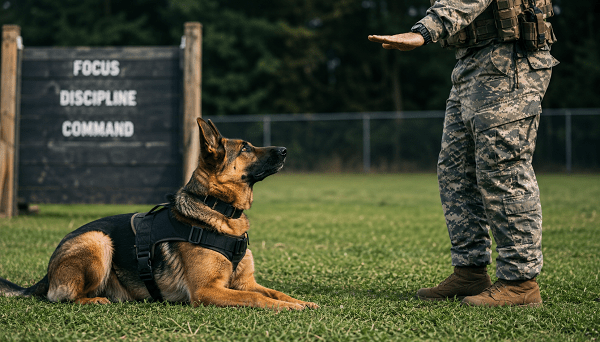
What are military-style GSD commands? They’re a small set of clear, consistently taught cues (Watch, Sit, Down, Stay, Heel, Come, Out, and a release word) drilled in short sessions and proofed against distraction in stages. Working K9 teams build focus first, then add duration, distance and distraction, in that order. Most owners see solid indoor focus in 4 to 6 weeks of daily practice. Reliable focus in public usually takes 6 to 12 months.
Table of Contents
- Introduction
- Focus vs Obedience: What Military Teams Actually Train
- How Professional Military Programs Do It
- The Core GSD Command Set (With German Cues)
- Should You Use German Commands?
- Step 1: Build the “Watch” Command
- Step 2: Marker Words and the Release
- Step 3: Heel, Sit, Down and Stay With Focus
- The 3 D’s: Duration, Distance, Distraction
- Controlling Arousal and Drive
- Corrections: What’s Fair and What Isn’t
- Your 8-Week Focus Plan
- Troubleshooting Table
- Common Mistakes
- FAQs
- Conclusion
Introduction
Ever watched a German Shepherd walk through a crowded street with its eyes locked on its handler? No pulling. No scanning for squirrels. It looks almost unreal.
It isn’t talent. It’s training. A GSD that bolts after every bike or ignores you at the park isn’t a bad dog. It’s an under-trained one, and most owners never learn how to build focus the way working teams do.
I’ve spent over 14 years as an Army dog instructor and handler, and I see the same story again and again. People teach “sit” and “down” at home, then wonder why the dog falls apart outside. Commands aren’t the problem. Missing structure is.
In this guide you’ll learn:
- What military-style dog training really means (it’s not about being harsh)
- The core GSD commands, including the German versions
- A step-by-step method to build the Watch command and hold it under distraction
- An 8-week plan you can start tonight
- Fixes for the problems that wreck focus
Whether you own a family GSD or you’re training toward working-level reliability, you can use this.
Focus vs Obedience: What Military Teams Actually Train
Here’s the thing most blogs skip. Obedience and focus aren’t the same.
- Obedience means the dog does what you ask when you ask it.
- Focus means the dog chooses to keep its attention on you while the world goes wild around it.
A dog can know “sit” perfectly and still ignore you the second a ball rolls past. Working programs fix that by training attention first, then attaching every other command to it.
Think of focus as the “on” switch. Without it, every command is a request the dog can ignore. If you want to see why instinct and trained behaviour sometimes fight each other, read our guide on obedience vs instinct in working dogs.
How Professional Military Programs Do It
Real military dog programs give us a useful blueprint. The U.S. Department of Defense trains its military working dogs at the 341st Training Squadron at Joint Base San Antonio-Lackland in Texas, a program that has been housed under one roof since 1957. According to base officials, the squadron trains more than 600 handlers and nearly 300 dogs a year, and roughly 15% of its dogs are bred in-house.
A few lessons stand out:
- Training is staged. Official descriptions of the dog course list basic obedience first, then obstacles, gunfire exposure, controlled aggression and searching. Obedience comes first for a reason.
- It takes time. Handler students train for about 11 weeks. The dogs spend roughly four to six months in training, depending on the program source. Nobody gets “military focus” in a weekend.
- Strictness means consistency, not cruelty. One Marine Corps trainer described the handler-dog relationship as “very strict and consistent.” That’s the whole idea.
- Reward matters. Instructors use rewards to teach the dogs at every phase.
Want a wider look at how these programs run? Our breakdown of how military working dogs are trained goes deeper.
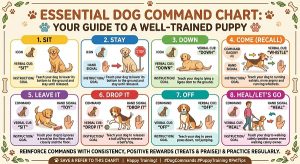
The Core GSD Command Set (With German Cues)
Working teams don’t use 40 commands. They use a handful and make them bulletproof. This is the set I’d teach first:
| Purpose | English | German | Pronunciation | What it trains |
|---|---|---|---|---|
| Attention | Watch / Look | Blick (or Schau) | “blick” / “show” | Eye contact on cue |
| Position | Sit | Sitz | “zits” | Impulse control |
| Position | Down | Platz | “plahtz” | Calm stillness |
| Hold | Stay | Bleib | “blybe” | Duration |
| Movement | Heel | Fuss | “foos” | Focused walking |
| Recall | Come | Hier | “here” | Response at distance |
| Let go | Out / Drop | Aus | “ows” | Releasing objects |
| Stand | Stand | Steh | “shtay” | Stable standing position |
| Release | Free / Break | OK / Free | any word you choose | End of the job |
A few quick notes from the field:
- “Blick” and “Schau” both appear in German-style training for attention. Pick one and stay with it.
- Aus is the most important safety command in the list. A dog that releases on cue is safer around kids, toys and food.
- Your release word matters more than people think. It tells the dog when the job ends. Without it, the dog decides.
Should You Use German Commands?
Short answer: you can, but you don’t have to.
Why handlers like German commands:
- Your dog won’t mix them up with everyday speech.
- They’re short, sharp words that carry well outdoors.
- Many working-line GSDs and imported dogs already know them.
When English works fine:
- You’re a first-time owner and clear communication matters more than tradition.
- Your family will all use the commands and needs easy words.
What matters is consistency. Every person must use the same word, tone and hand signal. A dog that hears “sit,” “sit down,” “Sitz” and “park it” from four different people learns nothing.
Important note: if you adopt an adult GSD that already knows German commands, don’t throw them out. Keep the dog’s existing vocabulary and build on it.
Step 1: Build the “Watch” Command
This is where absolute focus starts. Skip it and everything else is shaky.
What you need: A quiet room, a leash on the dog, and small, high-value treats (or the dog’s favourite toy).
How to do it:
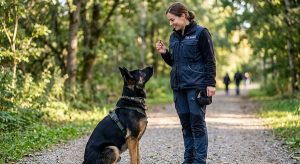
- Say the cue once: “Watch” (or “Blick”).
- Wait. Don’t wave food in front of the dog’s face.
- The instant the dog looks at your eyes, say your marker word (“Yes!”) and reward.
- Repeat 8 to 10 times per session.
- After a few days, ask for 2 seconds of eye contact before marking. Then 3. Then 5.
Rules I follow:
- Say the cue once. If you repeat it, you teach the dog it can ignore the first one.
- Reward position matters. Deliver the treat at your chest or hip, not above your head. This teaches the dog to return to heel with its eyes up.
- Keep sessions short. Young dogs may be done in 3 to 5 minutes. Adult dogs often do well at 10 to 15.
Timeline from my experience: Most dogs offer reliable eye contact indoors within 1 to 2 weeks if you practice daily. Don’t rush to the park. A dog that fails outside learns that ignoring you works.
Step 2: Marker Words and the Release
Working dog programs rely on clear signals. Two of them are the most important in your toolbox.
Marker word (“Yes!” or a clicker): It tells the dog “that exact moment was correct, a reward is coming.” Good timing here makes learning fast. Late marking makes it messy.
Release word (“Free” or “OK”): It tells the dog “you can stop working now.”
Here’s the rule that changes everything: a command lasts until you release it. If your dog breaks a Down-Stay on its own, you didn’t fail the dog. You failed to enforce the release. Put the dog back, calmly, and try an easier version.
Step 3: Heel, Sit, Down and Stay With Focus
Now attach focus to each position. The goal isn’t just “sit.” It’s “sit and look at me.”
Focused Heel (Fuss)
Walking beside you isn’t enough. Working teams want the dog’s shoulder near your leg and its attention up.
- Start with just 5 to 10 steps, then mark and reward at your leg.
- Change pace and direction so the dog has to watch you to know what’s next.
- Stop often. Make the dog sit without being told. That builds default behaviour.
Sit (Sitz) and Down (Platz)
- Ask once, mark when the position is correct, then wait one extra second before rewarding. This builds patience.
- Use Down to calm the dog. A GSD in a down position uses far less energy than one standing.
Stay (Bleib)
Stay is the test of focus. If the dog’s mind wanders, so does its body. We’ll build it properly in the next section.
The 3 D’s: Duration, Distance, Distraction
Every working handler I know follows this rule: add only one “D” at a time.
- Duration: how long the dog holds the position.
- Distance: how far you move away.
- Distraction: what’s happening around the dog.
If you raise two at once, the dog fails. If the dog fails, it learns failure is normal.
Example progression for a Down-Stay:
| Week | Duration | Distance | Distraction |
|---|---|---|---|
| 1 | 10 sec | At dog’s side | None |
| 2 | 30 sec | 1 step away | None |
| 3 | 1 min | 3 steps | Quiet room, one family member moves |
| 4 | 2 min | 5 steps | Toy on the floor |
| 6 | 3 min | 10 steps | Backyard, sounds outside |
| 8 | 5 min | Out of sight for 15 sec | Quiet street |
If your dog breaks, drop back one level. Don’t repeat the failure. Two successful easy reps beat five frustrating hard ones.
Proofing in the Real World
Proofing means practising in new places and under new conditions. Use this ladder:
- Living room
- Backyard
- Front yard or quiet driveway
- Quiet street
- Park at a distance from other dogs
- Busy pavement or shop entrance
Stay at each level until the dog succeeds around 8 times out of 10. Then move up.
Controlling Arousal and Drive
This is the section most “military-style” articles miss, and it’s often the real problem.
German Shepherds are high-drive dogs. When arousal climbs, thinking drops. A GSD that’s screaming at a squirrel isn’t ignoring you on purpose. Its brain has simply gone offline.
What helps:
- Train after exercise, not before. A short walk or play session takes the edge off.
- Keep distance. Work far enough from the trigger that the dog can still think. Then close the gap slowly.
- Use calm praise. Loud, excited praise during stay work can make the dog pop up. Save high-energy rewards (tug, ball) for after the release.
- Teach an “off switch.” Practise a settle on a mat for 10 to 20 minutes while you read or watch TV. This is the skill that makes public outings easier.
- Don’t drill an overheated or tired dog. Fatigue and heat kill focus and can hurt the dog. This matters in warm climates and summer.
If you want to know how these dogs compare with other high-drive breeds in focus and intensity, see our comparison of the German Shepherd’s intelligence and working style.
Corrections: What’s Fair and What Isn’t
“Military-style” gets a bad name because people confuse it with harshness. It shouldn’t.
Good correction means clear, fair and brief:
- The dog understood the command (it’s been taught, not guessed).
- The correction is mild and happens right when the mistake happens.
- You show the dog how to succeed right after.
- You reward the correct choice.
What doesn’t work, and what I don’t recommend:
- Yelling, hitting or shaking the dog
- Punishing a dog for a command it hasn’t been proofed on
- Using tools you don’t understand (prong collars, e-collars) without professional supervision
Many modern working programs lean heavily on reward-based methods and use corrections sparingly. If you’re unsure, start with a flat collar or well-fitted harness, a 6-foot leash, and a long line for distance work. If you ever feel tempted to escalate, that’s a sign to simplify the exercise, not add pressure.
Your 8-Week Focus Plan
Here’s a plan you can copy. Train 2 to 3 short sessions per day, 5 to 10 minutes each for puppies and 10 to 15 for adults.
| Week | Main goal | What to practise |
|---|---|---|
| 1 | Name response and Watch | Eye contact, marker word, treat delivery at your leg |
| 2 | Position + focus | Sit and Down with eye contact held 3 to 5 sec |
| 3 | Heel basics | Short focused heel, direction changes |
| 4 | Release and Stay (duration) | Down-Stay to 1 min, proper release word |
| 5 | Distance | Step away, return to reward (don’t call the dog out of position) |
| 6 | Mild distraction | Toy on the floor, family walking by |
| 7 | Outdoor proofing | Quiet street, then park edge |
| 8 | Real-life test | Café patio, shop entrance, light foot traffic |
End each session on a win. Even if it means asking for something easy at the end.
Troubleshooting Table
| Problem | Likely cause | Fix |
|---|---|---|
| Dog focuses at home, ignores you outside | Skipped proofing stages | Go back one level, shorten the distance |
| Dog stares but won’t obey after | Focus trained without follow-up | Pair eye contact with a command and reward |
| Dog breaks Stay | Too long, too far, or release unclear | Reduce duration, reinforce release word |
| Dog gets too excited, jumps, barks | Arousal too high | Add distance, train after exercise, practise settle |
| Dog loses interest quickly | Reward isn’t valuable enough or session too long | Use better rewards, shorten sessions |
| Dog looks away when corrected | Pressure too strong | Simplify, reduce pressure, rebuild confidence |
| Dog ignores recall (Hier) | Recall used only to end fun | Practise recalls that lead to rewards and more fun |
Common Mistakes
After years of handling dogs, these keep showing up:
- Repeating commands. “Sit, sit, SIT!” teaches the dog that the first two don’t count.
- Training only when the dog is calm and tired. Real life isn’t like that.
- Skipping the release word. The dog decides when the job ends.
- Moving too fast. The most common reason focus training fails.
- Different family members using different words. Confusing for the dog.
- Long sessions. Quality drops fast. Short and sharp wins.
- Using the command as a threat. If “Come” always means the fun is over, your dog will avoid it.
Want to Train Your GSD Like a Professional Handler?
If you’d like a full system with routines, correction guidance and distraction training laid out step by step, my book Beyond the Bark: Inside a Pro Handler’s Playbook for Raising the Ideal Dog covers it all in plain English.
And if you want new K9 training articles every week, subscribe to our weekly roundup newsletter here.
Frequently Asked Questions
1. What are the best military-style commands for a German Shepherd?
Start with Watch (Blick), Sit (Sitz), Down (Platz), Stay (Bleib), Heel (Fuss), Come (Hier), Out (Aus) and a release word. Teach Watch first, because every other command depends on attention.
2. How long does it take to train a GSD to focus?
Most dogs show solid indoor focus in 4 to 6 weeks of daily practice. Reliable focus in public usually takes 6 to 12 months, depending on age, temperament and how consistent you are.
3. What age should I start military-style training?
You can begin simple focus games at 8 weeks, using 3 to 5 minute sessions. Heavier duration and distraction work usually starts around 6 months, when the dog has more physical and mental maturity.
4. Is military-style training too harsh for a pet GSD?
No. “Military-style” describes structure and consistency, not force. The same methods work well for family dogs. Skip protection work unless you have professional supervision.
5. Why does my German Shepherd listen at home but not outside?
Almost always because the command wasn’t proofed against distraction. Dogs don’t generalise easily. Practise in new places, one level at a time, and lower your expectations at first.
Conclusion
Absolute focus isn’t a gift. It’s a skill you build. Start with the Watch command, add a clear marker and release word, then layer duration, distance and distraction one at a time. Keep sessions short, end on a win, and use fair, consistent corrections instead of pressure.
If you do one thing today, teach your dog to look at you on cue in a quiet room. Do it ten times, reward at your leg, and stop. Tomorrow, do it again.
Ready for the full system? Grab Beyond the Bark here and join our weekly newsletter here.

Her work centres on obedience, detection, protection and operational readiness. She favours proven methods built on repetition, consistency and real-world conditioning, so that both dogs and handlers are prepared for high-pressure tasks.
Rofiat represented the Nigerian Army Dog Centre at the Nigerian Army Day Celebration (NADCEL) 2026, where she led demonstrations in obedience, explosive detection, agility and tactical movement. Through articles, training content and documentaries, she shares field-based insight into how structured training, clear communication and trust between handler and dog affect performance and reliability.
She is the author of Beyond the Bark: Inside a Pro Handler's Playbook for Raising the Ideal Dog, a practical guide that helps dog owners and handlers apply professional training principles in everyday situations.
- Dog Agility Course Layout: Easy DIY Setup - October 7, 2026
- Local Dog Breeds: Temperament, Health & Training Guide - October 6, 2026
- How Long Do Military Working Dogs Serve? Full Guide - October 5, 2026