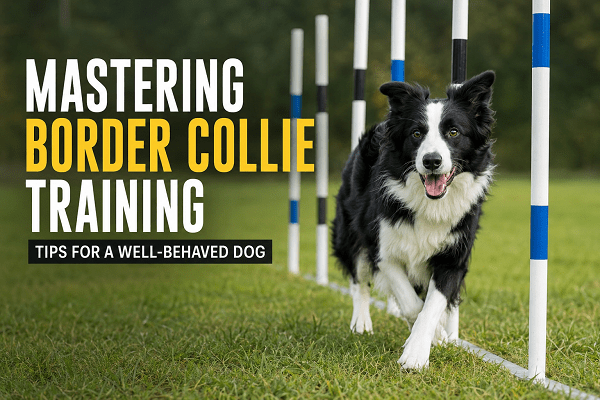
Mastering Border Collie Training: Tips for a Well-Behaved Dog
Introduction
Border Collies are widely regarded as one of the smartest dog breeds in the world, but their intelligence also makes them one of the most challenging to train without the right approach. Unlike many companion breeds, they require a balance of structured obedience, mental stimulation, and outlets for their natural herding instincts. In this guide, you’ll learn how to train a Border Collie from the ground up, including the first 30 days, essential commands, managing herding behavior, avoiding common mistakes, and creating a routine that helps your dog become calm, focused, and reliable.
Table of Contents
- Why Border Collie Training Is Different From Other Breeds
- Understanding the Border Collie Brain Before You Start
- Setting Up Your First 30 Days
- Core Obedience Commands Every Border Collie Needs
- Managing the Herding Instinct
- Mental Stimulation: The Missing Piece Most Owners Skip
- Common Training Mistakes With Border Collies
- When to Bring in a Professional Trainer
- FAQ
- Conclusion
Why Border Collie Training Is Different From Other Breeds
If you’ve ever tried to train a Border Collie the same way you’d train a Labrador, you’ve probably already learned this the hard way: it doesn’t work. Border Collie training isn’t about repetition alone. It’s about giving a dog with an exceptionally high working drive somewhere to put that energy before it puts itself somewhere you don’t want it.
Border Collies were bred for one purpose: to read a flock of sheep from a hundred yards away, anticipate their movement, and control them without a single word from the handler. That instinct doesn’t switch off just because your “flock” is now the kids running around the backyard or the neighbor’s cat.
So when people ask why their Border Collie nips at ankles, stares obsessively at moving objects, or seems impossible to tire out, the answer is almost always the same. This is a working dog living in a companion-dog world, and training has to bridge that gap.
Understanding the Border Collie Brain Before You Start
Border Collies are consistently ranked among the most intelligent dog breeds, and that intelligence cuts both ways. A bored Border Collie doesn’t just sit quietly and wait for direction. It finds its own job, and you often won’t like the job it picks.
Here’s a quick breakdown of what drives Border Collie behavior compared to a more laid-back breed:
| Trait | Border Collie | Typical Companion Breed |
|---|---|---|
| Problem-solving drive | Very high, seeks tasks constantly | Moderate, content with routine |
| Sensitivity to tone | Extremely sensitive, reads micro-cues | Moderate |
| Physical energy needs | 1.5–2+ hours daily | 30–60 minutes daily |
| Herding/chasing instinct | Strong, needs redirection | Usually mild or absent |
| Boredom threshold | Low, acts out quickly | Higher tolerance |
Knowing this before you start training changes everything. You’re not just teaching commands. You’re managing a dog that thinks several steps ahead of you, which honestly makes training either the most rewarding thing you’ll do with a dog, or the most frustrating, depending on how you approach it.
Setting Up Your First 30 Days
Whether you’ve got a Border Collie puppy or an adult rescue, the first month sets the tone for everything after it. This is when routines get locked in, good or bad.
Week 1 to 2: Establish structure. Fixed feeding times, a consistent sleep space, and short, low-pressure training sessions of five to ten minutes, two or three times a day. Don’t overwhelm a new dog with commands. Focus on name recognition and calm settling.
Week 3 to 4: Introduce structured exercise. This is where you start layering in physical activity alongside basic obedience. A tired Border Collie is a trainable Border Collie, but tired means mentally worked too, not just physically exhausted.
If you’re bringing home a new dog of any breed, it genuinely helps to understand the adjustment timeline before you judge behavior too early. A dog that seems anxious or withdrawn in week one is often just decompressing, not showing you its real personality yet.
Core Obedience Commands Every Border Collie Needs
Border Collies pick up commands fast, sometimes within a handful of repetitions, but fast learning also means they’ll learn bad habits just as quickly if you’re inconsistent.
Start with these five, in this order:
| Command | Purpose | Training Difficulty for BCs |
|---|---|---|
| Sit/Stay | Impulse control foundation | Easy |
| Recall (“Come”) | Critical for off-leash safety | Easy to Moderate |
| Down | Calming cue, useful during overstimulation | Easy |
| Leave It | Redirects fixation on moving objects | Moderate |
| Wait at doors/gates | Prevents bolting, builds patience | Moderate |
Recall deserves extra attention here. Because Border Collies are so visually triggered by movement, a squirrel or a passing car can override a half-trained recall in an instant. Practice recall in low-distraction environments first, then gradually add distractions once the response is reliable at least nine times out of ten.
If leash manners are a struggle alongside obedience work, it’s worth tackling that separately with focused technique rather than trying to fix everything in one walk.
Managing the Herding Instinct
This is the section most Border Collie owners actually came here for. Nipping at heels, circling family members, staring down the vacuum cleaner, these aren’t behavioral problems in the traditional sense. They’re instinct with nowhere productive to go.
The fix isn’t punishment. It’s redirection. Give the herding drive a legal outlet.
- Flirt pole work channels the chase instinct into a controlled game with clear start and stop cues.
- Herding balls (large, durable balls made for this exact purpose) let a Border Collie “herd” something without a living target.
- Treibball, essentially herding large exercise balls into a goal, is a genuinely great structured outlet, and many Border Collies pick it up almost instantly.
- “That’ll do” training, borrowed straight from real herding work, teaches an off-switch command that tells the dog the task is finished.
The dogs that struggle most with heel-nipping and chasing are almost always the ones getting zero legitimate outlet for that instinct. Give the drive a job, and a lot of the “problem” behavior fades on its own within a few weeks.
Mental Stimulation: The Missing Piece Most Owners Skip
Physical exercise alone will not tire out a Border Collie. I want to be direct about that because it’s the single most common mistake I see. You can run this breed for two hours and still come home to a dog bouncing off the walls, because the body is tired but the brain never got engaged.
Mental stimulation options that actually work for this breed:
Puzzle feeders replace regular bowls and force problem-solving at every meal. Scent work, even something as simple as hiding treats around a room, taps directly into a Border Collie’s natural drive to search and find. Trick training, teaching new tricks weekly keeps the brain active in a way basic obedience alone doesn’t. Agility courses, even a backyard version with household items, combine physical and mental work in one session.
A genuinely useful rule of thumb: fifteen minutes of focused mental work tires a Border Collie roughly as much as forty-five minutes of physical exercise. If your dog still seems restless after long walks, this is usually the missing piece.
Common Training Mistakes With Border Collies
After years around working and herding breeds, the same mistakes come up again and again with this breed specifically.
Owners often mistake a Border Collie’s intensity for aggression, when it’s usually fixation or overstimulation instead. Reacting with harsh corrections tends to escalate anxiety rather than resolve it.
Inconsistent household rules confuse this breed faster than almost any other. If jumping on the couch is fine with one family member and punished by another, a Border Collie will exploit that inconsistency, not out of defiance, but because the rule genuinely isn’t clear.
Skipping structured exercise for pure off-leash “zoomie” time feels generous, but it doesn’t build the focus and impulse control a Border Collie actually needs day to day.
And under-socializing during the critical puppy window, roughly eight to sixteen weeks, tends to show up later as reactivity toward strangers, other dogs, or new environments. If reactivity or nervousness has already set in with an older dog, the training approach needs to shift toward safety and patience rather than standard obedience drilling.
When to Bring in a Professional Trainer
Most basic obedience work is entirely doable at home, but there are specific signs that point to bringing in professional help sooner rather than later.
Persistent nipping that draws blood, even in play, resource guarding around food or toys, or reactivity that escalates despite consistent home training are all situations where a professional assessment saves months of frustration. Border Collies respond exceptionally well to skilled trainers because they’re so quick to generalize a lesson, but that same trait means a poorly handled correction can also generalize into fear just as fast.
A good trainer working with herding breeds will focus on channeling instinct rather than suppressing it entirely, since suppression tends to just delay the behavior rather than resolve it.
FAQ
How long does it take to train a Border Collie? Basic obedience commands are typically solid within four to eight weeks of consistent daily practice. Full off-leash reliability and instinct management, especially around the herding drive, usually takes six months to a year of ongoing work.
Are Border Collies hard to train for beginners? Not necessarily hard, but demanding. Border Collies learn commands quickly, which can trick new owners into thinking training is finished early. The real challenge is providing enough mental and physical outlets daily, not the obedience work itself.
Why does my Border Collie nip at my ankles? Ankle nipping is almost always herding instinct directed at a moving target, in this case, you or your kids. It responds well to redirection toward appropriate outlets like flirt poles or herding balls, plus a consistent “leave it” cue.
How much exercise does a Border Collie need daily? Most adult Border Collies need at least one and a half to two hours of combined physical and mental activity daily. Working-line dogs from herding parents often need even more.
Can Border Collies be left alone during the day? Yes, but gradual crate or space training is important, and daily needs still have to be met before and after alone time. Left understimulated for long stretches, this breed is prone to destructive behavior out of boredom, not spite.
Do Border Collies do well with children? Generally yes, with supervision, particularly around younger kids who run and shriek, which can trigger the herding chase response. Teaching kids to stay calm and still around the dog reduces nipping incidents significantly.
What’s the best age to start training a Border Collie puppy? Basic training, including name recognition and gentle handling, can start the day you bring a puppy home, typically around eight weeks. Structured obedience commands usually begin around ten to twelve weeks once the puppy has settled in.
Is crate training necessary for Border Collies? It’s not mandatory, but it’s genuinely useful for this breed. A properly introduced crate gives an easily overstimulated dog a calm-down space, and it supports faster house training during the puppy stage.
Conclusion
Training a Border Collie well comes down to a handful of things: understanding that the instinct driving “problem” behavior is actually a resource you can redirect, pairing physical exercise with genuine mental work, staying consistent across the whole household, and recognizing early when a behavior needs professional eyes rather than more repetition at home.
This is a breed that rewards effort disproportionately. Put in structured, thoughtful training, and you end up with one of the most responsive, focused dogs you’ll ever own. Skip the mental piece or stay inconsistent, and you’ll spend years managing behavior that could have been redirected in weeks.
Start small, stay consistent, and give that brilliant brain something worth doing every single day.

Her work centres on obedience, detection, protection and operational readiness. She favours proven methods built on repetition, consistency and real-world conditioning, so that both dogs and handlers are prepared for high-pressure tasks.
Rofiat represented the Nigerian Army Dog Centre at the Nigerian Army Day Celebration (NADCEL) 2026, where she led demonstrations in obedience, explosive detection, agility and tactical movement. Through articles, training content and documentaries, she shares field-based insight into how structured training, clear communication and trust between handler and dog affect performance and reliability.
She is the author of Beyond the Bark: Inside a Pro Handler's Playbook for Raising the Ideal Dog, a practical guide that helps dog owners and handlers apply professional training principles in everyday situations.
- Local Dog Breeds: Temperament, Health & Training Guide - October 6, 2026
- How Long Do Military Working Dogs Serve? Full Guide - October 5, 2026
- National Puppy Day 2026: Date, Best Deals & Freebies - October 4, 2026