Working Dog Agility Training: 5 Pro Drills for Confidence
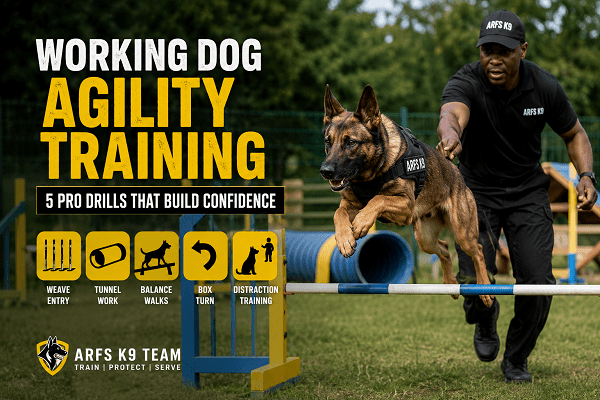
Working dog agility training builds confidence by teaching a dog to trust its footing, its own body and its handler while it moves fast. The five drills that do this best are balance and surface walks, tunnel send-aways, box turns, weave-channel entries, and a full sequence run under distraction. Train three times a week for 10 to 20 minutes, keep jumps low until growth plates close (usually 12 to 15 months), and expect visible confidence gains in 3 to 4 weeks. Solid performance under real distractions usually takes 8 to 12 weeks.
Table of Contents
- Introduction
- What Does “Confidence” Really Look Like in a Working Dog?
- Why Agility Matters for K9 Work
- Safety First: Age, Injury Data and Warm-Ups
- Simple Gear and Setup
- The 5 Pro Drills
- Your 8-Week Agility Plan
- Troubleshooting: When Drills Go Wrong
- Breed Notes: Malinois, Shepherds, Collies and Heavy Breeds
- Why Trust This Guide
- FAQs
- Conclusion
- Sources
Introduction
Ever watched a strong, driven dog stop dead at the bottom of a ladder? Tail low, eyes darting, ears flat. Ten minutes earlier, that same dog was ripping through a bite drill like nothing could touch it.
That’s the gap working dog agility training closes. Most online guides treat agility as a weekend sport: ribbons, speed and colorful poles. But if you handle a police dog, a security dog, a detection dog or a serious family protection dog, you need something different. You need a dog that stays steady on slick floors, in tight spaces and around noise, and that keeps listening to you while it does.
In this guide, you’ll learn:
- What real confidence looks like (and how to spot a dog that’s faking it)
- The safety rules that keep a working dog sound, backed by veterinary injury data
- Five step-by-step drills with setups, progressions and fixes
- An 8-week plan you can follow at home
- Breed-specific tips and a troubleshooting table for when things go sideways
Whether you’re a first-time owner of a German Shepherd or a professional handler, you’ll be able to follow along. Let’s get into it.
What Does “Confidence” Really Look Like in a Working Dog?
Here’s the thing most people miss: confidence isn’t boldness. A dog that charges at everything isn’t confident. It might just be reactive. Real confidence means a dog tries new things, recovers quickly after a slip, and keeps checking in with you.
Use this table as a quick check before and after each training block.
| Confident dog | Shaky dog (looks fine until pressure hits) |
|---|---|
| Sniffs new surfaces, then steps on | Freezes, or leaps over the surface |
| Shakes off a slip and keeps working | Shuts down or avoids the obstacle next time |
| Takes the treat softly | Snatches treats or won’t eat at all |
| Loose body, soft eyes | Stiff body, wide eyes, tucked tail |
| Looks back at you for the next cue | Looks away, scans the environment |
| Recovers in seconds | Stays on edge for minutes |
Watch for the small stress signals too: lip-licking, yawning, sudden sniffing, panting when it isn’t hot, and turning the head away. When you see two or three together, make the task easier. Don’t push through.
AKC agility competitor Valerie Dietz makes a point I agree with completely. When a dog makes a mistake, reset the exercise with a cheerful “let’s do that again” tone instead of frustration. She also suggests limiting repetitions. That keeps the dog willing to try. (See AKC’s “training tip” in Sources.)
Why Agility Matters for K9 Work
Agility isn’t just a sport. In professional K9 work, it’s a test.
The Delaware Council on Police Training defines agility training as work where the police dog must get over or through obstacles such as walls and tunnels it’s likely to meet on duty. In Pinellas County, Florida, K9 teams certify through the U.S. Police Canine Association. Their agility test includes hurdles, a catwalk, a broad jump, an A-frame and a ladder climb. One U.S. patrol and explosives handler course lists vertical jumps, broad jumps, ladder climbing, elevated walks, crawling, slippery floors, and loud, unusual noises in its agility and confidence block.
See the pattern? None of that is about speed. It’s about a dog that commits to unfamiliar footing and spaces while the handler is giving cues.
Sport agility and working dog agility share equipment, but the goals differ:
| Sport agility | Working dog agility | |
|---|---|---|
| Goal | Fastest clean run | Calm, reliable response in real conditions |
| Success looks like | Ribbons and times | A dog that stays steady on rubble, ladders and slick floors |
| Distractions | Controlled ring | Crowds, noise, traffic, other animals |
| Training emphasis | Speed and handling | Confidence, control and recovery |
That difference shapes every drill below.
Safety First: Age, Injury Data and Warm-Ups
I’m putting safety before the drills on purpose. Skip this section and you can undo months of good work in one bad landing.
Age and Growth Plates
Growth plates are soft areas of cartilage at the ends of a puppy’s bones. They close as the dog matures. The AKC advises that puppies shouldn’t jump at extreme or competitive heights until they’re at least 12 to 15 months old, and later for giant or slow-maturing breeds. In AKC agility, a dog must be at least 15 months old to compete. The AKC’s rule for young dogs is simple: “low and slow.”
That doesn’t mean waiting. Puppies can walk low boards, explore tunnels and learn new surfaces. They just shouldn’t do full-height jumps, full-height contact obstacles or closed weave poles yet.
What the Injury Numbers Say
Veterinary surveys of agility dogs give us a reality check:
- A 2009 survey in Veterinary and Comparative Orthopaedics and Traumatology covered 1,627 agility dogs. 33% had been injured. Shoulders and backs were hit most often, and the A-frame, dog walk and bar jump caused nearly two-thirds of the injuries that came from contact with an obstacle.
- A larger survey from The Ohio State University covered 4,701 dogs. 41.7% had an injury that kept them out of agility for over a week. The shoulder was the most common site (30.1%), followed by the iliopsoas muscle in the hip area (19.4%). Border Collies had the highest rate at 51.9%.
- A 2022 study in Frontiers in Veterinary Science found 41.4% of dogs had a week-plus injury. It also noted earlier research linking fewer than four years of agility experience with higher injury risk.
Two caveats. These surveys cover competition dogs, and owners reported the injuries themselves. But the lesson holds for working dogs: shoulders, backs and hips take the beating, and newer dogs get hurt more often.
What I do with that information:
- Keep jumps low and reps few. Quality beats volume.
- Skip steep A-frames and high dog walks in these drills. You don’t need them to build confidence.
- Always warm up for 5 to 7 minutes (loose-leash walking, light tug, sits and downs, gentle turns) and cool down for 3 to 5 minutes of easy walking.
- Check the surface. Dry, hard ground caused most injuries in the 2009 survey. Choose grass or a rubber mat, not concrete.
- Beat the heat. If you can’t hold the back of your hand on the ground for seven seconds, it’s too hot for paws. Train early morning or evening.
- Get a vet check before starting if your dog has any hip, elbow, shoulder or back history.
Simple Gear and Setup
You don’t need a competition course. I’ve seen great confidence work done with PVC, cinder blocks and a pop-up tunnel.
| Equipment | Purpose | Budget option |
|---|---|---|
| 6 to 8 weave poles | Rear-end control and focus | PVC pipe on stakes |
| Open or collapsible tunnel | Send-away confidence | Pop-up fabric tunnel |
| Low, wide board (4 to 6 in. high) | Balance and footing | 2×6 or plywood board on cinder blocks |
| 4 cones or markers | Box turn | Plastic cups, water bottles |
| Mixed surfaces | Surface confidence | Tarp, rubber mat, plywood, cardboard, folded towel |
| High-value treats and a toy | Reward | Cooked chicken, hot dog slices, a favorite tug |
Total cost for most setups: well under $100.
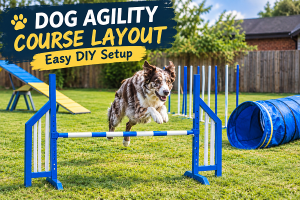
Not sure how to arrange it all in your yard? Our Dog Agility Course Layout: Easy DIY Setup guide shows spacing and floor plans for small and large spaces.
Visual note: add a top-down diagram of the starter layout here.
The 5 Pro Drills
A quick rule before you start: change only one thing at a time. Add distance, or add speed, or add distraction. Never all three. If the dog fails twice in a row, drop back one step and rebuild.
Drill 1: Balance and Surface Walks
Goal: Teach the dog to place its feet with care and trust unfamiliar footing.
Why it comes first: It builds proprioception (the dog’s sense of where its body is in space). It also builds the single most important working skill: stepping onto something odd without panic.
Setup: A board 8 to 10 inches wide, resting 4 to 6 inches off the ground and fixed so it can’t tip. Lay a few different surfaces nearby (tarp, rubber mat, plywood).
Steps:
- Put the dog on a loose leash. Walk beside the board.
- Lure the dog onto the board with a treat held at nose level. Reward each time all four paws are on.
- Walk the full length at a slow pace. Reward small, careful steps. Slow is the target.
- Pause mid-board for a two-second “hold” and reward. This builds calm.
- Repeat 4 to 6 times. End on a clean one.
- After the board is easy, repeat the pattern with each new surface.
| Level | Board height | Board width | Session length |
|---|---|---|---|
| Beginner | 4 to 6 in. | 8 to 10 in. | 5 minutes |
| Intermediate | 8 to 12 in. | 6 in. | 8 to 10 minutes |
| Advanced | 12 in. and up, uneven or slightly wobbly | 4 to 6 in. | 10 to 15 minutes |
Fix it: If the dog jumps off, lower the board to the ground and widen it. If the dog freezes, toss a treat onto the surface and let it choose to step on.
Pass mark: The dog crosses at a calm walk, head level, with no jump-offs, three times in a row.
Bonus: This is one of the best low-impact drills for older dogs coming back from layoffs, because it builds strength without hard landings. Get your vet’s okay first.
Drill 2: Tunnel Send-Away
Goal: Build a dog that commits to enclosed spaces without you leading the way.
Why it matters: Detection dogs, search dogs and patrol dogs all enter culverts, crawl spaces and narrow gaps. A hesitant dog loses seconds, or refuses.
Setup: An open tunnel, shortened and straight at first so the dog can see daylight at the other end.
Steps:
- Stand at the entrance. Toss a treat or toy through to the exit.
- Release with one clear cue, such as “tunnel.” Say it once.
- Have a helper at the exit to call and reward. If you work alone, put a bowl of treats at the exit.
- Back away to 3 feet, then 6, then 10, one step at a time.
- Lengthen the tunnel, then add a gentle curve so the dog can’t see through.
- Last step: walk or run in a different direction while the dog is in the tunnel, so it learns to trust the cue, not your body.
Fix it: Pause longer than about three seconds at the entrance? Make it easier. Shorten the tunnel, close the distance, and add a better reward. Don’t push, drag or crowd the dog. Fear gets worse fast in tight spaces. If your dog shows real fear, slow right down and use the methods in our guide to training fearful dogs.
Pass mark: The dog completes 4 out of 5 sends from 10 feet through a curved tunnel without a pause.
Drill 3: The Box Turn (Directional Control)
Goal: Teach the dog to turn tight and stay close, not swing wide.
Why it matters: A dog that can’t turn in a small space struggles in rooms, stairwells and crowded streets. It also teaches the dog to read your body.
Setup: Four cones in a square, about 6 feet apart.
Steps:
- Walk the dog around the outside of the box with the dog on your side. Reward for staying close.
- Add a verbal cue at each corner (“left,” “right” or “here”) and change direction as you say it.
- Tighten the turns. Reward when the dog’s shoulder stays near your leg.
- Drop the leash in a fenced space and repeat.
- Add a speed change: walk, trot, walk.
Honest check: When you drop the leash, you’ll learn how much of your dog’s control was really leash pressure. That’s valuable information. If the dog falls apart, go back on lead and rebuild. Nothing’s wrong with that.
Hind-end bonus: Teach the dog to put its front paws on a sturdy low platform and pivot the back legs around it. This builds rear-end awareness, which helps with turns and with stairs.
Pass mark: The dog turns within about one body length of your path, on cue, off lead, in 4 out of 5 corners.
Drill 4: Weave-Channel Entry (Adult Dogs)
Goal: Build rear-end control, focus and the habit of waiting for the right cue.
Straight talk: Weave poles aren’t on most police courses. We use them because they teach a dog to stay with the handler while its body twists and its brain gets busy. That’s a useful skill. But because weaves flex the spine, I only use them with dogs around 12 to 18 months or older. The AKC’s training advice for puppies says the same: closed weaves wait until the dog is mature.
Setup: Six poles in a line. Start in “channel” style: spread the two rows wide apart so the dog runs between them like a lane. Over several sessions, narrow the gap gradually.
Steps:
- Work only the entry first. Stand by the first pole with the dog on a loose leash.
- Cue “weave” and guide with your body position, not the leash.
- Reward the second the dog clears pole two, even if the rest wouldn’t be perfect.
- Reset. Repeat 5 to 6 times. Then add a third pole.
- Add poles one at a time. Don’t send the dog through all six on day one.
Fix it: A fast dog that blows past the entry? Slow your own pace and reward earlier. A dog that pops out early? Go back to a wider channel and fewer poles. Popping out is a habit that’s hard to undo, so stop at the first sign of it.
Pass mark: The dog enters correctly and completes four poles cleanly in 4 of 5 tries.
Drill 5: Full Sequence Under Distraction
Goal: Prove the skills hold when life gets noisy.
Why it matters: A dog that’s brilliant on an empty field but falls apart when a stranger walks past hasn’t learned the skill. It’s learned the location. This is the step most hobby programs skip, and it’s the one that counts for working dogs.
Sequence (20 to 30 seconds): balance walk, then tunnel send, then box turn, then weave entry.
Run it clean in a quiet place until the dog finishes smoothly three times. Then climb the distraction ladder one rung at a time:
| Level | Distraction | Rule |
|---|---|---|
| 1 | Quiet space, nothing around | Three clean runs to move on |
| 2 | A helper standing still 30+ feet away | Reward a glance at you, not at the helper |
| 3 | A calm dog at a distance | Increase closeness slowly |
| 4 | A helper walking past | Keep reps short |
| 5 | Sound: a dropped bucket, a clapped board, a radio | Start quiet and far away, then build |
| 6 | New surface or slick floor mid-sequence | Go slowly, reward heavily |
If the dog fails twice at any level, drop back one rung, win, and end the session on that win.
Pass mark: Three clean runs at each level. Most dogs I’ve trained reach Level 4 by week 7 or 8.
Visual note: add a photo or short clip of a full sequence here. It helps readers see what “clean” looks like.
Your 8-Week Agility Plan
How often should you do agility with a working dog? Three sessions a week, each 10 to 20 minutes, works better than daily marathon sessions. Joints, tendons and growth plates need recovery time between sessions. For young dogs, stay at the lower end of that range. The AKC’s own agility advisers suggest keeping early home sessions to five or ten minutes.
| Weeks | Focus | Session length | Notes |
|---|---|---|---|
| 1 to 2 | Drill 1 (balance and surfaces) | 8 to 10 min | Warm up, then 4 to 6 reps, then cool down |
| 3 to 4 | Add Drill 2 (tunnel) | 10 to 15 min | Build distance slowly |
| 5 | Add Drill 3 (box turn) | 10 to 15 min | On lead first, then off lead |
| 6 | Add Drill 4 (weave channel, adult dogs only) | 10 to 15 min | Skip for puppies and young dogs |
| 7 to 8 | Drill 5 at Levels 1 to 4 | 15 to 20 min | Change one variable at a time |
Check-ins:
- Week 4: You should see calmer footing and faster recovery after small mistakes.
- Week 8: You should see a dog that holds the sequence through at least Level 3 or 4 distractions.
Agility is one slice of the plan, not the whole thing. For how it fits with walks, mental work and rest days, read our guide on how often you should exercise a working dog.
Keep a simple training log: date, drill, level, reps, one note on how the dog’s body language looked. After a month, you’ll spot patterns you’d never catch from memory.
Troubleshooting: When Drills Go Wrong
| Problem | Likely cause | What to do |
|---|---|---|
| Dog refuses the board or tunnel | Too hard, too fast, or low reward value | Lower the challenge, upgrade the treat, reward any attempt |
| Dog bolts past the weave entry | Too much speed and arousal | Slow down, use a wider channel, reward before the miss |
| Yawning, lip-licking, sniffing the ground | Stress | End the rep. Make the next one easy |
| Dog spins and barks | Overexcited, handler unclear | Add a calm warm-up, give one cue, reward quiet |
| Dog only works on leash | Leash is doing the steering | Return to lead, then fade leash pressure in small steps |
| Dog quits after a mistake | Mistakes have felt unpleasant | Reset with a happy tone, make the next rep easy |
| Dog works well one day, badly the next | Fatigue, heat or soreness | Rest. Ask your vet if it continues |
| Training on a full stomach | Bloat risk in deep-chested breeds | Wait 1 to 2 hours after meals |
The biggest mistake I see? Handlers rush to the full sequence because it looks cool. Resist it. Master the single pieces first.
Breed Notes: Malinois, Shepherds, Collies and Heavy Breeds
Every dog is an individual, but breeds do have patterns:
- Belgian Malinois: Fast, intense, and quick to over-arouse. Keep reps short, build in a calm “settle” between runs, and don’t let enthusiasm turn into sloppy landings.
- German Shepherd: Many shepherds carry hip and back concerns. Keep jumps low, avoid repeated hard landings, and get a vet’s okay if there’s any hip history.
- Dutch Shepherd: Athletic and fast learners. The same warm-up and rep-limit rules apply.
- Border Collie: Highest injury rate in the Ohio State survey (51.9%). Warm up well, cap the reps, and watch for signs of obsessive repetition.
- Labrador, Springer and other detection breeds: Often heavier and more bodied. Use lower beam heights and shorter sessions, and put surface and tunnel work first.
- Rottweiler, Cane Corso and giant guard breeds: Skip jumping. Focus on balance, surfaces, turns and calm control. Joint protection matters more than speed.
Breed isn’t destiny. Age, fitness, weight and temperament matter more than the label.
Why Trust This Guide
This guide comes from the training ground, not a keyboard. Cpl. Rofiat Muritala is a Nigerian Army military working dog instructor and handler with more than 14 years of experience at the Nigerian Army Dog Centre. She has completed advanced obedience, K9 patrol and advanced explosive detection certification courses. Her work covers dog selection, foundational training, behavior shaping and performance evaluation in real operational settings.
Rofiat represented the Nigerian Army Dog Centre at the Nigerian Army Day Celebration (NADCEL) 2026, where she led demonstrations in obedience, explosive detection, agility and tactical movement. She’s also the author of Beyond the Bark: Inside a Pro Handler’s Playbook for Raising the Ideal Dog.
I’ve run agility sessions with green Malinois pups and with seasoned patrol dogs coming back from injury layoffs. The five drills here are the ones I keep returning to, because they build real skill instead of just burning energy.
This guide is educational and doesn’t replace veterinary advice. If your dog has a joint, spine or heart condition, talk to your vet before you begin.
FAQs
What age can a working dog start agility training?
Puppies can start gentle foundation work from about 8 to 10 weeks, such as walking over low, stable boards, exploring tunnels and meeting new surfaces. Hold off on full-height jumping, tall contact obstacles and closed weave poles until growth plates close, usually between 12 and 15 months (later for giant breeds). Your vet can confirm the right timing for your dog.
How often should I train agility with my working dog?
Aim for three sessions per week, 10 to 20 minutes each, with rest days in between. Shorter, more frequent sessions beat long ones because muscles, tendons and growth plates need time to recover. Puppies and young dogs should stay at the short end.
How long until I see results?
Most handlers see better body awareness and calmer recovery after mistakes within 3 to 4 weeks of steady training. Reliable performance with real distractions usually takes 8 to 12 weeks, depending on the dog’s age, history and temperament.
Can agility help a nervous or fearful dog?
It can help build confidence, because the dog learns that new things lead to rewards. Go slowly, let the dog choose to approach, and keep sessions short. But agility isn’t a fix for serious fear or aggression. Those need dedicated behavior work with a qualified trainer or veterinary behaviorist.
Do I need expensive agility equipment?
No. A board on cinder blocks, a few PVC poles, cones and a pop-up tunnel cover every drill in this guide, usually for under $100. Pro-grade gear matters more later, for competition or advanced tactical work.
Conclusion
Working dog agility training isn’t about ribbons or speed. It’s about building a dog that trusts its feet, its body and you, even when the ground is odd and the room is loud.
Here’s the short version:
- Start with balance and surface walks. They’re the foundation.
- Add tunnels, then box turns, then weave entries for adult dogs.
- Use the distraction ladder. Change one thing at a time.
- Keep sessions to 10 to 20 minutes, three times a week.
- Protect shoulders, backs and growth plates: low jumps, warm-ups, good surfaces.
- Stop when the dog shows stress. End on a win.
Your first 7 days: Build the board. Do three 5 to 8 minute balance sessions. Add one new surface. Write down how your dog’s body language looks. That’s it. You’ve started.
Want to go deeper? Our e-book, Beyond the Bark, covers agility progressions alongside obedience and drive-building exercises: Grab the ARFS K9 Team e-book here.
And if you’d like fresh guides like this one in your inbox every week, subscribe to our weekly articles roundup newsletter. No spam, just practical K9 training.
Sources
- AKC, “Training Tip: It All Starts with Confidence” (Valerie Dietz): https://www.akc.org/sports/agility/in-the-zone/training-tip-starts-with-confidence/
- AKC, “Can Puppies and Dogs Jump Safely?”: https://www.akc.org/expert-advice/training/puppies-dogs-jump-safely/
- AKC, “How to Prepare Your Puppy for Agility Training”: https://www.akc.org/expert-advice/sports/prepare-puppy-agility-training/
- AKC, “Practice Agility at Home”: https://www.akc.org/expert-advice/training/practice-agility-at-home/
- “A preliminary retrospective survey of injuries occurring in dogs participating in canine agility,” Vet Comp Orthop Traumatol, 2009: https://pubmed.ncbi.nlm.nih.gov/19597633/
- Markley, Shoben and Kieves, “Frequency and Types of Injuries Experienced by Dogs Competing in Agility Competitions” (Ohio State University): https://www.vsmr.org/frequency-and-types-of-injuries-experienced-by-dogs-competing-in-agility-competitions/
- Frontiers in Veterinary Science, 2022, agility injury risk factors: https://www.frontiersin.org/articles/10.3389/fvets.2022.869702/full
- Delaware Council on Police Training, 802 COPT K-9 Training Standards: https://archive.regulations.delaware.gov/AdminCode/title1/800/802.shtml
- NCJRS, Pinellas County Sheriff’s Office K9 teams: https://www.ojp.gov/ncjrs/virtual-library/abstracts/big-dogs-go-first
- K9 Cop Magazine, Patrol/Explosives K9 Handler Course listing: https://k9copmagazine.com/?p=17198

Her work centres on obedience, detection, protection and operational readiness. She favours proven methods built on repetition, consistency and real-world conditioning, so that both dogs and handlers are prepared for high-pressure tasks.
Rofiat represented the Nigerian Army Dog Centre at the Nigerian Army Day Celebration (NADCEL) 2026, where she led demonstrations in obedience, explosive detection, agility and tactical movement. Through articles, training content and documentaries, she shares field-based insight into how structured training, clear communication and trust between handler and dog affect performance and reliability.
She is the author of Beyond the Bark: Inside a Pro Handler's Playbook for Raising the Ideal Dog, a practical guide that helps dog owners and handlers apply professional training principles in everyday situations.
- Westminster Dog Show 2026: Winners & Full Results - October 17, 2026
- 10 K9-Approved Tricks to Teach Your Dog (Step-by-Step) - October 16, 2026
- COBA National Dog Championship 2026: Full Guide - October 15, 2026