Dog in Heat: What to Expect and How Long It Lasts

How long is a dog in heat? A dog in heat stays in season for about 2 to 4 weeks, and most cycles run close to 3 weeks. Bleeding usually lasts around 7 to 10 days, but she can still be fertile after the blood stops. Most dogs cycle about twice a year. Small breeds often start around 6 months old, while giant breeds can wait until 18 to 24 months.
Table of Contents
- Introduction
- What Does “In Heat” Mean?
- How Long Does a Dog Stay in Heat? (Day-by-Day)
- The 4 Stages of the Heat Cycle
- Signs a Dog Is in Heat
- First Heat and How Often Dogs Cycle
- How Long Is She Fertile? (The Biggest Myth)
- How to Care for a Dog in Heat
- Accidental Mating: What to Do
- How to Tell When Heat Is Over
- Health Risks After Heat: Pyometra and False Pregnancy
- Spaying: When Is the Right Time?
- When to Call a Vet
- FAQs
- Conclusion
Introduction
You notice spots of blood on the floor. Your usually calm girl is pacing, licking herself, and every male dog on the street has suddenly developed an interest in your gate. Sound familiar? You’re almost certainly dealing with a dog in heat.
Here’s the problem: most owners get the basics wrong. They think bleeding means “ready,” so no bleeding means “safe.” They think a fenced yard is enough. They think the first heat is a “practice run.” Those mistakes are how accidental litters happen.
In this guide, you’ll learn:
- exactly how long a dog stays in heat, day by day
- the signs to watch for, including the subtle ones
- how long she can really get pregnant
- how to keep her clean, calm and safe
- what to do after an accidental mating
- when to spay, and which health risks show up after the heat ends
(Quick note: “in heat” has nothing to do with hot weather. It’s the dog’s fertile reproductive cycle, also called “in season” or estrus.)
What Does It Mean When a Dog Is in Heat?
A female dog is “in heat” during the part of her reproductive cycle when she can become pregnant. Hormones surge, her body prepares for mating, and her scent tells males she’s available.
It’s not the same as a human period. Women bleed when the uterine lining sheds after ovulation. A dog bleeds before she ovulates, as estrogen rises. That’s why the bleeding stage isn’t the fertile stage, and why so many owners get caught out.
Dogs are also “monoestrous,” so they have one heat per cycle, followed by a long rest. They don’t go through menopause either. Heat cycles can become less noticeable with age, but they don’t stop completely.
How Long Does a Dog Stay in Heat?
Most dogs stay in heat for 2 to 4 weeks. AKC puts heat at roughly 2 to 4 weeks, and Dogs Trust gives the same range.
Here’s a typical 21-day heat. Your dog may run faster or slower, so use it as a guide, not a rule.
| Day | What You’ll Usually See | Fertile? |
|---|---|---|
| 1–3 | Vulva starts to swell. Light spotting or pinkish discharge. Males notice her. She’ll refuse them. | No |
| 4–9 | Swelling peaks. Discharge is bright red and heaviest. She licks a lot and pees often. | Not yet |
| 9–10 | Discharge fades to pink or straw colour. She starts “flagging” (tail moves aside). | Starting |
| 10–14 | Peak fertility. She actively seeks males and stands still for them. | Yes, highest |
| 14–21 | Swelling slowly drops. Discharge dries up. Receptiveness fades. | Possible until the end |
AKC notes the most fertile window may begin around 9 to 10 days in and last about 5 days, yet she can still get pregnant until the cycle ends. That last part is the one people forget.
Heat at a glance
| Fact | Typical Number |
|---|---|
| Total heat length | 2–4 weeks |
| Active bleeding | About 7–10 days |
| Time between heats | About 6–7 months (varies by breed) |
| First heat | 6–24 months, depending on size |
| Rest phase after heat | Several months |
The 4 Stages of the Dog Heat Cycle
Vets split the cycle into four stages. Only the first two are what we call “heat.”
| Stage | Length | What’s Happening |
|---|---|---|
| 1. Proestrus | About 7–10 days (can range wider) | Swelling, bloody discharge. Males are interested. She says no. |
| 2. Estrus | About 3–21 days, averaging around 9 | The fertile stage. She accepts males. Discharge often turns pale or pink. |
| 3. Diestrus | About 2 months | Fertility ends. Hormones stay high whether or not she’s pregnant. |
| 4. Anestrus | Several months | Resting phase. Hormones are low. No signs. |
Ever wonder why the discharge gets lighter right when she’s most fertile? Estrogen peaks before ovulation and then drops. The color change is the clue that ovulation is near, not that she’s finished. I’ve seen owners relax at exactly this point, and it’s the most common reason for accidents.
Signs a Dog Is in Heat
Some dogs are dramatic. Others hardly show anything. Look for these:
Physical signs
- Swollen vulva (often the first sign)
- Bloody, pink or straw-coloured discharge
- Licking the genital area more than usual
- Peeing more often, sometimes in small amounts
- Slightly bigger or firmer nipples in some dogs
Behavior changes
- Restlessness or pacing
- Extra clinginess, or the opposite, grumpiness
- Flagging: lifting the rear and moving the tail to one side
- Mounting objects or other dogs
- Trying to escape the yard or house
- Less interest in training or food (some dogs eat more)
Your sign checklist for the male dogs around her: whining at the fence, refusing food, marking, or suddenly becoming escape artists. Male dogs can pick up her scent from a surprising distance.
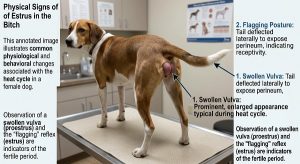
Does heat hurt? For most dogs, it’s more of an annoyance than pain. Think cramps-lite: tired, a bit moody, and sensitive to being handled around the back end. Actual pain, fever, or a bad smell is not normal (see the vet section below).
First Heat and How Often Dogs Cycle
Size matters here. Small dogs usually have their first heat at 6 to 7 months, medium dogs at 7 to 9 months, and large breeds at 12 to 16 months. Some start as early as 4 months, and some don’t cycle until after age 2. Some giant breeds may not go into their first heat until 18 to 24 months.
| Dog Size | First Heat (Typical) | How Often After |
|---|---|---|
| Toy / small (Chihuahua, Shih Tzu) | 6–7 months | Often every 4–6 months |
| Medium (Beagle, Border Collie) | 7–9 months | About every 6–7 months |
| Large (German Shepherd, Labrador, Malinois) | 12–16 months | About every 6–8 months |
| Giant (Great Dane, St. Bernard) | 18–24 months | Often every 12–18 months |
Smaller breeds can cycle as often as 3 to 4 times a year, while St. Bernards and Great Danes may only cycle every 12 to 18 months. A few breeds, like the Basenji, usually cycle just once a year.
Don’t panic about an irregular first heat. It can take up to 18 months for a young dog’s cycle to become regular. First heats often come with split heats, where she starts, stops, and starts again weeks later. Keep a log (template at the end) and it’ll make sense over time.
Related: If you’re also managing a young dog’s routines, our guide on how often to exercise a working dog helps you plan safe, controlled activity.
How Long Is a Dog Fertile? (The Biggest Myth)
So here’s the thing: bleeding does not equal fertility, and no bleeding does not equal safe.
Three facts explain why:
- She ovulates mid-cycle, not at the start. Ovulation happens roughly two days after the hormone surge, and the eggs need about two more days to mature. Eggs stay fertile for roughly 2 to 3 days.
- Sperm survives for days. Fresh sperm can live around 5 to 7 days inside her, so a mating on day 7 can still lead to puppies on day 12.
- Her fertile window is longer than most people think. Add sperm survival to egg timing and the “danger zone” can stretch across a week or more.
Silent heat and split heat
- Silent heat: very little swelling or discharge, but she still ovulates. These dogs are easy to miss.
- Split heat: a young dog starts proestrus, stops without ovulating, and tries again later. First-time cycles can include split heats.
My rule as a handler: treat her as fertile from the first drop of blood until she’s clearly finished. Dogs Trust advises keeping her on a lead for at least a week after bleeding stops. I go one step further and keep her separated from intact males for that same week.
Handler’s note: Heat tracking matters even more in working-dog programs, where breeding pairs are timed with vet progesterone tests instead of counting days. If you ever breed, don’t guess. Counting “day 12” is a myth that fails often. AKC’s expert notes it’s a misconception that breeding on day 10 to 12 will always succeed.
How to Care for a Dog in Heat
Your job is three things: keep her clean, keep her calm, keep her away from males.
1. Keep her clean
- Doggy diapers or heat pants protect furniture. They are not contraception.
- Change them every few hours to prevent skin irritation and odor.
- Wipe the area gently with a soft, damp cloth. Skip human wipes and perfumed products.
- Cover her bed with washable throws and keep a towel on the couch.
- Never use human pads or tampons. She can chew them, and swallowing them is dangerous.
For general coat and hygiene routines, our guide to essential dog grooming tips works well alongside heat care.

2. Prevent accidental mating
A fenced yard isn’t enough. Dogs jump, dig, squeeze through gaps and slip out in a second. Do this instead:
- Walk her on a leash, ideally a harness plus collar, never off-leash.
- Pick quiet times and quiet routes.
- Skip parks, daycare, group training and boarding with intact males.
- Supervise every toilet break, even in your own yard.
- Put doors, gates or crates between her and any intact male in your home.
- Keep her inside, or on a leash, during the 3-week window.
Male dog in the house? Even a well-trained, calm male can lose his head. Where possible, send one dog to a trusted relative or a female-only boarding setup for the heat. A neutered male may still show interest, so don’t assume he’s “safe.”
3. Keep her comfortable
- Stick to her normal feeding, walk and sleep routine. Dogs cope better when the day is predictable.
- Offer gentle exercise and puzzle games for her mind. Light activity is fine, but avoid rough play and long hikes.
- Give her a quiet, cozy space.
- Skip big changes like new foods or boarding, which add stress.
A word on working and training dogs
If your girl is a working dog, a sport dog, or in training, heat changes the plan:
- Group classes and shared fields: pause them. One heat-scented female can derail a whole session.
- Detection and obedience work: some handlers report lower focus during heat, and many pause high-stakes work until it passes. This is field observation, not strict science, so go with how your dog performs.
- Keep the basics alive: short leash work, recall in a secure area, and crate time maintain structure. Our e-book, Beyond the Bark: Inside a Pro Handler’s Playbook for Raising the Ideal Dog, walks through the everyday handling routines that keep dogs steady through life changes like this.
Accidental Mating: What to Do
If you think she’s been mated, call a vet immediately. Time matters.
- Note the date and time and whether the dogs “tied” (stuck together). A tie isn’t required for pregnancy, so lack of one doesn’t mean she’s fine.
- Don’t try home remedies. There’s no safe DIY option.
- Ask about options. Depending on your country, vets may offer:
- A mismating injection. Aglepristone blocks progesterone, and the course is two injections 24 hours apart. Availability varies. It’s not approved in the US, but it’s used in many other countries. vets-nowwhole-dog-journal
- Pregnancy testing and monitoring. Vets can confirm pregnancy later with ultrasound or blood tests.
- Spay. If you never plan to breed, spaying is possible even after mating, though surgery is riskier during pregnancy.
- If you decide to continue the pregnancy, plan for a vet check, proper nutrition and a whelping setup. Our guide to how long dogs are pregnant, with a stage-by-stage calendar will help you plan.
How to Tell When Heat Is Over
Heat fades slowly. Here’s what to look for:
- Discharge lightens, then stops
- Swelling goes down and the vulva returns to normal size
- She stops flagging and starts refusing males again
- Licking and restlessness settle
- Males lose interest
Even when everything looks finished, hold your precautions for about a week. Hormones don’t switch off on the same day the blood does. Heat that runs longer than about 3 weeks deserves a vet check, and one that drags on past 4 to 6 weeks needs attention. Vets also rule out vaginitis, since its discharge can look like heat.
Health Risks After Heat: Pyometra and False Pregnancy
Here’s what the “bleeding stopped, we’re done” crowd misses: some of the biggest risks show up after heat ends.
Pyometra (womb infection)
Pyometra is a serious uterine infection, and it’s a real emergency.
- About 25% of unspayed dogs develop pyometra before age 10.
- It usually appears about 2 to 8 weeks after a heat, so watch her closely during that window. AKC’s source says it can occur up to about 12 weeks after a heat.
- Pets 6 and older are at highest risk, though younger dogs can get it too.
- Mortality has been reported as high as 10%.
Warning signs: lethargy, not eating, drinking and peeing a lot, vomiting, a swollen belly, pale gums, or smelly discharge. Some dogs show no discharge at all (“closed pyometra”), which makes it even more dangerous. If she’s ill any time in the 3 months after a heat, see a vet the same day.
False pregnancy
A few weeks after heat, some dogs act pregnant even when they’re not. You may see nesting, mothering toys, swollen nipples, or even a little milk. It’s driven by hormones and usually passes, but call your vet if she’s distressed, producing a lot of milk, or off her food.
Spaying: When Is the Right Time?
Spaying removes the ovaries and uterus. It ends heat cycles, stops pregnancy, and removes the risk of pyometra. Here’s how timing works.
Spaying during heat: possible, but most vets avoid it. Vets typically avoid spaying in heat because of a higher bleeding risk. It also usually means longer anesthesia time, a slower recovery and a higher cost.
Spaying after heat: The usual advice is to wait about 2 to 3 months after the heat ends. Dogs Trust suggests at least 3 months.
Before first heat vs. later: this is where opinions differ.
- The cancer argument: The figures commonly quoted show a mammary tumor risk of 0.5% if spayed before the first heat, 8% after one heat, and 26% after the second. Worth knowing: a 2012 systematic review (Beauvais et al.) found the evidence behind those numbers weak, so treat them as a guide, not a guarantee.
- The growth argument: for large and giant breeds, some research (UC Davis studies in certain breeds) links very early spaying to higher joint-disorder risk. AKC’s vet source says breed, size and joint concerns all affect timing.
So the honest answer: ask your vet about the best age for your breed and size. Small breeds are often spayed earlier. Large and giant breeds may wait until physical maturity.
Breeding? Responsible breeders don’t breed on the first or second heat and usually wait until at least the third, around 18 to 24 months.
When to Call a Vet
| Red Flag | Why It Matters |
|---|---|
| Heat lasting more than about 3 weeks | Could signal a cyst, infection or hormone issue |
| Very heavy bleeding, or large clots | Needs urgent assessment |
| Foul-smelling or green/yellow discharge | Possible infection |
| Fever, vomiting, lethargy, refusing food | Possible pyometra |
| Lots of drinking and peeing in the weeks after heat | Possible pyometra |
| Painful belly or swollen abdomen | Emergency |
| Heat that never comes by 2 years old | Needs a check |
| Cycles very close together or suddenly stop | Worth a vet visit |
When in doubt, call. A phone call costs nothing, and pyometra can’t wait.
Your heat log (copy this)
- Date first spotting appeared:
- Date swelling peaked:
- Date discharge turned pink/straw:
- Dates she accepted or flagged at males:
- Date bleeding stopped:
- Date swelling fully gone:
- Mood, appetite and energy notes:
- Anything unusual (smell, heavy blood, vomiting):
After two or three cycles you’ll predict the next one almost to the week.
FAQs
1. How long is a dog in heat?
About 2 to 4 weeks, with most dogs near 3 weeks. Bleeding usually lasts around 7 to 10 days. She can stay fertile after the blood stops, so keep precautions up for about a week.
2. Can a dog get pregnant on her first heat?
Yes. A dog can get pregnant on her very first heat, even though she’s not fully grown. Treat the first season as a real pregnancy risk, and don’t breed on the first or second heat.
3. How long after bleeding stops is a dog still fertile?
It depends, but she may be fertile for several days after bleeding eases, and sperm can survive for days inside her. A safe rule is to keep her away from intact males for at least a week after all signs end.
4. Can you spay a dog while she’s in heat?
You can, but most vets prefer to wait. Surgery during heat carries more bleeding risk and costs more. Waiting about 2 to 3 months after the heat is the usual advice.
5. How often do dogs go into heat?
Most dogs go into heat about every 6 to 7 months, so roughly twice a year. Small breeds may cycle 3 to 4 times a year, while giant breeds like Great Danes and St. Bernards may cycle only every 12 to 18 months.
Conclusion
A dog in heat isn’t sick, but she needs sharper supervision for about three weeks. Here’s what to remember:
- Heat lasts 2–4 weeks, with bleeding for about 7–10 days.
- Peak fertility often comes after the heaviest bleeding.
- She can get pregnant on her first heat.
- Keep her on a leash, away from intact males, and keep precautions up for a week after all signs end.
- Watch her closely for 8–12 weeks after the heat for pyometra signs.
- Plan the spay with your vet, ideally 2–3 months after a heat or before the first one, depending on breed and size.
- Keep a heat log so the next season holds no surprises.
If this guide helped, get more like it every week. Subscribe to our weekly articles roundup newsletter and we’ll send practical handler-tested advice straight to your inbox.
Sources
- AKC, “How Long Are Dogs in Heat?”: https://www.akc.org/expert-advice/dog-breeding/how-long-are-dogs-in-heat/
- AKC, “Dogs in Heat”: https://www.akc.org/expert-advice/dog-breeding/dogs-in-heat/
- Dogs Trust, “Everything you need to know if your dog is in heat”: https://www.dogstrust.org.uk/dog-advice/health-wellbeing/essentials/in-heat
- American College of Veterinary Surgeons, “Mammary Tumors”: https://www.acvs.org/?p=5652
- Animal Medical Center NY, “Pyometra in Pets”: https://www.amcny.org/pet_health_library/pyometra/
- Vets Now, accidental mating: https://www.vets-now.com/?p=47253
- Weimaraner Club of America, Breeders’ Briefcase (progesterone timing): https://www.weimaranerclubofamerica.org/breeders_briefcase/BECColumn_Progesterone.pdf

Her work centres on obedience, detection, protection and operational readiness. She favours proven methods built on repetition, consistency and real-world conditioning, so that both dogs and handlers are prepared for high-pressure tasks.
Rofiat represented the Nigerian Army Dog Centre at the Nigerian Army Day Celebration (NADCEL) 2026, where she led demonstrations in obedience, explosive detection, agility and tactical movement. Through articles, training content and documentaries, she shares field-based insight into how structured training, clear communication and trust between handler and dog affect performance and reliability.
She is the author of Beyond the Bark: Inside a Pro Handler's Playbook for Raising the Ideal Dog, a practical guide that helps dog owners and handlers apply professional training principles in everyday situations.
- Dog Agility Course Layout: Easy DIY Setup - October 7, 2026
- Local Dog Breeds: Temperament, Health & Training Guide - October 6, 2026
- How Long Do Military Working Dogs Serve? Full Guide - October 5, 2026