Pitbull vs American Bully: Key Differences
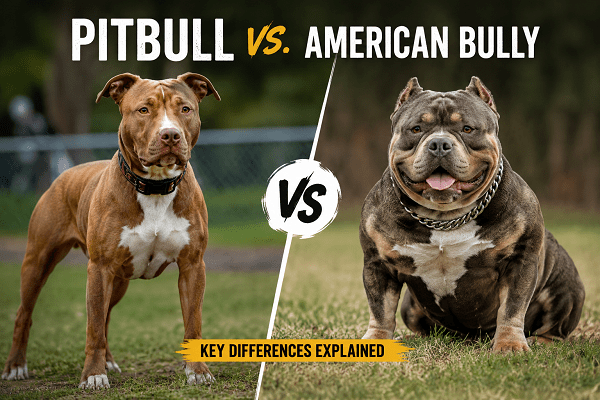
A Pitbull (usually the American Pit Bull Terrier, or APBT) is a leaner, more athletic, higher-drive terrier. An American Bully is a separate, newer breed with a thicker, broader body that was developed as a companion dog. They share ancestry, but they differ in build, size, energy, health risks, registry status and, in some countries, the law.
Quick takeaways:
- Size: APBT males are about 35-60 lb. Standard American Bullies run roughly 45-110 lb, and XL types go higher.
- Energy: The APBT usually wants more work. The Bully is bred to settle more easily at home.
- Law: The UK bans both pit bull type dogs and XL Bullies. Check local rules before you buy.
- Looks lie: Studies show even shelter staff often mislabel dogs, so papers and temperament matter more than appearance.
Table of Contents
- Introduction
- What Does “Pitbull” Actually Mean?
- Pitbull vs. American Bully at a Glance
- Origins and Who Recognizes Which Breed
- Size and Physical Differences
- Why You Can’t Always Tell by Looks
- Temperament and Behavior
- Training and Exercise Needs
- Health and Lifespan
- Laws, Bans and Ownership Rules
- Cost and Choosing a Responsible Breeder
- Which Dog Fits You Better?
- Myths That Won’t Die
- How I Evaluate a Bully-Type Dog
- Frequently Asked Questions
- Conclusion
Introduction
Ever stood next to a muscular, broad-chested dog and heard two people argue over whether it was a Pitbull or an American Bully? Both people were probably half right.
Here’s the problem. The word “Pitbull” gets used for several breeds, and the American Bully was built from some of the same bloodlines. Add social media photos, cropped ears and a lot of marketing hype, and buyers end up confused. That confusion has real costs: the wrong energy level in your home, surprise vet bills, and in some countries a dog that’s illegal to own.
In this guide, you’ll learn exactly how the two differ, how to tell them apart, what the research says about identifying them by sight, what the UK XL Bully ban means, and how to pick the one that fits your life. I’m writing this the way I’d explain it to a new handler on the training field: plain words, real numbers, no hype.
What Does “Pitbull” Actually Mean?
This is the part most articles skip, and it’s why the debate gets messy.
“Pitbull” is a type, not one breed. Depending on who’s talking, it can mean:
- American Pit Bull Terrier (APBT): recognized by the United Kennel Club (UKC) since 1898 and by the American Dog Breeders Association (ADBA). The American Kennel Club (AKC) doesn’t recognize it.
- American Staffordshire Terrier (AmStaff): the AKC’s version of a closely related dog.
- Staffordshire Bull Terrier (SBT): the smaller English cousin.
- American Bully: the newest of the group, often lumped in with the others.
When this article says “Pitbull,” it means the APBT, because that’s the breed people are really comparing to the Bully.
Pitbull vs. American Bully at a Glance
What’s the main difference between a Pitbull and an American Bully? The APBT is a lean, athletic terrier built for performance and stamina. The American Bully is a heavier, more compact companion breed with a broader head and thicker bone. Both are muscular, but the Bully is built for presence and the APBT is built for movement.
| Feature | Pitbull (APBT) | American Bully |
|---|---|---|
| Body type | Lean, athletic, terrier build | Thick-set, broad, heavy bone |
| Height (mature) | Males about 18-21 in, females 17-20 in | Pocket under 17 in, Standard/Classic about 17-20 in, XL over 20 in (males) |
| Weight | Males about 35-60 lb, females 30-50 lb (UKC) | Standard/Classic roughly 45-110 lb, XL roughly 80-140 lb |
| Head | Proportional, wedge-shaped | Larger, broader, blockier |
| Purpose | Sport, performance, versatile work | Companion and family dog |
| Energy | Usually higher drive | Often calmer off-duty |
| Breed group (UKC) | Terrier Group | Companion Breed Group, “not a Terrier” |
| Registry status | UKC, ADBA (not AKC) | ABKC (2004), EBKC (2008), UKC (2013) |
| Typical lifespan | About 11-13 years | Often quoted 8-13 years (limited data) |
Origins and Who Recognizes Which Breed
The APBT goes back to the bull-and-terrier crosses brought from England to America in the 1800s. UKC registered its first APBT in 1898, and the UKC standard says the breed has kept its type for over 150 years. For decades, these were all-purpose farm and sport dogs. Today, APBTs compete in weight pull, agility, dock jumping and obedience.
The American Bully is far younger. Breeders started building it in the 1980s and 1990s, using the APBT as the foundation and adding influence from the American Bulldog, English Bulldog and Olde English Bulldogge. The goal was simple: keep the powerful look, but breed for a friendlier, more predictable family temperament.
Here’s how the paperwork stacks up:
| Registry | American Pit Bull Terrier | American Bully |
|---|---|---|
| UKC (United Kennel Club) | Yes, since 1898 | Yes, since July 15, 2013 |
| ABKC (American Bully Kennel Club) | No | Yes, founded 2004 |
| ADBA | Yes | No |
| AKC | No | No |
| UK Kennel Club / FCI | No | No |
Why does this matter to you? Because it tells you where to check pedigrees. A “purebred” American Bully with no ABKC or UKC papers is just a dog that looks like one. UKC updated its American Bully standard in 2024 to describe the three common styles (Pocket, Standard/Classic and XL) and to state plainly that the Bully is not a Terrier.
Size and Physical Differences
Size is where most people spot the difference first, so let’s get specific.
The American Bully size classes
UKC recognizes three styles, and the ABKC uses a similar system based on height at the withers:
| Style | Mature male height | Notes |
|---|---|---|
| Under 17 in | Small but heavily built | |
| Standard | 17-20 in | The reference type |
| Classic | 17-20 in | Same height, lighter frame and less muscle mass than Standard |
| XL | Over 20 in | The type targeted by the UK ban |
You may also hear “Micro” and “XXL.” Those are informal labels for dogs smaller or bigger than the official classes, and they sit outside the standards.
The APBT has no size classes
The APBT is a single medium-sized dog. UKC describes it as solidly built, powerful and athletic, and it warns that quality should never be sacrificed for size. That last point matters. If someone sells you a “giant Pitbull,” you’re probably looking at a Bully-type cross or an oversized mix, not a standard APBT.
Head, body and movement
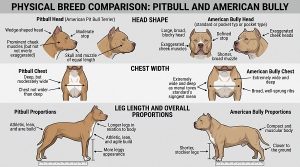
- Head: The Bully’s head is bigger and blockier. The APBT’s head is more proportional to its body.
- Chest and legs: The Bully has a very broad chest and a lower, wider stance. The APBT has longer legs and a deeper, athletic chest.
- Movement: The APBT moves like a sprinter. The Bully moves like a powerlifter. Both standards ask for sound, easy movement, and both warn against exaggeration.
- Muzzle: UKC says the Bully’s muzzle should be broad but not so short that it affects breathing. That’s a direct warning about a problem we’ll cover in the health section.
Why You Can’t Always Tell by Looks
Here’s something most competing articles don’t mention. Even experts get this wrong.
Researchers at Arizona State University ran DNA tests on 919 shelter dogs and compared the results to what staff had guessed from appearance. Only 4.9% of the dogs turned out to be a single breed, and visual guesses were rarely right. Earlier research found that about one in three dogs labeled “pit bull type” had no pit bull-type DNA at all, while about one in five dogs that carried pit bull-type markers were missed by staff.
What does that mean for you?
- A muscular head and cropped ears don’t prove a breed.
- Paperwork from a real registry and knowing the parents tell you far more than a photo.
- For an adopted dog, behavior in the first weeks tells you more than any breed label.
- This is also why breed-specific laws are so hard to enforce fairly.
My field rule: I judge the dog in front of me, not the label on its kennel card. Look at structure, movement and how the dog handles stress.
Temperament and Behavior
People ask which breed is “nicer.” The better question is what each breed was built to do.
The APBT: eager, driven, people-focused
UKC describes the APBT with words like strength, confidence and zest for life, and says aggression toward humans is uncharacteristic of the breed. In practice, APBTs are often very affectionate and love people. They’re also intense. They play hard, they work hard, and they can get fixated on balls, toys or movement.
One trait owners need to plan for: many APBTs become selective, or even intolerant, with other dogs as they mature (often between about one and three years old). It doesn’t happen to every dog, but it’s common enough that you should plan for controlled introductions, good fencing and leash management from day one.
The American Bully: steady, social, easier to settle
The UKC standard calls the American Bully confident and friendly, with a firm “off” switch for lounging with family. It also says aggression toward humans is uncharacteristic and highly undesirable. Many handlers report that Bullies recover from excitement faster than APBTs and have less drive for chasing and tugging.
Breed guides often say Bullies are easier to train because some of the terrier stubbornness was bred out. I’d say that’s a fair general trend, with one warning: a calm temperament doesn’t mean a low-effort dog. A 90-pound dog that never learned manners is a handling problem no matter how friendly it feels.
Temperament side by side
| Trait | APBT | American Bully |
|---|---|---|
| Affection toward people | High | High |
| Drive and intensity | Higher | Moderate |
| Settling indoors | Needs a job first | Often settles faster |
| Selectivity with other dogs | Common, plan for it | Varies by line |
| Best for | Active, experienced homes | Companion homes with a structured routine |
Remember, every individual dog differs. Genetics, breeding quality, socialization and training all matter more than the breed label. Learning to read your dog’s body language will teach you more about a particular dog than any breed stereotype.
Training and Exercise Needs
Both breeds are strong, smart and eager to please. Neither belongs in a “set it and forget it” home.
How much exercise?
These are my rules of thumb for healthy adult dogs, not scientific standards:
- APBT: 60-90 minutes a day, split into a structured walk, a training session and a game with rules (flirt pole, fetch with a “drop it”).
- American Bully: 45-60 minutes a day, with extra care in heat and for XL types with heavy joints.
Puppies need less, and short bursts beat one long run. Heavy exercise before about 12-18 months can stress growing joints, especially in the bigger Bully types.
A realistic training timeline
| Age | Focus for both breeds |
|---|---|
| 8-12 weeks | Name, sit, down, crate comfort, handling and gentle grooming |
| 8-16 weeks | Socialization window: new people, surfaces, sounds, calm dog meetings |
| 4-6 months | Recall, loose leash, “leave it” and impulse control |
| 6-18 months | Adolescence: repeat everything, add distractions, proof around other dogs |
| 18 months+ | Maintenance, sport or a job, plus ongoing social skills |
The skill I’d teach first in either breed is loose-leash walking. A 60-100 lb dog that drags you down the road is dangerous, and it’s the problem owners come to me with most. Our guide on how to stop a dog pulling on the leash walks through it step by step.
Training differences that matter
- For an APBT: Teach an “off switch” deliberately. Reward calm behavior on a mat, practice stay while a toy moves, and end play sessions before the dog is wild.
- For a Bully: Don’t let weight gain sneak up. Keep them lean, teach a solid recall, and watch for stubborn “sit-down” protests on walks.
- For both: Use reward-based methods, keep sessions short and consistent, and never leave either breed unsupervised with unfamiliar dogs.
New to Powerful Dog Breeds?
Owning a Pitbull or an American Bully takes more than choosing the right breed. It takes understanding how dogs think, how to communicate clearly and how to stay calm when your dog doesn’t. My book Beyond the Bark explains the psychology behind successful training and helps owners avoid the mistakes that lead to behavior problems.
👉 Get your copy here: BEYOND THE BARK: Inside a Pro Handler’s Playbook for Raising the Ideal Dog
Health and Lifespan
This is where the two breeds really split, and honesty matters here.
Lifespan: APBTs commonly live about 11-13 years. For American Bullies, you’ll see 8-13 years quoted, but there are no large, independent lifespan studies yet. Wikipedia’s breed entry notes there’s minimal health data on this young breed. Treat any single number you read as a rough guess.
The “extreme build” problem
Both UKC standards warn against exaggeration. UKC will not condone using exaggerated specimens for breeding in either breed. The reason is simple: the heavier, shorter and more wrinkled a dog gets, the more its body struggles. Watch for:
- Breathing trouble: Very short muzzles can narrow airways. Signs include loud snoring, noisy breathing on short walks and quick overheating.
- Hip and elbow problems: More weight and a wide frame stress the joints, especially in XL types.
- Skin issues: Skin folds trap moisture and can get infected. Allergies are also common in bully-type dogs.
- Weight gain: A low-activity Bully gains fast, and extra weight shortens life and worsens every joint problem.
- Heat sensitivity: Short-muzzled, heavy dogs overheat much faster than a lean APBT.
What to ask a breeder
- Can I see hip and elbow evaluation results for both parents (OFA or PennHIP)?
- Did a vet check the parents’ breathing and heart?
- How short are the muzzles in this line? Can I watch the parents exercise?
- What’s the temperament of the parents and grandparents with strangers and other dogs?
- Which registry are the papers from, and can I verify them myself?
A good breeder answers these without getting defensive. If you hear “we don’t need tests, they’re healthy,” walk away.
Laws, Bans and Ownership Rules
This is where buyers get caught off guard, so here are the facts.
United Kingdom
The UK has two separate rules to know:
- Pit bull type dogs have been banned under the Dangerous Dogs Act 1991 for decades.
- XL Bully type dogs were added to the ban. Since 31 December 2023 it has been illegal in England and Wales to sell, abandon, give away or breed an XL Bully, or to have one in public without a lead and muzzle. Since 1 February 2024, owning one without a Certificate of Exemption is a criminal offence. Applications for exemptions have closed, and new ones can only be authorized by a court order, according to GOV.UK.
When the ban began, government figures showed more than 35,000 XL Bullies registered for exemption, while estimates of the total number in England and Wales ranged from 50,000 to 100,000. The government pointed to 23 fatal dog attacks since the start of 2021, with at least 10 involving dogs identified as, or suspected to be, XL Bullies. Veterinary and welfare groups, including the BVA, RSPCA and The Kennel Club, argued that breed-specific bans should be replaced with measures aimed at breeders and owners. It’s a fair debate, and you should know both sides.
The UK ban targets a type, defined by a government conformation standard based on measurements and physical traits, not by pedigree papers. That’s another reason looks and labels matter legally even when they’re unreliable biologically. Rules also differ in other UK nations, so always check the current GOV.UK page before you act.
Rest of the world
Breed-specific legislation varies widely. Some countries and cities restrict APBTs, AmStaffs and Bully types. Many US states ban local breed bans, but individual cities, landlords and insurers can still restrict them.
Your ownership checklist
- Check national and local breed-specific laws.
- Read rental, HOA and condo rules.
- Ask pet insurers about breed exclusions before you buy.
- Check airline and ferry transport policies.
- If you plan to move abroad, check import rules for both breeds.
- Keep clear microchip, vaccination and registry records.
Cost and Choosing a Responsible Breeder
Prices swing wildly, and the cheapest puppy is rarely the cheapest dog. For American Bullies, breed guides commonly quote about $2,000 to $5,000 (USD) for Standard and Classic puppies, with rare “trending” colors and extreme lines costing more. Treat those numbers as ballpark figures and confirm with local breeders.
The purchase price is the smaller part of the cost. Plan for:
- Quality food for a 50-100 lb dog
- Vet care, vaccines, neutering and emergency savings
- Insurance, where breed exclusions apply
- Strong gear: a sturdy harness, a 4-6 ft leash and a solid crate
- Training classes
Red flags when buying either breed
- Sellers advertising “rare” colors or “exotic” traits instead of health and temperament
- No health testing records for the parents
- Puppies sold before 8 weeks
- No papers, or papers from a registry the seller can’t explain
- Pressure to put down a deposit today
- Parents not available for you to meet
If adopting from a shelter, remember the earlier research. Ask about the dog’s behavior, not just its label.
Which Dog Fits You Better?
Choose a Pitbull (APBT) if you want:
- An athletic partner for sport, hiking, weight pull or advanced obedience
- A lean, quick dog with high drive and lots of enthusiasm
- A dog you can give a job to every day
- You have experience handling strong, intense dogs and managing dog-to-dog selectivity
Choose an American Bully if you want:
- A substantial companion that’s often calmer indoors
- A friendly, people-focused dog for a family routine
- A dog that enjoys moderate exercise and plenty of couch time
- You live where Bully types are legal and can manage heat and weight carefully
Best fit by lifestyle
| Your situation | Better fit |
|---|---|
| First-time owner, moderate activity | Well-bred Standard or Classic Bully |
| Active runner or sport competitor | APBT |
| Apartment with daily walks | Standard Bully (never an XL without space and joint care) |
| Hot climate | APBT, or a Bully with a longer muzzle and strict heat rules |
| Home with young kids | Either, with strict supervision and a well-socialized dog |
| Lives in or moving to the UK | Check the law first, since both are restricted |
Still weighing your options? Our dog breed selector guide helps you score your lifestyle against energy, space, time and experience. And if you’re comparing other powerful breeds, see our breakdown of Boerboel vs. Cane Corso.
Myths That Won’t Die
- “An XL Bully is just a big Pitbull.” No. The XL is a size style of the American Bully, a separate breed with its own registries.
- “Pitbulls have locking jaws.” No special locking mechanism has been found in the anatomy. They have strong jaws, like many breeds.
- “You can tell the breed by the head shape.” The shelter DNA studies above show how unreliable that is.
- “Bullies don’t need training because they’re calm.” Calm puppies grow into big, strong adults who still need manners.
- “A mean dog is a good guard dog.” Neither breed is a natural protection dog. UKC says aggression toward people is uncharacteristic for both.
How I Evaluate a Bully-Type Dog
People often ask what I look for when I meet a strong breed for the first time. Here’s the checklist I use, drawn from handler training principles rather than breed labels:
- Recovery speed: After a sudden noise, how quickly does the dog settle? Fast recovery is a very good sign.
- Handler focus: Does the dog check in with you when excited? Dogs that can think under arousal are easier to train.
- Body handling: Can you touch the paws, ears and mouth calmly? This predicts vet and grooming success.
- Other dogs: Does the dog give soft, flexible greetings or stare, stiffen and fixate? Stiff and fixed is a warning sign.
- Frustration: Hold a toy just out of reach. Does the dog whine and recover, or escalate into frantic, mouthy behavior?
- Structure: Watch the dog walk. Smooth, balanced movement matters more than size.
This simple test often tells me more than pedigree charts. It’s also why I tell owners that early training, calm socialization and a firm routine matter far more than whether the dog has “Pitbull” or “Bully” on its papers.
Frequently Asked Questions
1. Is an American Bully a Pitbull?
Not exactly. The American Bully was developed from the American Pit Bull Terrier and other bully breeds, but it’s registered as its own breed by the UKC, ABKC and EBKC. Many people still use “Pitbull” as a broad label that includes Bully types, which is why the answer depends on who you ask.
2. Which is bigger, a Pitbull or an American Bully?
The American Bully is usually heavier and thicker, especially in XL lines. The UKC lists APBT males at about 35-60 lb, while Standard and Classic Bullies commonly run around 45-110 lb and XLs even more.
3. Which breed is better for families?
Both can be loving family dogs when well bred, socialized and supervised. Many families find the Bully’s calmer off-switch easier in a busy home, while an active family may enjoy the APBT’s energy. Never leave any dog alone with young children.
4. Are American Bullies less aggressive than Pitbulls?
Both UKC standards say aggression toward people is uncharacteristic, and Bullies are bred for a more companion-focused temperament. Still, temperament depends on the individual dog’s breeding, socialization and training, so judge each dog on its own behavior.
5. Is the XL Bully banned?
In England and Wales, yes. It’s illegal to sell, breed, abandon or give away an XL Bully, and owning one without a Certificate of Exemption is a criminal offence. Other places have different rules, so check your local laws before buying or moving.
Conclusion
So what’s the bottom line? The APBT is a leaner, higher-drive athlete, and the American Bully is a heavier, calmer companion breed. They share roots, but they differ in size, energy, health risks, registry status and legal treatment.
Here’s what to do next:
- Check your local and national laws before you fall in love with a puppy.
- Verify papers with a real registry and meet the parents.
- Ask for health tests, and walk away from extreme, short-nosed or “exotic” lines.
- Pick the dog that fits your energy, space, climate and experience, not the one with the biggest head.
- Start training and socialization at eight weeks, and keep it going for life.
The dog in front of you matters more than the label on its papers.
Get weekly K9 training tips in your inbox. Subscribe to our weekly articles roundup newsletter here: https://arfsk9team.com.ng/newsletter/
Sources and Further Reading
- United Kennel Club, American Pit Bull Terrier breed standard: ukcdogs.com/docs/breeds/american-pit-bull-terrier.pdf
- United Kennel Club, American Bully breed standard and 2024 update: ukcdogs.com/docs/breeds/american-bully.pdf
- GOV.UK, Ban on XL Bully dogs: gov.uk/guidance/ban-on-xl-bully-dogs
- Gunter, Barber and Wynne (2018), “A canine identity crisis: Genetic breed heritage testing of shelter dogs,” PLOS ONE
- Encyclopaedia Britannica, American Bully breed facts
- MRCVS (February 2024), reporting on XL Bully ban figures and veterinary body positions

Her work centres on obedience, detection, protection and operational readiness. She favours proven methods built on repetition, consistency and real-world conditioning, so that both dogs and handlers are prepared for high-pressure tasks.
Rofiat represented the Nigerian Army Dog Centre at the Nigerian Army Day Celebration (NADCEL) 2026, where she led demonstrations in obedience, explosive detection, agility and tactical movement. Through articles, training content and documentaries, she shares field-based insight into how structured training, clear communication and trust between handler and dog affect performance and reliability.
She is the author of Beyond the Bark: Inside a Pro Handler's Playbook for Raising the Ideal Dog, a practical guide that helps dog owners and handlers apply professional training principles in everyday situations.
- Dog Agility Course Layout: Easy DIY Setup - October 7, 2026
- Local Dog Breeds: Temperament, Health & Training Guide - October 6, 2026
- How Long Do Military Working Dogs Serve? Full Guide - October 5, 2026