Mini Husky Dog Breed vs. Klee Kai: What’s the Difference?
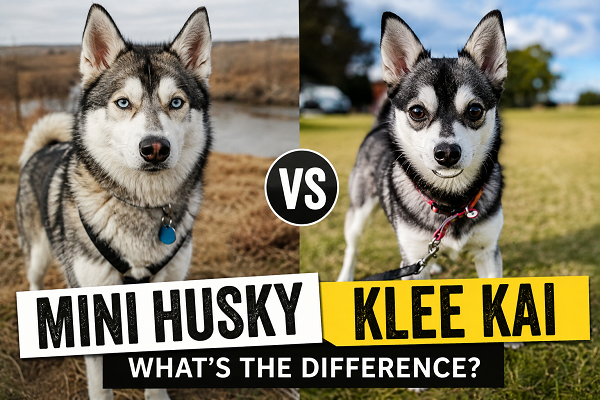
A Mini Husky is simply a small-sized Siberian Husky, either naturally undersized or produced by breeding down/crossing with smaller breeds. It is not recognized by any major kennel club. An Alaskan Klee Kai is a genuine, purpose-built breed developed in the 1970s from Alaskan Huskies, Siberian Huskies, Schipperkes, and American Eskimo Dogs, recognized by the United Kennel Club since 1997 and now in the AKC’s Miscellaneous Class. The Klee Kai tends to be smaller, more reserved with strangers, and easier to keep in an apartment, while the Mini Husky is friendlier but needs more space and exercise.
Table of Contents
- Introduction
- What Is a Mini Husky?
- What Is an Alaskan Klee Kai?
- Size and Appearance Compared
- Temperament: Which One Fits Your Home?
- Exercise, Training, and Trainability
- Grooming and Shedding
- Health Issues and Life Expectancy
- Cost of Ownership
- Which One Should You Choose?
- FAQs
- Final Thoughts
Introduction
If you’ve ever scrolled through dog photos online and stopped dead on a tiny, fox-faced Husky lookalike, you’ve probably typed “mini husky” into a search bar and landed on two very different answers. One says you’re looking at a Miniature Husky. The other insists it’s an Alaskan Klee Kai. Both photos can look almost identical to an untrained eye, and that’s exactly where the confusion starts.
I’ve fielded this question more times than I can count from people planning their next dog, and I get why it’s confusing. These two aren’t the same thing, they’re not related in the way most people assume, and picking the wrong one for your lifestyle can mean years of frustration for both you and the dog. So let’s clear it up properly.
What Is a Mini Husky?
Here’s the thing that trips people up first: there’s no such thing as an officially recognized “Miniature Siberian Husky” breed. No major kennel club, not the AKC, not the UKC, not the FCI, has a breed standard for it. What people call a Mini Husky is usually one of three things:
- A naturally small, purebred Siberian Husky. Breed standards allow some size variation, and breeders occasionally produce undersized, healthy pups that just top out smaller than average.
- A deliberately bred-down line. Some breeders pair smaller Siberian Huskies together over generations to consistently produce compact offspring.
- A crossbreed, mixing a Husky with a smaller breed like a Pomeranian (commonly called a Pomsky) or a Shiba Inu to shrink the frame while keeping the Husky look.
Because there’s no governing standard, a “Mini Husky” you buy from one breeder, can look and behave quite differently from one bought elsewhere. Full-grown, they typically stand around 12 to 17 inches at the shoulder and weigh somewhere between 20 and 35 pounds, roughly half the size of a standard Husky, which usually runs 45 to 60 pounds.
Personality-wise, a well-bred Mini Husky keeps almost everything that makes the standard Siberian Husky lovable: friendly with strangers, good with kids, playful, vocal, and stubborn enough to test a first-time owner’s patience.
What Is an Alaskan Klee Kai?
The Alaskan Klee Kai (often shortened to AKK) has a documented, traceable history, and that’s the single biggest difference between it and a Mini Husky. Breeder Linda Spurlin started developing the breed in Alaska in the early 1970s after seeing an unusually small Husky-type dog on a family trip. She spent years crossing Alaskan Huskies and Siberian Huskies with the Schipperke and American Eskimo Dog to lock in a smaller, companion-sized dog with that classic wolf-and-Husky look.
The breed wasn’t released to the public until 1988. It was officially named “Alaskan Klee Kai” in 1995 to tie it to its Alaskan roots (“Klee Kai” comes from an Athabascan phrase meaning roughly “small dog”), and the United Kennel Club granted it full recognition on January 1, 1997. More recently, the American Kennel Club moved the breed into its Miscellaneous Class in June 2025, an important step toward full AKC recognition. It’s still not recognized by the FCI in Europe.
The AKK comes in three official size categories, which is another thing you won’t find with Mini Huskies:
- Toy — up to about 13 inches, under 10 pounds
- Miniature — roughly 13 to 15 inches, 10 to 15 pounds
- Standard — roughly 15 to 17 inches, 15 to 22 pounds
Even at the largest “Standard” size, most Klee Kai stay noticeably smaller and more delicate-boned than a Mini Husky. And because the breed is still fairly young and carefully managed, it remains genuinely rare. Estimates put the total worldwide population at under a few thousand registered dogs, which is why waiting lists with reputable breeders can run a year or longer.
Size and Appearance Compared
At a glance, both breeds share the mask-like facial markings, upright triangular ears, curled tail, and black-and-white or red-and-white coloring that make people mistake them for baby Huskies. Look closer, though, and the differences show up fast.
| Feature | Mini Husky | Alaskan Klee Kai |
|---|---|---|
| Height | 12–17 inches | 13–17 inches (across all 3 sizes) |
| Weight | 20–35 lbs | 5–22 lbs, depending on size class |
| Build | Stockier, more like a scaled-down sled dog | Slimmer, fox-like, finer bone structure |
| Ears | Same as standard Husky | Larger relative to head size |
| Paws | Husky-sized, larger | Noticeably smaller and daintier |
| Eyes | Blue, brown, bi-eyed, or parti-eyed | Any color, heterochromia common |
If you’re standing next to one of each, the Klee Kai’s build usually gives it away, it looks like it was built for a lap, not a sled team, even though its ancestors pulled sleds too.
Temperament: Which One Fits Your Home?
This is where I’d stop most people from choosing on looks alone. Temperament is the real dealbreaker between these two.
Mini Huskies inherit the standard Siberian Husky’s social, pack-oriented personality. They’re generally:
- Outgoing and friendly with strangers and other dogs
- Good with children when raised around them
- Independent and occasionally stubborn during training
- Not natural watchdogs, Huskies are famously bad guard dogs because they tend to greet intruders like long-lost friends
Alaskan Klee Kai are a different animal socially. Breeders selected for a more cat-like, reserved temperament, closer to their Schipperke ancestry than their Husky side. Expect:
- Deep bonding with immediate family, wariness toward new people
- A genuine watchdog instinct, they’ll alert you to visitors, even if they won’t do much beyond bark
- High intelligence paired with an independent streak
- A need for early, consistent socialization, or that wariness can tip into fearfulness
If you want a dog that greets every visitor like a celebrity, the Mini Husky wins. If you want a dog that’s a little more selective about who it trusts and doubles as a built-in doorbell, the Klee Kai fits better. Neither breed, by the way, makes a reliable personal protection dog, if security is genuinely your priority, you’ll want to look at breeds actually developed for that job. Our team breaks down which dogs are worth considering in our guide to the best protective family dogs picked by a K9 trainer.
Exercise, Training, and Trainability
Both breeds are smart, and both breeds can be a handful for a first-time owner, but the exercise math is different.
Mini Husky exercise needs: Because it’s essentially a smaller Siberian Husky, this dog inherits real working-dog stamina. Plan on at least 60 to 90 minutes of active exercise daily: running, hiking, structured play, or a job to do. Skip it consistently and you’ll get a howling, digging, fence-testing dog fast.
Klee Kai exercise needs: Lighter, but not light. Most AKKs do fine with about 45 to 60 minutes split across a couple of walks and some mental stimulation, which makes them noticeably more apartment-friendly. That said, an under-stimulated Klee Kai gets vocal, and this breed has a wide vocal range, chirps, howls, and a sound owners nickname the “AKK scream” that can rattle neighbors.
Training-wise, both breeds are intelligent enough to pick up commands quickly but independent enough to decide whether they feel like listening. Positive reinforcement works far better than correction-heavy methods with either dog. If you’re setting up a new puppy’s routine from day one, crate training, socialization windows, house rules, getting the early structure right matters more with these breeds than with more naturally biddable ones. I go deeper into the exercise side of things for spitz-type and working dogs in this piece on how often you should really be exercising a working dog, which applies well to Mini Huskies especially.
Grooming and Shedding
Neither breed is low-shedding, so if you’re chasing a hypoallergenic pup, look elsewhere. Both carry a double coat, a soft, insulating undercoat plus a coarser topcoat and both blow that undercoat heavily twice a year during seasonal shedding (“coat blow”).
Weekly maintenance for both breeds:
- Brush 2–3 times a week normally, daily during shedding season
- Bathe only occasionally (every 6–8 weeks) since over-bathing strips natural oils
- Check and trim nails every 3–4 weeks
- Clean ears weekly, especially the Klee Kai’s larger, more open ear canals
One small upside for Klee Kai owners: many AKKs are noted for being unusually clean, self-grooming dogs, closer in habit to a cat than a typical spitz breed. It doesn’t cut brushing time down much, but it does mean less doggy odor between baths. If you’re weighing several low-fuss breed options against these two, our roundup of 10 low-maintenance dog breeds with basic grooming needs is worth a look for comparison.
Health Issues and Life Expectancy
Mini Husky: Because it’s genetically a Siberian Husky (or a Husky cross), it generally inherits the same health profile as the standard breed, plus whatever conditions come from any crossbred parent. Watch for hip dysplasia, progressive retinal atrophy, and hypothyroidism. Life expectancy typically runs 12 to 15 years, similar to a standard Husky, sometimes slightly longer thanks to the smaller frame putting less strain on joints.
Alaskan Klee Kai: Because the breed is young and breeders have kept the gene pool tightly managed with mandatory health testing, AKKs are generally considered a fairly healthy breed for their size, though a few conditions show up often enough to be on every buyer’s radar:
- Juvenile cataracts — hereditary, can affect vision starting young
- Patellar luxation — a loose kneecap, common in small breeds generally
- Factor VII deficiency — a hereditary blood clotting disorder
- Hypothyroidism — underactive thyroid, manageable with lifelong medication
- Liver shunts and heart murmurs — less common but reported
Life expectancy for a Klee Kai runs 13 to 16 years, on the longer end for a dog this size, which is one more reason responsible breeders lean so hard on genetic testing before pairing dogs.
Whichever breed you’re leaning toward, always ask the breeder directly for OFA or equivalent health clearances on the parents. A reputable Klee Kai breeder will have cataract and Factor VII testing on hand without you having to ask twice.
Cost of Ownership
This is where the “rare breed” status of the Klee Kai really shows up in your wallet.
Mini Husky puppy price: Generally $600 to $1,500 from a breeder, occasionally less from casual or backyard breeders (proceed carefully, that price gap usually reflects health testing, or the lack of it).
Alaskan Klee Kai puppy price: Typically $2,000 to $3,500, and it’s not unusual to see well-bred toy-sized pups from established breeders go higher. Waiting lists of 6 to 18 months with reputable breeders are common because litters are small and demand outpaces supply.
First-year costs (food, vaccines, initial vet visits, supplies) generally run $1,000 to $2,000 for either breed, and annual upkeep after that, food, routine vet care, flea/tick prevention, typically lands between $1,000 and $2,000 a year, more if a hereditary condition like patellar luxation or cataracts needs treatment down the line.
Add it up over a 13-to-15-year lifespan and a Klee Kai can easily run into five figures of lifetime cost once you factor in the higher purchase price and potential eye or joint surgery. It’s not a decision to make on impulse.
Which One Should You Choose?
Neither breed is objectively “better”, it genuinely comes down to your household, your energy level, and what kind of relationship you want with your dog.
Choose a Mini Husky if you:
- Want a friendly, outgoing dog that loves everyone
- Have a yard or regular access to trails and open space
- Can commit to 60+ minutes of real exercise daily
- Don’t mind a stubborn streak and some vocal opinions
- Are comfortable with a dog that isn’t a natural guard dog
Choose an Alaskan Klee Kai if you:
- Live in an apartment or smaller home
- Want a dog that bonds intensely with you specifically
- Can invest time in early socialization to prevent shyness
- Don’t mind (or actually want) a dog that alerts to strangers
- Are prepared to pay more upfront and wait for a litter
Whichever way you lean, both breeds do best with owners who understand spitz-type behavior, the independence, the vocalizations, the need for mental stimulation on top of physical exercise. If that’s new territory for you, it’s worth building your training toolkit before the puppy comes home rather than after. I put together a lot of what I’ve learned from handling vocal, high-drive breeds like these into my e-book, Beyond the Bark, which covers exactly this kind of early groundwork.
FAQs
1. Can a Mini Husky and an Alaskan Klee Kai breed together? Technically yes, since both share Husky ancestry, but responsible breeders of either type don’t cross them. Doing so would produce an unpredictable mix with no breed standard, muddying both the AKK’s carefully managed gene pool and the general “Mini Husky” line.
2. Is a Klee Kai the same as a Pomsky? No. A Pomsky is a deliberate cross between a Pomeranian and a Husky, with no official breed recognition. The Alaskan Klee Kai is a distinct, UKC-recognized breed with a documented lineage going back to the 1970s. They can look similar in photos, but their temperaments and coat types differ noticeably.
3. Are Mini Huskies or Klee Kai good with kids? Mini Huskies generally do well with children thanks to their friendly, pack-oriented nature, provided kids are taught to respect the dog’s space. Klee Kai can be good with kids too, but their more reserved, cautious temperament means early socialization with children specifically is important, and supervision is a must either way. For a broader look at which breeds handle family life best, our article on choosing a protective yet family-friendly dog covers useful ground.
4. Do Mini Huskies or Klee Kai bark a lot? Both breeds are vocal, but in different ways. Mini Huskies are known for howling more than barking. Klee Kai have an especially wide vocal range, including a distinctive high-pitched sound owners often call the “AKK scream,” and they’ll use it if bored or under-exercised.
5. Which breed is easier for a first-time dog owner? Neither is a true “beginner” breed, but the Mini Husky’s friendlier, more forgiving temperament generally makes it slightly easier for new owners, provided they can meet its exercise needs. The Klee Kai’s wariness and need for early, careful socialization tends to suit owners with some prior dog experience.
Final Thoughts
The short version: a Mini Husky is a smaller Siberian Husky with a Husky’s open, friendly heart, while the Alaskan Klee Kai is its own carefully built breed with a more reserved, watchful personality packed into an even smaller frame. Get the size right, and you’ve only solved half the puzzle, matching temperament and exercise needs to your actual daily life is what determines whether you end up with a happy dog or a frustrated one howling at 6 a.m.
Before you commit to either breed, talk to a breeder who health-tests, meet the parent dogs if you can, and be honest with yourself about how much exercise and socialization time you can realistically give. Get that part right, and both of these small Husky look-alikes make genuinely wonderful, devoted companions.
If you’re still narrowing down your options, it’s worth browsing a few more comparisons before you decide, breeds like the King Shepherd or a Bichon Poodle cross might end up being a better fit depending on what you’re actually looking for in a companion.

Her work centers on applied training across obedience, detection, protection, and operational readiness, with a strong focus on Military Working Dogs (MWDs) and security K9 programs. Rather than relying on theory alone, Rofiat emphasizes proven training methods built on repetition, consistency, and real-world conditioning principles that prepare both dogs and handlers for high-pressure tasks.
Through articles, training content, and documentaries, she shares experience-based insights from the field, highlighting how structured training, clear communication, and trust between handler and dog directly impact performance and reliability.
Drawing from years of frontline experience, she is also the author of “Beyond the Bark: Inside a Pro Handler’s Playbook for Raising the Ideal Dog,” a practical guide designed to help dog owners and handlers apply professional training principles in everyday situations.
She remains committed to responsible K9 development, continuous skill refinement, and practical education for handlers, trainers, and dog professionals.
- Are Corgis Easy to Train? A K9 Trainer’s Honest Guide - September 9, 2026
- How Much Does a Dog Really Cost in Nigeria? (2026) - September 9, 2026
- Best Dog for Security and Family: Top 7 Breeds - September 8, 2026