Pug Exercise Safety Guide: How Much Is Too Much?
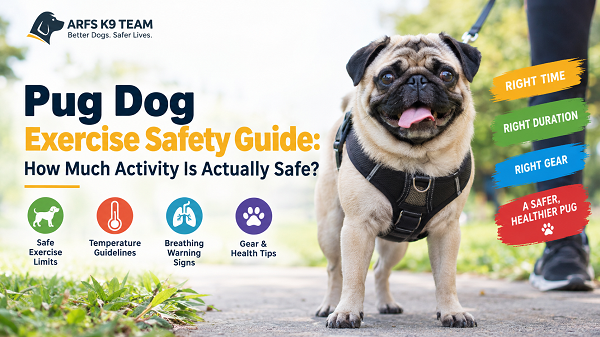
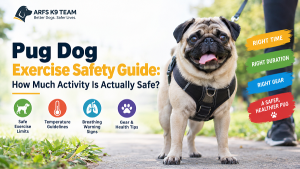
A healthy adult pug needs about 20 to 40 minutes of gentle exercise a day, split into two or three short sessions rather than one long walk, done in cool morning or evening temperatures, and stopped the moment breathing gets loud or labored. Pugs are brachycephalic (flat-faced) dogs, so their airway is physically too narrow to cool them the way a longer-nosed dog’s airway can, which makes overheating and breathing distress a real risk during exercise, not just a myth.
Table of Contents
- Why Pugs Need a Completely Different Exercise Plan
- How Much Exercise Does a Pug Actually Need?
- The Temperature Rules: When It’s Too Hot or Too Cold
- Reading the Warning Signs: The 4-Grade Breathing Scale
- Safe Exercises vs. Exercises to Avoid
- Gear That Helps (and Gear That Hurts)
- The Weight Connection Nobody Talks About Enough
- Emergency Protocol: If Your Pug Overheats
- Puppy and Senior Pug Adjustments
- Trainer’s Notes: Real Cases I’ve Seen
- FAQs
- Conclusion
Introduction
I’ve spent years around working and companion dogs, and pugs are one of the breeds people underestimate the most. Owners either baby them into obesity or push them like a Labrador and end up in an emergency vet clinic. This guide walks you through the real numbers: how long to walk, what temperature is genuinely dangerous, which activities are off-limits, and exactly what to do if your pug starts overheating. It’s built on veterinary research from the Royal Veterinary College (RVC), the Kennel Club’s Respiratory Function Grading Scheme, and data from thousands of pugs under veterinary care, not a repeated list of “keep walks short” with no actual numbers attached.
Why Pugs Need a Completely Different Exercise Plan
Here’s the thing most generic “dog exercise” articles miss: a pug’s face isn’t just cute, it’s a functional limitation. Pugs belong to a group of dogs vets call brachycephalic, meaning “short head.” Their skull has been bred to be short and flat, but their soft tissue (soft palate, tonsils, nasal folds) didn’t shrink to match. That extra tissue crowds a much smaller airway.
Dogs cool themselves almost entirely through panting, moving air across a long, wet tongue and nasal passage to release heat. A pug’s airway is too narrow and too obstructed by soft tissue to move air efficiently, so panting, their only real cooling method, works far worse for them than it does for a Border Collie or a Labrador. That’s the whole problem in one sentence: the exact mechanism a pug needs most during exercise is the one their body does worst.
This combination has an actual name: Brachycephalic Obstructive Airway Syndrome, or BOAS. It isn’t a rare complication, it’s a spectrum every pug sits somewhere on. Researchers at Cambridge University, working with the UK Kennel Club, built a grading system for it (more on that below), and it’s now used by vets across 18 countries, including through the Orthopedic Foundation for Animals in the US and Canada.
Add to that a body built low and heavy relative to its legs, a tendency toward joint and spine issues, and a breed that the Royal Veterinary College’s VetCompass program found carries more health predispositions than protections compared to other dogs, and you’ve got a breed where exercise has to be planned, not improvised.
How Much Exercise Does a Pug Actually Need?
Let’s get specific, because “just don’t overdo it” isn’t a plan.
Adult pugs (1–7 years, healthy weight, Grade 0–1 breathing):
- 20–40 minutes total per day
- Split into 2–3 sessions of 10–15 minutes each
- Flat, shaded routes; avoid hills and stairs where possible
- A mandatory breather every 10–15 minutes, even if your pug seems fine
Puppies (under 12 months):
- Short, frequent play sessions rather than structured walks
- A rough guide vets use for growing dogs generally is about 5 minutes of structured exercise per month of age, twice a day, so a 4-month-old pug gets roughly 20 minutes total, split up
- Skip stairs, jumping on/off furniture, and repetitive high-impact play; a pug’s growth plates and short legs don’t need that stress this early
Senior pugs (7+ years):
- 15–25 minutes, often best as three short outings
- Watch for stiffness, reluctance, or slower recovery after activity, all common signs of the joint and spinal issues this breed is prone to
Overweight or Grade 2–3 BOAS pugs:
- Exercise is still important, but intensity has to drop and it should be done under vet guidance, since obesity and BOAS severity feed each other in a loop that gets worse without careful management
If you’re weighing up whether a flat-faced breed like the pug actually fits your household activity level in the first place, our dog breed selector guide walks through matching a breed’s real exercise needs to your lifestyle before you commit, which is honestly a conversation worth having before, not after, bringing a pug home.
And if you’re comparing this to a higher-drive dog in your household, it’s worth knowing the numbers look completely different; our breakdown on how often you should exercise a working dog covers why breeds like Malinois or German Shepherds need 1–2+ hours daily, roughly four to six times what a pug can safely handle.
The Temperature Rules: When It’s Too Hot or Too Cold
This is where most pug owners get caught out, because the danger zone starts much earlier than people expect.
Brachycephalic breeds can start showing signs of heat stress at temperatures that feel completely mild to a human, sometimes as low as 21°C (70°F), especially with humidity or direct sun involved. That’s not a heatwave. That’s a pleasant spring afternoon.
A practical walk-decision chart:
| Temperature | Risk Level | What To Do |
|---|---|---|
| Below 15°C (59°F) | Low risk | Normal walk length, dress for cold if under 10°C (50°F) |
| 15–20°C (59–68°F) | Conditional | Fine in shade with a breeze; shorten if humid or sunny |
| 21–25°C (70–77°F) | Caution | Early morning/late evening only, 10–15 minutes, plenty of shade |
| Above 26°C (79°F) | High risk | Skip the walk; use indoor play or a cooled, shaded yard instead |
A few extra rules that matter more for pugs than for most breeds:
- Check the pavement, not just the air. Asphalt can run 20–30°C hotter than the air temperature. If you can’t hold the back of your hand on it for 7 seconds, it’s too hot for paws.
- Humidity changes everything. A humid 24°C day can be more dangerous than a dry 29°C day, because humidity is exactly what blocks the evaporative cooling panting relies on.
- Excitement counts as exertion. Vets note that pugs can overheat from excited play, car rides, or visitors at the door, not just from walks, because the breathing effort involved is similar either way.
- Cold isn’t harmless either. Short coats and low body fat mean pugs chill quickly below 5°C (41°F); a sweater and a shorter outing works better than pushing through.
If your climate runs hot for a good chunk of the year, a cooling vest can genuinely extend the safe window for outdoor time. We’ve tested a range of them in our dog cooling vest guide, including which designs actually lower core temperature versus which ones are mostly marketing.
Reading the Warning Signs: The 4-Grade Breathing Scale
Vets don’t just eyeball whether a pug is “breathing hard.” Cambridge University’s Respiratory Function Grading Scheme, now used in the UK, US, Canada, and over a dozen other countries, scores brachycephalic dogs on a 0–3 scale based on noise and effort, both at rest and right after three minutes of brisk walking:
- Grade 0: No noise, no visible effort, at rest or after exercise. This is the goal.
- Grade 1: Mild, intermittent snoring-type noise; no real effort to breathe in. Generally fine for normal daily exercise.
- Grade 2: Noticeable to loud noise, visible effort, and possibly frothy saliva after exercise. Time to scale activity back and get a vet check.
- Grade 3: Severe noise and effort at rest or after minimal activity, possibly with blue-tinged gums or fainting. This is a surgical-consultation conversation, not a “push through it” situation.
You don’t need a vet’s stethoscope to spot the practical version of this at home. Stop the activity immediately if your pug shows:
- Loud, harsh, or raspy breathing that doesn’t settle within a couple of minutes of rest
- Gums or tongue turning pale, blue, or dark red/purple instead of normal pink
- Wobbling, stumbling, or looking disoriented
- Excessive drooling or foaming, especially combined with retching
- Collapse, even briefly
One statistic that surprised even me: in a Cambridge/UFAW-linked study of 95 pugs and French bulldogs, only 4 owners reported that breathing problems were limiting their dog’s daily life, yet a vet’s physical exam found that nearly a third of those same dogs (31 of 95) had moderate to severe BOAS signs. In plain terms, owners routinely underestimate how much their dog is struggling because loud breathing gets normalized as “just how pugs sound.” It isn’t. It’s information.
Safe Exercises vs. Exercises to Avoid
Generally safe, in moderation:
- Leisurely leash walks on flat, shaded ground
- Short, low-key fetch in a cool room or shaded yard
- Sniff walks (letting your pug explore slowly at their own pace, which tires them mentally without heavy cardio load)
- Puzzle feeders and nose-work games for indoor mental exercise on hot or cold days
- Gentle, supervised play with a calm dog friend
Approach with real caution:
- Swimming. Some pugs enjoy water, but their body shape (short legs, barrel chest, heavy head) makes them poor natural swimmers, and the effort of staying afloat adds to breathing strain. If you swim with your pug, use a well-fitted dog life vest, stay in shallow water, and keep sessions under a few minutes with breaks.
- Stairs and jumping on/off furniture. Frequent stair use and jumping put repeated stress on a pug’s spine and joints; several structural back and joint problems are more common in this breed than in typical dogs, so minimizing avoidable impact matters over a lifetime, not just in one session.
- Group dog parks. Excitement plus running plus heat is a bad combination for a breed prone to overheating from arousal alone, not just physical output.
Avoid entirely:
- Running, jogging, or biking alongside your pug at pace
- Any exercise during the “high risk” temperature zone above
- Long hikes, especially anything with sustained inclines
- Repetitive high-impact games like frisbee that involve jumping and hard landings
- Continuing activity once your pug hits Grade 2 breathing signs
Gear That Helps (and Gear That Hurts)
A collar puts direct pressure on the throat and trachea every time your pug pulls, which is exactly the area you’re trying to protect in a breed already prone to airway restriction and, in some cases, tracheal collapse. Switch to a well-fitted, Y-front harness that distributes pressure across the chest and shoulders instead of the neck.
What to actually look for:
- A Y-shaped front that clears the throat entirely rather than sitting across it
- Adjustment points at the neck and chest, since pug proportions (short neck, wide chest) don’t match standard sizing charts well
- Breathable mesh or padded lining, since anything that traps heat against the body works against you in warm weather
- A front-clip or dual-clip design if your pug pulls, since it reduces forward lunging without adding neck pressure
Skip retractable leads for this breed. They give too much room for a pug to hit the end of the line at speed, which can jolt the chest and airway even through a harness. A standard 4–6 foot leash gives you faster control if you need to stop activity the moment breathing changes.
The Weight Connection Nobody Talks About Enough
This is arguably the single biggest lever pug owners have, and it’s the one most overlooked in generic exercise articles.
Royal Veterinary College research found that obesity is by far the most commonly diagnosed health disorder in pugs, affecting close to one in five pugs (roughly 17%) each year, and that pugs are over three times more likely to become obese than the average dog. Separate VetCompass data on pugs under UK veterinary care found overweight/obesity was the single most frequent disorder recorded, ahead of eye and ear conditions.
Why this matters specifically for exercise safety: excess weight makes breathing harder in a dog whose airway is already compromised, it raises the risk of overheating because fat is an insulator that traps body heat, and it increases joint and spinal load during any activity. A lean pug tolerates a 30-minute walk far better than an overweight pug tolerates a 15-minute one. Weight management isn’t separate from exercise safety here, it’s the foundation of it.
Practical steps: measure food rather than eyeball it, cut treats to under 10% of daily calories, weigh your pug monthly, and talk to your vet about a body condition score check rather than relying on the bathroom scale number alone, since ideal weight varies dog to dog.
Emergency Protocol: If Your Pug Overheats
Here’s a piece of advice you’ll still see repeated across the internet that’s now considered outdated and, worse, harmful: cooling a hot dog slowly with lukewarm water because cold water supposedly causes “shock.”
Current veterinary guidance from the Royal Veterinary College, based on a review of hundreds of UK heatstroke cases, is the opposite: cool first, transport second. Their research found that fewer than a quarter of dogs brought in for heatstroke had been actively cooled beforehand, and just under a quarter of those had used the actually-recommended method. Delaying effective cooling to rush to the vet costs valuable time, since the longer a dog’s core temperature stays elevated, the more organ damage occurs.
If your pug shows heatstroke signs (collapse, extreme panting, bright red or purple gums, vomiting, disorientation):
- Move them out of heat immediately, into shade or air conditioning.
- Cool them with water colder than their body, cold water immersion for a young, otherwise healthy pug, or pouring cool water over the body combined with a fan or breeze for older dogs or those with existing health conditions.
- Keep air moving across the wet fur, a fan, open car window, or AC vent all work; evaporation is doing the real cooling work here.
- Offer small amounts of water to drink, don’t force it.
- Call your vet while cooling, not instead of it. Once your pug is responsive and cooling has started, transport to a vet for a full check, heatstroke can cause internal damage that isn’t visible from the outside.
One sobering number worth remembering: UK veterinary data found that during heat-health alert periods, practices saw roughly five times more heatstroke cases than normal, and about one in four dogs presenting with heatstroke during that window died. This isn’t a breed quirk to shrug off, it’s a genuine emergency.
Puppy and Senior Pug Adjustments
Puppies: Keep everything low-impact until growth plates close, generally sometime after 10–12 months for a breed this size. Free play in a securely fenced yard, on grass rather than concrete, is better than structured leash walks at this stage. Avoid excessive stair use and jumping off furniture; it’s a small habit that compounds into joint problems later.
Seniors: Exercise shouldn’t stop, a sedentary older pug loses muscle and joint mobility faster, but sessions should get shorter and gentler, with closer attention to recovery time afterward. If a walk that used to take 15 minutes to recover from now takes 30, that’s your dog telling you to scale back and mention it at their next vet visit.
Trainer’s Notes: Real Cases I’ve Seen
I want to share two situations that show how this plays out in real life, not just in a chart.
The first was a client’s 4-year-old pug who’d start wheezing about eight minutes into every walk, every single day, and the owner assumed that was normal “pug sound.” A vet check found Grade 2 BOAS. Once they switched to three 10-minute walks instead of one 25-minute walk, kept to early morning and evening, and dropped the dog’s weight by about a kilogram over two months, the wheezing dropped to occasional and mild. Nothing about the dog’s airway anatomy changed, the exercise pattern and weight did.
The second was a pug who collapsed after 20 minutes of play at a family barbecue on a 25°C day, the kind of day nobody thinks twice about. Excitement, sun exposure, and a full stomach combined to push the dog into heat stress fast. Quick cooling with a garden hose and a fan while a family member called the emergency vet line likely prevented a much worse outcome. The lesson stuck with everyone there: it doesn’t have to be a scorching day, and it doesn’t have to be a “real” workout, for a pug to overheat.
Trainer Note
This guide draws on peer-reviewed veterinary research from the Royal Veterinary College’s VetCompass program, the University of Cambridge and UK Kennel Club’s Respiratory Function Grading Scheme (now adopted internationally, including by the Orthopedic Foundation for Animals in North America), and published studies on BOAS-affected pugs and French Bulldogs. It’s combined with direct handler experience working with brachycephalic and companion breeds in real training and consultation settings, not repackaged from a single source. Where numbers are cited (obesity rates, BOAS grading, heatstroke statistics), they come from named studies and organizations so you can verify them yourself rather than take a blog’s word for it.
FAQs
1. How long can a pug safely go for a walk?
Most healthy adult pugs do best with 10–15 minute walks, two to three times a day, adding up to 20–40 minutes total, rather than one long walk. Always adjust down for heat, humidity, age, or any breathing noise.
2. Can pugs go on long hikes?
It’s not recommended. Sustained inclines, distance, and unpredictable temperature and shade conditions make long hikes risky for a breed already prone to overheating and breathing distress. Short, flat, shaded routes are a far safer fit.
3. What temperature is too hot for a pug to exercise in?
Caution starts around 21°C (70°F), and exercise should generally stop above 26°C (79°F), earlier if it’s humid or sunny with no shade. Pavement heat and excitement level matter as much as the air temperature itself.
4. Is it normal for pugs to breathe loudly during exercise?
Mild, intermittent snoring-type noise (Grade 1 on the vet grading scale) is common and generally not dangerous. Loud, harsh breathing that doesn’t settle with rest, or any gum color change, is not normal and means the activity should stop immediately.
5. Do pugs need less exercise than other dogs?
Not necessarily less in total minutes needed for health, but structured very differently: shorter sessions, cooler timing, flatter terrain, and closer monitoring than a typical medium-energy breed would need.
Conclusion
Exercising a pug safely isn’t about doing less, it’s about doing it differently. Short, frequent sessions beat one long walk. Early morning and evening beat midday. A harness beats a collar. And knowing the difference between normal pug snorting and a Grade 2 breathing problem can genuinely be the difference between a healthy dog and an emergency vet visit.
The numbers are worth remembering: 20–40 minutes split into short sessions for a healthy adult, caution above 21°C, a hard stop above 26°C, and cool first, transport second if things go wrong. Keep your pug lean, watch their breathing rather than just their tail wag, and adjust the plan as they move from puppy to adult to senior.
If this guide helped, we cover breed-specific safety, gear reviews, and training breakdowns like this every week. Subscribe to our newsletter for the next one straight to your inbox, and if you want a deeper, structured resource to keep on hand, our Beyond the Bark: Inside a Pro Handler’s Playbook for Raising the Ideal Dog goes further into everyday care decisions like this one.

Her work centres on obedience, detection, protection and operational readiness. She favours proven methods built on repetition, consistency and real-world conditioning, so that both dogs and handlers are prepared for high-pressure tasks.
Rofiat represented the Nigerian Army Dog Centre at the Nigerian Army Day Celebration (NADCEL) 2026, where she led demonstrations in obedience, explosive detection, agility and tactical movement. Through articles, training content and documentaries, she shares field-based insight into how structured training, clear communication and trust between handler and dog affect performance and reliability.
She is the author of Beyond the Bark: Inside a Pro Handler's Playbook for Raising the Ideal Dog, a practical guide that helps dog owners and handlers apply professional training principles in everyday situations.
- Maltipoo Potty Training Schedule: Pro Tips That Work - October 30, 2026
- Pug Exercise Safety Guide: How Much Is Too Much? - October 29, 2026
- How Much Do Local Dog Groomers Cost? (2026 Price Guide) - October 28, 2026