Dog Anxiety Symptoms: 9 Signs Every Owner Must Know
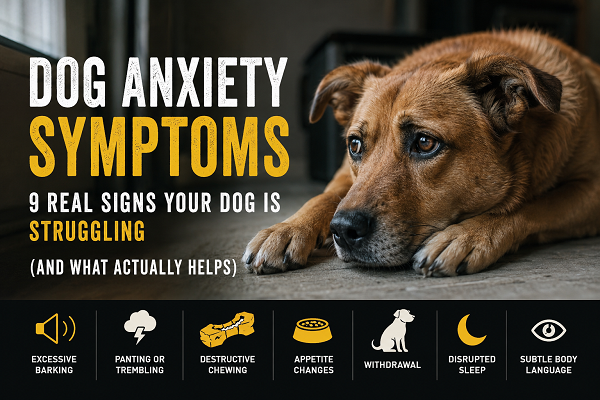
Dog anxiety symptoms include stress panting, drooling, trembling, nonstop barking or whining, destructive chewing near doors, pacing, clinginess, appetite changes, indoor accidents, hiding or sudden snapping, and compulsive licking. Most anxious dogs show a cluster of these, usually after quieter body-language clues like lip licking, whale eye and a tucked tail. In a 2020 survey of 13,700 Finnish dogs, 32% were highly fearful of at least one noise, so this is far more common than most owners think. Rule out pain or illness with your vet first, then fix the trigger, build a predictable routine and teach calm in small steps.
Table of Contents
- Introduction
- Stress, Fear and Anxiety: What’s the Difference?
- How Common Is Dog Anxiety?
- Early Warning Signs: The Body Language Cheat Sheet
- 9 Dog Anxiety Symptoms You Shouldn’t Ignore
- Anxiety or Something Medical? The Lookalike Problem
- Anxiety at Every Age: Puppies, Adults and Seniors
- What Triggers Dog Anxiety (and the 4 Main Types)
- The 7-Day Anxiety Diary
- What NOT to Do With an Anxious Dog
- A 4-Week Plan to Calm an Anxious Dog
- When to Call a Vet or Behaviorist
- A Handler’s Honest Take
- FAQs
- Final Thoughts
Introduction
Your dog shreds a cushion the second you leave. Or he paces all night. Or she hides when guests show up. Somewhere between “he’s just being naughty” and “something is seriously wrong,” most owners get stuck. Here’s the thing: those are classic dog anxiety symptoms, and scolding makes every one of them worse.
I’ve spent over a decade handling working dogs, including military and security K9s. One lesson holds across every breed and every job: an anxious dog isn’t a disobedient dog. It’s a dog whose nervous system is stuck in alert mode. A talented K9 in that state underperforms, and a family pet in that state falls apart in smaller, messier ways.
In this guide, you’ll learn:
- The 9 signs of anxiety in dogs, including the quiet ones most owners miss
- How to tell anxiety apart from pain, illness and old-age confusion
- How to track your dog’s triggers with a simple 7-day diary
- A 4-week plan you can start tonight, plus clear red flags for calling a vet

Stress, Fear and Anxiety: What’s the Difference?
Anxiety is your dog’s reaction to a threat that hasn’t arrived yet. Fear reacts to a threat that’s happening right now. Stress is the body’s general strain response to either one. Vets often group all three on one Fear, Anxiety and Stress (FAS) scale, because the same dog can slide from one to the next in minutes.
| Term | What it means | Everyday example |
|---|---|---|
| Stress | The body’s strain response to pressure | Panting and yawning in a busy vet waiting room |
| Fear | A reaction to a real threat happening now | Bolting when a firework explodes |
| Anxiety | Dread of something that might happen | Pacing and drooling because you picked up your car keys |
Why does this matter? Because anxiety is a whole-body event. Stress hormones like cortisol and adrenaline spike, the heart speeds up and digestion goes haywire. The brain’s alarm centre takes over, and trained commands slip away. That’s why a dog with perfect “sit” can ignore you completely mid-panic. It’s biology, not defiance.
How Common Is Dog Anxiety?
More common than most owners think. The best data comes from a 2020 study in Scientific Reports by Salonen and colleagues at the University of Helsinki. Owners of about 13,700 pet dogs, covering 264 breeds, filled in a detailed behavior questionnaire. Around 72.5% of the dogs showed at least one anxiety-related trait.
| Trait in the Finnish study | Share of dogs |
|---|---|
| Fear of at least one noise | 32% |
| Fear of fireworks specifically | 26% |
| General fearfulness (other dogs 17%, strangers 15%, new situations 11%) | 29% |
| Aggression | 14% |
| Separation-related behavior | 5% |
Three details stand out. First, 53% of the highly noise-sensitive dogs feared more than one sound, so anxiety tends to spread. Second, noise fear grew with age, especially fear of thunder. Third, breed mattered a lot. Lagotto Romagnolo, Wheaten Terriers and mixed breeds ranked highest for noise sensitivity, while Labrador Retrievers ranked lowest. Spanish Water Dogs and Shetland Sheepdogs ranked among the most fearful.
Two honest caveats. The data came from owner surveys in one country, so treat the numbers as a strong guide, not a global census. And the 5% separation figure is lower than many owners expect, which is a reminder that noise and general fear cause more trouble than being alone for a lot of dogs.
The takeaway? If your dog shows these signs, you didn’t do something uniquely wrong, and your dog isn’t broken.
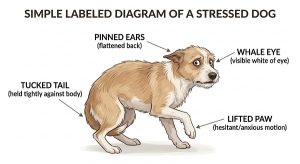
Early Warning Signs: The Body Language Cheat Sheet
By the time a dog barks nonstop or soils the carpet, the anxiety has usually been building for a while. Handlers learn to catch the quiet signals first. Here’s what to watch for.
| Signal | What you see | What it often means |
|---|---|---|
| Whale eye | Whites of the eyes show while the head stays still | Worry, or a warning to back off |
| Lip licking or yawning | Tongue flicks or big yawns when your dog isn’t hungry or tired | Mild stress, an attempt to self-calm |
| Tucked tail, lowered body | Tail pulled under, crouched or hunched posture | Fear or insecurity |
| Pinned ears | Ears flat against the head | Stress or fear rising |
| Freezing | Sudden stillness, mouth closed | A decision point: flee, fight or hope the threat passes |
| Paw lift | One front paw held up | Unsure, uneasy |
| Dry shake-off | Shaking like after a bath, but dry | Letting go of tension |
| Fast blinking, dilated pupils | Wide dark eyes, quick blinks | Arousal and alertness |
| Weight shifted backward | Body leaning away from the trigger | Wants distance |
| Sudden sniffing or scratching | Out-of-context ground sniffing or scratching | Displacement behavior to cope |
One signal on its own proves nothing. A yawn can be a yawn. What matters is a cluster: two or three signals together, in a situation where something is bothering your dog. As a rule of thumb, if you spot three of these within a minute or so, treat it as real stress and give your dog some space. Also learn your dog’s normal. A dog who always pants a little differs from one whose panting is new.
9 Dog Anxiety Symptoms You Shouldn’t Ignore
Most anxious dogs show a mix of these, not just one. Some are loud. Others are so quiet owners read them as “calm” or “stubborn.” Each sign below comes with what it looks like, why it happens and what to do first.
1. Stress Panting, Drooling and Trembling
Panting when it’s cool and your dog hasn’t exercised is one of the most overlooked signs of anxiety in dogs. Add heavy drooling, shaking and wide, dilated pupils, and you’re looking at a body in fight-or-flight mode.
- What it looks like: Fast, shallow panting with a tight mouth corner, drool strings, trembling legs, a rigid stance.
- Why it happens: Adrenaline speeds up the heart and breathing. It’s the same wave a person feels before a panic attack.
- What to do: Move your dog to a quiet room, add white noise and stay close and calm. For predictable triggers like fireworks, plan ahead (see the toolkit later). Panting with no trigger at all needs a vet visit, because pain, heart disease and hormone problems also cause it.
2. Excessive Barking, Whining and Howling
Alert barking at the courier is normal. Anxious barking is different. It keeps going after the trigger leaves, or it starts before you do anything, like when you grab your keys.
- What it looks like: Barking that escalates instead of settling, howling the moment you leave, a thin, high whine you can hear from the driveway.
- Why it happens: Vocalizing is a distress call, and for a social animal it’s also an attempt to bring the pack back.
- What to do: Teach a “settle” cue on a mat during calm moments, never mid-meltdown. Don’t rush back in when the barking peaks, because that teaches your dog that panic works. Wait for a breath of quiet, then reward it.
3. Destructive Chewing, Digging and Escape Attempts
A chewed cushion isn’t spite. But where the damage happens tells you a lot. Teething puppies and bored adolescents wreck random things. Anxious dogs target exits: door frames, window sills, crate latches, gates.
- What it looks like: Scratched doors, torn blinds, bloody paws or cracked teeth, chewing that only happens when you’re gone.
- Why it happens: Chewing and digging burn off stress hormones, and exit-focused damage is an attempt to reach you.
- What to do: Rule out under-exercise first, since a well-exercised dog has less energy for demolition. Then build alone-time in tiny steps. A properly introduced crate can become a calm den, and our guide on how to crate train a puppy shows the process. One warning from field experience: if your dog is injuring himself in the crate, stop using it and call your vet. A panicking dog and a locked box is a dangerous mix.
4. Pacing, Restlessness and Broken Sleep
An anxious dog often can’t settle, physically. You’ll see the same lap around the living room, circling before lying down, then popping back up. At night, anxious dogs sleep lightly, startle at small sounds and wander at odd hours.
- What it looks like: Non-stop walking, trouble lying down, getting up repeatedly, waking you at 3 a.m.
- Why it happens: The body is trying to burn off stress hormones it can’t process.
- What to do: Give structured exercise, not just a lap around the block. Working and herding breeds especially need purposeful output, and our guide on how often to exercise a working dog breaks it down by drive level. At night, keep a dark, quiet sleeping spot and a steady bedtime.
5. Clinginess and Shadowing
This is the sign owners often take as a compliment. Your dog follows you to the bathroom, leans on you, paws at you, and can’t be in a different room. A bit of closeness is normal. A sudden jump in it is a flag.
- What it looks like: Following room to room, panic when a door closes between you, getting upset when you pick up keys, shoes or a bag.
- Why it happens: Your dog has learned that you are the source of safety, so any distance feels risky. Those departure cues (keys, shoes) become early-warning alarms.
- What to do: Teach a calm “place” cue, then reward your dog for staying on the mat while you move around. Practice picking up keys and sitting back down, so the cues stop predicting a departure. Don’t force independence all at once.
6. Appetite Changes and Refused Treats
Stress hormones affect the gut just like they do in people. Some anxious dogs stop eating. Others gulp their food or turn into obsessive scavengers.
- What it looks like: Skipped meals, gulping, sudden pickiness, or turning down a treat they normally love.
- Why it happens: Cortisol disrupts digestion and appetite hormones. A dog who won’t take a top-value treat is often too stressed to eat, and that’s a handy test: offer chicken or cheese in a scary situation, and if your dog says no, the stress level is high.
- What to do: Keep feeding times and spots predictable. Feed in a quiet place and pick up the bowl after 15 to 20 minutes. If a healthy adult skips food for more than a day or two, call your vet. Puppies and tiny breeds shouldn’t go long without eating, so call the same day.
7. House Soiling and an Upset Stomach
An adult dog who’s been reliably house-trained for years and suddenly goes indoors is rarely being spiteful. Anxiety hits bladder and bowel control hard. Loose stools and vomiting during stressful events are common too.
- What it looks like: Accidents only when you’re out or during storms and fireworks, submissive urination when greeting guests, diarrhea after a vet visit or move.
- Why it happens: A dog in a full stress response can lose the ability to hold it, much like your stomach dropping before a big exam.
- What to do: See your vet first to rule out a urinary infection, bladder stones or age-related incontinence. Then never punish an anxiety accident. Punishment teaches your dog that your return is dangerous, which deepens the anxiety. Clean with an enzyme cleaner so the scent doesn’t invite a repeat.
8. Hiding, Shutting Down or Sudden Aggression
Fear has two exits: flight or fight. A dog who hides under the bed, avoids eye contact and stops greeting you is just as distressed as the dog who growls, snaps or lunges when startled. The Finnish study found aggression in 14% of dogs, and fear was its most common companion trait.
- What it looks like: Disappearing when guests arrive, refusing to enter certain rooms, going limp when touched, or on the other side, growling over resources, snapping when touched in a sore spot, lunging at dogs on leash.
- Why it happens: A cornered, frightened dog uses whatever works to create distance. Pain can be hiding underneath too.
- What to do: Never punish a growl. A growl is a warning, and a dog punished for warning learns to skip it and bite. Let a withdrawn dog come to you on his own terms. For reactivity, daily structured work beats one-off corrections, and our reactive dog training exercises are built for exactly that.
9. Compulsive Licking, Chewing and Spinning
Repetitive behavior is a dog’s self-soothing tool gone too far. Think paw licking, flank sucking, tail chasing, spinning or staring at shadows. Left alone, constant licking can lead to acral lick dermatitis, raw, thickened sores that are hard to heal.
- What it looks like: Licking one spot for long stretches, hair loss, red or raw skin, behavior that’s hard to interrupt.
- Why it happens: Repetitive actions calm the nervous system, and the habit can lock in. The Helsinki researchers found that compulsive behavior, impulsivity and separation-related behavior often travel together. Dogs rated hyperactive and impulsive were more than three times as likely to show separation-related signs.
- What to do: Check for allergies, skin infections, fleas and joint pain first, since these cause licking too. Then address the stress trigger and add mental work such as scent games and chew time. See a vet if skin is broken.

Anxiety or Something Medical? The Lookalike Problem
This is the part most guides skip, and it’s where owners lose months. Several health problems copy dog anxiety symptoms almost perfectly. Treat the behavior alone and you may never fix the cause.
| What you see | Anxiety explanation | Medical lookalikes to rule out |
|---|---|---|
| Panting and restlessness | Stress response | Pain, heart or lung disease, Cushing’s disease, fever |
| Indoor accidents | Cortisol and lost control | Urinary infection, bladder stones, diabetes, kidney disease |
| Compulsive licking | Self-soothing | Allergies, skin infection, sore joints |
| Fear of noise | Noise sensitivity | Musculoskeletal pain |
| Aggression or hiding | Fear-driven defense | Pain, dental problems |
| Night pacing, new fears in an older dog | Generalized anxiety | Canine cognitive dysfunction (dog dementia) |
Two findings are worth knowing. A University of Lincoln and Brazilian study compared noise-sensitive dogs with and without musculoskeletal pain. The researchers concluded that vets should routinely check noise-fearful dogs for pain, and dogs whose pain was treated improved. It was a small study, just two groups of 10 dogs, but the logic is sound. A startle that tenses sore muscles hurts, and the dog links the noise to the pain.
The second is cognitive decline. In an older US study, 28% of owners of dogs aged 11 to 12 reported at least one sign of cognitive dysfunction, climbing to 68% at ages 15 to 16. So when a senior dog suddenly paces at night, forgets the house rules or seems afraid for no reason, don’t label it “anxiety” and leave it there.
The practical rule: any new or sudden behavior change gets a vet check before a training plan. And if pain is found and treated, the learned fear may linger, so you’ll still need some behavior work afterward.
Anxiety at Every Age: Puppies, Adults and Seniors
| Life stage | What anxiety often looks like | Best first move |
|---|---|---|
| Puppy (under 1 year) | Crying when alone, fear of new sounds and people. Some protest is normal in the first weeks home. | Gentle, positive socialization in the first months, short alone-time practice |
| Adult (1 to 7 years) | Separation distress, noise fear, reactivity, generalized worry | Vet check, then trigger tracking and desensitization |
| Senior (8+ years) | New noise fear, night restlessness, confusion, soiling | Vet check first for pain, hearing or vision loss and cognitive decline |
Puppies that miss varied, positive experiences during their early socialization window (roughly the first 3 to 14 weeks) often struggle more with novelty later. That’s why early, gentle exposure matters so much.
What Triggers Dog Anxiety (and the 4 Main Types)
Spotting the sign is half the job. You also need the trigger, because “calm the barking” and “calm the barking caused by a noise phobia” need different fixes. Common causes:
- Being alone or apart from one person, especially in rescues and rehomed adults
- Loud or sudden noise: thunder, fireworks, gunshots, construction, even the vacuum
- Unpredictable routines, because dogs thrive on knowing what happens next
- Past trauma or an unknown history, or a single bad event like a rough vet visit
- Weak early socialization
- Genetics and breed. Don’t assume. In the Finnish data, German Shepherds scored low for noise sensitivity but high for aggression toward strangers, while Labradors scored low for noise fear. Anxiety looks different in every breed
- Pain, illness and aging
Most anxious dogs fall into one or more of four types:
- Separation anxiety: distress tied to being left alone or away from a particular person
- Noise or situational anxiety: reactions to storms, fireworks, vet visits, car rides
- Generalized anxiety: constant low-grade unease with no single clear trigger
- Social or fear-based anxiety: discomfort around unfamiliar people, dogs or places
Dogs rarely fit one box. A noise-phobic dog left home alone in a storm has two triggers stacked, which is why storms and fireworks produce the wildest reactions.
The 7-Day Anxiety Diary
Here’s a simple tool I’d put in every owner’s hands before any training starts. For one week, log every episode. Patterns jump out fast, and your vet or behaviorist will thank you for the notes.
| Date and time | What happened just before | Signs you saw (use the 9 above) | Intensity (1 to 5) | How long it lasted | What helped |
|---|---|---|---|---|---|
| Tue 6:40 p.m. | I picked up my keys and bag | Pacing, drooling, whining | 3 | 15 minutes after I left | Frozen chew toy |
| Thu 9:10 p.m. | Neighbors’ fireworks | Trembling, hiding, refused treats | 5 | 40 minutes | White noise, covered crate |
Two extra tips:
- Film your departure. Set your phone to record for 30 to 60 minutes after you leave. Most owners are surprised to see how fast the distress starts, and what it really looks like.
- Score it. A 1 means a few quiet signals. A 5 means panic, self-injury or loss of control. Your goal over the next month is to see those numbers fall.
What NOT to Do With an Anxious Dog
Well-meant mistakes slow more progress than anything else. Skip these:
- Punishing or scolding. It adds fear on top of fear, and dogs link it to your return, not the mess.
- Flooding. Forcing your dog to face the trigger “until he gets used to it” usually makes fear grow. Vets now favor gradual exposure instead.
- Forcing greetings with guests or dogs your pet is avoiding
- Locking a panicking dog in a crate. Escape attempts can cause injuries
- Relying on exercise alone. A tired dog is still an anxious dog
- Using human anxiety medication or supplements without your vet’s approval
- Using bark or shock collars. They suppress the signal without touching the cause
And here’s a myth to retire: calmly comforting a scared dog doesn’t “reward” fear. What can backfire is a loud, excited reunion that makes your leaving a huge event. Comfort quietly, then keep arrivals and departures low-key.
A 4-Week Plan to Calm an Anxious Dog
There’s no overnight fix, but this structure produces visible change for most mild to moderate cases within a month. Use your diary scores to check progress.
Week 1: Observe and rule out medical causes. Keep the diary. Book a vet check for pain, urinary problems, thyroid or other health issues, especially if the behavior is new or your dog is over 8.
Week 2: Build predictable structure. Fixed meal times, walk times and bedtime. Predictability is one of the fastest ways to lower baseline stress. Keep rules calm, clear and consistent, and skip “dominance” tactics, which only add pressure.
Week 3: Desensitize in small steps, below your dog’s threshold. The threshold is the point where your dog notices the trigger but can still eat a treat. Stay under it.
- Separation: Start with absences your dog handles calmly, even 5 to 30 seconds. Return before any signs appear. Add time only after several relaxed repeats, and step back if you see signs.
- Noise: Play a recording of storms or fireworks at very low volume while your dog eats or plays. Raise the volume a notch only when he stays loose and relaxed.
Week 4: Add outlets and reassess. Increase structured exercise and brain work: sniff walks, puzzle feeders, short training sessions, scent games. Compare your week 4 diary to week 1. Look for a drop in intensity scores, shorter episodes and faster recovery. If you see no change, bring in a professional now rather than waiting.
Your Calming Toolkit
- Exercise with a purpose. Mix a brisk walk with a slow “sniffari,” because sniffing itself calms the nervous system.
- A safe den. A quiet bed or covered crate in a low-traffic room, always optional.
- Lick mats and frozen stuffed toys. Licking and chewing soothe dogs.
- White noise or soft music to mask triggers.
- Thunder shirts and pheromone diffusers. Some owners like them. Evidence is mixed, so treat them as extras, never the whole plan.
- A fireworks plan. Start preparing a week or two ahead. Walk before dusk, close curtains, play white noise, stay home if you can, and never take a noise-fearful dog to a display. Ask your vet well before the date if you want medication support, because it works best when planned ahead.
When to Call a Vet or Behaviorist
Don’t wait a full month if you see any of these:
- Self-injury from chewing, licking, scratching or escape attempts
- Aggression that’s new, or that appears alongside anxious behavior
- Sudden anxiety, accidents or night restlessness in a dog over 8
- Symptoms that are getting worse despite 4 weeks of steady effort
- Not eating for more than a day or two, or any vomiting or diarrhea that won’t stop
- Panting, pacing or hiding with no trigger at all, which may point to pain or illness
A veterinary behaviorist (a vet with specialist behavior training) or a certified applied animal behaviorist can build a full plan. For moderate to severe cases, vets often combine behavior work with short-term or long-term medication. That’s not failure. Behavior work plus medical support usually beats either one alone. Your vet decides on any drug and dose, so never give your dog human anxiety medication.
A Handler’s Honest Take
I’ve worked military working dogs through explosive detection, agility and obedience under real pressure, including demonstrations at the Nigerian Army Day Celebration (NADCEL) 2026. In that world, an anxious dog underperforms no matter how talented it is. The fix is never punishment. It’s trust built through repetition, clear communication and calm, predictable leadership that the dog can rely on every single time.
That principle scales down to the family sofa just as well as it scales up to a security K9. If you want the full playbook I use with handlers and owners, covering dog psychology, obedience strategy and behavior correction that holds up under pressure, I put it in Beyond the Bark: Inside a Pro Handler’s Playbook for Raising the Ideal Dog. It’s the guide I wish more owners had before anxiety became a crisis instead of a pattern they caught early.
Want a fresh, practical dog or K9 tip in your inbox every week? Join our weekly articles roundup newsletter and never miss a new guide.
This article is educational and doesn’t replace advice from your own veterinarian. If you’re worried about your dog’s health or safety, call your vet.
FAQs
How can I tell if my dog is anxious or just bored or excited?
Look at the whole body and the context. A bored dog wrecks random things and settles after exercise. An excited dog looks loose and wiggly. An anxious dog looks tense, with whale eye, pinned ears, drooling or panting, and often refuses treats. Check the pattern too: if signs appear around specific triggers, like departures or storms, anxiety is likely. Your 7-day diary will usually settle it.
Can dog anxiety go away on its own?
Mild, one-time stress can fade once the event is over. True anxiety rarely disappears without help, and noise fears in particular tend to grow with age, according to the Finnish data. The earlier you start, the easier it is. Most owners who follow a structured plan see real change within 2 to 4 weeks, while severe or long-standing cases can take months.
Is it okay to comfort an anxious dog?
Yes. Calm comfort doesn’t create fear. What can backfire is a loud, dramatic reunion that makes your absence feel like a big deal. Stay quiet and steady, offer a safe spot and let your dog choose how close to be.
Can pain or illness cause anxiety symptoms?
Absolutely. Pain, urinary problems, skin issues and age-related cognitive decline can all look like anxiety. Research also suggests noise-fearful dogs should be checked for musculoskeletal pain. Any sudden change in behavior deserves a vet visit first.
Are some dog breeds more prone to anxiety?
Yes, but it depends on the type. In the Helsinki study, Lagotto Romagnolo and Wheaten Terriers ranked high for noise sensitivity, Spanish Water Dogs and Shetland Sheepdogs for fearfulness, and Miniature Schnauzers, German Shepherds and Border Collies for aggression toward strangers. Labradors scored lowest for noise fear. Genetics load the gun, but environment and training often pull the trigger.
Final Thoughts
Here’s the honest bottom line: dog anxiety is common, it’s manageable, and it’s not a sign of bad ownership. The dogs that improve fastest aren’t the ones with the easiest temperaments. They’re the ones whose owners learned to read the early signs, ruled out medical causes, stayed consistent and stopped mistaking fear for defiance.
Start small this week. Pick one trigger. Log it in your diary for seven days. Add one piece of structure, like a fixed feeding time, a real exercise routine or a calm place cue. Then book that vet check, especially if the change was sudden. If a genuine month of effort hasn’t moved the scores, bring in a vet or certified behaviorist. That’s doing right by your dog, not giving up.
Your dog isn’t trying to make life harder. He’s telling you something is wrong in the only language he has. Now you know how to listen.
Sources
- Salonen M. et al. (2020). Prevalence, comorbidity, and breed differences in canine anxiety in 13,700 Finnish pet dogs. Scientific Reports, 10, 2962.
- Lopes Fagundes A.L. et al. (2018). Noise sensitivities in dogs: an exploration of signs in dogs with and without musculoskeletal pain. Frontiers in Veterinary Science. Summary: ScienceDaily.
- Neilson J.C. et al. (2001), as cited in MacQuiddy B. et al. (2022). Assessment of risk factors in dogs with presumptive advanced canine cognitive dysfunction. Frontiers in Veterinary Science.
- Psychology Today, Is your dog anxious? It may be genes linked to its breed (breed findings from the Finnish study).

Her work centres on obedience, detection, protection and operational readiness. She favours proven methods built on repetition, consistency and real-world conditioning, so that both dogs and handlers are prepared for high-pressure tasks.
Rofiat represented the Nigerian Army Dog Centre at the Nigerian Army Day Celebration (NADCEL) 2026, where she led demonstrations in obedience, explosive detection, agility and tactical movement. Through articles, training content and documentaries, she shares field-based insight into how structured training, clear communication and trust between handler and dog affect performance and reliability.
She is the author of Beyond the Bark: Inside a Pro Handler's Playbook for Raising the Ideal Dog, a practical guide that helps dog owners and handlers apply professional training principles in everyday situations.
- Dog Hotel Prep: 7 Must-Haves Before Boarding - October 21, 2026
- How to Enter the COBA National Dog Championship - October 20, 2026
- K9 Advantix Dosage Chart & Safety Guide for Dogs - October 19, 2026