Reactive Dog Training at Home: 7 Fast Daily Exercises
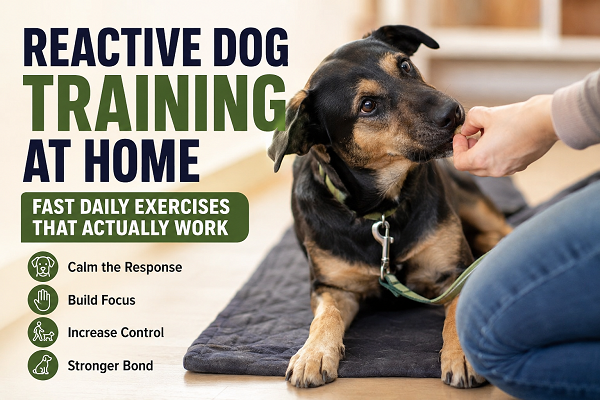
You can reduce reactive dog behavior with 5 to 15 minutes of daily home exercises, engage-disengage games, threshold distance work, mat settling, hand targeting, and short decompression walks, done consistently for 4 to 8 weeks before you’ll see reliable change. These drills work because they teach your dog a new, calmer response to triggers instead of just suppressing the old one.
Table of Contents
- What “Reactive” Actually Means (And What It Doesn’t)
- Why Fast, Daily Home Sessions Beat Long Weekend Walks
- Exercise 1: The Engage-Disengage Game
- Exercise 2: Threshold Distance Drills
- Exercise 3: Mat Settling (The “Off Switch” Skill)
- Exercise 4: Hand Targeting for Fast Redirection
- Exercise 5: Window and Doorway Trigger Drills
- Exercise 6: Pattern Games for Predictability
- Exercise 7: Decompression Sniff Walks
- A Sample 15-Minute Daily Routine
- How Long Until You See Real Change?
- Common Mistakes That Stall Progress
- When to Bring in a Professional Trainer
- Trainer Note
- FAQs
- Conclusion
Introduction
Reactivity, the barking, lunging, growling response dogs show toward triggers like other dogs, strangers, bikes, or traffic, isn’t the same thing as aggression, and it responds extremely well to short, structured home sessions rather than long, stressful walks. In this guide, I’ll walk you through the exact daily exercises I use with reactive working and pet dogs, why they work from a behavioral science standpoint, how long you can realistically expect results to take, and the mistakes that quietly sabotage most owners’ progress. You’ll get a sample 15-minute daily routine you can start today, plus guidance on when it’s time to call in a professional.
What “Reactive” Actually Means (And What It Doesn’t)
Let’s clear something up first, because it changes how you train. Reactivity is an over-the-top response to a normal stimulus, barking, lunging, spinning, or freezing when your dog sees a trigger. Aggression is intent to cause harm. Most reactive dogs have zero interest in actually hurting anything; they’re overwhelmed, frustrated, or scared, and their nervous system hits the panic button before their brain can catch up.
Veterinary behaviorists describe this as the dog going “over threshold,” meaning their stress hormones (cortisol and adrenaline) spike past the point where they can think or learn. Once a dog is over threshold, treats, cues, and corrections mostly bounce right off. That’s the whole reason home exercises work so well for reactivity: you’re training below threshold, in a calm environment, where your dog’s brain is actually online and able to form new associations.
Common reactivity triggers I see across pet and working dogs include:
- Other dogs on leash (the single most common trigger reported by trainers)
- Strangers approaching too directly or too fast
- Bikes, skateboards, joggers, and delivery vehicles
- Loud or sudden noises (garbage trucks, motorcycles, fireworks)
- Confinement combined with a trigger, like being behind a fence or car window
A 2021 study published in Applied Animal Behaviour Science found that a structured desensitization and counterconditioning protocol produced measurable behavioral improvement in the majority of fearful and reactive dogs studied, even without medication, though dogs with a longer history of the behavior took noticeably longer to shift. That’s the pattern I see in real life too: early intervention moves faster, but even dogs who’ve been reactive for years can improve with consistent daily work.
Why Fast, Daily Home Sessions Beat Long Weekend Walks
Here’s the thing nobody tells new reactive-dog owners: a single 60-minute walk through triggering territory can do more damage than good. Every time your dog reacts, barks, lunges, gets dragged past the trigger, that experience gets rehearsed and reinforced. You’re essentially running a “how to panic” practice session.
Short home sessions flip that. You control the distance, the duration, and the intensity, so your dog succeeds far more often than they fail. Dog trainers call this “setting your dog up to win,” and it matters because behavior that gets reinforced (even accidentally, through the relief of the trigger leaving) is behavior that repeats. Five minutes of controlled, successful practice beats an hour of chaos every single time.
There’s also a simple math problem with long walks: trigger stacking. If your dog reacts to a jogger at minute 10, a skateboard at minute 20, and another dog at minute 35, those stress responses pile on top of each other. By the third trigger, your dog is reacting harder and recovering slower, even to things that wouldn’t normally bother them. Short, planned sessions avoid this pile-up entirely.
Exercise 1: The Engage-Disengage Game
This is the single most useful exercise I teach, and it’s the foundation of most professional reactive-dog protocols, including the widely used “Look at That” (LAT) method developed by trainer Leslie McDevitt.
How to do it:
- Find a spot far enough from a trigger (a parked car, a dog walking in the distance, a person on a porch) that your dog notices it but stays quiet and relaxed. This is your dog’s threshold distance.
- The instant your dog looks at the trigger, mark it with a clicker or the word “yes,” then feed a high-value treat.
- Your dog will start automatically glancing at the trigger and then back at you, expecting the reward. That’s the “disengage.”
- Repeat 8 to 12 times, then walk away and end the session on a win.
You’re not asking your dog to ignore the trigger, you’re rewarding them for noticing it and staying calm. Over days and weeks, you gradually decrease the distance as your dog’s threshold improves.
Exercise 2: Threshold Distance Drills
Think of threshold like a volume dial, not an on/off switch. Every dog has a distance at which a trigger stops being scary and starts being manageable. Your job at home is to map that distance and train just inside it.
How to do it:
- Start in your driveway, front yard, or a quiet street corner with a predictable trigger (a neighbor’s dog, passing cars).
- Note the distance where your dog can see the trigger but still take treats and respond to their name.
- Practice 5 to 10 short reps at that distance, then close the gap by two or three feet only after three consecutive calm sessions.
- If your dog reacts, you moved too fast. Back up to the last successful distance and stay there longer.
I keep a simple training log for every reactive dog I work with, distance, trigger, and outcome, because “we did great today” doesn’t tell you much six weeks in. Numbers do.
Exercise 3: Mat Settling (The “Off Switch” Skill)
Every reactive dog needs a default behavior that isn’t barking or lunging. A trained “place” or mat behavior gives your dog somewhere to go, mentally and physically, when the world gets loud.
How to do it:
- Toss a treat onto a mat or dog bed and let your dog step on it.
- Mark and reward for four paws on the mat, then for lying down.
- Gradually build duration, starting at 5 seconds, working up to 2 minutes, before releasing with a cue like “break.”
- Practice near a slightly distracting environment, an open window, the front door, once your dog is solid in a quiet room.
This is also the exercise that pays off the most in daily life: a dog who can settle on a mat while guests arrive or the doorbell rings is a dog whose whole household gets calmer.
Exercise 4: Hand Targeting for Fast Redirection
Hand targeting, teaching your dog to touch their nose to your palm on cue, is the closest thing to an emergency brake you can build into a reactive dog. It gives you a fast, positive way to redirect focus before a reaction fully launches.
How to do it:
- Hold your palm a few inches from your dog’s nose. Most dogs will sniff it out of curiosity, mark and reward that immediately.
- Repeat until your dog reliably bumps your palm with their nose on cue, usually takes 10 to 15 minutes total across a couple of sessions.
- Add movement: ask for a touch while walking, while a trigger is at a safe distance, and while your dog is slightly distracted.
- Use it on walks the moment you spot a trigger approaching, before your dog has a chance to fixate and react.
Working K9 handlers use a version of this constantly, giving the dog a clear, physical job the instant focus starts drifting toward something they shouldn’t engage. The same principle works just as well in a suburban living room.
Exercise 5: Window and Doorway Trigger Drills
If your dog loses it every time someone walks past the front window or the mail carrier shows up, that spot in your house has become a trigger zone all on its own. You can retrain it directly.
How to do it:
- Sit near the window with high-value treats during a low-traffic time of day.
- Every time a person or dog passes (even far off), mark and reward calm behavior.
- If your dog barks first, wait for a single second of silence, then mark and reward that instead of the bark.
- For doorbell reactivity, record a doorbell sound, play it quietly, and reward calm responses before working up to full volume.
This exercise alone resolves a surprising amount of household stress, because window and door reactivity often happens multiple times a day, every single reaction is a rehearsal, so retraining this specific trigger zone has an outsized effect on your dog’s overall baseline stress.
Exercise 6: Pattern Games for Predictability
Reactive dogs generally do better with predictability than with novelty, because uncertainty itself is stressful for an already-anxious nervous system. Pattern games, a concept popularized by trainer Leslie McDevitt in her “Control Unleashed” work, give your dog a repeatable rhythm to lean on around triggers.
Try the “1-2-3” pattern:
- Count out loud, “1… 2… 3,” tossing a treat on each number, whether or not your dog is looking at you.
- Practice this pattern in a boring, trigger-free environment until your dog anticipates the rhythm and checks in automatically.
- Bring the pattern out on walks. When a trigger appears, start counting. Your dog’s brain locks onto the predictable rhythm instead of the unpredictable trigger.
I’ve watched this simple counting game talk dogs down from a near-reaction more times than I can count, it works because it gives the dog’s brain something structured to do instead of spiraling.
Exercise 7: Decompression Sniff Walks
Not every session needs to involve triggers at all. Reactive dogs are frequently running on a full tank of unreleased stress hormones, and pure sniffing, with zero training demands, is one of the fastest ways to bring cortisol back down.
How to do it:
- Find a quiet trail, empty park, or even your own backyard.
- Use a long line (10 to 15 feet) and let your dog sniff wherever they want, no heeling, no commands.
- Aim for 15 to 20 minutes, a few times a week, separate from your structured training sessions.
Research on canine stress recovery consistently shows sniffing activates the parasympathetic nervous system, the “rest and digest” state, which is exactly what an overstimulated reactive dog needs to reset.
A Sample 15-Minute Daily Routine
Here’s how I’d structure a realistic weekday session for a moderately reactive dog:
| Time | Exercise |
|---|---|
| 0–3 min | Hand targeting warm-up (indoors) |
| 3–8 min | Engage-disengage at your dog’s current threshold distance |
| 8–11 min | Mat settling with light distraction |
| 11–15 min | Short decompression sniff walk to end on a calm note |
Weekends can add a longer decompression walk and a window/doorway session. That’s it, you don’t need an hour. You need consistency more than duration.
How Long Until You See Real Change?
Owners always ask me for a timeline, and honestly, being straight with you matters more than giving you a nice round number. In my experience and based on published behavior modification protocols, most dogs show a measurable drop in reaction frequency and intensity within 4 to 8 weeks of consistent daily practice. Dogs with a shorter reactivity history (under 6 months) tend to progress faster, sometimes in 3 to 4 weeks. Dogs who’ve been rehearsing the behavior for years, or who have a genetic predisposition toward high reactivity (Border Collies, Belgian Malinois, and herding-type mixes show up disproportionately in reactivity caseloads), can take 3 to 6 months of steady work before you see the trigger distance shrink to a manageable level.
What almost never happens is a full “cure” where the dog never reacts again. The realistic goal is management and a dramatically reduced baseline, not perfection. That’s not a discouraging outcome, it’s a livable one, and it’s what most families actually need.
Common Mistakes That Stall Progress
I see the same handful of errors constantly, in pet homes and even among newer handlers:
- Starting too close to the trigger. If your dog is barking, you’re already over threshold, that’s not training, that’s just practicing the reaction.
- Skipping the boring foundation work. Hand targeting and mat settling feel unglamorous, but dogs who skip straight to real-world trigger exposure without these skills built first plateau fast.
- Punishing the reaction. Leash corrections or yelling when a dog reacts often increase anxiety around the trigger, since the dog associates the correction with the trigger’s appearance, not their own behavior.
- Inconsistent sessions. Three intense sessions one week and nothing for the next two weeks is far less effective than five minutes every single day.
- Assuming the dog will “grow out of it.” Reactivity that goes unaddressed tends to solidify with rehearsal, not fade with time.
- One long walk instead of several short sessions. As covered above, trigger stacking on a long walk can undo a week of good training.
When to Bring in a Professional Trainer
Home exercises handle a huge percentage of everyday reactivity, but there’s a line where DIY isn’t enough, and it’s important to be honest about where that line sits. Reach out to a certified professional (look for credentials like CPDT-KA, CBCC-KA, or a veterinary behaviorist, DACVB) if:
- Your dog has ever made contact during a reactive episode, even a graze
- Reactivity is escalating despite 4 to 6 weeks of consistent home work
- Your dog shows body language suggesting fear-based aggression, stiff body, whale eye, guarding, alongside the reactivity
- You feel unsafe managing the dog on walks or around visitors
There’s no shame in this. Working K9 handlers bring in outside decoys and behaviorists constantly, even highly trained dogs benefit from a second set of trained eyes catching things the primary handler misses day to day.
Trainer Note
This guide reflects real-world reactivity protocols used with pet dogs and working K9s alike, engage-disengage, threshold management, and pattern games are staples across professional force-free training curricula worldwide, from Karen Overall’s Protocol for Relaxation to Leslie McDevitt’s Control Unleashed method. If you’re working through leash reactivity specifically, our guide on choosing the right training collar for leash pullers pairs well with the drills above, and if your dog’s reactivity is tangled up with general drive and impulse control, our breakdown of obedience versus instinct in dog intelligence explains why some breeds need more structured mental work than others. Reactive dogs also tend to be under-exercised mentally more than physically, so it’s worth checking our guide on how much daily exercise your dog actually needs to make sure decompression walks fit into a balanced routine.
Handlers building a fuller obedience foundation alongside reactivity work can also check our list of essential commands every dog owner should master, and our 2026 training collar review, If you’re still deciding on equipment. For a deeper, step-by-step framework you can work through at your own pace, our team’s e-book Beyond the Bark expands on these exercises with fuller weekly plans.
FAQs
1. How often should I train a reactive dog at home?
Aim for daily sessions of 5 to 15 minutes rather than one long weekly session. Short, frequent practice below your dog’s threshold builds new habits faster than occasional long walks that risk trigger stacking.
2. Can reactive dog training work without treats?
Food is the fastest way to build a positive association with a scary trigger, but toys, play, or verbal praise can work for dogs with lower food drive. The key is that the reward has to genuinely matter to your dog, not just be offered.
3. Is a reactive dog the same as an aggressive dog?
No. Reactivity is an exaggerated response, usually rooted in fear, frustration, or overstimulation, while aggression involves intent to cause harm. Most reactive dogs have no interest in actually hurting anyone or anything.
4. What equipment helps most with reactive dog training at home?
A front-clip harness, a 10 to 15 foot long line for decompression walks, and high-value treats are the core tools. A well-fitted harness reduces the physical strain of sudden lunges while you work through the behavioral side.
5. Will my dog ever stop being reactive completely?
Most dogs reach a well-managed state rather than a complete “cure.” With consistent home exercises over 4 to 8 weeks (longer for dogs with a long reactivity history), you can expect a significantly increased trigger tolerance and far fewer full-blown reactions.
Conclusion
Reactive dog training doesn’t require hour-long walks, expensive equipment, or a dramatic personality overhaul, it requires short, consistent, below-threshold practice, done daily, with a clear structure. Start with engage-disengage and hand targeting this week, layer in mat settling and threshold drills as your dog’s confidence builds, and protect your progress with regular decompression walks that let your dog’s nervous system actually rest.
Track your sessions, celebrate the small wins (a glance at a trigger followed by a check-in is a win), and don’t be afraid to call in a professional if things plateau or escalate. Reactivity is manageable, and with the right daily habits, most dogs, and their exhausted owners, get their walks back.

Her work centres on obedience, detection, protection and operational readiness. She favours proven methods built on repetition, consistency and real-world conditioning, so that both dogs and handlers are prepared for high-pressure tasks.
Rofiat represented the Nigerian Army Dog Centre at the Nigerian Army Day Celebration (NADCEL) 2026, where she led demonstrations in obedience, explosive detection, agility and tactical movement. Through articles, training content and documentaries, she shares field-based insight into how structured training, clear communication and trust between handler and dog affect performance and reliability.
She is the author of Beyond the Bark: Inside a Pro Handler's Playbook for Raising the Ideal Dog, a practical guide that helps dog owners and handlers apply professional training principles in everyday situations.
- K9 Advantix Dosage Chart & Safety Guide for Dogs - October 19, 2026
- How to Set Up & Use Bousnic Dog Training Collar - October 18, 2026
- Westminster Dog Show 2026: Winners & Full Results - October 17, 2026