Best Dog Training Collars for Leash Pullers (2026 Guide)
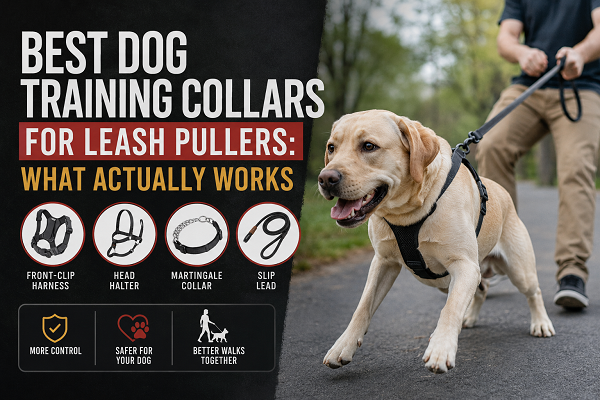
For most dogs that pull, a front-clip (Y-front) no-pull harness or a well-fitted head halter like the Gentle Leader or Halti gives you the most control with the least risk to your dog’s neck. A properly sized martingale collar works well for escape artists and dogs with narrow heads, while flat buckle collars and standard slip leads simply aren’t built to manage a determined puller. Aversive tools like prong collars and shock collars can suppress pulling, but every major veterinary behavior organization, including the American Veterinary Society of Animal Behavior (AVSAB), advises against them because of the welfare risks and the fact they don’t actually teach your dog anything.
If you want the short version, that’s it. If you want to know why that’s the answer, and which option fits your specific dog, keep reading, because “best” really does depend on what’s dragging you down the sidewalk.
Table of Contents
- Why Does My Dog Pull So Hard on the Leash?
- The Real Cost of Leash Pulling (It’s Not Just Annoying)
- Types of Dog Training Collars and Harnesses for Leash Pullers
- Quick Comparison: Which Tool Fits Which Dog
- How to Choose the Right Option for Your Dog
- How to Introduce a New Collar or Harness the Right Way
- Common Mistakes That Make Pulling Worse
- A Trainer’s Honest Take
- FAQs
- Conclusion
Why Does My Dog Pull So Hard on the Leash?
Before we get into gear, let’s talk about why this happens in the first place, because the equipment only works if you understand what it’s actually doing.
Dogs pull for one simple reason: it works. The second your dog leans into the leash and you follow, even half a step, you’ve just rewarded pulling. It’s called opposition reflex, a dog’s natural instinct to push back against pressure rather than yield to it. That’s not stubbornness or dominance. It’s physiology, and it’s the same reason a sled dog leans into a harness with everything it’s got.
Add in a nose that processes the world 10,000 to 100,000 times more sensitively than yours, a squirrel darting across the yard, or another dog three houses down, and you’ve got a mismatch: your dog wants to get there right now, and you’re anchored by a leash designed more for restraint than communication.
This isn’t rare, either. A survey of UK and Irish dog owners found that 82.7% of dogs pulled while on the lead, which lines up almost exactly with what I’ve seen walking dogs myself, on a good day at a busy park, you’re lucky if one in six dogs is walking politely.
The Real Cost of Leash Pulling (It’s Not Just Annoying)
Here’s where I want owners to slow down for a second, because pulling isn’t just a workout for your shoulder. It’s a documented safety issue on both ends of the leash.
For the dog:
- Constant pressure on a flat collar puts repeated strain on the trachea, thyroid, and cervical spine, especially in small and brachycephalic breeds (Pugs, French Bulldogs, Boston Terriers) whose airways are already compromised.
- Sudden jerks can spike intraocular pressure, a real concern for breeds prone to eye problems.
- Chronic neck strain has been linked in veterinary literature to thyroid gland irritation and, in some cases, changes in thyroid hormone readings.
For the handler: US emergency room data tells a sobering story here. Researchers reviewing national injury data found 8,189 dog leash-related injuries treated at emergency departments between 2001 and 2018, projecting to a national estimate of 356,746 injuries, and the most common cause was being pulled by the dog, followed by tripping or getting tangled in the leash. A later study tracked the trend even further and found the picture is getting worse, not better: emergency department visits from leash-related injuries rose more than fourfold between 2001 and 2020, from about 7,200 cases a year to roughly 32,000, with broken fingers, shoulder sprains, and traumatic brain injuries topping the list.
That’s not a scare tactic. It’s the reason I tell every client the same thing on day one: the right piece of equipment isn’t about convenience, it’s about keeping both ends of that leash safe while you actually teach the loose-leash skill underneath it. If you want the full rundown on how collars, leashes, and harnesses fit into a complete handler’s kit, I go deeper into that setup in our guide to essential K9 training equipment.
Types of Dog Training Collars and Harnesses for Leash Pullers
Let’s go through the actual options, in the order I’d recommend trying them.
1. Front-Clip (No-Pull) Harness
This is my default first recommendation for the average leash puller, and it’s what most force-free trainers reach for first too. The leash clips to a ring on the dog’s chest instead of their back, so when they pull forward, the harness gently redirects them sideways back toward you instead of letting them drive full-speed ahead like a sled dog (which is exactly what happens with a back-clip harness).
Why it works: Dogs don’t have the same natural opposition reflex against a chest-based turn the way they do against neck pressure. It doesn’t hurt or startle them, it just makes pulling mechanically inefficient.
What the research says: A controlled study using shelter dogs and a leash-tension meter compared pulling force on a neck collar versus a back-connection harness and found that, contrary to the common assumption that harnesses “let dogs pull harder,” pulling behavior varied a lot by individual dog rather than following a simple harness-makes-it-worse pattern. Front-clip designs weren’t part of that specific study, but they’re built on a different mechanical principle entirely, redirecting rather than simply cushioning force, which is why trainers see a bigger behavioral difference with them in practice.
Good for: Most pullers, puppies still learning leash manners, reactive dogs, brachycephalic breeds, anyone who wants a no-drama option. Downsides: Straps can chafe under the front legs if not sized correctly; some dogs need a week or two to stop veering sideways out of habit. Typical cost: $25–$60.
2. Head Halter (Gentle Leader, Halti, NewTrix)
Think of this like a horse halter: a strap goes around the muzzle and behind the ears, and the leash clips under the chin. Where the dog’s head goes, the body follows, which gives you an enormous amount of control with very little physical force on your end.
Good for: Strong, large-breed pullers (Labs, GSDs, Mastiffs) where a harness alone doesn’t cut it; dogs that lunge at other dogs or squirrels; owners with limited grip strength. Downsides: Most dogs need a proper introduction period, rushed use looks like the dog “hates” it, when really they just haven’t been desensitized to the muzzle strap. Never yank a head halter hard or attach it to a retractable leash; a sharp jerk near the neck and skull can cause injury. This is a redirection tool, not a correction tool. Typical cost: $15–$30.
3. Martingale Collar
A martingale is a limited-slip collar, it tightens slightly when the dog pulls, just enough to prevent them from backing out of it, but it’s designed with a stop so it can’t close down like a choke chain. Sighthound people have used these for decades because breeds like Greyhounds and Whippets have necks that are the same width as (or narrower than) their heads.
Good for: Escape artists, sighthounds, and any dog whose head is roughly the same size as their neck; also a solid, low-drama daily-wear collar for dogs that don’t pull hard but need a bit more security than a flat buckle. Downsides: Doesn’t do much to actively manage a hard, sustained puller on its own; best combined with training rather than relied on as a fix. Typical cost: $10–$25.
4. Slip Lead / Slip Collar
A slip lead is a single piece of rope or nylon that forms a collar and leash in one, tightening when the dog pulls and loosening when they stop. Used correctly, with quick corrections and immediate release, it can be an effective communication tool in the hands of an experienced trainer.
Good for: Quick vet visits, shelter intake, brief controlled use by handlers who know exactly what they’re doing. Downsides: This is the one I’m most cautious about recommending for everyday pet owners. Left tight or used with hard, repeated jerks, it functions like a choke chain and can cause tracheal damage. If you’re not confident in your timing, skip it. Typical cost: $8–$20.
5. Prong (Pinch) Collar
A prong collar has blunted metal links that pinch the loose skin around the neck when the dog pulls, distributing pressure in a way that’s arguably more even than a flat collar’s pressure point. Some handlers, particularly in traditional and balanced training circles, use these on very strong or high-drive working dogs.
I’ll be straight with you here: this is a tool where the debate in the training world is genuinely heated, and where I think owners deserve the full picture rather than a sales pitch either way. In 2021, the American Veterinary Society of Animal Behavior updated its position statement on humane training, stating that there is no evidence aversive methods are more effective than reward-based methods in any context, and that aversive methods should not be used in animal training or the treatment of behavior disorders. Behavioral studies cited in that review found dogs trained with aversive tools showed more stress-related behaviors during training sessions, including tense body posture, lip licking, lowered tail carriage, and yelping, while dogs trained with reward-based methods showed more attentiveness toward their owners.
My honest professional opinion: if you’re a pet owner dealing with everyday leash pulling, there is no scenario where you need a prong collar before you’ve properly tried a front-clip harness or head halter with real training behind it. I’ve seen too many prong collars used as a substitute for training rather than alongside it, and misuse (wrong sizing, left on too loose, yanked hard) can genuinely injure a dog.
Typical cost: $12–$35.
6. Remote Training Collar (E-Collar)
Modern e-collars have a wide range of stimulation levels, many starting at a vibration or tone before any static correction, and some handlers use them for off-leash reliability and long-distance recall, not specifically for close-range leash pulling. For leash-walking specifically, I rarely see a legitimate case for one; the tools above solve the problem with far less risk and far less skill required to use correctly.
Typical cost: $80–$300+.
7. Standard Flat Buckle Collar
Every dog should own one for ID tags and everyday wear. But for an actual puller, a flat collar concentrates 100% of the correction force on a very small, delicate area of the neck, right over the trachea and thyroid. It’s not a training tool for pulling; it’s a name-tag holder.
If you’re outfitting a dog from scratch and want to see how collar quality and construction actually hold up under daily pulling, I put one popular option through its paces in this Stunt Puppy collar review, and if you’re leaning toward a harness instead, our breakdown of what handlers actually look for in a tactical harness covers the fit and construction details that matter even outside a working-dog context.
Quick Comparison: Which Tool Fits Which Dog {#comparison}
| Tool | Control Level | Neck Safety | Learning Curve | Best For |
|---|---|---|---|---|
| Front-clip harness | High | Excellent | Low | Most pullers, puppies, reactive dogs |
| Head halter | Very high | Excellent | Moderate | Strong/large-breed pullers |
| Martingale collar | Moderate | Good | Low | Narrow-headed breeds, escape risk |
| Slip lead | Moderate–high | Fair (skill-dependent) | High | Quick controlled use only |
| Prong collar | High | Fair (debated) | High | Advanced handlers only, last resort |
| E-collar | High | Fair (debated) | Very high | Off-leash recall, not close-range pulling |
| Flat buckle collar | Low | Poor for pullers | Low | ID tags, dogs that already walk well |
How to Choose the Right Option for Your Dog
A few questions I ask clients before recommending anything:
- How big and strong is your dog relative to you? A 12-pound Beagle pulling is a nuisance. A 90-pound Cane Corso pulling is a safety issue. Bigger, stronger dogs generally do better starting with a head halter or front-clip harness rather than a martingale alone.
- Does your dog have a flat face or breathing sensitivity? Anything that puts pressure on the neck (flat collars, martingales, slip leads) is a harder no for Pugs, Frenchies, Bulldogs, and Boston Terriers. Go straight to a harness.
- Is this pulling from excitement, or reactivity toward triggers? Excitement-pulling responds beautifully to a front-clip harness plus consistent training. Reactive lunging toward dogs or people usually needs a head halter for the extra head-turning control, combined with a real behavior modification plan, not just better gear.
- How narrow is your dog’s head compared to their neck? Sighthounds, and some terrier types, can back straight out of a flat collar. That’s a martingale’s whole job.
- What’s your own strength and confidence level? Be honest here. A tool that requires perfect timing (slip lead, prong) in inexperienced hands often does more harm than a “less powerful” harness used consistently.
How to Introduce a New Collar or Harness the Right Way
Swapping equipment cold turkey is one of the most common mistakes I see. Dogs need a transition period, especially with head halters.
- Days 1–3: Let your dog wear the new gear indoors for 5–10 minutes at a time, paired with treats and play. No leash pressure yet, just getting used to the feel.
- Days 4–7: Clip the leash on and walk around the house or backyard. Reward loose-leash moments generously.
- Week 2: Move to a quiet outdoor area with minimal distractions. Keep sessions short (10–15 minutes).
- Weeks 3–6: Gradually work up to normal walking routes. Most dogs show a noticeable, real improvement in loose-leash walking within four to six weeks of consistent, reward-based practice, faster for puppies, longer for adult dogs with years of pulling practice behind them.
Consistency matters more than any single piece of equipment. I’ve watched dogs on a $12 martingale out-walk dogs wearing a $200 remote collar, purely because the owner was consistent about rewarding the right behavior every single time.
Common Mistakes That Make Pulling Worse
- Letting your dog reach what they’re pulling toward. Even once. That single success reinforces the whole strategy in the dog’s mind.
- Using a retractable leash while trying to fix pulling. The constant tension teaches the exact opposite of what you want.
- Switching tools every week. Give a new harness or halter real time (minimum two to three weeks) before deciding it “doesn’t work.”
- Correcting without rewarding. Stopping unwanted pulling is only half the equation; you also need to consistently reward the loose-leash moments, or the dog never learns what to do instead.
- Sizing gear by guesswork. A harness that’s too loose lets a dog back out and bolt into traffic. Measure your dog’s girth and neck properly, most brands provide sizing charts, and use them.
A Trainer’s Honest Take
I’ve spent over 14 years handling working and security dogs, from foundation obedience through operational deployment, and one thing has stayed consistent across every breed I’ve worked: equipment supports training, it doesn’t replace it. I’ve seen owners spend $150 on a top-of-the-line no-pull harness and still get dragged down the street because they never paired it with actual loose-leash rewards. I’ve also seen a $20 martingale collar produce beautiful walking manners in the hands of a consistent, patient owner.
If you’re building out a full training kit rather than just solving the leash-pulling piece, our guide to the 10 best tactical K9 gear items walks through what a well-equipped handler actually carries, and I go into the foundational side of raising a dog with real structure in my book, Beyond the Bark: Inside a Pro Handler’s Playbook for Raising the Ideal Dog, which covers loose-leash work as part of a bigger, structured approach to training rather than a standalone fix.
FAQs
What is the best collar for a dog that pulls a lot?
For most dogs, a front-clip no-pull harness offers the best combination of control and safety. For very strong or large-breed pullers, a head halter like the Gentle Leader gives even more precise control by directing the head rather than the body.
Is it bad to use a regular collar on a dog that pulls?
Yes, for regular walks with a puller, a standard flat collar concentrates all the pulling force on the trachea and thyroid, which can lead to coughing, gagging, or long-term neck strain. It’s fine for ID tags at home, but a harness or head halter is safer for actual walking.
Are prong collars or shock collars safe for leash pulling?
They can suppress pulling, but the American Veterinary Society of Animal Behavior and similar organizations advise against aversive tools because of documented welfare risks and stress responses, and because there’s no solid evidence they train more effectively than reward-based methods. Most trainers reserve them, if at all, for experienced handlers working with a professional, not as a first-line fix for everyday pulling.
How long does it take to stop a dog from pulling on the leash?
With the right equipment and consistent, reward-based practice, most owners see real improvement in four to six weeks. Puppies often pick it up faster; adult dogs with years of pulling habits may take a couple of months of steady work.
Do harnesses make dogs pull more than collars?
Not necessarily, it depends heavily on the harness design and the individual dog. Back-clip harnesses can make some dogs pull harder because they’re built like a sled-dog rig, but front-clip harnesses are specifically designed to counteract that by redirecting the dog sideways when they pull.
Conclusion
Leash pulling isn’t a character flaw in your dog, it’s a mechanical and behavioral pattern that the right equipment, used with real training, can absolutely fix. Start with a properly fitted front-clip harness or head halter, size it correctly, give the transition period real time, and reward the loose-leash moments as consistently as you’d want to correct the pulling ones. Save aversive tools like prong and e-collars for genuinely last-resort situations under professional guidance, not as a shortcut around the training itself.
Your shoulders, your dog’s neck, and honestly your daily walks together will thank you for making the switch.
Rofiat Muritala is a veteran, military K9 handler and certified dog trainer with over 14 years of hands-on experience in working dogs, security operations, and handler development. Her work spans obedience, detection, and protection training, with a focus on practical, field-tested methods over theory. She is the author of “Beyond the Bark: Inside a Pro Handler’s Playbook for Raising the Ideal Dog.”

Her work centres on obedience, detection, protection and operational readiness. She favours proven methods built on repetition, consistency and real-world conditioning, so that both dogs and handlers are prepared for high-pressure tasks.
Rofiat represented the Nigerian Army Dog Centre at the Nigerian Army Day Celebration (NADCEL) 2026, where she led demonstrations in obedience, explosive detection, agility and tactical movement. Through articles, training content and documentaries, she shares field-based insight into how structured training, clear communication and trust between handler and dog affect performance and reliability.
She is the author of Beyond the Bark: Inside a Pro Handler's Playbook for Raising the Ideal Dog, a practical guide that helps dog owners and handlers apply professional training principles in everyday situations.
- Local Dog Breeds: Temperament, Health & Training Guide - October 6, 2026
- How Long Do Military Working Dogs Serve? Full Guide - October 5, 2026
- National Puppy Day 2026: Date, Best Deals & Freebies - October 4, 2026