Working vs Show English Cocker Spaniel: Key Differences
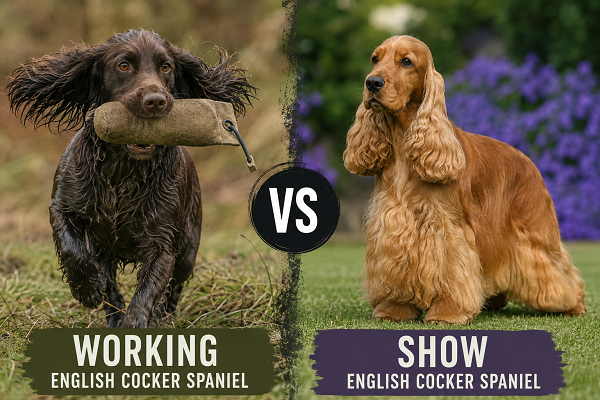
The working English Cocker Spaniel is bred for stamina and flushing game, with a leaner body, shorter feathering, and an “always-on” drive that needs real outlets. The show English Cocker Spaniel is bred to the Kennel Club and AKC conformation standard, with a fuller, silkier coat, a calmer temperament, and lower daily exercise needs. Same breed on paper. Two very different dogs to actually live with.
Table of Contents
- Introduction
- Why One Breed Split Into Two Different Dogs
- Body and Build: What You’ll See First
- Coat, Colour and Grooming: The Real Time Cost
- Temperament and Drive: The Difference That Actually Matters
- Exercise and Mental Work: How Much Is Really “Enough”
- Health Differences Worth Knowing Before You Buy
- Tails, Titles and Paperwork: How to Read a Pedigree
- Which One Actually Fits Your Life?
- Cost and Finding a Responsible Breeder
- Trainer’s Note: Where I Stand on This
- FAQs
- Final Thoughts
Introduction
If you’ve only ever met one type of English Cocker Spaniel, you might be surprised to learn the breed basically forked into two different dogs. Ask someone who’s owned both, and they’ll usually laugh before they even answer, because a working-bred Cocker and a show-bred Cocker can look like distant cousins rather than the same breed.
I get asked about this constantly, usually from someone standing in front of two very different-looking Cocker litters wondering which one to bring home. One breeder’s showing you a compact, round-headed pup with a thick, flowing coat. Another’s showing you a leggier pup with a narrower face and a coat you could practically wash and go. Same breed name on the paperwork. Different dog, in almost every way that matters day to day.
By the end of this guide, you’ll know exactly how working and show English Cocker Spaniels differ in body, coat, temperament, exercise needs, and health risk, plus which one actually fits your household, whether that’s a quiet apartment or a muddy field five mornings a week.
Why One Breed Split Into Two Different Dogs
The Cocker Spaniel didn’t start as two breeds. It started as one small, tenacious flushing dog used across the UK to push woodcock and other game birds out of thick cover so hunters could get a shot. That’s actually where the name comes from, “cocker,” after woodcock.
The split happened slowly, through breeding choices, not through any official decision to divide the breed. As dog shows grew in popularity through the 20th century, breeders selecting for the show ring prioritized coat, head shape, and movement that matched the Kennel Club standard. Breeders working the shooting field kept selecting almost entirely for one thing: could the dog find and flush a bird all day without quitting.
The working strain actually hit a real low point. By the 1960s, sporting writers were openly wondering if the working cocker’s decline could ever be reversed. The breed’s revival is largely credited to one trainer, Keith Erlandson, whose field trial bitch became a turning point for the entire working line. His dog, FTCh Speckle of Ardoon, won the UK’s Cocker Championship three years running in the early 1970s, and that run of wins is what pulled interest and numbers, back up. If you own a working-bred Cocker today, there’s a decent chance Erlandson’s breeding program sits somewhere in that dog’s pedigree.
Fast forward to now, and the two strains have diverged enough that most national kennel clubs still register them as one breed, but everyone in the Cocker world, breeders, trainers, vets, treats them as functionally distinct. That’s the context you need before you even start comparing traits, because it explains why the differences below aren’t cosmetic. They’re the direct result of decades of breeding for two completely different jobs.
Body and Build: What You’ll See First
Stand a working Cocker next to a show Cocker and the build difference jumps out immediately, even before you look at the coat.
Working English Cocker Spaniels tend to be:
- Leaner and more athletic through the body, built for hours of movement rather than a quick burst
- Longer in the body relative to leg length, which helps them cover ground efficiently in cover
- Narrower through the skull, with a longer, more tapered muzzle, several breeders describe the look as almost fox-like
- Higher-set ears that sit above eye level rather than draping as low
Show English Cocker Spaniels tend to be:
- More compact and square in overall proportion, closer to the “cobby” build described in the Kennel Club standard
- Heavier in bone, with a rounder, more domed skull
- Lower-set, longer ears that frame the face
- Slightly larger on average, with a fuller chest
None of this is about one type being “better built.” A working dog’s body is a tool shaped by function, it needs to push through hedgerows and swim cold water without tiring. A show dog’s body is shaped by an aesthetic standard that hasn’t asked the dog to flush a pheasant in eighty years.
If you’re bringing home a puppy of either type, it genuinely helps to have a realistic sense of adult size before you commit to gear, crate size, or a feeding plan, our puppy growth calculator is a quick way to get a rough estimate from a pup’s current weight and age.
Coat, Colour and Grooming: The Real Time Cost
This is where the split becomes impossible to miss, and it’s usually what people notice first.
Working Cockers carry a medium coat with moderate feathering on the legs, chest, and ears, and it may be slightly wavy but never excessively long. Practical, weather-resistant, easy to dry after a wet field session. Most working owners can get away with a weekly brush and the odd trim around the feet and ears.
Show Cockers are a different maintenance project entirely. Their coats are noticeably richer, with much heavier feathering across the legs and body, giving the whole dog a fuller, “teddy bear” look compared to the leaner, foxier working type. That coat doesn’t maintain itself. Expect brushing several times a week at minimum, regular professional grooming to keep the feathering from matting, and real care around the ears and belly where hair traps dirt and moisture.
Colour, interestingly, is one place where breeders of both types have a lot of freedom. Both strains come in a huge range of colours and bi-colours, black and tan, tan-white-and-black, sable and white, and more. Working breeders in particular don’t put much weight on coat colour at all, since it has zero bearing on flushing ability. Show breeders care more, since colour and markings are judged against the breed standard in the ring.
A practical note from years of grooming both types: a show Cocker’s ears need extra attention because that heavier coat traps moisture against the ear canal, and Cockers of both types are already prone to ear infections thanks to their pendulous ear shape. I keep a bottle of enzymatic ear cleanser on hand for exactly this, a quick wipe-down after wet walks or baths goes a long way toward preventing the yeasty ear infections this breed is known for. For the coat itself, a self-cleaning slicker brush handles feathering on both types without tugging at the skin, though show Cocker owners will get far more use out of it week to week. For a full routine, our guide on essential grooming tips for a healthy puppy walks through the basics from day one.
Temperament and Drive: The Difference That Actually Matters
Coat and body get all the attention because they’re visible in a five-second glance. Temperament is the difference that actually decides whether the dog fits your household and it’s the one people underestimate most.
Working Cockers are bred, generation after generation, for one trait above almost everything else: drive. That’s the instinct to keep working, searching, flushing, retrieving, even when it’s cold, wet, and the birds aren’t cooperating. Live with a working-bred Cocker as a pet, without an outlet for that drive, and you’ll usually see it come out sideways: excessive digging, chewing, obsessive ball fixation, or a dog that seems incapable of settling even after a long walk.
Show Cockers were bred toward a different goal entirely, a sound temperament and a biddable, easygoing nature that suits life in the show ring and, by extension, life as a family companion. They still have hunting instinct buried in there somewhere (it’s the same breed, after all), but generations of selecting for calm, adaptable dogs has genuinely softened that edge.
I explain this distinction to handlers a lot, because it isn’t unique to Cockers, it shows up any time you compare a working line against a companion line in the same breed. Instinct and obedience aren’t the same thing, and a dog with high natural drive isn’t “badly behaved” for struggling to settle without a job. If you want the fuller breakdown of how drive and trained obedience interact, our piece on obedience vs. instinct covers exactly this, and it applies just as much to a hyperactive working Cocker as it does to a Malinois.
Exercise and Mental Work: How Much Is Really “Enough”
Here’s where a lot of new owners get caught out, especially with working-bred puppies bought without knowing the difference.
A working English Cocker Spaniel isn’t satisfied by a 20-minute leash walk around the block. These dogs were bred to work full field days alongside a handler, covering miles of rough ground while using their nose constantly. Realistically, a working-bred adult needs somewhere in the range of 60 to 90 minutes of real exercise a day, and a fair chunk of that needs to involve scent work, retrieving games, or off-lead exploration, not just walking in a straight line. Skip the mental piece and you’ll have a physically tired but mentally wound-up dog, which is its own kind of problem.
Show Cockers are considerably easier to satisfy. Daily walks and regular playtime are usually enough to keep a show-type Cocker content, without the intensive outlets a working dog needs. That doesn’t mean zero exercise, they’re still a sporting breed underneath the coat, but the bar is a lot lower.
If you’re bringing a working-bred pup or adult into an active household, a long training line is genuinely one of the more useful pieces of gear you can own, since it lets you build reliable recall in open space before trusting the dog fully off-lead, something like this 30-foot training lead is a good starting point. For a deeper look at how much daily activity working breeds actually need and how to structure it, we’ve broken it down in our guide on how often to exercise a working dog.
Health Differences Worth Knowing Before You Buy
Both types share some breed-wide health risks, but there are a few worth flagging specifically before you commit to either line.
Familial nephropathy (FN) is the big one to know about across the whole breed. It’s a fatal inherited kidney disease caused by a genetic mutation, passed on when both parents carry the gene, and it leads to kidney failure in young dogs rather than old ones. Affected puppies usually show protein in their urine starting between five and eight months old, with kidney failure and death typically following well before the dog turns three. The good news: a DNA test for the mutation has been available since researchers identified it in 2006, and it’s now offered internationally. Any breeder, either working or show, who can’t produce FN test results on both parents is a breeder to walk away from.
Beyond FN, cockers of both types can be prone to autoimmune conditions, certain cancers, epilepsy, and hip issues, though the working strain’s leaner build and more intense exercise regime generally means somewhat lower rates of obesity-linked joint problems compared to some show lines.
Ear infections deserve their own mention because both types are affected, just for slightly different reasons. Show Cockers’ heavier ear feathering traps moisture more easily. Working Cockers, spending more time in wet cover and water, pick up dirt and debris in the ear canal during a normal working day. Either way, routine ear checks aren’t optional with this breed.
One more thing worth a mention if you’re raising a puppy of either type: young Cocker Spaniel puppies can have sensitive stomachs during the transition to solid food, and knowing when a stomach upset needs a vet versus home monitoring matters. Our guide on puppy vomiting and diarrhea breaks down exactly where that line sits.
Tails, Titles and Paperwork: How to Read a Pedigree
If you’re comparing puppies from two different litters and the breeders keep throwing letters at you, here’s the quick decoder.
Titles in the pedigree tell you what the dog’s line was actually bred and tested for:
- FTCh (Field Trial Champion) means the dog earned real placements competing against other dogs at flushing, retrieving, and steadiness in live field trial conditions. This is a working-line title.
- Sh.Ch. (Show Champion) means the dog won enough points in conformation showing to earn a championship title under the breed standard. This is a show-line title.
Seeing one or the other in a pedigree is a strong signal of which strain that dog actually comes from, regardless of what the breeder calls the puppies.
Tail docking is the other detail people ask about, and the legal picture genuinely varies by country and even by region within a country. In the UK, cosmetic tail docking is illegal across England, Wales, Scotland, and Northern Ireland, but there are specific exemptions for certain working dog breeds, including spaniels. Under England’s working dogs exemption, a vet can dock a spaniel puppy’s tail before it’s five days old, but only after seeing documented evidence, such as proof of shooting rights, a gamekeeper’s letter, or a pest control certificate, that the dog is genuinely destined for lawful field work. That’s why you’ll almost never see a docked tail on a show-bred Cocker in the UK, while working-bred litters destined for the shooting field often are docked, and pet-bred puppies from working lines legally cannot be. In the US and much of continental Europe, the legal picture is different again and varies by state or country, so it’s worth checking local rules rather than assuming either way.
Which One Actually Fits Your Life?
Neither type is objectively “better”, they’re bred for different jobs, and the right one depends entirely on what you can realistically offer.
A working English Cocker Spaniel is probably right for you if:
- You hunt, do gundog trials, or want a genuine working partner in the field
- You can commit to over an hour of real exercise daily, rain or shine
- You enjoy scent work, agility, or other high-engagement dog sports
- You’ve owned a high-drive breed before and know what “not tired yet” looks like
A show-type English Cocker Spaniel is probably right for you if:
- You want an affectionate family companion first, with sporting instincts a distant second
- Your household runs on a calmer, more predictable daily routine
- You’re willing to commit real time (or money) to regular professional grooming
- You’re a first-time dog owner who wants a biddable, adaptable breed to learn with
If you’re weighing a working-type Cocker against another small, high-drive working breed, it’s worth comparing notes, the working Jack Russell Terrier shares a surprising amount of overlap in drive, exercise needs, and the kind of owner who does well with either. Our Jack Russell temperament and care guide is a useful side-by-side read if you’re still deciding between breeds entirely.
Cost and Finding a Responsible Breeder
Puppy prices for both types run a wide range depending on country, breeder reputation, and pedigree, but working-line pups from proven field trial parents and show-line pups from champion bloodlines both tend to sit at the higher end, often well above the price of a pet-bred litter with no titled parents behind it.
Whichever type you choose, a few non-negotiables apply across the board:
- Ask for FN (familial nephropathy) test results on both parents. This alone rules out a huge chunk of preventable heartbreak.
- Ask what the parents actually do. A breeder advertising “working lines” should be able to name field trial results, not just point at a pedigree with FTCh names buried several generations back.
- Meet the dam in person if at all possible. Temperament is heavily influenced by how the mother was raised and handled.
- Avoid anyone who can’t answer basic health-testing questions confidently. Hesitation here is a red flag regardless of which type you’re buying.
Trainer’s Note: Where I Stand on This
I’m Rofiat Muritala, and most of my working life has been spent around high-drive working breeds rather than companion lines, but the principle that separates a working Cocker from a show Cocker is the exact same principle I apply with every dog I train, from a Malinois on a detection team to a family pet learning basic obedience. A dog’s genetics set its baseline drive. Your job as the owner is to give that drive a legitimate outlet, whether that’s a structured training routine, scent work, or simply enough real exercise to match what the dog was actually bred for. Get that piece wrong, and even the calmest show-bred Cocker can develop behavior problems, get it right, and even the most driven working-bred Cocker settles beautifully at home. If you want a deeper, structured framework for applying that principle day to day, I put together everything I’ve learned from handling and training working dogs into Beyond the Bark.
FAQs
1. Can a working-bred English Cocker Spaniel live happily as a pet, not a hunting dog?
Yes, but only with a genuine commitment to daily exercise and mental work. Without an outlet for their drive, working-bred Cockers commonly develop destructive habits or anxious, restless behavior.
2. Are working Cockers more aggressive than show Cockers?
No, drive and aggression aren’t the same thing. Working Cockers are more intense and harder to tire out, but properly socialized dogs of either type are typically friendly and non-aggressive. Temperament issues in either line usually trace back to poor breeding or inadequate socialization, not the working/show split itself.
3. Do show Cockers still have any hunting instinct?
Yes. Some show-type Cockers are still trained to the gun and retain much of the breed’s natural hunting instinct, even though they’re bred primarily for the show ring. The instinct is dialed down, not gone.
4. How do I tell if a puppy is from working or show lines if the breeder doesn’t say?
Check the pedigree for FTCh (field trial champion) versus Sh.Ch. (show champion) titles, and look at the parents directly, working-bred adults tend to be leaner with shorter, less profuse coats, while show-bred adults are more compact with heavier feathering.
5. Which type is better with kids?
Show Cockers are generally the easier fit for families with young children, thanks to their calmer, more predictable temperament. Working Cockers can absolutely live well with kids too, but their higher energy and exercise needs mean they suit active families better than quiet households.
Final Thoughts
The working and show English Cocker Spaniel share a name, a history, and a breed standard on paper, but decades of breeding for two different jobs have made them genuinely different dogs to live with. Working lines carry the breed’s original purpose: lean, driven, built to work all day in the field. Show lines carry its show-ring evolution: fuller-coated, calmer, and built for companionship first.
Neither choice is wrong. The mistake is picking based on looks alone, without being honest about how much exercise, grooming time, and mental engagement you can realistically offer. Get that match right, and either type of Cocker Spaniel will reward you with exactly what the breed has always been known for, genuine warmth, sharp intelligence, and a level of devotion that’s hard to find anywhere else in the sporting group.
About the Author: Rofiat Muritala is a veteran K9 handler and certified trainer with ARFS K9 Team, specializing in working dog behavior, drive-based training, and breed-specific development for handlers and dog professionals worldwide. She is the author of Beyond the Bark: Inside a Pro Handler’s Playbook for Raising the Ideal Dog*.*

Her work centres on obedience, detection, protection and operational readiness. She favours proven methods built on repetition, consistency and real-world conditioning, so that both dogs and handlers are prepared for high-pressure tasks.
Rofiat represented the Nigerian Army Dog Centre at the Nigerian Army Day Celebration (NADCEL) 2026, where she led demonstrations in obedience, explosive detection, agility and tactical movement. Through articles, training content and documentaries, she shares field-based insight into how structured training, clear communication and trust between handler and dog affect performance and reliability.
She is the author of Beyond the Bark: Inside a Pro Handler's Playbook for Raising the Ideal Dog, a practical guide that helps dog owners and handlers apply professional training principles in everyday situations.
- Local Dog Breeds: Temperament, Health & Training Guide - October 6, 2026
- How Long Do Military Working Dogs Serve? Full Guide - October 5, 2026
- National Puppy Day 2026: Date, Best Deals & Freebies - October 4, 2026