Puppy Growth Calculator: How Big Will Your Dog Get?
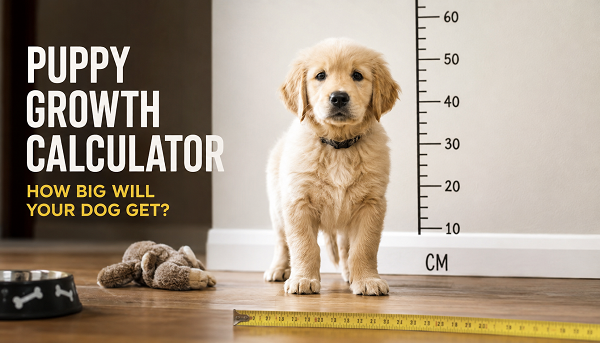
To estimate your puppy’s adult weight, take their current weight, divide it by their age in weeks, then multiply by 52. For a faster gut-check, small breeds roughly double their 8-week weight by adulthood, medium breeds triple it, and large and giant breeds can multiply it by 4 to 6 times. None of these formulas are exact, so cross-check them against your puppy’s breed, parents, and a proper growth chart before you buy that crate or budget for food.
Table of Contents
- Introduction
- Why “How Big Will My Puppy Get?” Isn’t a Simple Question
- The Standard Formula: Weight ÷ Age in Weeks × 52
- Breed Size Categories and What They Mean for Growth
- Other Reliable Ways to Predict Adult Size
- Growth Chart by Breed Size: Month by Month
- Growth Plates: Why “How Big” Matters More Than You Think
- Mixed Breeds and Rescue Puppies: Estimating the Unknown
- When Growth Isn’t Following the Curve: Red Flags
- Tools That Make Tracking Growth Easier
- FAQs
- Conclusion
Introduction
If you’ve ever cradled an eight-week-old fluffball in one arm and thought, “there’s no way this thing gets much bigger,” you already know how deceiving early puppy size can be. I’ve handed over plenty of Malinois and German Shepherd pups that fit in a jacket pocket at pickup and came back six months later looking like a completely different animal. Guessing wrong isn’t just a fun surprise, though. It affects the crate you buy, the harness that will actually fit in three months, the food budget you plan for, and, if you’re raising a working dog, how you schedule training loads around still-developing joints.
So here’s the thing: there’s no single magic number that nails a puppy’s adult size. But there are several well-tested methods that, used together, get you remarkably close. In this guide, we’ll walk through the standard puppy growth calculator formula, the breed-based shortcuts vets and breeders actually use, a full growth chart broken down by breed size, and because this is a working-dog site, what growth curves mean for joint health and training timing. Let’s get into it.
Why “How Big Will My Puppy Get?” Isn’t a Simple Question
Ever notice how two puppies from the same litter, fed the same food, can grow into completely different-sized adults? That’s not bad luck or bad math. Adult dog size comes down to a mix of genetics, sex, spay/neuter timing, nutrition, and even the size of the litter the puppy was born into (bigger litters often mean smaller individual pups, since there’s more competition for milk in those first few weeks).
Genetics does most of the heavy lifting, though. Research referencing the American Kennel Club’s breed standards shows a German Shepherd’s adult weight can land anywhere between 49 and 88 pounds depending on sex and line, which is a massive range for one “breed.” That’s why any calculator you use, including the one in this article, gives you an estimate with a margin of error, not a guarantee. Think of it as a weather forecast: useful for planning, not something to bet your last dollar on.
The Standard Formula: Weight ÷ Age in Weeks × 52
The most widely used puppy growth formula looks like this:
Adult weight = (current weight ÷ age in weeks) × 52
Fifty-two is simply the number of weeks in a year, since most dogs are roughly done growing by 12 months (smaller breeds finish sooner, giant breeds take longer, which we’ll get to). Here’s the formula in action:
Say your Labrador puppy weighs 12 pounds at 8 weeks old.
12 ÷ 8 = 1.5
1.5 × 52 = 78 pounds projected adult weight
That’s right in line with a typical adult Lab, which usually lands between 55 and 80 pounds. Not bad for a formula you can do on a napkin.
This method works best for medium and large breeds between 8 and 20 weeks old. It gets shakier outside that window and with toy breeds, since small dogs finish most of their growth so early that the math overshoots. If you’ve got a Chihuahua or a Yorkie, you’re better off leaning on breed charts (covered below) than this formula alone.
Breed Size Categories and What They Mean for Growth
Before you can predict a specific number, it helps to know which growth “speed lane” your puppy is in. Vets and breeders typically split dogs into four broad categories:
| Size Category | Typical Adult Weight | Growth Finishes By | Example Breeds |
|---|---|---|---|
| Small/Toy | Under 22 lbs | 8–10 months | Chihuahua, Yorkshire Terrier, Mini Husky |
| Medium | 22–55 lbs | 10–12 months | Beagle, Border Collie, Cocker Spaniel |
| Large | 55–90 lbs | 12–18 months | German Shepherd, Labrador, Rottweiler |
| Giant | 90+ lbs | 18–24 months | Great Dane, Mastiff, King Shepherd |
Notice the pattern: the bigger the eventual dog, the longer it takes to get there. A Mini Husky, which we cover in detail in our breed guide, is usually finished growing well before its first birthday, weighing in between 20 and 35 pounds full-grown. Compare that to a giant hybrid like the Pyrenees Bernese Mix, which we’ve profiled here, where pups can keep filling out well into their second year and finish anywhere from 25 to 32 inches at the shoulder.
Other Reliable Ways to Predict Adult Size
The weeks-times-52 formula is a solid starting point, but I always tell handlers and new owners to triangulate with at least one other method. Here are the ones worth knowing.
The Doubling and Tripling Method
This is the one breeders have used for decades, long before online calculators existed:
- Small breeds roughly triple their birth-to-8-week weight by adulthood.
- Medium to large breeds typically double their weight between 14 and 16 weeks, meaning whatever they weigh at that age, roughly double it for a reasonable adult estimate.
- Giant breeds often need to multiply their 8-week weight by 4 to 6 to get in the ballpark.
Look at the Parents
If you know the litter’s parents (which any responsible breeder should be able to show you), average their adult weights. This is one of the more accurate shortcuts, especially for purebreds, since a puppy’s genetics are quite literally sitting right there in front of you. It’s less reliable for mixed breeds where you might only know one parent, or neither.
The Paw Size Trick (Use With Caution)
You’ve probably heard that oversized paws mean an oversized dog. There’s some truth to it, paws do grow ahead of the rest of the body in many breeds, but it’s a rough visual cue at best, not a measurement you should plan a budget around. I’ve seen plenty of “big paw” puppies plateau at completely average adult sizes.
Veterinary Growth Charts
Many vet clinics and organizations like WALTHAM publish percentile-based growth charts, similar to a pediatrician’s chart for human babies. These track your puppy’s weight against thousands of other dogs of similar breed and age, flagging if they’re tracking notably high or low for their percentile. If your vet offers this at checkups, it’s genuinely one of the more scientifically grounded options available.
Growth Chart by Breed Size: Month by Month
Here’s a general breakdown of what percentage of adult weight a puppy typically hits at various ages, based on commonly cited veterinary growth-tracking data:
| Age | Small Breed (% of adult weight) | Large/Giant Breed (% of adult weight) |
|---|---|---|
| 8 weeks | ~25–30% | ~10–15% |
| 4 months | ~60–70% | ~35–45% |
| 6 months | ~85–90% | ~60–65% |
| 9 months | ~95–100% | ~75–80% |
| 12 months | 100% | ~85–90% |
| 18–24 months | Fully mature | 95–100% |
A practical example: a large-breed puppy destined to weigh 70 pounds as an adult is often only about 45 pounds at six months old and still packing on another 20+ pounds over the following year. This is precisely why so many German Shepherd and Labrador owners panic mid-adolescence, convinced their “lanky” dog isn’t growing right, when in reality they’re watching a completely normal, if awkward, growth spurt play out in real time.
Growth Plates: Why “How Big” Matters More Than You Think
This is the part most puppy weight calculators skip entirely, and it’s arguably the most important section for anyone raising a working dog or an active family pet.
While your puppy is still growing, the ends of their long bones contain soft, cartilage-like zones called growth plates. These are what allow bones to lengthen. Until they close and harden, they’re genuinely fragile, and repetitive high-impact activity (think jumping, hard agility work, or long forced runs on pavement) can damage them in ways that show up years later as joint problems, uneven limb growth, or early arthritis.
Roughly speaking:
- Toy and small breeds: growth plates close around 6–8 months
- Medium breeds: around 10–12 months
- Large breeds: 12–18 months
- Giant breeds: can remain open until 18–24 months, sometimes longer
Here’s why this matters practically: knowing your puppy’s projected adult size isn’t just a fun party trick. It tells you roughly how long you should be holding off on intense structured training, hard agility reps, or serious bite work conditioning. I’ve watched eager handlers push six-month-old Malinois puppies into full defense-drive conditioning because the dog “looked ready,” only to deal with early hip or elbow issues down the line. A dog that’s projected to be a 75-pound adult at 6 months but currently sitting at 45 pounds still has a third of its skeletal development ahead of it, that’s not a dog ready for sustained hard-surface work yet.
If you’re raising a working prospect and want to support joint development properly through this window, it’s worth reading through our breakdown of nutrition supplements built for working dogs, which covers the glucosamine and omega-3 combinations most commonly used to support joints through the growth years.
Mixed Breeds and Rescue Puppies: Estimating the Unknown
If you adopted a mixed-breed or shelter puppy with an unclear background, prediction gets trickier, but it’s not impossible. A few practical approaches:
- Use the medium-large formula as your default. Most mixed-breed shelter puppies land somewhere in the medium-to-large range, so the weeks-times-52 formula tends to work reasonably well as a starting point.
- Look at paw size and bone structure relative to body, even though it’s imprecise, it’s still a useful directional clue for mixed breeds where parentage is unknown.
- Consider a DNA test. Breed identification kits have become inexpensive and are surprisingly accurate at flagging the size-relevant breeds in the mix, which then lets you apply that breed’s specific growth chart instead of guessing blind.
- Track actual weekly weight gain. For an unknown-breed puppy, watching the trend line (are they gaining steadily, plateauing, or spiking) tells you more than any single formula.
This is also where understanding the difference between a companion mixed breed and a purpose-bred working dog matters. If you’re considering a rescue for security or detection work, our comparison of K9 canines versus pet dogs explains why predictability of both size and drive is so much higher in purpose-bred working lines than in mixed-breed dogs of unknown origin.
When Growth Isn’t Following the Curve: Red Flags
Most growth “surprises” are completely normal. But a few patterns are worth a vet visit:
- Sudden weight loss or a flat growth line for more than 1–2 weeks in a puppy under a year old
- A pot-bellied appearance alongside poor overall growth, which can point to a heavy parasite load
- Visible limb bowing, limping, or reluctance to rise, especially in large or giant breed puppies during rapid growth phases
- A puppy tracking well below the low end of their breed’s growth chart at multiple checkups in a row
None of these are things a calculator can catch. They’re things you catch by weighing consistently and paying attention, which brings us to the next section.
Tools That Make Tracking Growth Easier
Whatever method you use to predict adult size, the accuracy improves dramatically if you’re weighing your puppy consistently, ideally weekly, at the same time of day. A bathroom scale works in a pinch for larger pups (weigh yourself, then weigh yourself holding the puppy, and subtract), but a dedicated pet scale removes the guesswork.
For puppies under about 44 pounds, something like the Greater Goods Digital Pet Scale gives precise, wiggle-tolerant readings, which matters a lot with a squirmy 10-week-old who won’t sit still. Once your dog outgrows that range, a larger-capacity option like a heavy-duty digital veterinary scale rated up to 440 pounds will carry you through adulthood, which is handy if you’re tracking body condition on a full-grown working dog too.
FAQs
1. How accurate are puppy growth calculators? They’re generally within 10–15% of actual adult weight for medium and large breeds when used between 8 and 20 weeks of age. Accuracy drops for toy breeds and for puppies weighed outside that window, so treat any single number as an estimate, not a guarantee.
2. At what age is a puppy’s adult size most predictable? Around 4 to 6 months tends to give the most reliable estimate, since the puppy has moved past the unpredictable newborn growth spurt but still has enough growing left that projections are meaningful.
3. Do male and female puppies grow at different rates? Yes. Within the same breed, males are typically 10–20% heavier than females at adulthood, and often take slightly longer to finish filling out, particularly in large and giant breeds.
4. Does spaying or neutering affect final adult size? It can. Sex hormones help trigger growth plate closure, so puppies altered very early (before growth plates would naturally close) sometimes end up slightly taller or leggier than they would have otherwise, since growth continues a bit longer than normal.
5. Can I predict the size of a mixed-breed puppy accurately? Less precisely than a purebred, but yes, reasonably. Using the standard weeks-times-52 formula alongside a breed DNA test (to identify the size-relevant breeds involved) gets you a workably accurate estimate.
Conclusion
Predicting how big your puppy will get isn’t about finding one perfect formula, it’s about stacking a few reliable methods together: the classic weight-divided-by-age-in-weeks calculation, breed size category norms, parent weights where available, and consistent weekly tracking. Do that, and you’ll land close enough to plan real things around it, the right crate size, the right food budget, and, if you’re raising a working or sport prospect, the right training timeline that respects still-developing growth plates.
If there’s one thing years of raising and handling working dogs has taught me, it’s that patience beats guessing every time. Weigh consistently, compare against a real breed chart rather than a vibe, and don’t rush structured conditioning before the skeleton is ready for it. For handlers building out a full raising and training plan from puppyhood through working age, our e-book, Beyond the Bark: Inside a Pro Handler’s Playbook for Raising the Ideal Dog, walks through exactly how growth, nutrition, and training timing fit together across a dog’s first two years.
Insights from the ARFS K9 Training Team: This article was reviewed by Rofiat Muritala, a military K9 handler and certified trainer with hands-on experience raising and conditioning working dogs from puppyhood through operational readiness. The growth-plate and training-timing guidance reflects real handling decisions made across multiple working litters, not just textbook averages.

Her work centres on obedience, detection, protection and operational readiness. She favours proven methods built on repetition, consistency and real-world conditioning, so that both dogs and handlers are prepared for high-pressure tasks.
Rofiat represented the Nigerian Army Dog Centre at the Nigerian Army Day Celebration (NADCEL) 2026, where she led demonstrations in obedience, explosive detection, agility and tactical movement. Through articles, training content and documentaries, she shares field-based insight into how structured training, clear communication and trust between handler and dog affect performance and reliability.
She is the author of Beyond the Bark: Inside a Pro Handler's Playbook for Raising the Ideal Dog, a practical guide that helps dog owners and handlers apply professional training principles in everyday situations.
- Australian Cattle Dog vs Blue Heeler: Any Difference? - October 1, 2026
- Bousnic Dog Training Collar Review: Is It Safe? - September 30, 2026
- Gravy Train Dog Food Review: Ingredients & Recalls - September 30, 2026