Reason Why Explosive Detection Dogs Are Often Successful
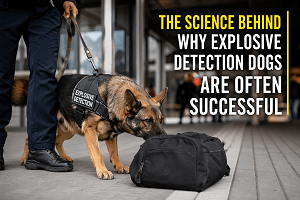
Explosive detection dogs are successful because three things work together. First, a dog’s nose is hugely sensitive and can find tiny vapor traces that machines miss. Second, careful selection and reward-based training turn that sense into a reliable, repeatable alert. Third, a skilled handler reads the dog correctly and avoids passing on their own bias. Take away any one of the three and performance drops.
Table of Contents
- What “Successful” Really Means
- The Nose: What Makes Dogs Natural Detectors
- What Dogs Actually Smell (and a Common Myth)
- Success Starts Before Training: Dog Selection
- How Explosive Detection Dogs Are Trained
- The Handler Factor Most Articles Skip
- Dogs vs. Machines: Why Dogs Still Win
- Why Detection Dogs Sometimes Fail
- What I’ve Seen as a Handler
- Practical Checklist for Handlers, Trainers and Security Buyers
- FAQs
- Final Thoughts
Introduction
Ever wonder why airports, armies and police forces still use dogs to find bombs in an age of scanners and sensors?
Here’s the problem. Most articles say “dogs have an amazing nose” and stop there. That’s only a third of the story. A great nose in an untrained dog, or a good dog with a careless handler, will still fail.
In this guide, you’ll learn why explosive detection dogs succeed, how well they really perform (the honest numbers, not just the flattering ones), how they’re trained, and why they sometimes miss. Whether you own a working breed or handle one professionally, you’ll walk away with practical points you can use.
1. What “Successful” Really Means
There’s no single success rate. When someone quotes one number, ask what it measures. Three numbers matter:
- Hit rate: how often the team finds a real explosive.
- False alert rate: how often the dog signals when nothing is there.
- Miss rate (false negative): how often a real explosive goes undetected.
Here’s what the research and field reports show:
| Number | What it measures | Source |
|---|---|---|
| 95% | Accuracy that military explosive dogs must hit to certify (drug dogs need 90%) | Scientific American, adapted from Rebecca Frankel’s War Dogs |
| ~80% | Success finding IEDs when trained dogs were used, per a Pentagon study | Auburn University College of Veterinary Medicine |
| 30% | Labradors that made it through one drug detection program (197 dogs) | Frontiers in Veterinary Science (Lazarowski et al.) |
| 4.9% | Success rate across 2,107 candidate German Shepherds and Labradors for search tasks | Frontiers in Veterinary Science (Lazarowski et al.) |
See the gap? Certified dogs perform very well. But very few candidate dogs ever get certified. That selection filter is a big part of why the dogs you see on duty look so good. For a deeper look at accuracy, read our guide on how accurate military dogs are at detecting explosives.
Real-world numbers are lower than lab numbers. Wind, heat, crowds, fatigue and stress all push accuracy down. Any article promising 98% in the field is selling you something.
2. The Nose: What Makes Dogs Natural Detectors
Let’s start with the hardware.
More receptors, more brain. A human has about 5 million scent receptors, while a dog has up to 300 million, and the dog’s brain area for analysing smell is about 40 times bigger than ours. Sources vary on the exact receptor count (some give about 220 million), but the gap is huge either way.
Stereo smelling. Dogs can use each nostril independently, which helps them tell not just what a smell is but where it’s coming from. That’s why a good dog turns its head and works toward the strongest odor instead of wandering.
Long, continuous sniffing. Humans smell in tiny bursts as we breathe. Dogs sniff in rapid bursts and can keep a stream going. One Norwegian study found a hunting dog smelling in an unbroken airstream for 40 seconds across 30 breathing cycles.
A nose that can adapt. Some veterinary sources report that a dog’s smell receptor cells renew every 30 to 60 days and that repeated exposure to a trained odor may improve sensitivity to it. Treat that as a promising idea rather than settled fact, but it fits what handlers see: dogs that work odors daily tend to stay sharp.
Here’s an honest point most blogs skip. Researchers at the University of Freiburg say scientists know dogs detect incredibly tiny traces, but still don’t fully understand exactly how they do it. We know it works. We’re still learning why.
And one more reality check. Auburn’s Paul Waggoner says dogs might not even have the best nose in the animal kingdom. The best bomb-dog breeds are chosen more for their tireless work ethic than for special smelling ability. The nose gets the credit, but drive does a lot of the work.
Curious how this same nose is used to find people? See how search and rescue dogs work.
3. What Dogs Actually Smell (and a Common Myth)
Many articles say dogs smell chemicals “released after an explosion.” That’s not how detection work happens. We want to find explosives before they go off.
Here’s the real picture:
- Explosive materials give off tiny amounts of vapor and particles, even when sealed or stable.
- Air currents carry that odor away from the source, creating an invisible “plume.”
- The dog samples the air with fast, repeated sniffs.
- The dog compares what it smells with odors it learned in training.
- When it recognizes a match, it gives a trained alert, often a sit or a freeze.
- The handler reads the alert and clears the area.
The dog isn’t smelling “a bomb.” It’s smelling chemicals. That’s why a dog can find an explosive hidden in luggage, a vehicle or a pile of rubble. Odor leaks through zippers, seams and gaps.
This also explains the limits. If almost no odor escapes, or the wind blows the plume away, the dog has less to work with.
4. Success Starts Before Training: Dog Selection
Think of it like recruiting athletes. Training can’t fix a dog that lacks the right wiring.
What do trainers look for?
- Strong, steady drive to hunt and retrieve (the toy or food is the real prize).
- Nerve strength: calm around noise, crowds and slippery floors.
- Focus that lasts through boring, repetitive searches.
- Impulse control. A Finnish study of 24 police dogs found that dogs with better inhibitory control in a cylinder test did better in an annual explosive detection test. In plain words, calm, thinking dogs beat dogs that just react.
Breeds. You’ll see Belgian Malinois, German Shepherds and Labradors most often. Shepherds tend to be “play reward” dogs, while Labs are “food reward” dogs. The UK government’s detector dog programme also favors gun dog breeds, noting they have a natural instinct to hunt, and it typically selects dogs between 12 and 24 months old.
Supply is a real problem. Researchers at Auburn point out that rising demand for explosive detection dogs is straining the supply of dogs capable of the work. That’s one reason breeding programs matter so much.
5. How Explosive Detection Dogs Are Trained
Training turns “smells interesting” into “I know that exact smell, and I’ll tell you.”
The Core Steps
Step 1: Odor imprinting. Trainers imprint each target odor through constant repetition and reward. The dog learns: this smell equals a great reward.
Step 2: Train odors one at a time. One major program imprints dogs on all five families of commercial explosives plus homemade ones such as TATP and HMTD, and it never “cocktails” the odors, which helps recognition in the field.
Step 3: Add variety and mixtures. Real threats aren’t pure and neat. A university study found that dogs trained with changing odor mixtures handled homemade explosive precursors better than dogs trained only on the pure target. The sample was small (six dogs), but it makes sense to any field trainer: train in messy conditions.
Step 4: Build the alert. A clear, consistent final response (sit, down or freeze) so the handler never has to guess.
Step 5: Add distractions and locations. Vehicles, cargo, luggage, crowds, noise, other animals, different surfaces and weather.
Step 6: Blind testing. Nobody on the search team knows where the target is hidden. This keeps bias out.
Step 7: Keep training forever. Explosive threats keep evolving, so sustainment training is part of the job.
How Long Does It Take?
There’s no single answer, because it depends on the job:
| Program type | Typical time | Source |
|---|---|---|
| Standard explosive detection dog | About 2 to 4 months of odor training | Auburn University |
| Vapor Wake (moving-person detection) | About 15 to 18 months | Auburn University |
| UK dog-and-handler team course | About 8 weeks | UK government detector dog programme |
| Marine handler course (US) | 6 to 8 weeks | US Marine Corps report |
Those timelines don’t include the months or years spent breeding, raising and selecting. And washout is brutal. The US Army has estimated it must train 200 dogs to get 100 war-ready.
Want the basics of reward timing and obedience that sit under all detection work? Our K9 dog training: 5 basic steps guide covers them.
6. The Handler Factor Most Articles Skip
Here’s the part that surprises people. The best nose in the world still depends on the person holding the leash.
Researchers describe the explosive detection team as unique because mammals on both ends of the leash must perform at a high level.
The most famous proof is a UC Davis study. Eighteen certified dog teams searched four rooms where researchers had hidden no target scents at all, but handlers were told scent might be present, and the teams still called 225 false alerts, mostly at spots marked with red paper. Another summary notes 123 of 144 searches ended with at least one alert.
What does that tell us? Handler belief matters. A nervous glance, a tighter leash or a slower pace can push a dog toward a spot. Dogs read us far better than we read them. Some of those alerts may have come from handler cues, which is why trainers talk about the “Clever Hans effect.”
Good handlers fix this with simple habits:
- Stay neutral. Walk the same pace and posture whether you expect a find or not.
- Learn your dog’s “change of behavior.” Breathing, tail, ear set and head turns show up before the final alert.
- Use blind and double-blind drills so you can’t help the dog by accident.
- Reward honestly. Only pay for real finds.
- Stay fit and rested. A tired handler makes sloppy calls.
This is also the biggest edge you can build over other teams, because it costs nothing.
7. Dogs vs. Machines: Why Dogs Still Win
Machines are getting better. So why do dogs still lead?
- They find non-metal threats. Unlike metal detectors, dogs can learn to find devices made from fertilizer and everyday materials.
- They move. Stairs, rubble, vehicles, crowds, fields: a dog goes where a scanner can’t.
- They search fast. A Marine handler in Afghanistan reported a dog finding three IEDs in under an hour and said dogs are faster and more accurate than a metal detector.
- They adapt. A dog can learn a new odor in training, while a machine often needs new hardware or software.
The strongest evidence came from a big spending comparison. In 2010, the head of the US Joint IED Defeat Organization admitted that after about $19 billion spent on drones, jammers and sensors, dogs were still unmatched at detecting IEDs.
That doesn’t mean “dogs only.” Researchers describe the explosive detection team as the best available mobile sensor against explosive threats. The smart future pairs dogs with instruments that help trainers deliver rewards more accurately. Think partnership, not competition.
8. Why Detection Dogs Sometimes Fail
If I only sold you the wins, you wouldn’t trust me. Here’s the honest side.
An NBC 5 investigation found that K9 teams failed annual certification tests at large US airports more than 50 times between 2013 and 2015. A former TSA training overseer explained part of the cause in simple terms: the team’s job is to find explosives, but the dog’s real goal is getting the toy in the handler’s pouch. Experts also said trainers weren’t spending enough time on explosive detection itself.
Common reasons for failure:
- Weak training or too little practice time on real explosive odors.
- Handler bias or poor reading of the dog.
- Fatigue and heat. Long shifts dull the nose, and panting in hot weather limits sniffing.
- Low odor availability. Sealed containers, strong wind or rain.
- Distractions from food, crowds, other animals or stress.
- Narrow training. A dog trained only in tidy conditions struggles in messy ones.
False alerts vs. misses. A false alert wastes time. A miss can cost lives. That’s why programs lean toward catching more. But too many false alerts hurt trust and wear out the team, so both numbers need tracking.
9. What I’ve Seen as a Handler
I’m Cpl. Rofiat Muritala, a Nigerian Army military working dog instructor and handler with more than 14 years at the Nigerian Army Dog Centre. I’ve completed advanced obedience, K9 patrol and advanced explosive detection courses, and I demonstrated explosive detection at the Nigerian Army Day Celebration (NADCEL) 2026.
Here’s what that experience keeps teaching me:
- Consistency beats intensity. Short, regular, honest sessions beat one long heroic session.
- Most “dog problems” are handler problems. When a team struggles, I look at the leash end first.
- A clean, clear alert protects everyone. A dog that “kind of” alerts is a liability.
- Rest is part of training. A tired dog is a wrong dog.
10. Practical Checklist for Handlers, Trainers and Security Buyers
For handlers and trainers:
- Train on many surfaces, vehicles and weather types.
- Rotate hide locations so patterns never form.
- Use blind tests regularly, with a second person who knows the hide.
- Keep detailed logs of finds, misses and false alerts.
- Limit continuous search time and build in rest breaks.
- Reward quickly and only for real finds.
If you’re hiring a detection K9 service, ask:
- What odors are the dogs certified on, and by whom?
- How often are they re-tested, and are tests blind?
- What are the work-time and rest rules?
- Can I see recent training and certification logs?
A provider who answers these easily is usually a good one.
If you want the hands-on handler habits behind all of this, my book Beyond the Bark: Inside a Pro Handler’s Playbook for Raising the Ideal Dog walks through the same obedience, timing and consistency principles I use with working dogs.
Want a new K9 article every week? Subscribe to our weekly roundup newsletter.
11. FAQs
1. How accurate are explosive detection dogs?
In certification, military explosive dogs must reach about 95% accuracy. In the field, results are lower and vary with weather, fatigue, training quality and handler skill. One Pentagon study cited by Auburn reported an 80% success rate finding IEDs.
2. Can explosive detection dogs smell through sealed containers or metal?
Only if odor escapes. Most containers leak tiny amounts through seams, zippers and gaps. A perfectly sealed container is hard for any dog.
3. Why do bomb dogs give false alerts?
Common causes are leftover odor from earlier training, cross-contamination, distractions, fatigue and handler cues. The UC Davis study showed handler belief alone can push teams toward false alerts.
4. How long does it take to train a bomb detection dog?
Standard odor training can take about 2 to 4 months, while advanced programs like Vapor Wake take 15 to 18 months. Add months or years for breeding, raising and selection, and expect many candidates to wash out.
5. Which breeds make the best explosive detection dogs?
Belgian Malinois, German Shepherds and Labrador Retrievers are most common. Experts say they are chosen mainly for drive and work ethic. A well-chosen individual dog matters more than the breed name.
12. Final Thoughts
Explosive detection dogs succeed because a powerful nose is only the starting point. Careful selection finds the few dogs with the right drive and nerves. Reward-based training builds a clear, repeatable alert. And a skilled, neutral handler turns that alert into a safe decision.
Here’s what to do next:
- Handlers: run more blind drills and log your false alerts.
- Trainers: train in messy, varied conditions, not just clean ones.
- Security buyers: ask for certification and testing proof.
- Dog lovers: respect the science, and remember the dog is only as strong as the team behind it.
Science gives the nose. Training gives the reliability. The handler makes it work.
References (for your sources section)
- Auburn University College of Veterinary Medicine, Vapor Wake program
- Lazarowski et al., Frontiers in Veterinary Science (2018, 2020)
- Lit, Schweitzer & Oberbauer, Animal Cognition (2011)
- Tiira et al., inhibitory control in police dogs (Univ. of Helsinki)
- Smithsonian Magazine, “The Education of a Bomb Dog”
- MIT Technology Review (2019)
- Global News / NBC 5 TSA K9 investigation
- UK government Detector Dogs programme document
- PMC: Expert Perspectives on Explosive Detection Canine Performance (PMC8300196)

Her work centres on obedience, detection, protection and operational readiness. She favours proven methods built on repetition, consistency and real-world conditioning, so that both dogs and handlers are prepared for high-pressure tasks.
Rofiat represented the Nigerian Army Dog Centre at the Nigerian Army Day Celebration (NADCEL) 2026, where she led demonstrations in obedience, explosive detection, agility and tactical movement. Through articles, training content and documentaries, she shares field-based insight into how structured training, clear communication and trust between handler and dog affect performance and reliability.
She is the author of Beyond the Bark: Inside a Pro Handler's Playbook for Raising the Ideal Dog, a practical guide that helps dog owners and handlers apply professional training principles in everyday situations.
- Westminster Dog Show 2026: Winners & Full Results - October 17, 2026
- 10 K9-Approved Tricks to Teach Your Dog (Step-by-Step) - October 16, 2026
- COBA National Dog Championship 2026: Full Guide - October 15, 2026