3 Advanced Focus Exercises for High-Energy Breeds
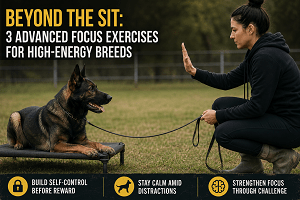
The three best advanced focus exercises for high-energy breeds are the Threshold Focus Drill (the dog earns access by staying calm), the Moving Place (the dog stays neutral while the world moves around it), and the Controlled Frustration Game (the dog keeps thinking when it can’t have what it wants). Practice each for 5 to 10 minutes a day, rewarding calm instead of speed. Together they teach emotional control, which basic obedience and extra exercise alone don’t.
Table of Contents
- Why more exercise and more obedience won’t calm a wired dog
- Before you start: the Arousal Ladder and three ground rules
- Exercise #1: The Threshold Focus Drill
- Exercise #2: The Moving Place
- Exercise #3: The Controlled Frustration Game
- A 4-week plan with pass/fail criteria
- Troubleshooting: what’s going wrong and how to fix it
- Breed notes: where each high-energy breed usually struggles
- Where nose work, puzzle toys and flirt poles fit in
- How handlers proof this work in real operational settings
- Signs it’s working (and when to call a professional)
- Conclusion
- Frequently Asked Questions
Why More Exercise and More Obedience Won’t Calm a Wired Dog
Picture a Belgian Malinois that can do a perfect sit, down and heel in the backyard. Then a jogger passes the fence, and the dog turns into a spinning, barking tornado. Sound familiar?
If you live or work with a Malinois, German Shepherd, Border Collie, Dutch Shepherd, Australian Cattle Dog, working-line Labrador or any driven sport, protection or hunting breed, you’ve seen this gap. The dog knows the commands. It just can’t use them when it’s excited.
Here’s the thing most guides miss: obedience isn’t the same as calm. A dog can obey and still vibrate with excitement. Many high-drive dogs actually get more wound up during fast, repetitive obedience because they start predicting the reward. Their brain says, “Ball coming? Treat coming? When do I explode?”
The usual fix people reach for is more exercise. Longer runs, more fetch, a bike ride every morning. It feels logical. But fitness builds capacity. Think of a human athlete who trains harder and gets more energy, not less. If you only add physical work, you can end up with a super-fit dog that still can’t switch off. Trainers who work with Malinois often say the same thing: an hour of running gives you a fitter dog that’s still over-threshold.
Other trainers have noticed the flip side too. Without breaks, too much arousal can do more harm than good, and over-the-top behavior can last for hours afterward. That’s why the best dogs aren’t the ones that never get excited. They’re the ones that can get excited and come back down on their own.
Many owners also blame stubbornness when a driven dog ignores them. Most of the time it’s a reinforcement problem, not a willingness problem. We covered that in Your Dog Isn’t Stubborn, You’re Using the Wrong Reinforcement. The exercises below build on it.
In this guide you’ll learn:
- How to measure your dog’s excitement level so you train at the right intensity
- Three advanced focus exercises, with exact steps, pass criteria and progressions
- A 4-week plan you can follow without guessing
- The most common mistakes (including one that looks like good focus but isn’t)
- How to know when to slow down or bring in a professional
Before You Start: The Arousal Ladder and Three Ground Rules
Most training advice says “work when your dog is calm.” That’s vague. What does calm look like on a dog that lives at a 7 out of 10?
Use this simple Arousal Ladder. It’s our own handler shorthand, not a scientific scale, but it works well in the field.
| Level | What you see | Can the dog learn? |
|---|---|---|
| 1 – Asleep or loose | Soft eyes, slow breathing, sprawled out | Too sleepy for training |
| 2 – Calm and curious | Relaxed mouth, loose body, looks around, can take food gently | Best learning zone |
| 3 – Alert | Ears up, body firm, still responds to you | Good for proofing |
| 4 – Wound up | Fast breathing, whining, scanning, mouthy, grabs the leash | Learning drops; reduce difficulty |
| 5 – Over threshold | Spinning, lunging, barking, deaf to you | Stop, create distance, reset |
Your target: train in levels 2–3. If your dog hits 4, make the task easier. If it hits 5, end the session and put distance between your dog and the trigger.
Three Ground Rules
1. Rule out medical causes first. If your dog suddenly turned frantic, check with your vet. Pain, ear or skin discomfort, and diet issues can all look like “too much energy.” Focus work can’t fix an itch or an ache.
2. Keep sessions short. Five to ten minutes beats an hour. Mental work is tiring, and a dog that’s mentally spent makes more mistakes, which means you start rehearsing the wrong behavior.
3. Know who this guide is for. These exercises suit dogs that are over-excited, impulsive or frustrated. If your dog has a bite history, shows true aggression toward people or dogs, or redirects onto you when frustrated, work with a qualified trainer or veterinary behaviorist in person before you try the frustration exercise.
You’ll also need a flat collar or harness and a standard leash (a 15–20 ft long line helps in Exercise #2), a reward your dog loves (food, a toy, or access to something exciting), and a raised cot, platform or mat for Exercise #2.
Exercise #1: The Threshold Focus Drill
The Goal
Teach your dog that calm behavior unlocks the thing it wants. Your dog learns one powerful rule: “Calm opens the door.”
Why It Works
High-energy dogs rehearse impulsive behavior dozens of times a day. They rush through doors, launch out of crates, hit the car boot like a rocket, and charge into the park. Every repeat makes impulsivity stronger, and every time it works, the dog learns that arousal is the fastest road to reward.
This drill breaks that cycle. You add a short pause before the exciting thing, and you make calm the key that opens it.
Handler timing matters a lot here. Late marking, repeating cues and releasing too early are the usual ways this drill falls apart. We break those down in 10 Handling Mistakes That Are Quietly Ruining Your Dog’s Training Progress.
What You Need
- Leash
- Marker word (“Yes”) or clicker
- A “door” that matters: a gate, crate, car door, house door or training field entrance
- The reward: the door itself, plus a toy or treat
Step-by-Step
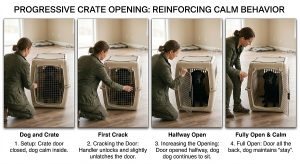
Step 1: Walk to the threshold on a loose leash. The moment your dog pulls, whines, spins or fixates on the door, stop moving. No talking, no correcting, no jerking the leash. The door stays closed and the environment becomes the teacher.
Step 2: Wait for the reset. This is the step most owners rush. Don’t ask for a sit right away. Wait for the signs of a real reset:
- Soft eye contact or a head turn toward you
- Slower breathing
- A softer body and a loose leash
- A closed mouth
In the first few sessions, this can take 30 seconds. It can occasionally take a few minutes. That’s fine. You’re training the nervous system, not obedience speed.
Step 3: Mark and open. The instant your dog softens, say “Yes,” then open the door a few inches. If the dog surges, calmly close it and reset. If the dog stays loose, open the door fully and release with a cue like “Okay.”
Step 4: Repeat 3 to 5 times, then stop. End on a win. Short and clean beats long and sloppy.
Pass Criteria Before You Move Up
Move to the next level when your dog resets within 10 seconds on 4 out of 5 doors across two sessions in a row.
Level-Up Ladder
- Level 1: Doors inside the house
- Level 2: Crate door and car door
- Level 3: Yard gate with a toy lying nearby
- Level 4: Training-field entrance with another dog working in view
- Level 5: Park entrance, open the door halfway, pause, then open again
Safety note: Use the leash to control car exits, especially from SUVs and pickup trucks. A dog that launches out of a high boot at full speed can hurt its joints. Calm exits protect your dog’s body as well as your nerves.
A Real Example
One Belgian Malinois I worked with used to slam crate doors hard enough to rattle the room. The owner was sure the dog needed more exercise. In reality the dog needed better transition control. After three weeks of threshold drills before every release (crate exits, car exits, feeding and toy games), the dog stopped launching itself.
Not because it got tired. Because it learned that patience opens doors.
Exercise #2: The Moving Place
The Goal
Most dogs can hold a “place” command in a quiet room. That’s beginner-level focus. The Moving Place teaches your dog to stay mentally neutral while things move around it.
Why Movement Is So Hard for High-Energy Dogs
Movement triggers instinct. Joggers, bikes, squirrels, kids, cars, bouncing balls and other dogs all switch on chase and engage behaviors. Many owners accidentally teach “movement means react.” This exercise flips it to “movement happens, and I stay neutral.”
Passive behaviors like a long down-stay are often harder for driven dogs than active ones, because the dog has to hold all that energy in. That’s why we build the stay slowly and pay generously.
What You Need
- A raised cot, platform or non-slip mat
- A reliable “go to place” and “release” cue
- A long line for safety (optional but smart)
- Controlled distractions (a helper makes this much easier)
Safety note: Keep the cot low (about 4 to 8 inches for most medium and large dogs) and non-slip. A dog that bounces off a tall platform in a rush can injure a shoulder.
Step-by-Step
Step 1: Make sure the foundation is solid. Before adding movement, your dog should already do three things without help: go to the place, stay on the place for 30 seconds, and wait for the release cue. If it can’t, build that first.
Step 2: Add tiny movements. With your dog on the cot, begin small: shuffle your feet, walk a slow circle, clap softly, open and close a door, slowly move a toy. Reward calm observation with a quiet “Yes” and a treat delivered low and between the paws.
Step 3: Raise the pressure one notch at a time. Add one new thing per session:
- Jogging past
- Tossing a toy nearby
- Another person walking a dog at a distance
- Kids running (at a distance, with an adult helper)
- A vacuum cleaner or a bouncing ball
- A food bowl placed on the floor
The challenge isn’t how long the dog stays. It’s how neutral the dog stays while the environment changes.
Step 4: Release on your terms. Release when the dog is calm. Don’t release because the dog broke or because you got nervous. If you release at a peak of excitement, you teach the dog that arousal ends the exercise.
Pass Criteria
Your dog holds the place for 60 seconds through a medium distraction (someone jogging past at 10 to 15 feet) with a loose body, 4 out of 5 times.
Don’t Mistake Hyper-Focus for Good Focus
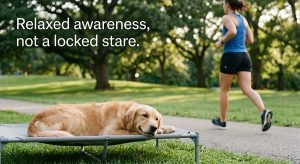
This is the most common mistake we see. Owners reward rigid staring because it looks like concentration. But real focus is relaxed.
Watch for the red flags of over-arousal:
- Tight, closed mouth
- Hard, locked eyes
- Trembling or shallow breathing
- A body that looks ready to spring
A good Moving Place dog looks thoughtful, not loaded. If you see tension, make the task easier and pay for breathing out.
If Your Dog Keeps Breaking
Reduce intensity, increase distance, or slow your movement. Repeated failure becomes a habit, so set the dog up to win.
Advanced Variations
- Bounce a ball repeatedly
- Run agility drills nearby
- Work in a public park with a helper
- Add multiple moving dogs at a distance
- Practice at a café patio or outside a vet clinic
The goal is self-regulation, not suppression.
Exercise #3: The Controlled Frustration Game
The Goal
Teach your dog to stay thoughtful when it can’t have what it wants right now. For many working-breed owners, this is the most valuable skill of all.
Why Frustration Tolerance Matters
A surprising number of problem behaviors come from poor frustration handling. Barking, lunging, spinning, leash biting, demand behavior, fence fighting and redirected mouthing often start with a dog that wants something badly and can’t get it.
Here’s the trap. When the owner gives in at the peak of the meltdown, the dog learns that intensity works. This game teaches the opposite: composure makes rewards appear.
Reading your dog’s tension is part of the job. You need to spot the subtle shift from tight to soft so you can reward at exactly the right moment. Our guide on dog body language and early warning signs shows what to look for.
What You Need
- A high-value toy (ball, tug) or special food
- A leash or a tether attached to a secure point
- A quiet training area
Safety note: If your dog grabs your clothes or hands when frustrated, tether the dog to a secure anchor, keep the reward out of reach, and get in-person help from a qualified trainer first. Don’t try to “tough it out.”
Step-by-Step
Step 1: Create desire. Show your dog the toy or food. Hold it still. Don’t hand it over.
Step 2: Observe, don’t react. Most high-drive dogs will bark, paw, jump, stare, spin or bite the leash. Stay quiet and neutral. No yelling, no punishment, no reaction. You’re gathering data on your dog’s frustration threshold.
Step 3: Reward the first sign of self-control. Mark and reward the moment your dog does any of these:
- Stops vocalizing
- Breathes out
- Looks away briefly
- Sits on its own
- Softens its body
You’re rewarding emotional recovery, not a command.
Step 4: Build the delay. Start with a one-second pause before the reward. Then two seconds, then five. Increase slowly. If your dog melts down again, go back to an easier delay.
Turn It Into an On/Off Switch
Once your dog gets the idea, add the “off switch” game, a version of the “Chill Out” idea that behavior consultants like Dee Ganley use to lower arousal:
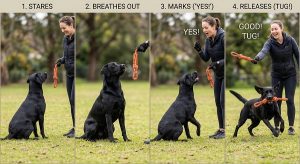
- Play tug for 5 to 10 seconds.
- Freeze. Stop all movement.
- Wait for the dog to go quiet (even briefly).
- Say “Yes.” Resume tug as the reward.
Calm brings the game back. After a week or two you’ll see your dog drop from excited to still much faster. Elite working dogs do this naturally because they’ve been trained for it. Most pet dogs just need a handler who rewards the drop.
Pass Criteria
Your dog holds a calm pause for 5 seconds with the toy moving in front of it, 4 out of 5 times, without vocalizing or grabbing at you.
Advanced Variations
- Longer delays (10 to 20 seconds)
- Move the reward around, or bounce the ball
- Add a flirt pole at a distance, then pause
- Practice around another dog at a distance
- Ask for an easy behavior (sit, down) before release
A 4-Week Plan With Pass/Fail Criteria
Most guides tell you what to do but not when to move on. Use this plan. You’ll train 5 days a week, 5 to 10 minutes a session.
| Week | Focus | Where | Move on when… |
|---|---|---|---|
| 1 | Threshold Drill (inside the house) + Place foundation | Home | Dog resets in 10 seconds on 4/5 doors |
| 2 | Threshold at car and gate + Moving Place with tiny movements | Home + yard | Dog holds place 30 seconds through small movements |
| 3 | Controlled Frustration (1–5 second delays) + Moving Place with medium movement | Yard | Dog holds a 5-second calm pause 4/5 times |
| 4 | Combine all three + one outing to a quiet public spot | Yard + park edge | Dog stays at level 2–3 on the Arousal Ladder for most of the session |
Weekend: Do a recovery walk and calm exposure. Let the dog sniff and watch the world with no demands. That’s training too.
If a week goes badly, repeat it. A slow plan that sticks beats a fast one that falls apart. Remember to pair focus work with the right amount of physical exercise for your dog’s job and age. Our guide on how often to exercise a working dog gives you a starting point.
Troubleshooting: What’s Going Wrong and How to Fix It
| What you see | Likely cause | Fix |
|---|---|---|
| Dog never settles at the door | Reward is too exciting for the level, or you open too soon | Use a calmer reward, wait longer, practice at an easier door |
| Dog resets at home but fails at the park | Skills haven’t transferred; distractions too high | Go back two levels; practice with distance |
| Dog stares hard at you and stays rigid | Hyper-focus, not calm | Reward breathing out and a soft body, not the stare |
| Dog screams or barks through the frustration game | Delay too long or reward too exciting | Cut the delay to one second; use a lower-value reward |
| Dog calm in sessions but wild at home | Practice only in “training mode” | Add tiny threshold moments through the day (meals, doors, leash on) |
| Dog is calm one day and wired the next | Poor sleep, a hard day before, or too much arousal play | Add a rest day; cut chase games for a week |
| Dog grabs your hands or clothes | Frustration is spilling over | Tether the dog, increase distance, and get a qualified trainer’s help |
Breed Notes: Where Each High-Energy Breed Usually Struggles
Every dog is an individual, but breed history leaves patterns. Use this as a starting point, not a rulebook.
| Breed | Common challenge | Start with |
|---|---|---|
| Belgian Malinois | Very fast arousal, mouthy, body-slams when excited | Threshold Drill, then Controlled Frustration |
| German Shepherd | Fixation, leash reactivity, hyper-vigilance | Moving Place |
| Border Collie | Visual fixation on movement, obsessive staring | Moving Place (watch for hyper-focus) |
| Dutch Shepherd | Intense, sensitive, quick to over-react | Threshold Drill with short sessions |
| Australian Cattle Dog / Blue Heeler | Nipping at heels, frustration biting | Controlled Frustration; swap grabbing for a toy to carry |
| Working-line Labrador | Mouthy, exploding at the door, “ball brain” | Threshold Drill and delayed fetch |
| Terrier types (e.g., Jack Russell) | Barking, digging, fast frustration | Short Controlled Frustration sessions |
Where Nose Work, Puzzle Toys and Flirt Poles Fit In
You’ve probably read that nose work, puzzle feeders and agility are the answer for high-energy dogs. They’re good tools. Many trainers say a short, focused nose-work session can tire a dog as much as a much longer walk. Dogs have a huge advantage with scent: they have tens to hundreds of millions of scent receptors compared with roughly 6 million in people.
But these activities only help if you use them correctly:
- Do use nose work, puzzle toys and flirt poles as an outlet and a reward.
- Don’t use them as a replacement for self-control work. A dog that gets a flirt pole session every time it screams learns to scream.
- Do end high-arousal games with a short calm cue and a settle on the mat.
- Don’t add endless chase games to a dog that already struggles to turn off.
Think of it this way: outlets fill the tank. Focus exercises teach the dog how to drive without flooring the pedal.
How Handlers Proof This Work in Real Operational Settings
In professional working-dog programs, nobody expects a dog to be calm because it’s tired. Handlers expect the dog to be calm because it understands the job of staying calm. That’s why working dogs are proofed in layers.
We start in a quiet space. We add small distractions, one at a time. Then we add distance, duration and difficulty, but never all three at once. We train in different places, because dogs don’t automatically carry a skill from the living room to the street.
Three principles carry over directly to pet owners:
- Raise one variable at a time. Distance, duration or distraction, never all three.
- Reward the dog for recovery. A dog that recovers quickly from a spike is more valuable than a dog that never spikes.
- Finish with calm. End every session with a few seconds of quiet, so the last thing the dog rehearses is composure.
If you want the deeper foundation behind all of this, my e-book Beyond the Bark: Inside a Pro Handler’s Playbook for Raising the Ideal Dog walks through how professional handlers build calm, reliable dogs from the ground up.
Signs It’s Working (and When to Call a Professional)
The first changes are small. Look for:
- Calmer exits from the crate and car
- Less scanning and pacing indoors
- A softer face and body
- Faster recovery after excitement
- Fewer “launch” moments at doors
Then bigger changes show up:
- Less leash pulling and reactivity
- Better recall around distractions
- Neutral behavior around dogs and people
- More reliable obedience in busy places
Call a qualified trainer or veterinary behaviorist if:
- Your dog bites or tries to bite people or dogs
- Frustration turns into redirected aggression toward you
- Your dog can’t settle even after weeks of consistent work
- You suspect pain or a medical problem
Asking for help isn’t failure. It’s what experienced handlers do.
Conclusion
A tired dog isn’t the same as a calm dog. High-energy breeds don’t need more drills. They need structured mental work that teaches them to pause, recover and think.
Here’s your quick recap:
- Threshold Focus Drill: calm opens the door.
- Moving Place: stay neutral while the world moves.
- Controlled Frustration Game: stay thinking when you can’t have it yet.
Your next steps:
- Check your dog’s Arousal Ladder level and rule out any medical issue.
- Start with the Threshold Drill at one door in your home this week.
- Follow the 4-week plan and move up only when your dog hits the pass criteria.
- End every session calm, and repeat the easy level if you’re unsure.
Want more training plans like this, straight to your inbox? Subscribe to our weekly articles roundup newsletter and get new K9 training guides every week.
Frequently Asked Questions
1. How do I calm a high-energy dog without medication?
Teach self-regulation through structured mental work: threshold control, place training with distractions, and frustration tolerance. Pair that with the right amount of physical exercise, enough sleep and a predictable routine. If your dog is extremely anxious or reactive, talk to your vet or a veterinary behaviorist, since some dogs benefit from medical support alongside training.
2. What is the best training for a hyperactive dog?
The best training combines impulse control, a reliable settle on a mat and environmental neutrality exercises. Basic obedience and extra exercise alone rarely fix hyperactivity. Karen Overall’s 15-day Protocol for Relaxation is also a well-known, structured way to teach a dog to settle.
3. Why is my dog still hyper after exercise?
Exercise tires the body, not the part of the brain that controls excitement. Too much high-arousal exercise can even raise a dog’s baseline arousal and build stamina without self-control. Add short focus sessions and calm breaks to every active day.
4. How long does it take to train focus in a high-energy dog?
Most owners see small changes in 1 to 2 weeks of daily 5- to 10-minute sessions, and clearer changes in 4 to 6 weeks. Adolescent dogs, strongly bred working lines and dogs with a long history of rehearsed excitement can take longer. Progress isn’t a straight line.
5. Can working breeds ever be calm indoors?
Yes. Working breeds can learn to switch off indoors while keeping their drive for outdoor work. It takes consistent practice, enough physical and mental outlets, and rewarding calm every day. The best working dogs can go from full intensity to full composure on cue, and that skill is trained, not automatic.

Her work centres on obedience, detection, protection and operational readiness. She favours proven methods built on repetition, consistency and real-world conditioning, so that both dogs and handlers are prepared for high-pressure tasks.
Rofiat represented the Nigerian Army Dog Centre at the Nigerian Army Day Celebration (NADCEL) 2026, where she led demonstrations in obedience, explosive detection, agility and tactical movement. Through articles, training content and documentaries, she shares field-based insight into how structured training, clear communication and trust between handler and dog affect performance and reliability.
She is the author of Beyond the Bark: Inside a Pro Handler's Playbook for Raising the Ideal Dog, a practical guide that helps dog owners and handlers apply professional training principles in everyday situations.
- Dog Hotel Prep: 7 Must-Haves Before Boarding - October 21, 2026
- How to Enter the COBA National Dog Championship - October 20, 2026
- K9 Advantix Dosage Chart & Safety Guide for Dogs - October 19, 2026