5 Essential Dog Training Tips for GSD Puppies
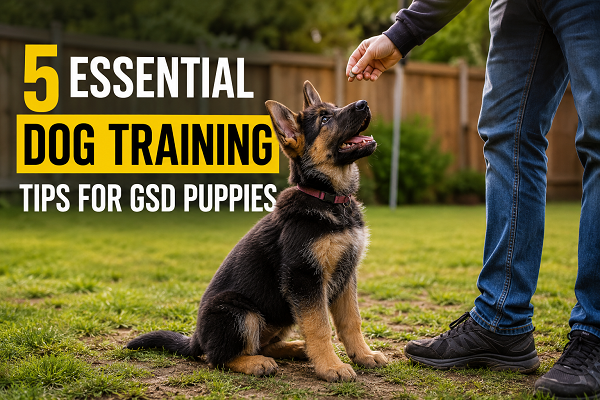
The 5 essentials for training a GSD puppy are starting socialization before 14 weeks, using short daily positive-reinforcement sessions, crate and potty training on a consistent schedule, channeling their high energy through structured mental work, and staying consistent with one set of house rules from day one. Get these right in the first four months and the rest of obedience training becomes dramatically easier.
Table of Contents
- Introduction
- Why GSD Puppies Need a Different Approach
- Tip 1: Start Socialization Before the Window Closes
- Tip 2: Keep Training Sessions Short, Frequent, and Positive
- Tip 3: Nail Down Crate and Potty Training Early
- Tip 4: Give That Big Brain a Job
- Tip 5: Be Boringly Consistent
- What It Costs to Train a GSD Puppy
- Common Mistakes That Set GSD Owners Back
- FAQs
- Final Thoughts
Introduction
I’ve spent years working alongside German Shepherds in training and security contexts, and I can tell you the dogs that turn into calm, confident adults almost always had the same thing in common: an owner who took the first 16 weeks seriously. This isn’t about being perfect. It’s about knowing where to put your energy so you’re not fighting bad habits for the next two years.
In this guide, you’ll learn exactly what to do in those early months, how long each stage realistically takes, what it might cost you if you bring in professional help, and the mistakes that trip up even experienced owners.
Summary of What You’ll Learn
- Why the 3-to-14-week window is the single most important stretch of your puppy’s life
- How to structure training sessions so a GSD puppy actually retains commands
- A realistic potty and crate training timeline (with the numbers most guides don’t give you)
- How to manage a GSD’s famous energy and drive so it doesn’t turn destructive
- Why consistency matters more than any single training technique
- Real costs, timelines, and expert tips pulled from working K9 experience
Why GSD Puppies Need a Different Approach
German Shepherds aren’t a “figure it out as you go” breed. They were bred in Germany in the late 1800s to herd sheep and think independently while doing it, which is exactly why they later became the backbone of police, military, and detection K9 programs worldwide. That same independent streak means an under-trained GSD doesn’t just misbehave, it starts making its own decisions about what’s “acceptable.” And a 90-pound adult male making his own decisions is a very different problem than a Chihuahua doing the same thing.
The good news? GSDs are also famously eager to please and quick to learn. Most puppies with consistent daily sessions pick up sit, down, stay, come, and their name within two to six weeks. The catch is that “knowing” a command and “reliably obeying” it in a park full of squirrels are two very different skill levels, and that gap usually takes another three to six months of practice to close.
Tip 1: Start Socialization Before the Window Closes
Here’s the thing most new owners don’t realize until it’s too late: puppies have a biological window, roughly 3 to 14 weeks of age, where their brains are wired to accept new experiences as normal. After that window narrows around 12 to 16 weeks, it doesn’t slam shut completely, but fear responses become much harder to prevent and much harder to undo.
During this stage, your job isn’t formal obedience. It’s exposure. Get your GSD puppy comfortable with:
- Different types of people (kids, people in hats, people using canes or wheelchairs, people of different heights and skin tones)
- Other vaccinated, friendly dogs
- Everyday sounds (vacuum cleaners, traffic, doorbells, thunder recordings)
- Different surfaces (grass, tile, gravel, stairs)
- Car rides, vet visits, and being handled all over (ears, paws, mouth)
A widely cited behavioral study of puppies followed through their socialization period found a strong link between fewer novel experiences early on and increased fearfulness later in life. For a breed like the GSD, which already carries a genetic tendency toward protectiveness and territorial behavior, skipping this stage is one of the most common reasons otherwise good dogs develop reactivity or fear-based aggression as adults.
Handler’s tip: Vaccination schedules can make owners nervous about taking puppies out before 16 weeks. You don’t have to choose between health and socialization. Carry your puppy through unfamiliar environments, host controlled playdates with healthy, vaccinated dogs, and use puppy classes that require proof of at least the first round of shots. If you’re weighing a GSD against another popular working breed for your household, this comparison of German Shepherds versus Belgian Malinois is worth a read before you commit, since temperament and socialization needs differ more than people expect between the two.
Tip 2: Keep Training Sessions Short, Frequent, and Positive
Ever wonder why some GSDs seem to “get it” almost instantly while others seem to forget a command they knew yesterday? Nine times out of ten, it comes down to session length and consistency, not intelligence.
Puppies, GSDs included, have short attention spans. Five to ten minutes, two to three times a day, beats one 30-minute marathon session every time. Here’s a simple structure that works:
- Pick one command per session (don’t try to teach sit, stay, and down all at once)
- Use high-value rewards (small pieces of chicken or cheese work better than dry kibble for a new behavior)
- Mark the exact moment your puppy does the right thing with a clicker or a consistent word like “yes”
- End on a win so the last thing your puppy remembers is success
- Practice in new locations once a command is solid at home, since dogs don’t automatically generalize a skill from your living room to the sidewalk
Modern trainers and behaviorists overwhelmingly favor positive reinforcement over correction-based methods for puppies. Punishment can suppress a behavior in the moment, but it also raises stress hormones and can damage the trust you’re trying to build, something that matters even more with a breed as sensitive to its handler’s mood as the GSD.
If you want a sense of how a working-line dog’s early training compares to a family GSD’s, our breakdown of basic training techniques used for military K9s shows how the same core principles, short sessions, clear markers, high consistency, scale up for professional working dogs.
Tip 3: Nail Down Crate and Potty Training Early
Potty training frustrates more new GSD owners than almost anything else, mostly because expectations are off. Here’s a realistic timeline based on what most breeders and trainers report:
| Stage | Age | What to Expect |
|---|---|---|
| Introduction | 8 weeks | Crate is a positive space; potty every 1-2 hours |
| Building routine | 10-12 weeks | Fewer accidents; consistent schedule forming |
| Improving reliability | 12-16 weeks | Puppy starts signaling need to go out |
| Mostly reliable | 16-20 weeks | Accidents rare with consistent schedule |
| Fully reliable | 5-7 months | Occasional lapses only under stress or illness |
The crate isn’t punishment, and it shouldn’t ever be used as one. Introduced correctly, it becomes your puppy’s den, a place it chooses to relax in even with the door open. Feed meals in the crate for the first couple of weeks, keep initial crate sessions short, and never let a puppy out of the crate while it’s mid-whine or mid-bark, or you’ll accidentally teach it that noise gets results.
A quick rule of thumb for bladder control: a puppy can typically hold its bladder for roughly one hour per month of age, up to about eight hours. So a 3-month-old puppy needs a potty break at least every three hours during the day, not “whenever it’s convenient for you.”
Tip 4: Give That Big Brain a Job
GSDs were bred to work all day, and that drive doesn’t disappear just because your puppy now lives in an apartment instead of on a farm. A bored GSD is a destructive GSD, chewing, digging, and barking are often boredom symptoms dressed up as “bad behavior.”
Structured mental work channels that energy productively:
- Scent games – hide treats around a room and let your puppy search
- Puzzle feeders – make mealtime a problem to solve instead of a five-second event
- Short obedience “reps” – a few minutes of sit-stay-come throughout the day, not just one formal session
- Controlled tug or fetch – with clear start and stop cues, which doubles as impulse control training
If you’re drawn to the GSD specifically because of its working-dog reputation, it helps to understand what actually separates a true working dog from a family pet, since the expectations, and the amount of daily engagement required, are genuinely different.
Tip 5: Be Boringly Consistent
This is the tip nobody wants to hear because it’s not glamorous. Consistency beats every clever training trick out there. If one family member allows the puppy on the couch and another doesn’t, your GSD isn’t learning a rule, it’s learning that rules depend on who’s in the room. Smart dogs are especially good at exploiting inconsistency.
Before your puppy comes home, sit down with everyone in the household and agree on:
- Which furniture is allowed and which isn’t
- What words you’ll use for each command (sit vs. sit down vs. sit please, pick one)
- Who feeds, walks, and handles training, and on what schedule
- How jumping, mouthing, and door-dashing will be handled, every single time
Handlers who work German Shepherds professionally will tell you the same thing: the dogs that struggle most in training usually don’t have a “stubborn” problem, they have an inconsistency problem upstream. For a side-by-side look at how intelligence and trainability compare across working breeds, this piece on GSD versus Belgian Malinois intelligence is a genuinely useful read if you’re trying to set realistic expectations for your own dog.
What It Costs to Train a GSD Puppy
Costs vary a lot depending on where you live and how much you outsource, but here’s a rough breakdown international owners can expect:
- Group puppy classes: $100–$250 for a 6-8 week course
- Private in-home training: $75–$200 per session
- Board-and-train programs: $1,500–$6,000 for 2-4 weeks, depending on the trainer’s credentials and location
- DIY training with online resources and consistent practice: essentially free beyond the cost of treats and a good crate
Most owners get excellent results with a mix: a basic group class for socialization exposure, combined with daily at-home practice. If you’d rather have a complete, structured curriculum to follow at your own pace instead of piecing information together from scattered articles, our full German Shepherd puppy training guide walks through the entire first year step by step.
Common Mistakes That Set GSD Owners Back
- Waiting until 6 months to start “real” training. By then you’re not starting fresh, you’re correcting six months of self-taught habits.
- Inconsistent rules between household members. Covered above, but it’s worth repeating because it’s the number one issue trainers report.
- Skipping the vet before starting intense exercise. GSDs are prone to hip and elbow dysplasia, and too much high-impact activity too young can cause lasting joint damage.
- Over-relying on punishment. It might suppress unwanted behavior short-term but tends to erode trust and can worsen fear-based reactivity in a breed already prone to it.
- Under-socializing out of an abundance of caution. Waiting for full vaccination before any exposure often does more long-term harm than the small, manageable health risk of careful, controlled early socialization.
FAQs
When should I start training my German Shepherd puppy?
As early as 7-8 weeks, focusing on gentle socialization and name recognition first. Formal obedience commands can begin around 8-10 weeks with short, positive sessions.
How long does it take to potty train a GSD puppy?
Most GSD puppies are mostly reliable by 16-20 weeks and fully reliable by 5-7 months, assuming a consistent schedule and no medical issues.
Are German Shepherd puppies hard to train?
Not typically. GSDs rank among the most trainable breeds due to their intelligence and eagerness to please, but their energy and drive mean inconsistent or infrequent training tends to backfire faster than it would with a lower-energy breed.
How many hours a day does a GSD puppy need for training and exercise?
Plan for at least 30-60 minutes of combined structured training, mental enrichment, and appropriate exercise daily, split into several shorter sessions rather than one long block.
Should I use a crate for my GSD puppy?
Yes. Crate training supports potty training, gives your puppy a secure space, and prevents destructive behavior when you can’t supervise directly, as long as it’s introduced positively and never used as punishment.
Final Thoughts
Raising a German Shepherd puppy isn’t about mastering some secret technique. It’s about getting the fundamentals right in the first four months: socializing before that window narrows, training in short positive sessions, sticking to a real potty and crate schedule, giving that brain something to do, and staying consistent even when it’s inconvenient. Do that, and you’ll spend the next decade with a dog that’s not just obedient, but genuinely a joy to live with.
Start today, even if it’s just five minutes of sit-stay practice before dinner. Your future self, and your puppy, will thank you.

Her work centers on applied training across obedience, detection, protection, and operational readiness, with a strong focus on Military Working Dogs (MWDs) and security K9 programs. Rather than relying on theory alone, Rofiat emphasizes proven training methods built on repetition, consistency, and real-world conditioning principles that prepare both dogs and handlers for high-pressure tasks.
Through articles, training content, and documentaries, she shares experience-based insights from the field, highlighting how structured training, clear communication, and trust between handler and dog directly impact performance and reliability.
Drawing from years of frontline experience, she is also the author of “Beyond the Bark: Inside a Pro Handler’s Playbook for Raising the Ideal Dog,” a practical guide designed to help dog owners and handlers apply professional training principles in everyday situations.
She remains committed to responsible K9 development, continuous skill refinement, and practical education for handlers, trainers, and dog professionals.
- How to Stop Puppy Biting Fast: 5 Proven Steps - September 12, 2026
- Best Dog Trainer in the US: K9 Obedience Guide (2026) - September 11, 2026
- Blue Heeler Dog Training: 5 Secrets to Control High Energy - September 11, 2026