Are German Shepherds Smarter Than Humans? Science Says
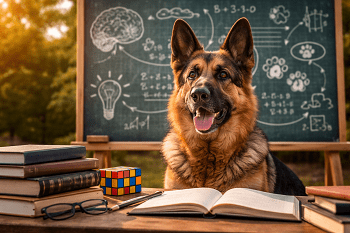
No, German Shepherds are not smarter than humans overall. Humans win at language, math, planning and creativity. But German Shepherds beat us in specific jobs: smelling (up to 300 million scent receptors versus about 6 million in people), learning commands fast, staying calm under pressure and reading human body language. Researchers compare a dog’s general mental ability to a 2 to 2.5 year old child. Think of it this way: it’s a different kind of smart, not a lesser one.
Table of Contents
- What Does “Smarter” Actually Mean?
- German Shepherd Brain vs Human Brain (The Numbers)
- Where German Shepherds Beat Humans
- Where Humans Win Easily
- How Smart Is a German Shepherd? IQ, Rankings and Word Learning
- Is a German Shepherd Smarter Than a Child?
- Real-World Proof: Trakr and the Working Dog Record
- A Handler’s View: What I See in the Field
- Four Simple Tests to Try With Your Own Dog
- The Catch: When a Smart German Shepherd Becomes a Problem
- Common Myths About German Shepherd Intelligence
- FAQs
- Conclusion
Introduction: Is Your Dog Secretly Smarter Than You?
Ever watched your German Shepherd stare at you, then walk straight to the one cupboard where you hid the treats, and wondered, are German Shepherds smarter than humans?
You’re not alone. It’s one of the most searched questions about the breed. And the honest answer isn’t a simple yes or no. Most articles online either gush about “genius dogs” or repeat the same “2-year-old” line without explaining it. Some even invent numbers (you’ll see fake “IQ of 150 to 200” claims floating around, and no real study backs them).
In this guide, you’ll get the real science: brain cell counts, famous studies, ranking data, and what actually happens when German Shepherds work next to people. You’ll learn exactly where they beat us, where they fall short, and how to bring out your own dog’s best thinking.

What Does “Smarter” Actually Mean?
Here’s the thing. “Smart” isn’t one skill. Psychologist Stanley Coren, who wrote The Intelligence of Dogs, split dog intelligence into three types:
- Instinctive intelligence: what the breed was built to do (for GSDs, herding, guarding and tracking).
- Adaptive intelligence: solving problems and learning from experience.
- Working and obedience intelligence: learning what humans teach.
Now add the human side. We have language, abstract thinking, long-term planning and tool-making. A dog can’t match any of that. But we can’t smell a buried phone from a metre away or hear a whistle pitched far above our hearing range.
So the fair question isn’t “who is smarter?” It’s “smarter at what?”
German Shepherd Brain vs Human Brain (The Numbers)
Let’s start with the hardware. A 2017 study from Vanderbilt University and international partners counted brain cells in the cerebral cortex, the “thinking layer” tied to planning and complex behavior. The study found dogs have about 530 million cortical neurons. Cats have about 250 million. Humans have about 16 billion.
So a human cortex holds roughly 30 times more neurons than a dog’s. That gap explains a lot.
But look at what dogs spend their brain power on. Here’s a quick comparison:
| Ability | German Shepherd | Human |
|---|---|---|
| Cortical neurons | About 530 million (dog average) | About 16 billion |
| Smell receptors | Up to 300 million | About 6 million |
| Brain area for smell | About 40 times larger (proportionally) | Much smaller |
| Detection sensitivity | Parts per trillion | Parts per million at best |
| Language | Dozens to 1,000+ words understood (with training) | Tens of thousands of words, grammar, writing |
| Planning ahead | Very limited | Years or decades |
| Math and abstract thought | None shown | Advanced |
Notice the pattern? Humans invested in the front of the brain (planning, language). Dogs invested in the nose. Same species-level “budget,” very different spending.
Where German Shepherds Beat Humans
1. Smell: It’s Not Even Close
Dogs have up to 300 million scent receptors, compared with about 6 million in people. They also detect odors at concentrations as low as one part per trillion, which equals roughly one drop in 20 Olympic swimming pools. Researchers estimate their noses are 10,000 to 100,000 times more sensitive than ours.
That’s why military and police units trust them to find bombs. If you want to see how reliable that really is, read our breakdown of how accurate military dogs are at detecting explosives.
2. Learning Speed With Repetition
In Coren’s survey of around 200 dog obedience judges, German Shepherds ranked third for working and obedience intelligence, behind the Border Collie and Poodle. Dogs in that top tier learn a new command in fewer than five repetitions and obey a known command 95% of the time or better.
Most adult humans learn a spoken command in one try, sure. But we don’t do it while a crowd is cheering and a helicopter is overhead. Dogs do.
3. Reading Human Signals
This one surprises people. In well-known experiments by Brian Hare and Michael Tomasello, dogs followed a human pointing finger to find hidden food far better than chimpanzees, our closest relatives. Wolves raised by humans struggled more than dogs too. Hare’s team concluded that dogs gained these social skills through domestication, which started roughly 15,000 years ago.
In plain words: your German Shepherd reads your hands, eyes and tone better than a chimp ever could.
4. Staying Alert and Reacting Fast
Shepherd dogs were bred to watch moving things for hours. A GSD notices tiny changes in posture, footsteps or scent long before most of us look up from our phones. That’s not magic, just a brain tuned for it.
5. Focus Under Pressure
A well-trained working GSD keeps doing its job through noise, crowds and chaos. Most people freeze or panic in the same conditions. That calm is trained and bred, and it’s a big reason the breed dominates military working dog programs.
Where Humans Win Easily
Let’s be fair. German Shepherds can’t:
- Speak or understand grammar the way a child can
- Do math, write, or read
- Plan next month, next year or retirement
- Invent tools or technology
- Imagine problems that haven’t happened yet
- Explain why they did something
When a puzzle needs abstract thinking, humans win by a mile. A GSD can learn to open a gate by watching you. It can’t design a better gate.
How Smart Is a German Shepherd? IQ, Rankings and Word Learning
Is There a German Shepherd IQ Score?
No. Dogs don’t take human IQ tests, and anyone quoting a “German Shepherd IQ of 150” is guessing. What researchers do say, based on Coren’s work, is that a dog’s overall mental ability roughly matches a child of 2 to 2.5 years. Coren also estimated that the average dog understands about 165 words and gestures.
Treat “2 years old” as a rough comparison, not a literal age. A toddler can’t track a scent trail, and your dog can’t ask for a snack in a full sentence.
How Many Words Can a German Shepherd Learn?
The record holder isn’t a German Shepherd. It’s a Border Collie named Chaser. Researchers at Wofford College (South Carolina) spent three years teaching her the names of 1,022 objects. They tested her 838 times, and she never scored below 18 out of 20. She also understood categories like “ball” and “toy,” and could pick a new object by elimination.
What does that mean for GSDs? They can learn large vocabularies too, but it takes consistent, structured teaching. Chaser’s owner stressed that the training method mattered most, not just the breed.
Where Does the German Shepherd Rank?
Germans Shepherds sit in the top three on Coren’s list, but here’s the fine print many blogs skip:
- The ranking comes from judges’ opinions, not lab tests.
- It measures obedience and trainability, not problem-solving or creativity.
- A 2019 Science study of about 14,000 dogs found trainability is one of the most inherited behavior traits. Yet a later 2022 study found breed explains only about 9% of the difference in an individual dog’s behavior.
Translation? Your German Shepherd’s breed gives it a nudge, not a guarantee. Some GSDs are brilliant. Some are average. Training and daily life decide the rest.
How does the breed compare to its famous cousin? See our full test in German Shepherd vs Belgian Malinois: which is smarter for working roles.
Is a German Shepherd Smarter Than a Child?
It depends on the child’s age and the skill.
A toddler (age 2 to 3): The dog wins at scent, obeying quick commands and staying alert. The toddler wins at language growth, pretend play and creativity.
A school-age child (age 6 and up): The child pulls far ahead. Reading, counting, abstract thinking and planning develop fast, and a dog’s ceiling stays where it is.
So a German Shepherd can out-think a toddler in some tasks, but a typical 8-year-old leaves it behind in most mental skills.
Real-World Proof: Trakr and the Working Dog Record
Numbers are great, but stories show real intelligence.
Trakr was a German Shepherd police dog from Halifax, Nova Scotia. After the September 11, 2001 attacks, his handler, Officer James Symington, drove him to New York. On September 12, Trakr alerted to a spot in the rubble. Rescuers dug through unstable debris and pulled out Genelle Guzman-McMillan, the last survivor found at the World Trade Center, more than a day after the collapse.
No human instrument at the site found her first. Trakr combined scent detection, stamina and trust in his handler. He collapsed from exhaustion soon after.
That’s the German Shepherd’s real genius: scent power plus handler partnership.

A Handler’s View: What I See in the Field
Why you can trust this section: I’m Cpl. Rofiat Muritala, a Nigerian Army military working dog instructor and handler with more than 14 years at the Nigerian Army Dog Centre. My work covers dog selection, foundation training, obedience, detection and performance evaluation. I also led obedience, explosive detection, agility and tactical movement demonstrations at the Nigerian Army Day Celebration (NADCEL) 2026.
Here’s the pattern I keep seeing when I evaluate working dogs:
- Raw brains don’t make a good working dog. Drive and handler bond do. A “clever” dog with no focus fails selection just as fast as a slow one.
- The smartest dogs learn your mistakes too. If you reward a bad habit twice, a sharp GSD locks it in.
- A bored GSD isn’t being stubborn. It’s under-stimulated. Digging, chewing and barking are usually signs of an unemployed brain.
- Calm beats clever. The dogs that pass the toughest tests stay steady under noise and pressure, which is more about nerves than IQ.
Four Simple Tests to Try With Your Own Dog
Want to see your German Shepherd’s thinking in action? Try these. They’re simple, safe and fun.
- The Towel Test (problem-solving): Drape a light towel over your dog’s head. Does it shake it off quickly or stand confused? Fast solvers tend to think flexibly.
- The Hidden Treat Test (memory): Show your dog a treat, hide it under one of three cups, then wait 30 seconds before releasing. A strong memory finds it right away.
- The Pointing Test (social intelligence): Hide a treat under one of two cups without letting your dog see which. Point at the right cup. Most dogs follow the point within a few tries.
- The Detour Test (reasoning): Put a treat behind a see-through fence and watch whether your dog works out the way around, or just presses against the barrier.
These aren’t scientific, and one result doesn’t define your dog. But they’re a great way to spot strengths, then build on them.
The Catch: When a Smart German Shepherd Becomes a Problem
High intelligence comes with a price tag: high needs. A GSD with nothing to do will invent its own job, and you won’t like it.
Typical signs of an under-stimulated German Shepherd:
- Digging under fences or escaping the yard
- Destroying furniture or shoes
- Non-stop barking or pacing
- Learning bad habits (like stealing food) super fast
- Anxiety or reactivity when left alone
How to Keep a German Shepherd’s Mind Sharp
Here’s a realistic routine that works for pet owners and handlers alike:
- Daily training (10 to 15 minutes, 2 to 3 times a day): Short bursts beat one long boring session.
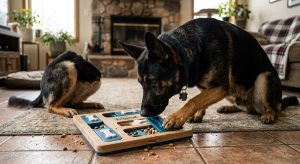
- Scent games: Hide treats or a toy around the house and say “find it.” It’s the best brain workout for the breed.
- Puzzle feeders: Swap the food bowl a few times a week.
- Teach new things: New commands, tricks or names for toys keep learning alive.
- Physical exercise: Brain work doesn’t replace a proper run. Check our guide on how often to exercise a working dog to find the right amount.
- Positive reinforcement: Harsh correction shuts down thinking in sensitive dogs. Rewards build confidence.
Rough timeline: Most GSD puppies show basic focus by 8 to 12 weeks, solid foundation obedience by 6 to 8 months with daily practice, and full mental maturity around 2 to 3 years. Dogs also go through cognitive aging, so keep games going into the senior years.
Common Myths About German Shepherd Intelligence
Myth: German Shepherds understand every word you say. Reality: They learn to link sounds with actions and objects, mostly through tone, context and body language.
Myth: German Shepherds have a human-level IQ. Reality: No such test exists, and no study supports it.
Myth: A smart dog doesn’t need much training. Reality: The opposite. Sharp dogs need more structure, or they teach themselves the wrong things.
Myth: The GSD is the smartest dog in the world. Reality: It’s among the best at working intelligence, but Border Collies and Poodles ranked ahead in Coren’s survey.
Myth: Dogs feel guilty when they misbehave. Reality: That “guilty look” is usually a reaction to your tone and posture, not a moral thought.
Frequently Asked Questions
1. Are German Shepherds smarter than humans?
No. Humans are far ahead in language, math, planning and creativity. German Shepherds beat humans in scent detection, quick obedience learning, alertness and reading body language.
2. How smart is a German Shepherd compared to a human child?
Researchers compare a dog’s overall mental ability to a child of about 2 to 2.5 years. A GSD can beat a toddler at scent and obedience, but older children quickly pass any dog in reasoning and language.
3. What is a German Shepherd’s IQ?
There’s no real IQ score for dogs. Any number you see online is made up. Stanley Coren ranked the breed third for working and obedience intelligence, which measures trainability, not IQ.
4. Can German Shepherds understand human emotions?
Yes, in a practical way. They read your voice, face and posture, and many react when you’re upset or tense. Studies show dogs follow human gestures better than chimpanzees. But this is pattern reading, not a deep understanding of feelings.
5. How can I make my German Shepherd smarter?
You can’t raise its natural ceiling, but you can help it reach it. Use daily short training sessions, scent games, puzzle feeders, new tricks, regular exercise and reward-based training.
Conclusion: Different Minds, Great Partners
So, are German Shepherds smarter than humans? No, but they’re smart in ways we aren’t.
Here’s what to remember:
- Humans have about 30 times more cortical neurons and far stronger language, planning and abstract thinking.
- German Shepherds win at smell, speed of learning, vigilance and reading human cues.
- The breed ranks third in Coren’s obedience survey, but breed explains only a small share of each dog’s personality.
- A smart GSD needs daily mental work, or it will find trouble.
- Real intelligence shows up in teamwork, like Trakr’s search at Ground Zero.
Your next step: Pick one test from this guide and try it with your dog this week. Then add 10 minutes of scent games to your daily routine. You’ll see the difference in focus within a couple of weeks.
Want to turn that sharp mind into reliable obedience and confidence? My book, Beyond the Bark: Inside a Pro Handler’s Playbook for Raising the Ideal Dog, lays out the same professional methods I use with service dogs, adapted for everyday owners.
Get more K9 tips every week: Join our weekly articles roundup by subscribing to the ARFS K9 Team newsletter.
Sources referenced: Herculano-Houzel and colleagues, Frontiers in Neuroanatomy (2017); Coren, The Intelligence of Dogs (1994); Pilley and Reid, Behavioural Processes (2011); Hare, Brown, Williamson and Tomasello, Science (2002); Kirchhofer et al., PLoS ONE (2012); MacLean et al., Science (2019); Morrill et al., Science (2022); PBS NOVA, “Dogs’ Dazzling Sense of Smell.”

Her work centres on obedience, detection, protection and operational readiness. She favours proven methods built on repetition, consistency and real-world conditioning, so that both dogs and handlers are prepared for high-pressure tasks.
Rofiat represented the Nigerian Army Dog Centre at the Nigerian Army Day Celebration (NADCEL) 2026, where she led demonstrations in obedience, explosive detection, agility and tactical movement. Through articles, training content and documentaries, she shares field-based insight into how structured training, clear communication and trust between handler and dog affect performance and reliability.
She is the author of Beyond the Bark: Inside a Pro Handler's Playbook for Raising the Ideal Dog, a practical guide that helps dog owners and handlers apply professional training principles in everyday situations.
- K9 Advantix Dosage Chart & Safety Guide for Dogs - October 19, 2026
- How to Set Up & Use Bousnic Dog Training Collar - October 18, 2026
- Westminster Dog Show 2026: Winners & Full Results - October 17, 2026