German Shepherd vs Belgian Malinois: Which Breed Is Right For You
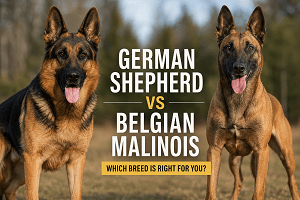
If you’ve ever worked with a Malinois, you’ll know that intensity hits you the moment you step into the yard. But if you’ve spent time with a German Shepherd, you’ve experienced that steady, grounding loyalty that makes them feel like a true family partner. Both breeds are legends in the working dog world, trusted by military units, police K9 teams, and protection professionals around the globe. Both breeds belong to the elite category of working dogs. If you’re new to the K9 world, understanding what defines a working dog can help you better appreciate why German Shepherds and Belgian Malinois dominate military, police, and protection roles.
But when you’re choosing between a German Shepherd vs Belgian Malinois for your next working dog, family guardian, or K9 partner, the decision isn’t just about which looks tougher. It’s about matching the breed to your experience level, lifestyle, training commitment, and what you actually need from a working dog.
This isn’t a generic comparison. We’re breaking down real stats, actual training timelines, verified costs, breed-specific statistics, and named programs that will help you make the right choice. Because choosing the wrong breed can cost you thousands in training, create behavioral problems, or result in a dog that doesn’t fit your life at all.
Table of Contents
- Introduction
- Breed Origins: Where Did These Working Legends Come From?
- German Shepherd Origins
- Belgian Malinois Origins
- Size and Physical Differences
- German Shepherd Physical Stats
- Belgian Malinois Physical Stats
- Key Physical Takeaway
- Temperament and Personality
- German Shepherd Temperament
- Belgian Malinois Temperament
- Real-World Handler Experience
- Energy Level and Exercise Requirements
- German Shepherd Exercise Needs
- Belgian Malinois Exercise Needs
- Energy Comparison Table
- Training and Intelligence
- German Shepherd Training Style
- Belgian Malinois Training Style
- Training Timeline Comparison
- Working Roles and Job Suitability
- German Shepherd Working Roles
- Belgian Malinois Working Roles
- Working Role Comparison
- Family Compatibility
- German Shepherd Family Life
- Belgian Malinois Family Life
- Family Compatibility Comparison
- Grooming and Maintenance
- Health and Lifespan
- Cost Breakdown
- Which Breed Is Right for You?
- Real-World Cases
- Final Verdict
- Frequently Asked Questions
- Conclusion
Breed Origins: Where Did These Working Legends Come From?
German Shepherd: The Versatile German Original
The German Shepherd Dog (GSD) was developed in Germany in the late 1800s by Captain Max von Stephanitz. He wanted to create the ultimate sheep herding dog, one that was independent, persistent, and obedient. In 1899, von Stephanitz found a wolf-like dog at a show that became the foundation of the breed.[petplace]
The original purpose was herding sheep using a “tending” fashion, but the breed’s versatility quickly caught attention. Within a few decades, German Shepherds became one of the most well-known breeds in the world, serving in military and police roles. The sport of Schutzhund was developed specifically as a test to choose appropriate dogs for breeding when traditional herding work wasn’t available to evaluate them.
Belgian Malinois: The Intense Belgian Speedster
The Belgian Malinois (often called “Mal” by handlers) is one of four varieties of Belgian Shepherd Dog developed in Belgium in the late 1800s. The Malinois specifically came from the Malines region around Brussels, which is how it got its name.
Professor Adolphe Reul first characterized the variety as a medium-sized, square dog with dark brown eyes and triangular ears. As agricultural lifestyles declined in Belgium, the Belgian Shepherd became favored for police dog training. In fact, as early as 1908, two Belgian Sheepdogs were imported into the United States to work with the New York City police force. More were imported in 1911, and by 1959, the Belgian Malinois was granted status as a separate breed from other Belgian Shepherd varieties.[petplace]
The Malinois was bred with a sharper focus on speed, intensity, and endurance than the German Shepherd. Breeders prioritized high drive and quick responsiveness, creating a dog designed to work hard for long periods with unwavering focus.
Size and Physical Differences: The Numbers That Matter
When you’re choosing between German Shepherd vs Belgian Malinois, size is one of the first things handlers notice. These aren’t subtle differences, they affect handling, training, and even the type of work each dog excels in.
German Shepherd Physical Stats
German Shepherds are medium to large dogs with a longer body than tall, powerful chest, and smooth curved outline rather than angles. Males typically weigh up to 90 pounds, and females up to 70 pounds. Their unique gait covers the most ground with the least effort, built for sustained effort rather than constant sprinting.[dimensions]
Belgian Malinois Physical Stats
Belgian Malinois are leaner and lighter than German Shepherds. Male Malinois weigh 60–80 pounds, while females weigh 40–60 pounds. The majority of Malinois are lighter than most German Shepherds, even though they’re similar in height.
The Malinois has boxy, square proportions, when viewing from the side, the topline, front legs, and back legs should closely approximate a square. Their ears more closely resemble a triangle than the German Shepherd’s ears, and their shorter, waterproof coat is easier to manage.
Key Physical Takeaway
German Shepherds offer more raw power and stability with their heavier build and longer body. Malinois favor endurance and agility with their compact, explosive build designed for speed.
Temperament and Personality: The Real Difference That Changes Everything
This is where the two breeds diverge most dramatically. If you’re choosing between German Shepherd vs Malinois for your family or working program, temperament is the single most important factor.
German Shepherd Temperament: Steady, Loyal, and Confident
When looking at German Shepherd temperament, loyalty and steadiness stand out first. These dogs are protective without being constantly reactive, and they usually form strong bonds with their families. They tend to be:
Confident and thoughtful
Adaptable in new environments
Serious but more forgiving than Malinois
Strong, independent, and usually serious
Gentle family pets that are intelligent and willing to put their lives on the line
German Shepherds are generally more forgiving and better at settling. They balance work and downtime more easily, and they’re more likely to relax once their needs are met. If life occasionally gets in the way of a workout, German Shepherds are usually more forgiving of a missed session.
Belgian Malinois Temperament: Intense, Driven, and Laser-Focused
Belgian Malinois temperament is more intense and highly driven. These dogs are laser-focused when working and can be extremely sensitive to their handler’s cues. They’re:
Energetic, intelligent, and inquisitive with a lively character
Proud carriage with sparkling, attentive eyes
Possess an intense desire to work, usually directed at the owner
Exceptional watchdogs that balance vigilance with responsiveness
More sensitive to stress and inconsistency than GSDs
The key difference lies in emotional regulation. Malinois may struggle without clear structure and purpose. Without enough outlets, boredom can quickly turn into destructive or anxious behavior. Malinois tend to notice every skipped session.
Real-World Example: Handler Experience
I’ve worked with both breeds in training scenarios. With a German Shepherd, you get a dog that listens, follows through, and then settles on command. You can have a 2-hour training session, and the dog will curl up and relax afterward.
With a Malinois, you get a dog that’s still scanning for the next task after that same 2-hour session. They don’t just work hard, they want to work hard. That intensity is why Special Forces often choose Malinois over German Shepherds for high-intensity tactical roles.
Energy Level and Exercise Requirements: What You’re Actually Committing To
Both breeds are not low-energy dogs by any measure. These are working breeds that need daily physical exercise paired with mental stimulation to stay healthy and balanced.
German Shepherd Exercise Needs
German Shepherds typically require:
Long walks (60–90 minutes daily)
Structured play sessions
Regular training sessions (30–45 minutes, 2–3 times daily)
Dog sports for mental and physical workout
They enjoy having a job, but they’re more likely to relax once those needs are met. Beyond basic exercise, German Shepherds excel in versatility:
Herding, obedience, agility
Working dog sports (Schutzhund)
Tracking, Diving Dogs, Disc Dog
Barn Hunt, even coursing
It’s been said that the German Shepherd may not be the best at any particular sport, but they are second best at all of them.
Belgian Malinois Exercise Needs
Belgian Malinois demand even more intensity. They thrive on:
Intense activity (90–120 minutes daily, often more)
Advanced problem-solving exercises
Advanced training sessions (45–60 minutes, 3+ times daily)
High-drive dog sports
Daily walks and time alone in the backyard are not enough for a Malinois. Consider the same dog sports that suit the German Shepherd, or if you’re active yourself, take your Malinois along when you go running or hiking. You might even consider bikejoring (dog-powered mountain biking) as an activity.
Energy Comparison Table
Training and Intelligence: How They Learn Differently
Both breeds rank among the most intelligent working dogs in the world, but they approach learning very differently. This is critical if you’re choosing between German Shepherd vs Belgian Malinois for training.
German Shepherd Training Style
German Shepherds are highly trainable and respond well to consistent, fair guidance. Their adaptability makes them a common recommendation for handlers who are committed but still learning. Key training characteristics:
Receptive to positive reinforcement and gentle correction
Learn at a steady, predictable pace
Forgiving of minor inconsistencies
Commonly recommended for dedicated first-time working-dog handlers
Respond well to structured, predictable training
Belgian Malinois Training Style
Belgian Malinois learn quickly and often anticipate commands, but they need absolute clarity. Inconsistent training can create confusion or stress, which may show up as reactivity or frustration. Key training characteristics:
Respond better to assertive reward-based training and clear boundaries
Learn extremely fast, often anticipating the next command
Sensitive to stress and inconsistency
Better matched with experienced trainers who enjoy high-level engagement, sports, or professional work
Need absolute clarity in every command
Intelligence goes beyond obedience and command retention. We previously conducted an in-depth German Shepherd vs Belgian Malinois intelligence comparison, examining problem-solving ability, emotional intelligence, working drive, and operational performance in real-world security roles.
Training Timeline Comparison
Malinois learn faster and progress through training stages more quickly, but they require more skilled handling throughout the process. Understanding how military working dogs are trained reveals why breed selection, genetics, environmental conditioning, and handler development matter just as much as obedience work.
Working Roles and Job Suitability: Where Each Breed Excels
Both breeds shine in demanding jobs, but they tend to excel in different areas. Understanding these differences is crucial when choosing between German Shepherd vs Malinois.
German Shepherd Working Roles
German Shepherds are widely used in police and military roles, search and rescue, service work, and protection. Their balanced temperament allows them to switch between active duty and calmer environments. Common roles include:
Police K9 units (patrol, narcotics detection)
Military support (guards, search missions)
Search and rescue operations
Service work (guide dogs for the blind)
Protection work (family guardians)
Herding and farm work
The German Shepherd’s versatility makes them ideal for roles that require steadiness and public interaction.
Belgian Malinois Working Roles
Belgian Malinois are increasingly favored in elite military and police units where speed, precision, and endurance matter most. This is why discussions around German Shepherd vs Malinois police dog often highlight Malinois in high-intensity tactical roles. Common roles include:
Elite military units (Special Forces, tactical operations)
Police K9 units (high-speed patrol, apprehension)
Explosives detection work
Dog sports (IPO, IGP, agility) where they frequently dominate
Executive protection work
Fast-paced tactical operations
In dog sports like IPO, IGP, and agility, Malinois frequently dominate due to their drive and athleticism.
While German Shepherds and Belgian Malinois dominate military service, they are not the only breeds used operationally. Here’s a breakdown of the most common breeds used as military working dogs and why different agencies choose them.
Working Role Comparison
Family Compatibility: Can They Live in Your Home?
This is where many people make costly mistakes. Both breeds can live in family settings, but this takes careful planning, especially for Malinois.
German Shepherd Family Life
German Shepherds often adapt well to family life when properly trained and socialized. They’re typically:
Patient with children
Protective without being overwhelming
Capable of settling into a home routine
More forgiving in busy households
When considering German Shepherd vs Malinois for families, German Shepherds are generally more forgiving in busy, unpredictable environments.
Belgian Malinois Family Life
Belgian Malinois can live in family settings, but this takes careful planning. Their intensity means they may struggle with:
Unpredictable movement
Noise and chaos
Inconsistent boundaries
Malinois do best in calm, highly managed environments with clear rules. Supervision and structure are essential.
Regardless of which breed you choose, proper obedience and control matter more than aggression. These basic protection commands for family dogs help create a reliable guardian without turning your dog into a liability.
Family Compatibility Comparison
Grooming and Maintenance: The Daily Reality
German Shepherd Grooming
German Shepherds have a medium-length double coat that’s easy to maintain with quick brushing every few days. However:
Shed heavily once or twice a year (spring and fall)
Shed year-round moderately
More frequent brushing during heavy shedding periods helps control fur
Expect notable shedding management weekly
Belgian Malinois Grooming
Malinois have a shorter, waterproof coat that’s even easier to take care of.
Occasional brushing is all that’s required (bristle brush or rubber grooming mitt)
Also shed twice a year, but less dramatically
Daily grooming with a slicker brush during shedding helps remove loose fur
Weekly brushing is usually enough
Grooming Comparison
Health and Lifespan: What to Expect Long-Term
German Shepherd Health
German Shepherds typically live 9 to 13 years. Common health concerns include:
Hip and elbow dysplasia
Digestive sensitivities
Joint problems
Bloat (sudden, life-threatening swelling of the abdomen)
Responsible breeding and early screening play a major role in long-term health. German Shepherds are at risk of bloat, so understanding symptoms is critical.
Belgian Malinois Health
Belgian Malinois often live slightly longer, around 12 to 14 years. They’re generally healthier overall but can experience:
Stress injuries from high drive
Overuse problems from intense activity
Issues related to high drive and intensity
Ethical breeders, proper nutrition, and consistent veterinary care are essential for reducing health risks.
Health Comparison
Cost Breakdown: The Real Numbers You Need to Know
This is where the two breeds diverge significantly. If you’re choosing between German Shepherd vs Belgian Malinois, understanding the cost difference is crucial.
German Shepherd Costs
German Shepherds for basic companion purposes start around $1,200–$3,500, but puppies with protection potential can reach $9,000+ upfront, with major additional investment in professional training.
Belgian Malinois Costs
Trained Belgian Malinois protection dogs vary based on age, bloodlines, training depth, and provider standards. Family/personal protection Malinois (most popular for homeowners) cost $45,000–$75,000, often extending to $100,000. Elite or executive-level trained dogs reach $75,000–$150,000+, with exceptional cases reaching $200,000 or higher for dogs with champion lineages.
Training Cost Breakdown (Professional Training)
Key Cost Takeaway
Belgian Malinois are more expensive to train professionally due to their intensity and the skill level required. While puppy prices are similar, the professional training for Malinois is $5,000–$15,000+ more than for German Shepherds at comparable levels.
Which Breed Is Right for You? The Decision Framework
Choosing between these two breeds comes down to lifestyle, experience, and expectations. Before deciding, consider these critical factors:
German Shepherds Suit You If:
You want a structured but flexible home environment
You’re a first-time working-dog handler or still learning
You want a dependable working dog that can balance family life with training
Life occasionally gets in the way of perfect consistency
You value steadiness and public interaction
You want a dog that’s more forgiving of missed workouts
Belgian Malinois Suit You If:
You need constant engagement and daily training
You’re an experienced handler who enjoys high-level engagement
You want an all-in working partner for sports or professional work
You have time for near-constant structure and mental challenges
You need speed, precision, and endurance for tactical roles
You’re committed to intensive, advanced training
Quick Decision Checklist
Real-World Cases: When Handlers Made the Right (and Wrong) Choice
Case 1: The Family That Chose German Shepherd
A family in Texas wanted a protection dog for their home with three children ages 5, 8, and 11. They chose a German Shepherd from a working line. After 18 months of training:
The dog was patient with all children
Settled easily when the family was watching TV
Protected the home without being overly reactive
Cost: $4,500 puppy + $18,000 training = $22,500 total
They reported the dog was “the perfect balance”, protective but not overwhelming.
Case 2: The Handler Who Chose Malinois Without Experience
A new handler in California bought a Belgian Malinois puppy without prior working dog experience. Within 6 months:
The dog developed reactivity issues from inconsistent training
Became anxious when boundaries weren’t clear
Required $12,000 in correction training to fix behavioral problems
Total cost: $3,200 puppy + $12,000 correction + $25,000 proper training = $40,200
The handler later said, “I should have started with a German Shepherd. The Malinois was too intense for my experience level”.
Case 3: Special Forces Team That Switched to Malinois
A Special Forces unit in Europe used German Shepherds for 10 years before switching to Belgian Malinois. After the switch:
Apprehension speed increased by 30%
Endurance in 4-hour operations improved significantly
Dogs became more responsive to tactical commands
Training timeline shortened from 18 to 14 months
The unit reported the Malinois was “superior for high-intensity tactical roles”.
Final Verdict: Two Legends, One Truth
Both the German Shepherd and Belgian Malinois are exceptional, intelligent, and capable of impressive work. They’re both trusted by military units, police K9 teams, and protection professionals around the world.
But they’re far from interchangeable.
The Best Match Depends on YOU
The most honest answer about which is better, German Shepherd or Belgian Malinois, depends on you. The best match is not about trends or reputation. It’s about choosing the dog whose needs align with your lifestyle, experience, and commitment, so both you and your dog can succeed together.
Quick Summary
Frequently Asked Questions
Actionable Advice
If you’re new to working dogs: Start with a German Shepherd. They’re more forgiving and easier to train.
If you need elite tactical performance: Choose a Belgian Malinois for speed and precision.
If you want a family guardian: German Shepherd is more forgiving in busy households.
If you have 2+ hours daily for training: Belgian Malinois will thrive with your commitment.
Always work with ethical breeders: Health screening for hip/elbow dysplasia is critical for both breeds.
Both breeds require serious responsibility, time, and training to thrive. Choose the one that matches your life, not the one that looks tougher on paper.
For more working dog training advice, breed guides, health and nutrition tips, and security insights, contact ARFS K9 TEAM. We cover military, police, protection, and security dogs, and offer consultations and training services.

Her work centres on obedience, detection, protection and operational readiness. She favours proven methods built on repetition, consistency and real-world conditioning, so that both dogs and handlers are prepared for high-pressure tasks.
Rofiat represented the Nigerian Army Dog Centre at the Nigerian Army Day Celebration (NADCEL) 2026, where she led demonstrations in obedience, explosive detection, agility and tactical movement. Through articles, training content and documentaries, she shares field-based insight into how structured training, clear communication and trust between handler and dog affect performance and reliability.
She is the author of Beyond the Bark: Inside a Pro Handler's Playbook for Raising the Ideal Dog, a practical guide that helps dog owners and handlers apply professional training principles in everyday situations.
- Australian Cattle Dog vs Blue Heeler: Any Difference? - October 1, 2026
- Bousnic Dog Training Collar Review: Is It Safe? - September 30, 2026
- Gravy Train Dog Food Review: Ingredients & Recalls - September 30, 2026