Best Training Methods for Fearful Dogs (Step-by-Step)
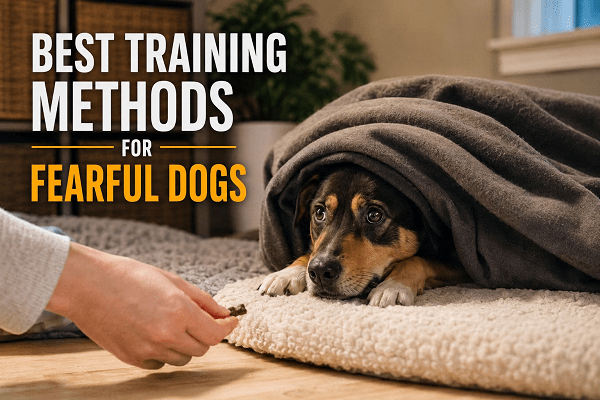
The best training methods for fearful dogs are desensitization and counter-conditioning, delivered with reward-based training and backed by good management. You expose your dog to a trigger at a distance where they stay calm, pair it with a high-value treat, and shrink the distance only when your dog stays relaxed. Never punish, flood, or force a greeting. Most dogs show early change within 2–4 weeks, but real confidence usually takes several months, and severe cases need a vet or veterinary behaviorist.
Table of Contents
- Introduction
- Why Dogs Become Fearful (And What Fear Looks Like)
- Before You Train: The Three Non-Negotiables
- The Threshold Ladder: Know Exactly Where Your Dog Is
- The 9 Best Training Methods for Fearful Dogs
- Which Method Fits Which Fear? (Quick Chart)
- What Doesn’t Work (And What the Science Says)
- A Realistic Timeline
- Troubleshooting: When Training Stalls
- When to Call a Vet or Behaviorist
- Real-World Examples
- Why You Can Trust This Guide
- Want a Complete Dog Training Blueprint?
- Join the Weekly K9 Newsletter
- FAQs
- Conclusion
Introduction
Ever watched your dog freeze at the front door because a stranger walked past the window? Or seen them shake through a car ride, hide behind the sofa when the vacuum comes out, or refuse a treat they’d normally steal off the counter?
If so, you already know the hardest part isn’t the barking or the trembling. It’s the feeling that your dog is stuck in a world that feels unsafe, and you don’t know how to fix it.
Here’s the good news. Fear is an emotion, not a character flaw, and emotions can change. I’ve worked with dogs for many years, and I’ve seen shy, jumpy dogs turn into relaxed, curious ones. It never happened through force. It happened because someone slowed down and taught the dog that the scary thing predicts something good.
In this guide, you’ll learn:
- How to read your dog’s fear signals, including the quiet ones people miss
- A simple 5-level “threshold ladder” so you always know how hard to push (or when to back off)
- The 9 best training methods for fearful dogs, with step-by-step instructions
- What to do when your dog won’t eat, hits a setback, or has several fears at once
- Realistic timelines, and when it’s time to call a veterinary behaviorist
Let’s get into it.
Why Dogs Become Fearful (And What Fear Looks Like)
What Causes Fear in Dogs?
You can’t fix a problem you don’t understand, so let’s start with the “why.” Most fearful dogs land in one (or more) of these groups:
- Genetics. Some dogs are born more sensitive. Shelter trainers regularly point out that most fear cases trace back to a genetic tendency, a lack of early socialization, or both. Abuse is a real cause, but it’s less common than people assume.
- Missed socialization. The early weeks of a puppy’s life (roughly the first 12–16 weeks) are when the brain learns “new things are usually safe.” Puppies separated from their mother and littermates too early are more likely to grow into fearful adults.
- One bad experience. A single scary vet visit, a dog attack, or a thunderstorm can leave a lasting mark, especially during a puppy “fear period” (commonly seen around 8–10 weeks and again in adolescence).
- Pain or illness. A dog in pain is more likely to act afraid. The AKC advises a vet check before any fear training starts, and I agree completely.
- A new environment. Rescue dogs often arrive overwhelmed. Everything smells, sounds, and moves differently.
The Signs of Fear Most Owners Miss
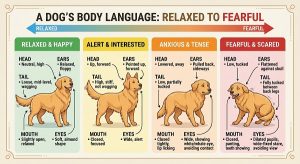
The loud signs are easy: hiding, trembling, barking, lunging. But dogs usually whisper long before they shout. Learn the whispers, because they’re your early warning system.
| Level | What You’ll See |
|---|---|
| Subtle | Lip licking, yawning (when not tired), turning the head away, sniffing the ground suddenly, slow movement, a furrowed brow |
| Moderate | Tail tucked, ears pinned back, hunched body, panting without heat, pacing, whale eye (you see the whites), refusing treats |
| Severe | Freezing, trembling, trying to escape, drooling, uncontrolled urination or defecation |
| Defensive | Growling, snapping, barking and lunging |
Here’s the point many guides skip: defensive behavior is usually fear in disguise. Some dogs “go on the offensive” to make the scary thing go away. A growl isn’t disobedience. It’s a dog saying, “I’m out of options.” Punish it, and you only teach the dog to stop warning you.
Before You Train: The Three Non-Negotiables
Skip these and even the best methods will struggle.
1. Book a Vet Check First
Pain, thyroid problems, hearing or vision loss, and other medical issues can all drive fearful behavior. If the fear appeared suddenly in a dog who used to be confident, a vet visit comes before everything else.
2. Set Up Safety Gear
Fearful dogs can bolt or bite when cornered. A dog who panics will try to back out of a collar in a heartbeat. Use a well-fitted harness (ideally clipped at both the chest and back, or paired with a back-up collar) and a secure leash. If you want to know what features matter most for control and escape-proofing, our guide on Best Tactical K9 Harness: What Military Handlers Look For breaks it down.
Never train a fearful dog off-leash in an unfenced space. One panic dash toward a road can undo months of progress, or worse.
3. List Your Dog’s Triggers
Grab a notebook and write down:
- What scares your dog (strangers, men with hats, other dogs, skateboards, thunder, handling)
- Where it happens (home, street, vet clinic, car)
- How close the trigger can get before your dog reacts
That last line matters most. That distance is your starting point. It has a name: the threshold.
The Threshold Ladder: Know Exactly Where Your Dog Is
Every article tells you to “stay below threshold.” Few tell you how to measure it. So here’s the simple 5-level scale I use. Rate your dog during every session.
| Level | Dog’s State | What It Looks Like | What You Do |
|---|---|---|---|
| 1 – Relaxed | Calm, curious | Loose body, soft eyes, takes treats gently, sniffs around | Great. Train here. |
| 2 – Alert | Notices the trigger | Ears up, brief stare, still takes treats | Still good. This is your teaching zone. |
| 3 – Uneasy | Worried | Lip licking, slow treat-taking, tense body, looks away | Add distance. Slow down. |
| 4 – Over threshold | Fear taking over | Refuses food, freezing, whining, trembling | Calmly leave. Reset. |
| 5 – Panic | Survival mode | Bolting, lunging, barking, snapping | Create distance immediately. End the session. |
The golden rule: Train at Level 1–2. Level 3 is a warning. Levels 4–5 are the dog saying “too much.” Training at those levels doesn’t teach anything. It only adds more fear.
A quick test that works every time: if your dog can’t eat, think, or respond to their name, they’re over threshold. Fear shuts down the learning part of the brain. A dog in Level 4 isn’t being stubborn. They physically can’t learn.
The 9 Best Training Methods for Fearful Dogs
These methods work best together. Think of them as tools in a toolbox. You won’t use all of them for every dog.
1. Management: Make the World Smaller First
Management isn’t training, but it’s the base everything else sits on. Every time your dog goes through a scary experience, the fear gets rehearsed and gets stronger. So your first job is to stop the practice of being afraid.
- Walk at quiet times and on quiet routes.
- Close the curtains if the window triggers barking.
- Put your dog in a separate room when the vacuum runs or guests arrive.
- Skip dog parks. For a fearful dog, they’re an obstacle course of triggers.
- Keep a predictable daily routine. Feed, walk, and play at similar times.
Give your dog a safe zone, such as a crate with a cover, a quiet bed, or a small room. Make it a no-disturbance area, for dogs and children alike. Our guide to how to crate train a puppy shows how to build that “cave” feeling the right way (and the same steps work for adult dogs).
Think of management as turning down the volume while you build skills.
2. Desensitization: Shrink the Scary Thing
Desensitization means exposing your dog to the trigger at a level so mild that it doesn’t cause fear. You then raise the intensity in tiny steps.
You can change three things:
- Distance (far to near)
- Duration (a glimpse to longer)
- Intensity (quiet to loud, still to moving)
Change only one at a time. Cornell’s veterinary team gives a clear example with the vacuum cleaner. Start with it unplugged and sitting still. Then move it around. Then switch it on in a faraway room. Then slowly bring that sound closer. At every step, your dog stays calm before you move on.
For people or dogs, distance is your main dial. For sounds, it’s volume. (Play thunder or fireworks recordings very quietly at first.)
3. Counter-Conditioning: Change the Feeling
Desensitization lowers the volume. Counter-conditioning changes the song. You pair the trigger with something your dog loves, so the trigger starts to predict good things.
Here’s the most important rule, and the one most owners get backwards:
The trigger appears first. Then the treat.
If you produce treats before the scary thing shows up, you’re just bribing the dog. If the trigger comes first and the treat follows, your dog learns “stranger = chicken.” Over time, their gut reaction changes from “Danger!” to “Where’s my chicken?”
Use truly high-value food. Kibble won’t cut it. Try small pieces of cooked chicken, cheese, hot dog, or liver. Keep them pea-sized so your dog can eat fast and keep working.
Handler tip: save your jackpot treats for training only. If your dog gets chicken all day, it stops being special.
4. Put Them Together: The Step-by-Step DS/CC Plan
Here’s the full process, as I’d teach it to a new handler:
- Find the starting distance. Stand where your dog can see the trigger at Level 1–2 (calm, eating well).
- Show the trigger. The moment your dog notices it, say a marker word (“Yes!”) or click.
- Feed. Deliver 3–5 small treats in a row while the trigger is visible.
- Remove the trigger. The treats stop when the trigger goes away. Your dog learns: trigger on = party on.
- Repeat 5–8 times. Then take a break.
- Look for the “check-in.” When your dog sees the trigger and then looks at you with a soft, expectant face (“Okay, where’s my food?”), that’s a conditioned emotional response. That’s the lightbulb moment.
- Move closer slowly. Shrink the distance by a small step, only after 2–3 calm sessions at the current distance.
- If your dog moves up the ladder to Level 3, go back. That isn’t failure. It’s data.
Keep sessions to 5–10 minutes, and end while your dog is still doing well.
5. “Look at That” and Choice-Based Games
The “Look at That” game was created by trainer Leslie McDevitt. It teaches a dog that noticing a trigger is a great way to earn a reward, and then checking in with you is even better.
Here’s how it works in the real world:
- Start at a distance where your dog sees the trigger but stays calm.
- The moment your dog glances at it, mark (“Yes!”) and give a treat.
- Your dog turns back to you for the treat. That head-turn becomes the habit.
- Add a cue (“Look!”) once the pattern is solid.
The beauty of this game is choice. Your dog gets to look, think, and decide, rather than being stared down or shoved toward something scary. Choice-based approaches like this, along with Behavior Adjustment Training (BAT), give fearful dogs a sense of control, and control is exactly what fear takes away.
If your dog won’t look back at you after seeing the trigger, you’re probably too close. Add distance.
6. Relaxation Mat Work
A mat sounds boring. It’s one of the most powerful tools you have.
You teach your dog that a specific mat means “relax and good things happen here.” Reward your dog for lying down on it, then for staying a little longer, then for staying calm while small, boring things happen (you walk around, drop a spoon, open a door).
Once it’s solid, the mat travels with you: to the vet’s waiting room, a friend’s house, or a café patio. Your dog carries a “calm button” with them.
Build it slowly in a quiet room first. Don’t try it for the first time when the doorbell is already ringing.
7. Confidence-Building Games
Confidence grows when a dog learns, “I can figure things out, and I’m good at this.” That belief spills into other parts of life.
Great confidence-builders include:
- Nose work and “find it” games. Scatter treats in the grass or hide them in boxes. Sniffing is naturally calming and gives your dog a job.
- Hand targeting (“touch”). Your dog boops your open palm with their nose. It’s easy, fast, and success-guaranteed.
- Puzzle feeders and snuffle mats. Low-pressure problem-solving at mealtime.
- Trick training. Spin, paw, “go to bed.” Simple tricks create winning streaks.
- Gentle agility. Low jumps, a wide plank on the ground, a tunnel. Agility teaches dogs they can conquer new obstacles. Keep the heights tiny and the mood fun.
Short and successful beats long and stressful every time. Three or four easy wins in a five-minute session do more for a nervous dog than twenty minutes of hard work.
8. Muzzle Conditioning (Yes, Really)
Many owners flinch at this one. Please don’t.
If your fearful dog has ever snapped, or if they’re likely to panic at the vet, a well-fitted basket muzzle is a safety and training tool, not a punishment. A basket muzzle (Baskerville is a common brand used by trainers and vet schools) lets the dog pant, drink, and take treats.
Cornell’s vet school breaks muzzle training into two stages. First, your dog learns to put their nose in the muzzle. Second, they get comfortable with the strap behind their head. Here’s how:
- Put a high-value treat inside the muzzle’s nose and let your dog approach on their own.
- When they eat the treat, praise and slowly back the muzzle away.
- Repeat for 1–2 minutes, a few times a week.
- Next, present the muzzle with no treat and let your dog put their nose in.
- Once that’s easy, add the strap, build up to a few seconds, then longer.
Never chase your dog with the muzzle or force it on. Let the dog choose to put their nose in. Rushing this step is the fastest way to make a dog hate it.
Why do it? A muzzled dog can stay in situations that would otherwise be too risky, so you can keep training and keep everyone safe, including your dog.
9. Controlled Social Exposure
Dogs often learn best by seeing calm dogs and calm people. But “calm” and “controlled” are the keywords.
- For fear of other dogs: Ask a friend with a very calm, non-reactive dog to help. Start far apart, with both dogs on leash, and use counter-conditioning. Reward your dog for calm looks, then slowly work closer over many sessions.
- For fear of people: Have the guest sit sideways, avoid eye contact, ignore your dog, and toss treats away from themselves. Let your dog decide whether to approach. Voluntary approach lowers fear far faster than forced petting.
- Training classes: A quiet, positive-reinforcement class can work well, since all dogs are on leash and work in their own space. Ask the trainer in advance whether they’ll let you sit at the back or work at a distance.
Never let a stranger lean over your dog, reach for their head, or “just let them sniff your hand” when your dog is backing away. That’s not socialization. That’s pressure.
Which Method Fits Which Fear? (Quick Chart)
| Fear | Best Starting Methods | Key Tip |
|---|---|---|
| Strangers | Management + counter-conditioning + “Look at That” | Let your dog approach. Never force. |
| Other dogs | Distance + calm helper dog + “Look at That” | Avoid dog parks. Use parallel walks. |
| Loud noises | Sound desensitization + safe zone + relaxation mat | Start with recordings at a whisper-quiet volume. |
| Vet / handling | Muzzle conditioning + touch games + vet “happy visits” | Practice handling at home in tiny steps. |
| Car rides | Short, rewarding trips + counter-conditioning | Start with sitting in a parked car with treats. |
| Objects (vacuum, umbrella) | Desensitization (object off, still, then moving) | Change one thing at a time. |
| Everything (generalized fear) | Vet check + management + relaxation + professional help | Consider a veterinary behaviorist early. |
What Doesn’t Work (And What the Science Says)
Punishment, Corrections, and “Showing Them Who’s Boss”
Let’s clear up an old myth. Fearful dogs don’t need “firmer leadership.” They need safety. Cornell’s veterinary team states plainly that punishment can make fear worse and create new behavior problems. I’ve written about why intimidation backfires in Dominance vs. Discipline: What K9 Trainers Know That Pet Owners Don’t. The short version: structure and clarity work. Fear and force don’t.
Research backs this up. In a 2020 study published in PLOS ONE, researchers from the University of Porto followed 92 companion dogs from seven training schools (42 from reward-based schools and 50 from aversive-based schools). They filmed sessions and measured cortisol, a stress hormone. Dogs from aversive schools showed more stress behaviors, spent more time in tense or low states, and had higher cortisol after training. Later, in a “cognitive bias” test that measures a dog’s underlying mood, the aversive-trained dogs were more “pessimistic.”
That same research team noted that an earlier review of 17 studies found aversive methods weren’t more effective than reward-based ones. In other words, you don’t gain anything by being harsh, and your dog loses a lot.
Veterinary behavior groups such as AVSAB also recommend reward-based training and warn against aversive methods, especially for fearful and anxious dogs.
Flooding (Forcing Exposure)
Flooding means putting a scared dog in the middle of what scares them “until they get over it.” Some dogs shut down and look calm. That isn’t calm. It’s learned helplessness, and it’s fragile. Other dogs panic and bite. Neither outcome is a win.
The Dog Park “Cure”
“He just needs to socialize!” Please don’t. Off-leash chaos is one of the worst places for a fearful dog.
Trigger Stacking
This one sneaks up on owners. Fear adds up. A dog who handled the vacuum fine in the morning may snap at the delivery driver in the afternoon, because the stress hasn’t drained yet. Cortisol can stay elevated in the body for hours or even days after a big scare.
If your dog has had a rough day, cancel the training session. Give them a quiet sniff walk, a chew, and a nap. Rest is training too.
Moving Too Fast
Progress isn’t a straight line. A dog who tolerates a trigger at 50 feet may fall apart at 30. That’s normal. Measure progress in inches of comfort, not giant breakthroughs.
A Realistic Timeline
Everyone asks, “How long will this take?” The honest answer is: it depends on your dog, the trigger, and how long the fear has been practiced. These ranges come from what I’ve seen in practice, not from a guarantee.
| Phase | Typical Timeframe | Main Goals |
|---|---|---|
| Foundation | Weeks 1–2 | Vet check, safety gear, management, safe zone, mat work, and easy confidence games |
| First exposure work | Weeks 3–4 | Start DS/CC at a big distance. Your dog begins giving “check-in” glances. |
| Building | Weeks 5–12 | Shrink distance slowly. Add duration and mild movement. |
| Generalizing | Months 3–6 | Practice in new places, with new people, and in new conditions |
| Maintenance | Ongoing | Keep routines, keep rewarding calm, and refresh before big events |
Some dogs improve in a few weeks. Others, especially those with severe or long-standing fear, need many months, and some stay a bit sensitive for life. That’s okay. Success isn’t a dog who never feels fear. It’s a dog who recovers quickly and lives comfortably.
Troubleshooting: When Training Stalls
“My Fearful Dog Won’t Take Treats.”
This is one of the most common problems, and it’s actually useful information. A dog who refuses food is usually at Level 4 or higher. Here’s what to do:
- Add distance until the dog eats again.
- Upgrade the treat. Try something smellier and softer.
- Make sure your dog isn’t just full. Train before meals, not after.
- If food stays off the table even at huge distances, the dog may be too stressed or unwell. Call your vet. A dog who won’t eat at all in a safe place needs medical support.
“My Dog Was Doing Great, Then Went Backward.”
Setbacks are normal. Common reasons include a bad day, trigger stacking, a new stressor at home, an adolescent fear period, or you moved too fast. Drop back two steps, do easier work for a week, and rebuild.
“My Dog Has Lots of Fears.”
Pick one trigger and work on it. Don’t try to fix everything at once. As confidence grows in one area, it usually lifts others. Building a general foundation (mat work, nose games, a safe zone) helps across the board.
“Should I Comfort My Dog When They’re Scared?”
Yes, in a calm and quiet way. Comfort doesn’t create fear. Fear is an emotion, not a behavior you can “reinforce” with a gentle hand. Don’t flood them with high-pitched baby talk, though, and don’t pull a frightened dog toward you. Offer a calm voice, give space, and, if your dog wants contact, offer it.
When to Call a Vet or Behaviorist
Some fearful dogs can improve at home. Others need professional help. Reach out if:
- Your dog has bitten or snapped at people or other dogs
- Fear is widespread (many triggers, most of daily life)
- Your dog can’t recover after a scare, or stays on edge for hours
- You see self-injury, constant pacing, or destructive panic
- Your dog won’t eat in situations that should be safe
- Progress has stalled for weeks despite good effort
Who Should You Call?
- Your regular vet to rule out pain or illness
- A veterinary behaviorist (a vet with specialist training in behavior) for complex or serious fear and for medication decisions
- A qualified, force-free trainer or behavior consultant for hands-on coaching. Ask what methods they use. If they mention “corrections,” “alpha,” or “dominance,” walk away.
What About Medication?
Medication isn’t a failure, and it isn’t a shortcut. For dogs with intense anxiety, a vet may prescribe medication such as fluoxetine alongside a behavior plan. One veterinary behavior researcher, Dr. Daniel Mills of the University of Lincoln, has highlighted that medication together with a behavior modification program is what’s essential for effective treatment. Pills alone don’t teach new skills. But for some dogs, lowering the baseline fear is what finally lets the training stick.
Only a vet can decide this. Never give your dog human medication on your own.
Real-World Examples
The Vacuum Cleaner Dog
Here’s a classic scenario. A dog bolts when the vacuum comes out. Many owners drag the dog closer “to show it’s harmless.” Don’t. Instead, put the vacuum on the floor, off, and unplugged, and toss treats near (not at) it. Do that for a few days. Then move it a little. Then turn it on in another room while your dog eats. Over a couple of weeks, the vacuum becomes background noise.
The Dog Who Hates Visitors
Rather than letting guests crowd your dog, ask them to ignore the dog entirely, sit, and drop treats on the floor from a distance. Let your dog approach on their own terms, take a treat, and retreat. The more control your dog feels, the faster they relax.
Yuma’s Football-Field Problem
A shelter dog named Yuma at Best Friends Animal Society became so overwhelmed by other dogs that she could only cope when one was about a football field away. Her trainers used “Look at That.” They took her to a distance where she could see another dog without getting upset, clicked, and gave her a treat each time she noticed one. With practice, Yuma began looking at other dogs and then turning back to her handler for a treat, instead of stressing out. It’s a good reminder that even an extreme starting distance is fine. The distance isn’t the point. Calm is.
What Working Dogs Teach Us
In working-dog programs, trainers value dogs who recover fast from surprise. A dog doesn’t need to be fearless, but it needs to bounce back. That’s the same goal for your pet. You’re not trying to remove fear. You’re teaching your dog that the world is mostly safe, and that they can trust you to make good choices.
Why You Can Trust This Guide
This guide comes from the ARFS K9 Team, and it reflects the approach used by Cpl. Rofiat Muritala, a Nigerian Army military working dog instructor and handler with more than 14 years of experience at the Nigerian Army Dog Centre. Her background covers dog selection, foundational training, and behavior shaping in real operational settings, including leading obedience, detection, and agility demonstrations at NADCEL 2026.
The methods in this article are not “soft” or untested. They line up with guidance from Cornell University’s College of Veterinary Medicine, the American Kennel Club, the American Veterinary Society of Animal Behavior (AVSAB), and peer-reviewed research in PLOS ONE. Strong working dogs are built on trust, repetition, and clear communication, and fearful pets respond to the same principles, just at a gentler pace.
Important: this article is educational, not veterinary advice. If your dog bites, panics severely, or shows sudden behavior changes, speak to your vet or a veterinary behaviorist.
Want a Complete Dog Training Blueprint?
If you’re juggling fear, leash trouble, obedience gaps, and confidence-building all at once, a single structured system helps more than a pile of scattered tips. My book, Beyond the Bark, walks through practical dog-training strategies, behavior insights, and step-by-step guidance that fit alongside the methods in this article.
👉 Get your copy here: BEYOND THE BARK: Inside a Pro Handler’s Playbook for Raising the Ideal Dog.
Join the Weekly K9 Newsletter
Want training tips like these delivered to your inbox? Subscribe to our weekly articles roundup and never miss a new guide.
👉 Subscribe here: https://arfsk9team.com.ng/newsletter/
Frequently Asked Questions
1. What is the best training method for a fearful dog?
The best approach combines desensitization, counter-conditioning, and reward-based training, supported by good management. You expose your dog to the trigger at a calm distance, pair it with high-value treats, and make progress in tiny steps. Add confidence games and a safe space for best results.
2. How long does it take to train a fearful dog?
It varies by dog and trigger. Many owners see small changes within 2–4 weeks, such as better recovery and relaxed check-ins. Real confidence often takes 3–6 months, and severe or long-standing fear can take longer. Consistency matters more than speed.
3. Can a fearful dog be cured?
Many fearful dogs improve a great deal, and some become very confident. Others stay a little sensitive for life. The realistic goal is a dog who feels safe more often, recovers faster, and enjoys daily life, not one who never feels fear.
4. Should I comfort my dog when they’re scared?
Yes, calmly. Comfort doesn’t make fear worse. Stay quiet, give your dog space or gentle contact if they ask for it, and move them away from the trigger. Skip the loud, anxious reassurance, and never force them to “face it.”
5. Is punishment ever helpful for fearful dogs?
No. Punishment can raise stress, deepen fear, and cause new problems such as hiding warning signals. Research comparing reward-based and aversive training found higher stress and more “pessimistic” moods in aversive-trained dogs. Reward-based training is safer and works better.
Conclusion: Small Steps, Real Change
Training a fearful dog isn’t about dominance, discipline, or “toughening them up.” It’s about safety, patience, and teaching your dog that the world isn’t as scary as it seems.
Here’s your action plan:
- See your vet to rule out pain or illness.
- Set up safety: a secure harness, a safe zone, and a quiet routine.
- Map your dog’s triggers and find their threshold distance.
- Use the ladder. Train at Level 1–2 and back off at Level 3 or higher.
- Combine desensitization and counter-conditioning, with the trigger first, then the treat.
- Add confidence games, mat work, and “Look at That.”
- Teach muzzle comfort if there’s any bite risk.
- Track progress in a notebook and celebrate small wins.
- Call a veterinary behaviorist early if fear is severe, widespread, or involves biting.
Progress in fearful dog training is often quiet before it’s obvious. One day your dog will glance at the thing that used to terrify them, then look at you with a wagging tail and a “got any chicken?” face. That’s the moment it all clicks. Keep going. Your dog is worth the patience.

Her work centres on obedience, detection, protection and operational readiness. She favours proven methods built on repetition, consistency and real-world conditioning, so that both dogs and handlers are prepared for high-pressure tasks.
Rofiat represented the Nigerian Army Dog Centre at the Nigerian Army Day Celebration (NADCEL) 2026, where she led demonstrations in obedience, explosive detection, agility and tactical movement. Through articles, training content and documentaries, she shares field-based insight into how structured training, clear communication and trust between handler and dog affect performance and reliability.
She is the author of Beyond the Bark: Inside a Pro Handler's Playbook for Raising the Ideal Dog, a practical guide that helps dog owners and handlers apply professional training principles in everyday situations.
- Dog Agility Course Layout: Easy DIY Setup - October 7, 2026
- Local Dog Breeds: Temperament, Health & Training Guide - October 6, 2026
- How Long Do Military Working Dogs Serve? Full Guide - October 5, 2026